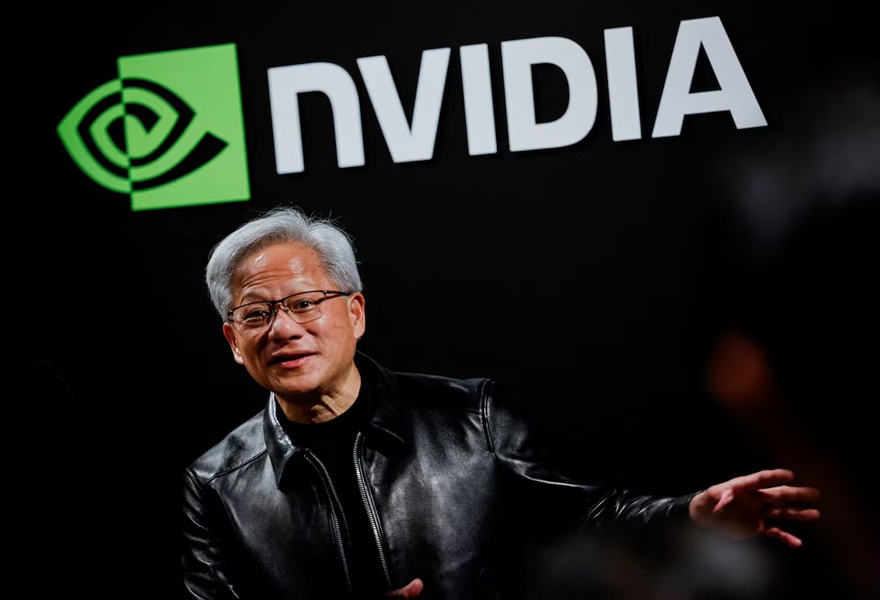
Nvidia shares sank as much as 10% in premarket trading on Thursday, November 12, after the chipmaker confirmed that co-founder Jensen Huang had resigned immediately as chief executive and left its board. Chief Financial Officer Colette Kress has become interim CEO, while Nvidia begins searching for a permanent successor.
The sudden departure intensified volatility across artificial-intelligence stocks. Rival chipmakers AMD and Broadcom advanced as investors considered whether competitors could benefit from disruption at the leading supplier of AI processors. By contrast, Nvidia-backed cloud provider CoreWeave fell sharply, alongside Nebius and several semiconductor suppliers. The move was far from uniform across the industry.
Nvidia’s November 12 leadership announcement did not state why Huang stepped down. The change followed reports about his personal relationships and an investigation into possible foreign-intelligence targeting, but the company’s formal disclosure did not attribute the resignation to any specific allegation or identify a finding of wrongdoing.
Colette Kress takes over while Nvidia searches for a CEO
Huang resigned as president, chief executive officer and a director, ending a leadership tenure that began when he co-founded Nvidia in 1993. Kress will continue serving as executive vice president and chief financial officer while acting as CEO. She joined Nvidia in September 2013 and previously held senior finance positions at Cisco and Microsoft.
The board also appointed Harvey C. Jones as its first chair. Jones has worked as a technology executive and investor and previously served as chief executive and executive chairman of chip-design software company Synopsys. Nvidia said its CEO search will consider internal and external candidates, without naming a preferred successor or giving a completion date.
Jones said the leadership team was equipped to continue Nvidia’s strategy, customer obligations and product roadmap. Kress also pledged continuity in operations and support for partners and developers. Those assurances reduce immediate uncertainty about who is in charge, though they do not resolve how the business will replace Huang’s long-standing relationships with cloud customers, suppliers and policymakers.
The company is due to report fiscal third-quarter results on November 17, followed by an earnings call the same afternoon. Investors will now hear that update with an interim chief executive in place. A new leader, and not yet a permanent one.
AMD and Broadcom gain as Nvidia-linked stocks fall
AMD gained more than 3% in early trading indications, while Broadcom also rose. Both companies compete for portions of spending on AI compute, through graphics processors and custom accelerators. Their gains reflected expectations of potential opportunity, not evidence that either had already secured orders lost by Nvidia.
Shifting large AI workloads between hardware suppliers can require software changes, capacity commitments and redesign of computing systems. Nvidia’s CUDA software ecosystem and integrated networking products remain difficult for customers to replace quickly. DaveFinances previously examined how OpenAI’s potential use of Google TPUs could diversify AI-chip sourcing without an immediate loss of Nvidia’s existing business.
Other parts of the supply chain moved in the opposite direction. CoreWeave shares dropped around 10% in premarket trading, while Nebius also declined. Intel, Taiwan Semiconductor Manufacturing Company, Micron and several equipment and storage stocks were lower in early indications. For cloud operators that depend on Nvidia systems and on continued financing for data-centre expansion, the immediate uncertainty centres on coordination and future spending rather than a confirmed interruption in chip shipments.
Nvidia’s valuation makes the market reaction unusually consequential. A decline of around one-tenth in a company valued near $4 trillion implies hundreds of billions of dollars of market capitalisation at risk, although the final session change may differ from premarket quotations. The selloff also comes after a period of pressure across AI-related shares. DaveFinances tracked the earlier rotation between Apple and Nvidia in market-value leadership, which predated Thursday’s confirmed management transition.
Board investigation remains separate from confirmed resignation
Huang’s departure follows media reports of two extramarital relationships. One involved a former executive at a company with ties to Nvidia whom U.S. authorities reportedly suspected of links to Chinese intelligence. Another concerned a senior Nvidia executive who reported to Huang, according to The New York Times. The alleged intelligence connection has not been established through a public criminal finding, and no official finding has shown that Nvidia secrets were compromised.
Independent Nvidia directors had opened a review of whether Huang was targeted by foreign intelligence and had earlier expressed confidence in his leadership. On November 11, reports that the board might consider removing him led to sharp after-hours losses. DaveFinances covered the board’s deliberations and the newer allegations before the company’s formal announcement confirmed his exit.
Neither the earlier inquiry nor subsequent reporting establishes that trade secrets were transferred, export controls were violated by Huang or that the relationships caused Nvidia to lose specific customers. The official succession statement makes no such findings. Personal-conduct reporting and national-security claims need seperate evidentiary treatment from Nvidia’s actual leadership decision.
The investment case now faces two timelines. Kress must lead Nvidia through its November 17 earnings report and continue executing customer commitments, while the board evaluates successors and its seperate inquiry proceeds. AMD and Broadcom may find opportunities over time, but the Thursday share-price split is an early reaction to leadership risk, not yet a measurable change in AI-chip market share.

Johan Shamshad is Editor-in-Chief at Dave Finances, covering financial markets, digital assets, trading platforms, brokers, fintech, payments and regulation. Since 2023, he has also worked as an editor at Gulf News, the UAE English-language newspaper published by Al Nisr Publishing LLC. His work focuses on market-moving developments, company disclosures, regulatory changes and trading infrastructure, with an emphasis on primary-source verification and practical context for traders and investors.