
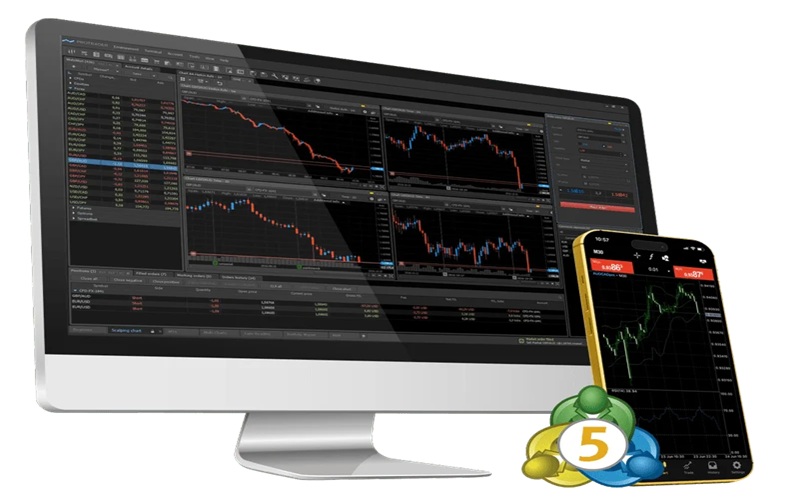
MetaQuotes is pushing artificial intelligence deeper into the mechanics of MetaTrader 5, giving its built-in AI Assistant more direct control over Expert Advisors, scripts, indicators and strategy-testing workflows.
MetaTrader 5 Build 6230, dated September 24 in MetaQuotes’ release notes, expands the agent’s toolset so it can prepare Expert Advisors for testing, retrieve program parameters, launch MQL5 programs on charts, remove Expert Advisors and indicators, inspect indicator status and access economic-calendar data without requiring the trader to manually prepare each stage.
The update builds directly on the MetaTrader 5 AI upgrade released earlier in September, which had already given the assistant access to Strategy Tester reports, optimization functions, tester settings and program logs.
Build 6230 Gives the AI Assistant More Control Over the Trading Environment
One of the most significant additions is the ability to prepare Expert Advisors for Strategy Tester runs.
The AI Assistant can now retrieve an EA’s available input parameters and configure those parameters before a test begins. That removes another manual step from the process of testing or optimizing an automated trading strategy, particularly when a user is working with an unfamiliar Expert Advisor or a large number of configurable inputs.
The assistant can also work more directly with programs running on charts. MetaQuotes says it can retrieve parameters from Expert Advisors and scripts, launch them on charts, remove Expert Advisors and indicators and check the current state of indicators.
This extends the chart-level functionality introduced previously. Build 6180 had already allowed the assistant to add and configure technical indicators. Build 6230 gives the agent more ability to manage the wider environment around those indicators and automated programs.
The result is a longer AI-controlled workflow. Instead of asking a user to manually identify an EA’s parameters, configure the Strategy Tester, run the test, export the results and then return for analysis, the assistant can increasingly move through several of those stages itself.
That direction is similar to what other brokers are beginning to explore. Dukascopy, for example, has been testing MCP-based AI interaction with trading accounts, allowing compatible assistants to retrieve account information, analyze positions and prepare trading instructions through its JForex infrastructure.
Economic Data Becomes Part of the Agent’s Native Context
Build 6230 also gives the AI Assistant access to MetaTrader 5’s built-in Economic Calendar.
The agent can request lists of countries and events, retrieve values for economic indicators and locate specific calendar records by ID. MetaQuotes says this allows macroeconomic releases to be incorporated directly into more complex market-analysis workflows.
A trader could therefore ask the assistant to examine an instrument, retrieve upcoming or recently published economic data and compare that information with market prices without manually moving between the calendar, charts and AI interface.
That matters because much of the first wave of AI inside retail trading platforms focused on summarizing information. Brokers have been increasingly moving beyond that model. eToro’s redesigned AI-focused trading application, for example, is built around an assistant that can proactively surface information tied to portfolios and watchlists rather than functioning purely as a question-and-answer chatbot.
MetaQuotes is pursuing a more infrastructure-heavy version of the same shift. Its assistant is not only being given additional information; it is being given platform tools that allow it to act on the environment in which analysis, coding and automated-strategy testing take place.
The rollout has accelerated rapidly since July. Build 6060 introduced native Model Context Protocol support and agentic AI, allowing MetaTrader 5 to communicate with AI agents through a standardized interface. It also allowed external systems such as compatible OpenAI, Anthropic, Gemini, DeepSeek and Ollama tools to connect to the platform.
Build 6140 expanded the range of supported AI providers. Build 6180 then pushed the assistant into Strategy Tester reports, optimization, logs and chart indicators. Build 6230 now closes more of the gaps between those individual functions.
MetaQuotes Is Also Expanding the Development Layer
The release is not limited to the AI Assistant.
MetaQuotes added support for .NET CoreCLR 8 and newer versions, allowing compatible libraries to be imported and used in MQL5 programs. It also introduced sorting methods for vectors and matrices, a Print method for matrices and additional mathematical functions for complex matrices and vectors.
Those changes matter because MetaTrader’s automation ecosystem has historically been one of the platform’s strongest sources of lock-in. Traders build Expert Advisors, indicators, scripts and testing workflows around MQL5, making a trading platform more than simply an interface for entering orders.
That becomes particularly visible when brokers attempt platform migrations. OANDA Japan’s ongoing move away from MetaTrader 4 illustrates how automated strategies and custom tools can complicate what would otherwise look like a straightforward software upgrade.
Other brokers are attacking the same retention problem through proprietary platform development. Exness has been adding features such as persistent TradingView chart layouts, reducing the friction created when traders repeatedly reconstruct their analytical workspace.
MetaQuotes’ strategy is different. Instead of only improving individual workflows, it is trying to make the AI layer capable of coordinating more of them.
AI Is Moving From Trading Feature to Operating Layer
This is where Build 6230 becomes more important than its release notes initially suggest.
Adding another AI market summary would not materially change MetaTrader. Giving an AI agent the ability to inspect an Expert Advisor, determine its parameters, configure a test, examine the results, manage programs on charts and bring economic data into the same workflow potentially does.
The interface between the trader and the trading platform starts to change.
Historically, using algorithmic trading effectively meant understanding several separate systems: MQL5 code, Expert Advisor settings, charts, logs, Strategy Tester configurations, optimization results and economic data. Generative AI first reduced the difficulty of writing the code. MetaQuotes is now working on reducing the operational friction around everything that happens after the code exists.
That is part of a broader move toward automation across trading infrastructure. The difference with MT5 is distribution. A technology provider building an AI trading tool from scratch still needs brokers or traders to adopt it. MetaQuotes already sits inside the technology stack of a large number of FX and CFD brokers.
That creates an important advantage. A broker offering an updated MT5 environment can expose increasingly sophisticated AI-assisted functionality without having to build an equivalent coding, analysis and testing layer internally.
For brokers, however, that is both an advantage and a competitive problem.
If every MT5 broker gains access to similar AI functionality, AI itself becomes less of a differentiator. The competitive question shifts back toward execution quality, pricing, instruments, service, proprietary tools and how intelligently each broker builds around the common MetaTrader layer. That is similar to the wider industry trend toward unified multi-asset platforms, where the underlying trading capability increasingly acts as the starting point rather than the finished product.
There are also risks for traders.
Making strategy testing easier does not make the resulting strategy better. In fact, an AI system capable of quickly modifying parameters and repeatedly optimizing historical results can make overfitting easier. A trader may end up with an apparently excellent backtest that is simply tuned too closely to historical market conditions.
Autonomy also raises the importance of permissions and confirmation controls. The more actions an AI agent can perform inside a trading environment, the more consequential a misunderstood instruction, incorrect assumption or software error can become.
The key development in Build 6230 is therefore not that MetaTrader has become autonomous. It has not.
The important change is that MetaQuotes is systematically removing the manual boundaries between asking the AI a question and having the AI manipulate the tools required to complete the task.
That is a much bigger shift than adding another chatbot to a trading terminal. MetaTrader’s AI Assistant is gradually becoming an operating layer over the platform itself.

Johan Shamshad is a financial markets writer at Dave Finances covering cryptocurrencies, trading platforms, brokers, fintech, financial regulation, and developments across global markets. He previously worked at Gulf News, adding newsroom experience to his coverage of fast-moving financial and digital-asset markets.
His work focuses on identifying market-moving events, company developments, regulatory changes, product launches, and shifts in trading and financial infrastructure.
Johan contributes news and analysis designed to help readers understand not only what happened, but why a development matters and how it may affect the wider financial landscape.