
When a liquidity provider withdraws its bid and ask, a CFD broker may still be able to quote through other providers or its own risk book. But executable depth can shrink, spreads can widen, and orders may be rejected, partially filled or slipped. The important question is not whether one quote disappears; it is whether the broker has enough alternative liquidity, clear execution rules and capital to manage the resulting exposure.
Research desk | DaveFinances.com | October 29, 2026
A Missing Quote Is a Market Event, Not Automatically a Broker Failure
A liquidity provider (LP) supplies prices and, depending on the arrangement, may execute or hedge transactions for a broker. Banks, non-bank market makers and specialist trading firms can all perform that role. In a multi-provider setup, a broker’s pricing engine may combine several bid-and-ask streams, apply its own spread or markup and decide which price is available for a particular order size. A retail customer normally trades under the CFD agreement with the broker; the LP is often a separate counterparty in the broker’s own hedge, not the customer’s direct counterparty.
An LP can stop quoting for several reasons. Its risk limits may be reached; its systems may be disconnected; the underlying market may be closed or disorderly; credit limits may bind; or it may judge that a price cannot be maintained safely. A provider can also keep quoting but show less size or a much wider spread. A vanished quote therefore does not prove insolvency or misconduct. It does, however, remove one source of executable liquidity at the moment a broker may need it.
The FCA’s best-execution framework focuses on obtaining the best possible result for a client under the firm’s execution arrangements, taking relevant factors into account. It does not promise a continuous quote at every price, nor does it require every broker to display the same bid and ask. A broker’s published policy should explain how it selects prices, handles insufficient liquidity and deals with orders that cannot be executed at the requested level. The distinction matters because a legitimate market disruption and a poorly managed execution process can look similar on a frozen trading screen. [1][2]
What the Broker’s Pricing Engine Does Next
The first response is usually technical: check whether the quote is stale, remove the unresponsive LP from the aggregation pool, and ask the remaining providers for updated prices. If three providers each showed 40 lots near the best quote, a simplified 120-lot top-of-book capacity could fall to 80 lots when one exits, before considering any replacement quote or changes in the others’ size. Under stress, the remaining providers may also reduce depth, so the decline can be greater than the departing provider’s nominal share.
The broker can sometimes continue to quote by internalising client flow. If one group of customers is buying while another is selling, opposing positions may offset before the firm needs to hedge externally. But internalisation is not infinite liquidity. If client flow becomes one-sided, or if the broker reaches its own exposure limit, the firm may need external hedges precisely when external quotes are least reliable. IG’s annual report describes this sequence: it offsets customer positions, measures residual real-time exposure and hedges when exposure approaches approved limits. [3]
A broker may also widen its spread, reduce the maximum accepted order size, permit partial fills, reject orders whose price has moved too far, or temporarily disable a product. Those responses can be disruptive, but they may be preferable to pretending that an unavailable price remains executable. The quality question is whether the response follows a disclosed policy, is applied consistently and allows customers to understand what happened. A firm that silently uses stale quotes or selectively rejects orders after favourable moves raises a different concern from one that clearly rejects an order because no valid market price is available.
Failover quality depends on independence, not merely count. If three price feeds ultimately rely on the same exchange gateway, bank credit line or market-data source, a shared disruption can affect all three. A broker should test whether its routing engine can identify stale prices, remove a failed source and rebuild a valid market without creating crossed or obviously outdated quotes. A static list of liquidity providers says little about how the system behaves when the providers are simultaneously reducing risk.
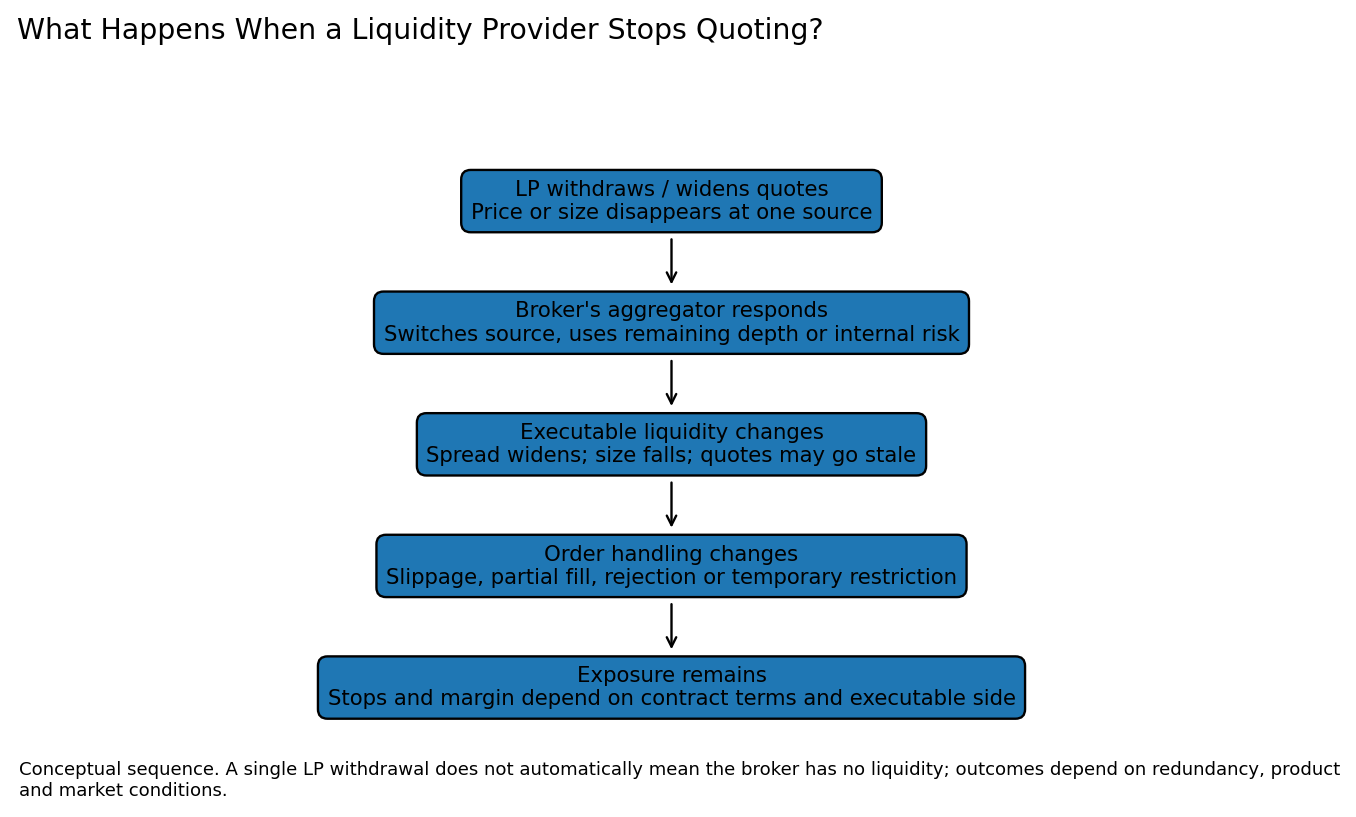
Figure 1. The impact of an LP withdrawal depends on the broker’s ability to replace the quote and manage residual risk.
A Numerical Example: The Cost of Losing One Price Source
Assume a CFD is worth $10 per index point. At a normal 0.8-point spread, the approximate spread friction on a round trip is $8 if the midpoint remains unchanged. If the spread widens to 2 points, that friction becomes $20; at 5 points, it becomes $50. This is an illustrative arithmetic model, not a claim about a particular broker or index. The broker may also add commission, financing or slippage, so spread alone does not represent the full cost.
Now assume a 120-lot hedge was available at three providers, with 40 lots at the best quote from each. If one provider withdraws, only 80 lots may remain at the original level. A 120-lot market order could then consume deeper levels, be split into partial fills, or be rejected if the customer has not authorised a price tolerance. If the broker hedges its own residual exposure in the same market, it can face a worse average hedge price even after the customer’s trade has already been accepted.
The important distinction is between quoted price and available size. A narrow bid-ask spread displayed for a tiny size does not prove that a large order can be executed at that spread. In the example, if the remaining depth is insufficient, the platform may show an attractive top quote while the effective price for a large order is materially worse. This is why professional execution reports distinguish price, size, fill rate, rejection rate and slippage rather than treating the spread as a complete measure of liquidity.
When the Problem Becomes a Liquidity Cliff
A liquidity cliff occurs when several sources disappear or reduce size together. This can happen during a central-bank surprise, employment release, market opening, geopolitical shock, exchange outage or sudden price gap. LPs are not independent if they all rely on the same underlying venue, bank credit, data feed or risk model. Three providers on a broker’s screen may therefore represent less diversification than the number suggests.
The FX market makes the point especially clearly. The BIS describes spot FX and most FX derivatives as fragmented over-the-counter markets, rather than one central exchange order book. Its 2025 analysis found dealers increasingly matched customer flow internally, with internalisation ratios above 80% across major FX trading hubs. Internalisation can reduce unnecessary external hedging in normal conditions, but when flow becomes one-sided, a broker or dealer still needs a path to external liquidity. [4][5]
Liquidity also depends on the instrument. A cash index CFD may reference an index calculation while the broker hedges with futures; a share CFD may depend on the underlying stock’s exchange hours; a commodity CFD may use a particular futures month. If the hedge market is closed, halted or thin, the broker’s reference price can become less reliable. A broker may calculate a fair-value quote, but a derived price is not equivalent to having a deep, immediately executable hedge. Contract specifications and trading-hour disclosures therefore matter as much as the brand name of the LP.
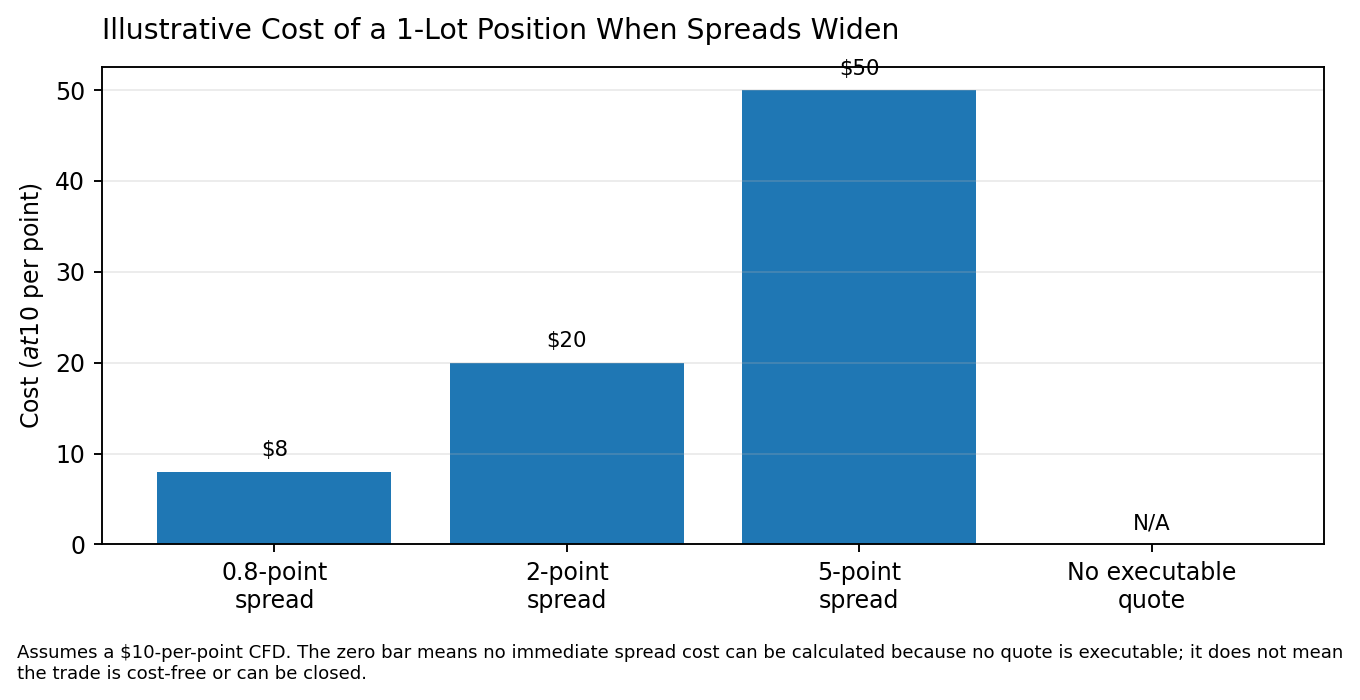
Figure 2. Illustrative spread costs rise from $8 to $50 as the spread widens from 0.8 to 5 points for a $10-per-point position.
Illustrative Comparison
| Event | Likely immediate effect | What it does not prove |
| One LP stops quoting | Less depth; aggregator switches or reprices | That every source has disappeared |
| Remaining LPs widen spreads | Higher entry/exit friction | That the broker has manipulated the price |
| Order exceeds available size | Partial fill, slippage or rejection | That the top quote was executable for any size |
| Broker reaches risk limit | Reduced sizes or temporary dealing restrictions | That the firm is insolvent |
| LP or clearing counterparty fails | Possible hedge, collateral or settlement loss | That the retail customer automatically has a direct claim against that LP |
The same event can have different consequences depending on product, market conditions, broker policy and counterparty structure.
What Happens to Market Orders, Stops and Existing Positions?
A market order prioritises execution over a specified price. If the best quote disappears between submission and execution, the order may fill at a worse price, fill in parts, or be rejected according to the platform’s rules. A limit order controls the worst acceptable price but may not fill. Some brokers offer price-tolerance controls or partial-fill settings; others apply different rules. Traders should not assume that a visible quote is guaranteed for the instant when the server receives the order.
A standard stop-loss commonly becomes a market order when its trigger condition is met. If the LP withdrawal coincides with a gap or spread widening, the stop may trigger at the broker’s bid or ask and fill beyond the stop level. A chart may show a midpoint or last price, while the executable side used for a long or short position differs. A guaranteed stop, if offered and valid for that instrument, is a separate contractual commitment and usually carries a premium or eligibility restrictions. [6]
An existing position does not necessarily close automatically just because one LP has stopped quoting. The broker may maintain prices through other providers, internalise risk or continue displaying indicative prices while restricting new trades. But if the firm cannot produce a reliable executable quote, it may suspend dealing or close positions under the client agreement and market-disruption clauses. Whether it may do so, and how it values a forced close, depends on the contract and local rules. Traders should read the actual terms rather than infer them from a platform status message.
Traders should also distinguish an LP withdrawal from an exchange trading halt. If the underlying exchange is halted, the broker may have no fresh executable hedge price at all and may need to suspend trading under its policy. If only one LP stops quoting while the underlying market remains active, the broker may still have other sources. These situations can look identical in the app, but the cause, available remedies and evidence needed to assess execution are different.
A Liquidity Provider Is Not the Same as the Broker’s Legal Counterparty
This is a crucial legal distinction. A retail CFD customer generally holds a bilateral contractual claim against the provider named in the client agreement. If that broker routes a hedge to a bank or non-bank LP, the hedge is a separate transaction used to manage the broker’s risk. The customer does not automatically acquire a direct claim against that LP if it stops quoting, fails or disputes a hedge. The broker’s obligations to its client remain governed by the CFD contract and applicable regulation.
External hedging reduces some market exposure but creates counterparty, collateral and settlement dependencies. A broker can be economically hedged and still face a liquidity squeeze if its hedge counterparty demands more margin, delays settlement or fails. Conversely, a broker can internalise some exposure without automatically acting improperly; the relevant questions are its capital, limits, execution quality, conflicts controls and treatment of clients. Dave Finances’ analysis of how forex brokers hedge client trades explains why a customer trade and the broker’s hedge should not be confused.
The broker’s financial disclosures can reveal how it manages liquidity risk. CMC Markets’ annual report identifies the need to fund hedge margin requirements, manage counterparty exposures and maintain diversified funding and high-quality liquid assets. That is the balance-sheet side of the same problem: an LP withdrawal is not just a quote-feed event if it forces the broker to replace hedges at worse prices or post more collateral. The customer’s immediate concern is execution, while the broker must also survive the resulting cash-flow stress. [7]
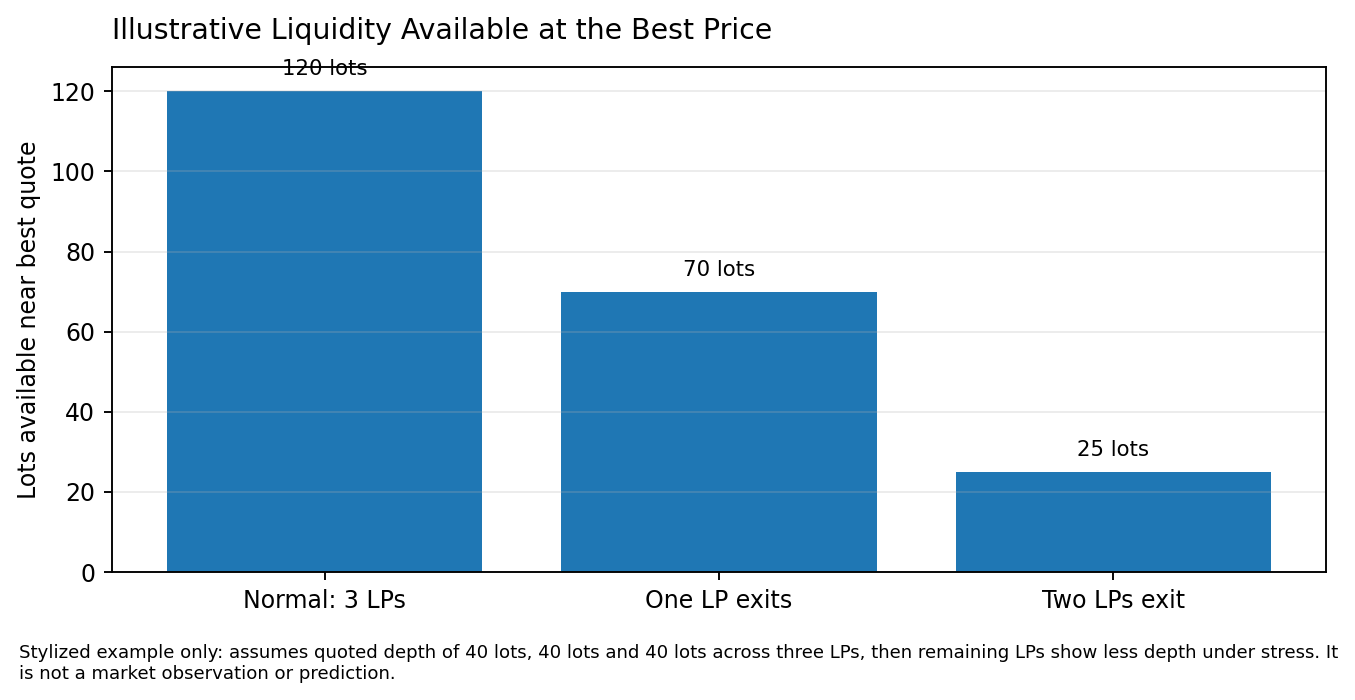
Figure 3. Stylised top-of-book capacity shows why provider redundancy must be measured by executable depth, not provider count.
How to Tell a Resilient Broker From a Fragile Setup
Look for more than a claim to have ‘deep liquidity.’ A credible execution policy should identify whether the firm acts as principal, how it sources prices, whether it uses multiple providers, how it handles fast markets and stale quotes, and whether it can reject or partially fill orders. A broker need not publish every LP name or internal threshold, but it should explain material execution mechanics clearly enough for a client to understand the risks.
Provider count is only one indicator. A broker with five LPs all dependent on the same bank or venue may have correlated failure risk. A smaller provider set can still be robust if the sources are independent, credit lines are diversified, the broker has adequate capital and the firm tests its fallback arrangements. Ask whether the firm can switch data feeds, route to alternative venues, reduce position sizes, or stop accepting new exposure without compromising its existing obligations.
Track execution outcomes during both quiet and stressed periods. Record timestamps, displayed bid and ask, order size, requested price, fill price, partial-fill details and any rejection reason. Compare those records with a relevant external reference at the same time, while recognising that a reference price may not be executable for the same size. The site’s analysis of why most retail CFD traders lose money discusses how spreads, financing and execution friction can erode a strategy that looks profitable on a chart.
One practical test is to compare published execution data across calm and volatile periods. A broker that discloses rejection rates, the reasons for rejections, slippage distribution and rules for partial fills gives customers a more useful basis for evaluation than a broker that publishes only a minimum spread. Statistics should still be read with their denominator and scope: a high fill rate may exclude certain order types or reflect small trades, while an average slippage figure can hide a small number of extreme outcomes.
What Would Prove the Broker’s Liquidity Framework Is Failing?
One isolated rejection during a fast market is weak evidence of a systemic problem. A more persuasive pattern would combine repeated unexplained quote gaps during liquid hours, persistently one-sided slippage, high rejection rates without clear market explanations, or inconsistent treatment of comparable orders. Even then, the correct analysis needs order-level data and the broker’s policy; screenshots from different timestamps cannot establish a fair comparison by themselves.
Counterparty concentration is another warning sign. If the broker depends heavily on one LP or group affiliate, the loss of that relationship could remove a large share of its executable depth. Public reports may disclose counterparty concentrations, credit risk and liquidity stress testing, although retail brokers do not all publish the same detail. A broker that explains its fallback plan and monitors slippage symmetry provides more evidence than one that only advertises a low minimum spread.
Finally, separate a temporary market-liquidity problem from a firm-level solvency problem. A broker can experience wider spreads because the underlying market is thin and still remain financially sound. A broker can also face a liquidity problem because it cannot meet hedge margin or settlement obligations even if its customer book appears offset. If trading restrictions are accompanied by withdrawal problems, regulatory notices or material financial disclosures, the situation deserves closer scrutiny. Dave Finances’ guide to forex broker licences and protections explains why the contracting entity and its regulatory regime matter when operational trouble escalates.
Methodology
All numerical examples are illustrative and do not describe a named broker or actual liquidity event. The spread example assumes $10 per index point and compares spread × point value. The depth example assumes three providers initially offering 40 lots each; stress scenarios reduce aggregate quoted depth to 70 and 25 lots. The analysis draws on FCA best-execution rules, broker execution disclosures, BIS FX market-structure research and public-company liquidity-risk disclosures. Product terms and regulatory duties vary by jurisdiction.
Sources
- FCA Handbook, COBS 11.2A Best Execution
- FCA, Contract for Differences: Provider Expectations
- IG Group, Annual Report 2025
- BIS, FX Trade Execution Landscape Through the 2025 Survey
- BIS, Global FX Markets When Hedging Takes Centre Stage
- IG, How Are Orders Priced?
- CMC Markets, Annual Report and Financial Statements 2025
- Pepperstone, Trading Account Conditions and Stop-Loss Execution
- Pepperstone, Order Execution Policy
- ESMA, Q&A on CFDs and Other Speculative Products Under MiFID II
- FCA, Best Execution and Payment for Order Flow Review

Johan Shamshad is Editor-in-Chief at Dave Finances, covering financial markets, digital assets, trading platforms, brokers, fintech, payments and regulation. Since 2023, he has also worked as an editor at Gulf News, the UAE English-language newspaper published by Al Nisr Publishing LLC. His work focuses on market-moving developments, company disclosures, regulatory changes and trading infrastructure, with an emphasis on primary-source verification and practical context for traders and investors.