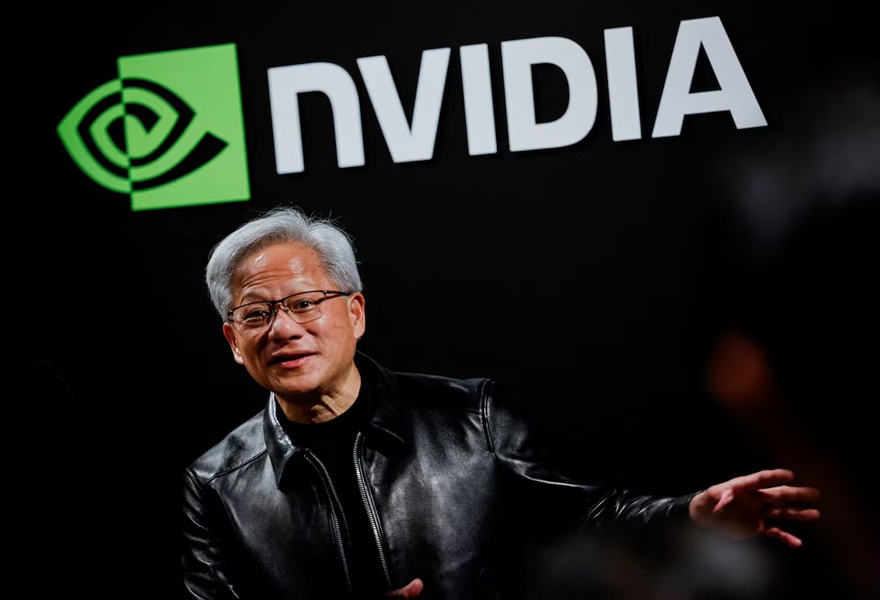
Nvidia board reportedly moves to oust Jensen Huang
Nvidia’s board is preparing to potentially remove founder and CEO Jensen Huang following reports of a second extramarital affair involving a company executive, according to The Wall Street Journal. The directors could meet as soon as Wednesday, November 11, 2026, to decide his future, raising the prospect of an abrupt leadership change at one of the world’s most valuable technology companies.
Nvidia shares fell approximately 8% in after-hours trading following the report, according to Reuters. The stock had finished Wednesday’s regular session at $173.73, up 2.9%, before the fresh allegations reversed the day’s recovery. At approximately 5:51 p.m. Eastern, shares were indicated at $160.69, down 7.5% from the closing price.
The rebound had lasted through the regular session, and then not much longer.
The New York Times reported Wednesday that Huang had a relationship with Kimberly Powell, an Nvidia executive who leads its healthcare business and reports to him. The newspaper cited five people who had worked at the company. The allegations emerged days after Huang acknowledged being unfaithful to his wife amid a separate controversy involving a former executive suspected by U.S. intelligence officials of having links to Chinese intelligence.
No dismissal has been publicly confirmed. Reuters reported that Nvidia did not immediately respond to a request for comment on the potential leadership change.
Second alleged affair intensifies Nvidia leadership crisis
According to The New York Times, Powell joined Nvidia in 2008 and currently oversees its healthcare operations. The newspaper reported that Huang and Powell were seen behaving affectionately at a hotel during Nvidia’s GPU Technology Conference in March 2026.
The account also described an incident in which someone photographed the interaction and a security guard allegedly intervened, separating the individuals involved and offering a nondisclosure agreement to the person who had taken the photograph.
Those details remain allegations attributed to the newspaper’s sources. Nvidia has not publicly confirmed the reported relationship or the circumstances surrounding the alleged hotel encounter.
The Powell allegations introduce an internal workplace dimension to the controversy. Unlike the previously reported relationship involving an executive at another company, Powell holds a senior position within Nvidia and reportedly answers directly to Huang.
That reported management relationship could fall within the scope of an examination of executive conduct and workplace oversight, although there has been no public finding that either individual violated company policy.
The board had already been examining Huang’s conduct, but the new allegation gives it another matter to investigate, and one inside the company itself.
The earlier controversy began with reporting that Huang had maintained a relationship with Alice Huang, an unrelated former executive at Singapore-based technology company Megaspeed, which has business ties to Nvidia.
The New York Times reported in late October that U.S. intelligence officials suspected Alice Huang of acting as an intelligence asset for Beijing. The allegations concern intelligence assessments reported by the newspaper, not a publicly established criminal finding against her.
Huang acknowledged in a November 8 message to employees that he had been unfaithful to his wife and apologized for his conduct. He also committed to cooperating with the board’s investigation.
On the same day, Nvidia’s directors announced an independent inquiry into whether Huang had been targeted by a foreign intelligence operation. The company said its board had no reason to believe national security or Nvidia’s confidential information had been compromised.
The board’s Sunday statement also expressed confidence in Huang and his leadership team. Wednesday’s report of possible removal therefore represents a sharp change from the board’s publicly stated position just three days earlier, although the directors have not formally announced a reversal.
Nvidia’s board faces a difficult succession decision
The potential removal places Nvidia’s corporate governance arrangements under immediate scrutiny.
Huang co-founded Nvidia in 1993 and has served as its chief executive since the company’s establishment. He remains closely associated with its product strategy, major customer relationships and expansion into artificial intelligence infrastructure.
According to Nvidia’s 2026 proxy statement filed with the SEC, the company nominated ten directors for its June annual meeting, nine of whom were classified as independent. It also approved expanding the board to eleven members effective July 13, with the appointment of former Goldman Sachs vice chairman Suzanne Nora Johnson.
The filing identifies Stephen C. Neal, a former senior partner at law firm Cooley, as the company’s lead independent director. Nvidia’s governance policies assign directors responsibility for overseeing management and evaluating the company’s operations.
There is an established board structure here, but removing the founder who has led the company for more than three decades is another kind of decision altogether.
The investigation is being overseen by independent directors with outside legal counsel. Reports indicate that law firm Wachtell, Lipton, Rosen & Katz and former federal prosecutor Joon H. Kim have been retained for the inquiry.
It remains unclear whether directors would wait for the investigation’s conclusions before reaching a decision on Huang’s position. The Journal’s report indicates they may act sooner, but neither the outcome nor the board’s timetable has been officially disclosed.
The company has not publicly identified an executive who would automatically replace Huang in the event of his departure. Chief Financial Officer Colette Kress and other senior executives hold substantial operational responsibilities, but no confirmed succession arrangement has emerged from the current reporting.
Nvidia stock faces another setback after steep selloff
The latest allegations arrive during an already difficult period for Nvidia shareholders.
Nvidia shares closed November 6 at $186.64 before falling 4.3% on November 9 and another 5.5% on November 10. By Tuesday’s close at $168.89, the stock had lost approximately 9.5% across those two sessions.
Wednesday’s recovery briefly interrupted the decline before the new reports triggered another round of selling outside regular market hours.
The company’s valuation had already been under pressure from concerns about artificial intelligence infrastructure spending and competition among technology suppliers. DaveFinances previously examined Nvidia’s market capitalization contest with Apple, which reflected changing investor preferences across major technology stocks even before the latest governance controversy.
The financial consequences of a potential leadership change remain uncertain. Nvidia’s operating business has continued reporting exceptional growth, and the current allegations have not been accompanied by a downward revision to revenue guidance or an announcement of disrupted product deliveries.
For the second quarter of fiscal 2027, Nvidia reported revenue of $96.2 billion, an increase of 106% from a year earlier. Its data center business generated $89 billion, up 117%, with demand for AI computing infrastructure accounting for most of the company’s expansion.
Nvidia previously projected approximately $108 billion in revenue for its fiscal third quarter, with a 2% range around that estimate. Those projections were issued before the leadership controversy and have not been publicly revised in connection with the investigation.
Competitive pressures are also developing independently of the scandal. DaveFinances examined OpenAI’s reported interest in Google’s AI chips and how alternative computing architectures could affect Nvidia’s pricing power.
These commercial questions have not disappeared, and investors now have to assess them alongside the possibility of a change in executive leadership.
November 17 earnings approach amid board uncertainty
Nvidia is scheduled to report fiscal third-quarter results on November 17, 2026, with its earnings conference call set for 5 p.m. Eastern.
The scheduled release provides a near-term test of whether the company’s financial performance continues to support expectations for rapid AI infrastructure growth. It also places a relatively short interval between the latest leadership reports and Nvidia’s next formal communication with investors.
In its previous quarterly results, Nvidia reported a 75% gross margin and $59.7 billion in net income. The company also disclosed approximately $99 billion remaining under its share repurchase authorization at the end of that quarter.
DaveFinances has previously documented Nvidia’s extraordinary long-term revenue growth, illustrating the scale of the business developed under Huang’s leadership.
The question for shareholders is whether the company’s existing management structure and operating teams can maintain that trajectory if the board decides a leadership change is necessary.
And the earnings date is close, just six days after Wednesday’s reports, with the board’s decision still unresolved.
The allegations have also revived political scrutiny of Nvidia’s relationship with China, particularly the handling of advanced semiconductor exports. U.S. lawmakers have called for further examination of the intelligence-related reports, adding a seperate policy dimension to the company’s leadership concerns.
Those developments should be distinguished from any established compromise of confidential information. Nvidia’s board has said it has no reason to believe company secrets were exposed, and its investigation remains ongoing.
As of Wednesday evening, no official announcement had confirmed Huang’s removal, an interim successor or the completion of the independent review. The market reaction reflects the uncertainity surrounding those unresolved questions rather than a confirmed change in Nvidia’s executive management.
The next material disclosure could come from the board itself, rather than from the company’s earnings report. For investors, the immediate issue is whether Nvidia’s directors will retain the founder who built its AI business or appoint new leadership while that business continues operating at record scale. Either decision would arrive under unusually intense scrutiny.

Johan Shamshad is Editor-in-Chief at Dave Finances, covering financial markets, digital assets, trading platforms, brokers, fintech, payments and regulation. Since 2023, he has also worked as an editor at Gulf News, the UAE English-language newspaper published by Al Nisr Publishing LLC. His work focuses on market-moving developments, company disclosures, regulatory changes and trading infrastructure, with an emphasis on primary-source verification and practical context for traders and investors.