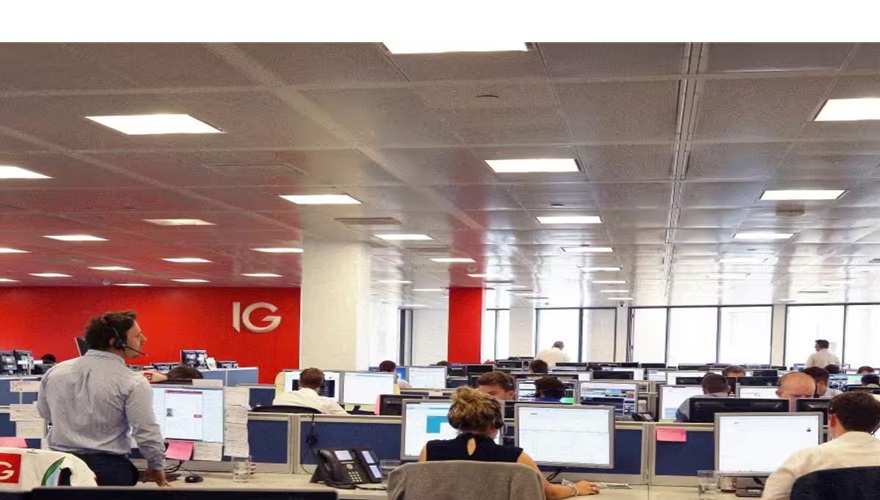
IG Group’s former UK-listed parent has registered a fresh set of capital reduction and scheme-of-arrangement documents with Companies House, providing further evidence of the legal steps behind the trading group’s completed move to a Jersey-incorporated holding company.
Four filings dated November 19, 2026, appear under IG UK Holdings Limited, company number 04677092, which operated as IG Group Holdings plc before the restructuring. They include a share allotment return, a statement showing zero nominal share capital, a certificate of capital reduction and a scheme-of-arrangement document.
According to the Companies House filing history, the SH01 return records a statement of capital of £16,851.78575 following an allotment on November 13. A seperate SH19 filing, dated November 19, displays £0. The other documents are classified as CERT15, a certificate of reduction of issued capital, and OC425, a scheme-of-arrangement filing.
These figures represent nominal share capital, rather than the company’s net assets, regulatory capital or consolidated shareholders’ equity. The dates sit a bit awkwardly together on the public record.
All four underlying documents were still being processed when the register was checked, with Companies House indicating that their PDF versions would become available within 10 days. Their detailed contents, including the precise sequence of the registered capital changes, therefore remain unavailable for direct examination.
Capital filings follow cancellation of existing shares
The November 19 registrations follow a restructuring that became effective at 8 p.m. UK time on November 13, following approval by shareholders and sanction by the High Court of England and Wales on November 11.
The transaction established a Jersey-incorporated company, originally named Jenkins Topco plc and subsequently renamed IG Group Holdings plc, as the ultimate parent of IG’s international brokerage and investment businesses.
Under the approved scheme, existing ordinary shares in the England-and-Wales company were cancelled and replacement shares in the Jersey parent were issued to shareholders on a one-for-one basis.
The court-approved implementation timetable also provided for the cancellation of the former parent’s entire existing share capital and the issuance of new shares in the UK company as part of establishing the new ownership structure.
And £0, read on its own, looks like an unusually blunt figure.
In this case, however, the zero-capital entry appears alongside a documented share-cancellation process and a subsequent share allotment return. The public filings are consistent with the capital reconstruction described in the scheme documents, although the unpublished forms prevent a complete reconciliation of their chronology.
The £16,851.78575 figure provides a particularly useful numerical connection. IG’s November prospectus identified 337,035,715 ordinary shares outstanding before implementation of the restructuring. At their nominal value of 0.005 pence each, that number of shares represents exactly £16,851.78575 in nominal capital.
The numbers fit rather neatly, though that only gets the analysis so far.
The calculation matches the amount disclosed in the November 19 SH01 return. It is consistent with the transaction’s share structure, but the filing summary does not independently identify the recipient, share class or complete terms of the November 13 allotment. Those details require examination of the underlying return.
Former listed company becomes a private subsidiary
The capital documents follow another corporate change recorded on November 17, when the former IG Group Holdings plc was re-registered as a private limited company and renamed IG UK Holdings Limited.
The company remains active on the UK register, with its registered office at 88 Wood Street, London. Its legal registration number, 04677092, remains unchanged.
It is the same old UK company, just no longer the one investors own directly.
Shareholders instead recieved ordinary shares in the new Jersey parent, which retained the IG Group Holdings plc name and the IGG trading symbol on the London Stock Exchange.
The replacement shares began trading on November 16, with 337,035,715 ordinary shares admitted and a new international securities identification number, JE00C08DXT95.
The new parent structure was originally presented to investors in July and subsequently submitted for shareholder approval in September. Dave Finances previously examined the Jersey holding-company proposal, including its implications for the group’s listing, tax residence and regulated operations.
IG said the reorganisation was intended to provide greater financial and strategic flexibility while reflecting its increasingly international business, with approximately two-thirds of group revenue generated outside the UK.
The company also stated that its London Stock Exchange listing, UK tax residence and London operations would remain unchanged. The former UK parent would continue to serve as the head of the group’s FCA-supervised regulatory structure.
These arrangements leave an important boundary between the adminstrative capital reduction at the former parent and the regulatory capital maintained within IG’s supervised businesses. The nominal share-capital amounts disclosed on November 19 do not establish changes to the group’s prudential resources.
Restructuring also transferred £550 million of debt
The new filings come three days after IG disclosed that the Jersey parent had replaced its former UK parent as issuer and principal debtor under £550 million of outstanding senior notes.
That substitution, effective November 13, covered £300 million of 3.125% senior notes maturing in November 2028 and £250 million of 6.125% senior notes maturing in October 2030.
As previously reported by Dave Finances, the £550 million debt transfer to the Jersey parent involved existing borrowing obligations, rather than the issuance of additional debt or fresh financing proceeds.
The bond substitution and share-capital reconstruction are different components of the same corporate reorganisation. The former changed the legal issuer of outstanding group debt, while the latter rearranged ownership of the former parent and established the replacement listed entity.
The restructuring also coincides with a more demanding operating environment for IG. In October, the company reduced its 2026 revenue-growth outlook to a mid-single-digit percentage rate after weaker revenue retention in its over-the-counter derivatives business.
Its third-quarter revenue was expected to fall to approximately £240 million from £280.1 million a year earlier, despite increases in customer activity. Dave Finances previously covered the reduction in IG’s 2026 revenue outlook and the decline in OTC revenue retention to approximately 70%.
IG also projected around £30 million of non-recurring costs in 2026 associated with its Jersey redomiciliation and organisational restructuring, including £16.4 million already recognised during the first half.
Those disclosed expenses provide financial context for the wider reorganisation. The November 19 capital entries themselves do not quantify any additional restructuring charge or establish a change in consolidated group equity.
What the latest filings establish
The November 19 registrations add documentary evidence to a transaction that had already passed its principal shareholder, court and stock-exchange milestones.
They also provide a closer view of the capital reconstruction than the earlier public announcements, particularly through the appearance of both a zero-capital statement and a share allotment amount matching the nominal value of the former listed share count.
A full comparision between the two capital statements requires the SH01 and SH19 PDFs, together with the certificate of reduction and scheme document. These should establish the relevant share classes, allotment details and order of the capital changes.
The filing trail comes after the deal, not before it, which is easy to miss.
For investors, the confirmed position is that the Jersey parent has replaced the former UK company as the listed issuer, while the original corporate entity continues within the group as a private company. The latest Companies House entries document further legal steps in that transition, without establishing a new capital raise, a cash distribution or a change in the group’s overall financial resources.

Johan Shamshad is Editor-in-Chief at Dave Finances, covering financial markets, digital assets, trading platforms, brokers, fintech, payments and regulation. Since 2023, he has also worked as an editor at Gulf News, the UAE English-language newspaper published by Al Nisr Publishing LLC. His work focuses on market-moving developments, company disclosures, regulatory changes and trading infrastructure, with an emphasis on primary-source verification and practical context for traders and investors.