
Tor can protect a Bitcoin node operator’s network identity without protecting the node against every network attack. Bitcoin Core’s November 10, 2026 disclosure makes the distinction concrete. A flaw allowed certain incoming Tor connections to inherit permissions intended for trusted peers, weakening denial-of-service limits and privacy mitigations on affected configurations. It did not mean that every Tor-connected node was vulnerable, that Tor itself was broken or that an attacker could automatically steal the operator’s bitcoin. The problem was a trust-boundary error between Bitcoin Core’s peer-permission rules and the network address of a local Tor proxy.
What the November Disclosure Actually Says
Bitcoin Core disclosed CVE-2025-62860 on November 10, rating it medium severity. In affected releases before 28.3, 29.2 and 30.0, inbound peers arriving through Tor could be treated as whitelisted when an operator configured the non-default `-whitelist` option to cover the Tor daemon’s IP address or network. The daemon often runs on localhost, so otherwise unrelated remote Tor peers could appear to originate from a locally trusted address. Bitcoin Core’s whitelist privileges relax anti-abuse limits and certain privacy protections. Peer-origin anonymity and blanket trust are not the same thing.
The project says thousands of reachable mainnet nodes were inadvertently whitelisting incoming Tor connections because popular node vendors combined Bitcoin Core with a Tor daemon and the matching network-based whitelist setting. That is a statement about affected configurations across the network, not an estimate of exploited wallets, stolen funds or unique persons attacked. Developers received the report in September 2025, merged a fix that month and released patched versions beginning October 10, 2025. Public disclosure occurred more than a year later, after the last vulnerable 29.x release had reached end of life on October 27, 2026.
Crucially, users who never configured the non-default `-whitelist` setting were not affected by this specific vulnerability, according to Bitcoin Core. A node restricted to Tor still deserves updates and careful configuration, but users should not conclude that the mere presence of Tor creates this bug. The cause was the promotion of the proxy’s local address into a trust decision about a remote peer.
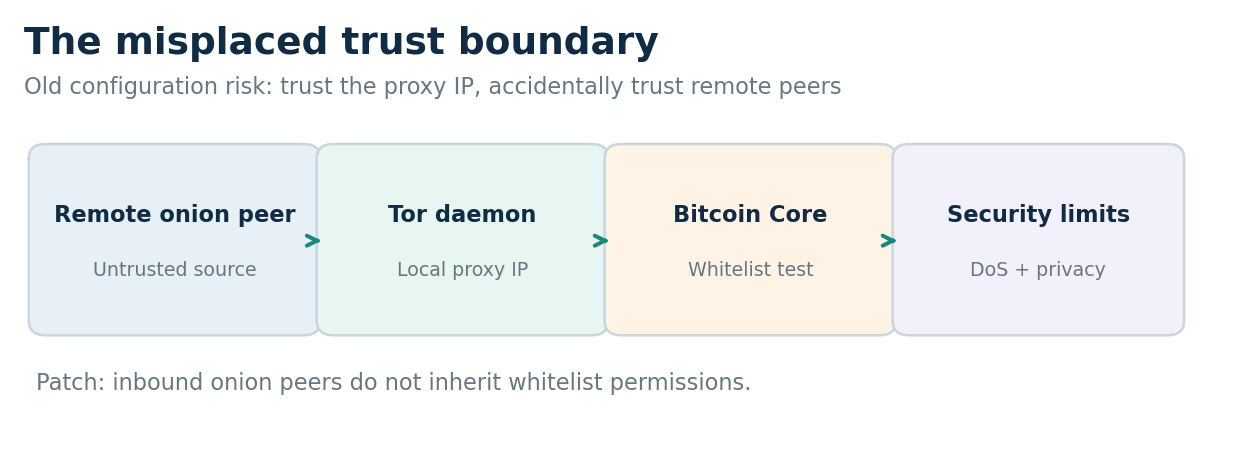
Figure 1. Tor proxy and Bitcoin whitelist trust boundary. Source: Bitcoin Core CVE-2025-62860; Dave Finances calculations.
Why a Proxy Address Can Defeat a Trust Rule
Bitcoin Core makes distinct connections to IPv4, IPv6, onion services and, where configured, other peer networks. An inbound onion-service connection is delivered by Tor, often over a loopback socket. In many designs the application sees the proxy endpoint at the transport layer rather than a meaningful public source IP belonging to the actual remote peer. A rule that says ‘trust every connection from this local subnet’ can therefore accidentally trust all connections coming through a proxy on that subnet.
For this CVE, the whitelist logic could remove defenses that are deliberately withheld from untrusted peers. The exact collection of permissions depends on configuration and implementation. Those elevated privileges relate to how the node handles network traffic; they are not wallet-signing keys and do not automatically let a peer broadcast a valid spend from somebody else’s wallet. Yet they can matter to an operator who relies on the node for timely block validation, transaction relay and privacy-aware data access.
A safe response is to upgrade and audit the configuration, not to discard all anonymity tools. Bitcoin Core’s Tor documentation still describes onion-service support, including ephemeral onion services when a compatible Tor proxy and control interface are configured. It also notes that modern releases use v3 onion addresses. Operators running packaged node distributions should check the actual Bitcoin Core binary and configuration shipped by the vendor, rather than relying on a product’s advertised ‘Tor enabled’ checkbox.
| Threat | Can Tor alone prevent it? | Relevant boundary |
|---|---|---|
| Host IP exposure to peers | Often reduces it | Tor connection routing |
| Malicious peers / eclipse | No | Peer selection and multiple independent routes |
| Traffic-based DoS | No | Node limits, updates, permission rules |
| Wallet-key theft | No | Key custody, process isolation, RPC controls |
The Three Different Risks: Privacy, Isolation and Availability
Tor’s value is principally at the network layer: it helps prevent ordinary peers from learning the operator’s public IP address. That does not make the application immune to traffic analysis, malicious peers, exposed management interfaces or software defects. Nor does an encrypted Bitcoin peer connection necessarily provide the same network-location privacy as Tor. BIP324, Bitcoin’s encrypted peer-to-peer transport, aims to make passive observation and certain active interference more difficult, but it does not automatically hide the IP addresses of the endpoints from each other.
An eclipse attack is a separate mechanism: an adversary attempts to fill a node’s peer slots with controlled connections and thereby isolate it from honest network information. A node so isolated may see blocks or transactions later than the network does, and a wallet or monitoring process using only that node may receive a misleading view of confirmation progress. Bitcoin Core’s peer-diversity safeguards are intended to raise the cost of such attacks. Tor peers are not inherently malicious, but an operator relying on a small or poorly diversified peer set can create additional opportunities for concentration.
Availability risk is different again. A malicious network peer might consume bandwidth, CPU or memory, slow a node’s synchronization or trigger software vulnerabilities. Some of these failures can occur with or without Tor. The November whitelist bug was serious because it made otherwise untrusted incoming Tor peers qualify for exceptions to certain normal defenses. Those exceptions made the node more permissive exactly where the operator expected the proxy to preserve privacy.
A fourth risk is often conflated with the three above: wallet compromise. A full node used only to validate blocks does not ordinarily give remote peers the ability to sign transactions. If an operator places a spend-capable wallet on the same host, exposes management RPC or installs an untrusted plugin, the potential consequences can be much larger, but those are additional threat paths requiring separate analysis. Bitcoin Core’s own RPC security documentation warns that its remote-procedure-call interface is not hardened for arbitrary internet exposure, even through an onion service. That warning should not be confused with ordinary peer-to-peer onion networking.
How Much Does Peer Concentration Change the Math?
The probability of all peers being malicious provides a transparent illustrative model of exposure to complete isolation, although actual eclipse attacks do not follow independent random sampling. Suppose an adversary controls 20% of reachable peers in a simplified hypothetical population. With four independently selected peers, the chance that all four are adversarial would be 0.16%. With eight, it falls to 0.000256%; with 12, to approximately 0.00000041%. Increasing peers helps sharply under independent selection—but a coordinated adversary exploiting correlated gateways, address buckets or connectivity failures can invalidate that assumption.
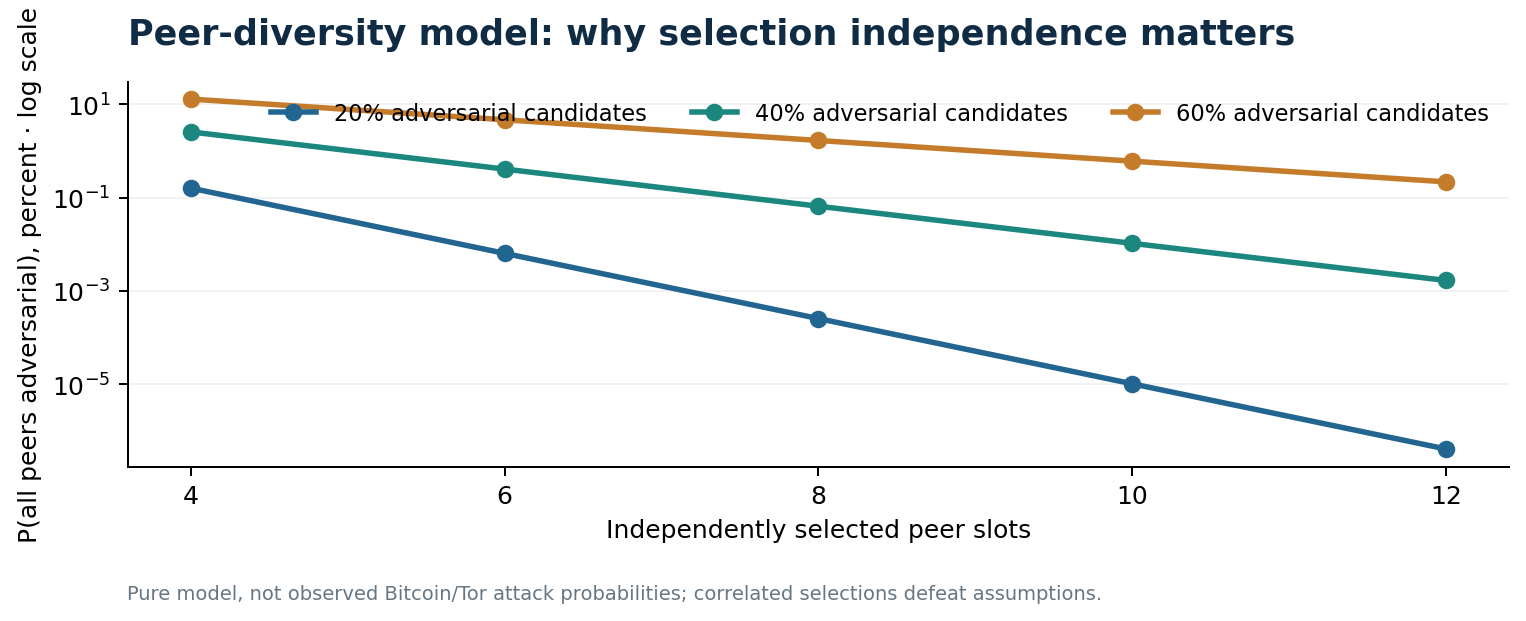
Figure 2. Independent peer sampling sensitivity. Source: hypothetical model; Dave Finances calculations.
The independence caveat matters more than the small result. A node connected through one access route can be dependent on a single proxy daemon, operating system, network firewall or hosting provider even when its peer list contains many addresses. A cautious operator therefore considers diversity in pathways and software, not merely how many green connection icons appear on a dashboard. A Tor-only policy may strengthen IP privacy while changing the set of reachable counterparties; Tor plus clearnet may improve diversity but disclose the host address on the clearnet side. There is no cost-free universal setting for every threat model.
A second scenario shows why false certainty is dangerous. Imagine that an attacker can concentrate 60% of a node’s candidate peer set through manipulation or failure of other routes. Under the same naive independence model, the chance of all eight peers being attacker-controlled rises to about 1.68%. That is orders of magnitude larger than the 20% example, without changing the number of peer slots. It is not a forecast of the real Bitcoin network’s adversarial share; no credible global estimate is supplied here. The purpose is to show why the composition of connection candidates dominates a simple peer count.
A Configuration Audit That Targets the Real Failure
First identify the Bitcoin Core version and check whether it includes the Tor-whitelist fix. Operators on an affected old branch should migrate to a supported patched release, not rely on the vulnerability’s public-disclosure date. Next inspect `bitcoin.conf`, startup flags and any configuration generated by a node appliance. The specific dangerous combination was an inbound Tor listener paired with a network-range `-whitelist` rule matching the Tor daemon’s address. Removing arbitrary trust rules is not always sufficient if a vendor regenerates them at startup; configuration should be inspected where it is actually applied.
Next distinguish Bitcoin’s P2P listener from the RPC management interface. A public P2P listener is an intended part of a reachable full node. An open RPC interface can expose a much more privileged control surface and should remain restricted to trusted local access and robust authentication or another explicitly engineered secure channel. Bitcoin Core’s documentation cautions against making RPC reachable over the internet, including via Tor onion services. If wallets are present on the host, minimize privileges and isolate signing keys where practical.
A node’s software supply chain also deserves attention. Verify releases from official sources, update the operating system and Tor daemon, and review added services, port-forwarding defaults, remote web dashboards and backup procedures. The point is not that every operator needs enterprise infrastructure. It is that the weakest layer can shift after the IP address has been concealed.
| Item | Practical check |
|---|---|
| Bitcoin Core build | Use supported version containing CVE-2025-62860 fix |
| -whitelist flags | No trust rule accidentally matching Tor proxy subnet |
| Tor configuration | Check v3 onion service and daemon permissions |
| RPC exposure | Local access only; no public RPC onion endpoint |
| Peers | Observe independent sources and network reachability |
| Wallet isolation | Keep signing credentials separate from exposed node functions |
What the Vulnerability Does Not Establish
The November advisory does not prove a large-scale successful eclipse attack, wallet theft, miner takeover or chain-consensus failure. It reports a flaw, the conditions under which it mattered and the fixes. Bitcoin Core separately disclosed other 2025-era vulnerabilities in November and additional 2026 availability issues; those should not be combined into an invented single Tor attack. A node that was affected may not have been exploited. A node that was unaffected by this particular bug could still have other software or operational weaknesses.
The distinction resembles the one between compromised wallet infrastructure and stolen signing credentials. In a separate bitcoinj payment-protocol security disclosure, risky outbound requests did not mean the same thing as automatic control of private keys. Similarly, a self-custody wallet backend incident can manipulate payment requests without necessarily obtaining the cryptographic authority to spend. These are different products and vulnerabilities; the shared lesson concerns drawing correct boundaries around the actual control surface.
There is a second analogy with crypto browser-extension risks: a friendly interface or privacy brand says little about what software components are trusted behind it. The operator needs to distinguish peer traffic from wallet-signing authority and local administration. A Tor-connected node can be an excellent privacy tool when its underlying applications do not accidentally elevate untrusted traffic.
What Users Should Watch After November 2026
For individual operators, the most relevant indicators are patch status, the existence of unusual whitelist rules, actual peer diversity, RPC exposure and the provenance of node software. For developers and appliance vendors, the problem is more structural: testing network proxies under permission checks and documenting what ‘trusted peer’ means. When remote connections arrive through an anonymizing proxy, the proxy’s local address cannot safely substitute for the identity or trustworthiness of the remote endpoint.
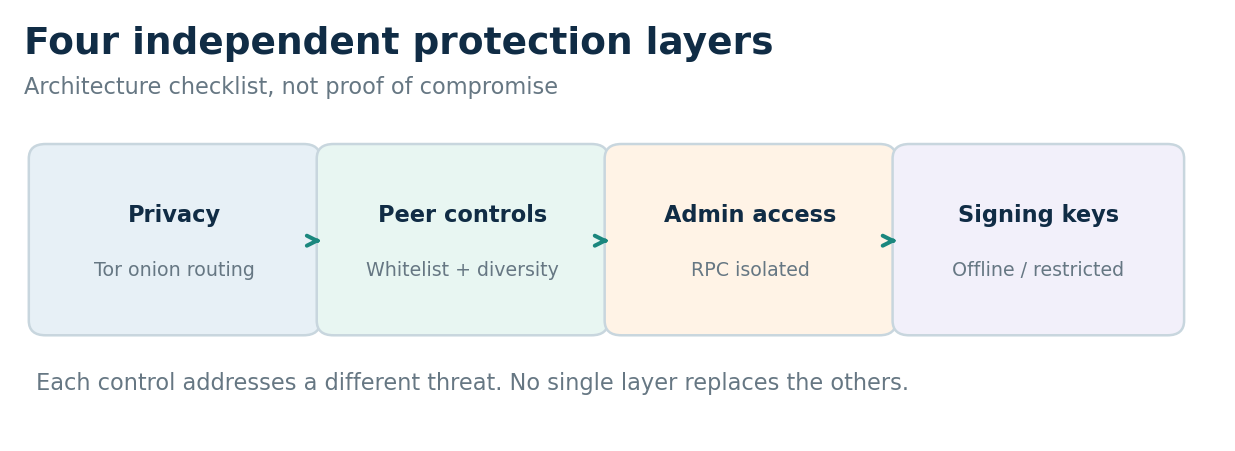
Figure 3. Separated network, administration and signing protections. Source: Bitcoin Core documentation; Dave Finances calculations.
A meaningful rebuttal to this analysis would show that the specific trust-boundary condition no longer exists on maintained releases and that operators are verifying their configurations. That is already partly supported by the official fix timeline. What remains uncertain publicly is how many potentially affected nodes were exploited, which vendors had deployed particular configurations, and what downstream effects—if any—occurred. Reporting those unknowns is preferable to treating a disclosed potential attack as a proven loss event.
Choosing Privacy Means Choosing Which Risks to Accept
Node operators face a genuine configuration trade-off rather than a universal checklist. Running entirely through Tor may make it harder for ordinary counterparties and internet providers to connect Bitcoin traffic to a household IP address. Maintaining both Tor and clearnet peers can diversify routes and improve availability but exposes the clearnet identity to the peers on that side. Tor, by design, is not meant to make the administrator’s own computer immune to malware, data theft or poor operational practices.
The operator’s use case is decisive. A home node validating a personal hardware wallet can put its spending keys on a separate device and give the node only the job of checking consensus rules and broadcasting signed transactions. An infrastructure provider serving multiple users will care more about sustained uptime, peer reachability and traffic-abuse mitigation. A miner may face additional timing-sensitive risks from stale blocks or interrupted template creation. None of these users should infer from the CVE headline that Bitcoin Core’s block-validation rules had somehow been replaced by Tor’s routing rules.
A more realistic threat model separates five questions: can a remote peer learn the host’s public IP, can it exhaust resources, can it dominate the peer list, can it reach management interfaces, and can it obtain signing authority? The answers vary. Tor primarily addresses the first. Bitcoin Core’s peer-selection and transport controls contribute to the second and third. Host networking and RPC permissions address the fourth. Hardware signing and wallet isolation address the fifth. One tool’s success does not imply the remaining four protections are present.
Bitcoin Core’s November 20 advisory on duplicate orphan announcements and October 28 disclosures about memory growth also show why operators should monitor the full security feed, not one Tor-specific headline. These reports concern other weaknesses and affected versions. Their publication should prompt a general patch audit, not an unsupported assertion that they were chained together in the wild. More alarming headlines are possible, but causality requires evidence.
Bottom Line
Running Bitcoin over Tor does not inherently create the November 2026 flaw. A non-default trust rule created a loophole by treating anonymous remote peers as though they inherited the trusted local Tor daemon’s permissions. Updated Bitcoin Core releases fix that behavior. Tor can obscure an operator’s network location; a secure node still depends on restrained peer permissions, diverse connections, patched software and a carefully protected administrative interface.
Methodology
The peer-isolation chart calculates p to the power n, where p is a hypothetical malicious-peer share and n is the number of independently sampled peers. It illustrates the effect of independence assumptions and is not an empirically estimated attack probability. CVE scope, severity and release dates come from Bitcoin Core’s November 10 security advisory. Configuration and transport distinctions follow Bitcoin Core’s Tor and JSON-RPC documentation and the BIP324 specification. The analysis does not assume wallet-theft losses or confirmed exploitation where the advisory reports neither.
Sources
Reporting and analysis based primarily on regulatory documents, exchange notices, official technical advisories and product documentation. Accessed November 27, 2026.
1. Bitcoin Core — CVE-2025-62860 official advisory, November 10, 2026
2. Bitcoin Core — Security advisories index
3. Bitcoin Core GitHub — Tor and onion-service support
4. Bitcoin Core GitHub — JSON-RPC security guidance
5. Bitcoin BIPs — BIP324 encrypted peer-to-peer transport
6. Bitcoin Core GitHub — Network peer-permission implementation
7. Bitcoin Core — CVE-2025-62859 block-processing stall disclosure
8. Bitcoin Core — CVE-2026-117348 orphan-announcement stall advisory
9. Bitcoin Core — CVE-2026-117349 memory growth advisory
10. Bitcoin Core — CVE-2026-117350 TCP urgent data advisory
11. Blockstream — Practical Bitcoin node security and privacy
12. Bitcoin Core — Version 30.0 release notes

Johan Shamshad is Editor-in-Chief at Dave Finances, covering financial markets, digital assets, trading platforms, brokers, fintech, payments and regulation. Since 2023, he has also worked as an editor at Gulf News, the UAE English-language newspaper published by Al Nisr Publishing LLC. His work focuses on market-moving developments, company disclosures, regulatory changes and trading infrastructure, with an emphasis on primary-source verification and practical context for traders and investors.