
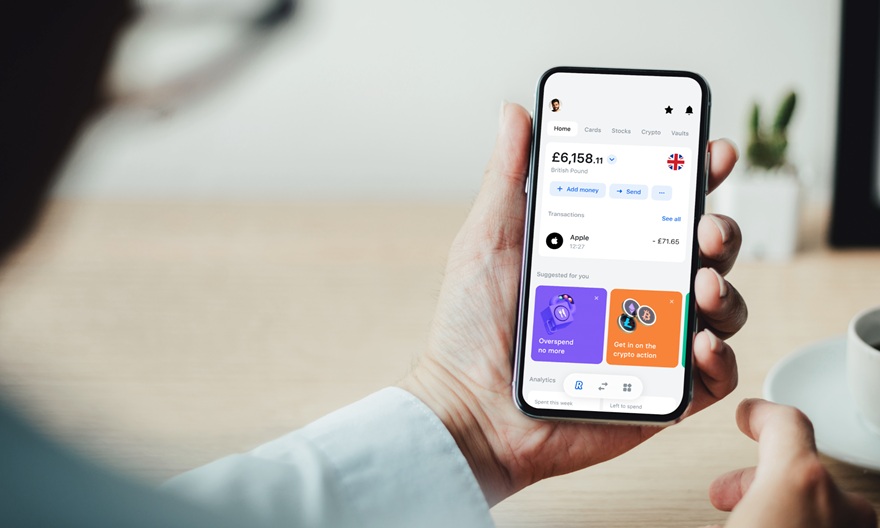
The unusual incident began on September 19 after the customer replaced a phone that had stopped working and logged into Revolut on the new device. According to the customer’s account on Reddit, the app initially displayed their account and balance briefly before switching to a screen stating: “Your account is closed.”
The customer said they had received no email or SMS notifying them that Revolut intended to terminate the account.
That detail was important because actual account closures normally involve a materially different process from a simple login error. Revolut’s UK terms say customers are generally notified when the company decides to close an account, although immediate closure is permitted in certain exceptional circumstances.
The case became considerably more interesting on September 20.
The customer reported that they could successfully sign into Revolut through a web browser and see their account, card and transaction history normally. At the same time, the mobile app continued to insist that the account was closed.
That mismatch strongly suggested the customer’s underlying Revolut relationship had not simply disappeared.
Revolut’s own documentation says customers with full web-app access can view account details, cards and transactions. The fact that those functions remained available through the browser while the mobile application displayed a closure message therefore points toward inconsistent account-state information between Revolut’s access layers rather than a straightforward completed account termination.
Identity Verification and a Backend Change Restored the App
The customer subsequently contacted Revolut by email and went through an identity-verification process.
In the final update, the customer said Revolut “did something in the backend” and then instructed them to uninstall and reinstall the mobile application. After reinstalling it and signing in again, normal access returned.
Revolut has not publicly explained what was changed, and the Reddit account does not establish whether the fault involved device registration, authentication state, cached account information, account-status synchronization or another internal service.
It would therefore be premature to call this a specific backend bug.
What can be established from the customer’s reported sequence is narrower: the mobile application displayed an account-closure state, browser access remained available, identity verification was completed, Revolut made an internal change, and reinstalling the application restored access.
There is also no evidence in the report that money disappeared or that transactions had been removed from the actual account. That distinction resembles other cases where a financial app interface displayed information that did not accurately reflect the underlying asset state.
Changing Devices Adds Another Authentication Layer
The fact that the problem appeared after a phone change is notable.
Revolut says customers logging in on a new device may be required to undergo additional authentication, including one-time passcodes, selfies or identity-document verification. Its support documentation also specifically advises users experiencing login problems to ensure they are using the correct phone number, the latest Revolut application and an updated operating system.
Device changes are a sensitive point for financial apps because the platform has to distinguish a legitimate customer migrating to new hardware from an attacker attempting to take control of an account.
Those controls are necessary, but they also create another layer where account status, device trust and identity verification must remain synchronized.
Similar complexity can be seen across financial platforms tightening KYC and fraud checks. Stronger authentication can reduce account-takeover risk while simultaneously creating new failure modes when automated systems classify a legitimate login incorrectly.
No Clear Evidence Yet of a Wider Revolut Device-Change Bug
The September 20 case should not currently be interpreted as evidence of a broad Revolut outage or a large-scale false-closure problem.
Other public complaints exist from users who have encountered “account closed” messages, but the circumstances vary substantially. Some appear to involve genuine compliance or account-termination decisions, while others lack enough follow-up information to determine what happened.
The particularly unusual feature here is the combination of a closure message on the new phone, continued full browser visibility and successful restoration after Revolut support intervened.
No clear cluster of public reports showing that same sequence has yet emerged.
That matters because customer complaints involving account blocks become much more significant when multiple independently reported cases display the same trigger and resolution pattern.
The Incident Comes as Revolut Becomes a Much Larger UK Bank
The reliability question carries more weight because Revolut is no longer operating in the UK at the scale of a niche fintech application.
Revolut received approval in March 2026 to launch as a fully licensed UK bank following the completion of its mobilisation period. The company said at the time that it had approximately 13 million UK customers and would gradually transition eligible customers toward Revolut Bank UK.
Globally, Revolut reported 68.3 million retail customers at the end of 2025, alongside £4.5 billion in annual revenue and £1.7 billion in profit before tax. The company has since said its worldwide customer base has continued growing beyond 70 million.
As digital finance platforms increasingly attempt to combine payments, cards, investments and banking inside one application, the reliability of the banking infrastructure behind the interface becomes as important as the products themselves.
Analysis: “Your Account Is Closed” Is Almost the Worst Error Message a Banking App Can Show
The most interesting part of this case is not that an app apparently glitched.
Apps glitch every day.
The problem is what Revolut’s app told the customer had happened.
There is an enormous difference between “We can’t log you in right now” and “Your account is closed.”
The first message tells a customer there is a technology problem. The second tells them their financial relationship with the company may have ended.
For someone holding their salary, savings, cards or investments inside the same platform, those two messages create completely different levels of concern.
That is why false state reporting deserves more attention than an ordinary app crash.
The Browser Became an Accidental Source of Truth
The browser login is what makes this case particularly revealing.
Without it, the customer had very little evidence available to distinguish an actual account closure from a software problem.
Once the browser showed the account, card and transaction history normally, the situation changed. Two Revolut interfaces were effectively presenting contradictory versions of the same customer relationship.
Financial platforms increasingly have multiple frontend and backend layers operating at once: mobile applications, browser sessions, authentication systems, card infrastructure, payment engines, KYC services and internal risk systems.
The customer sees one company.
Technically, they are interacting with a stack of interconnected services.
That is similar to the distinction seen during transfer delays, where one platform can show a problem even though another layer of the financial infrastructure is functioning normally.
False Closure States Could Create Their Own Security Risk
There is another less obvious problem.
A frightened customer who believes their account has suddenly vanished becomes much more vulnerable to bad decisions.
They may search social media for support, respond to fake customer-service accounts, click unofficial recovery links or give information to someone claiming they can restore the account.
A false closure message therefore does not only create customer-service friction. If badly handled, it can create a secondary security problem.
That makes clear fallback instructions critical. When a bank’s primary application becomes unreliable, customers need an obvious alternative route for verifying whether their money and account are actually intact.
Revolut Needs to Know Whether This Was a One-Off or a Repeatable State Error
One Reddit report is not enough to establish a systemic defect.
But it is enough to identify the question Revolut should want answered internally.
Why did one access channel apparently classify the account as closed while another still treated it as active?
If the answer is an isolated corrupted session or stale local application state, the significance is limited.
If a new-device authentication workflow can reproducibly produce a false account-closure flag, the issue becomes much more serious because customers change phones constantly.
Financial platforms have faced plenty of incidents where service infrastructure becomes temporarily unavailable. Users generally understand an outage once it is clearly identified.
A system that remains operational while incorrectly telling a customer their account no longer exists is harder to interpret.
For now, this appears to have ended well: browser access remained available, support verified the customer, the mobile application was restored and the account apparently returned to normal.
The bigger question is whether anyone else moving to a new device encounters the same sequence.
If similar reports begin appearing, the September 20 case could become an early indicator of a specific Revolut authentication or account-state synchronization problem. If they do not, it may remain an unusual but instructive example of how a frontend error can make a perfectly live financial account look as though it has disappeared.

Johan Shamshad is a financial markets writer at Dave Finances covering cryptocurrencies, trading platforms, brokers, fintech, financial regulation, and developments across global markets. He previously worked at Gulf News, adding newsroom experience to his coverage of fast-moving financial and digital-asset markets.
His work focuses on identifying market-moving events, company developments, regulatory changes, product launches, and shifts in trading and financial infrastructure.
Johan contributes news and analysis designed to help readers understand not only what happened, but why a development matters and how it may affect the wider financial landscape. You can reach out to him via his social media accounts:
Linkedin: https://www.linkedin.com/in/johan-shamshad-742851262/
X: https://x.com/Yasmine_FX
Investing: https://www.investing.com/members/contributors/279781574