Britain’s competition regulator has moved from asking whether iPhone contactless access is a problem to proposing the rules that could change it. On October 20, 2026, the Competition and Markets Authority (CMA) began consulting on a conduct requirement that would oblige Apple to give rival developers fair, reasonable, transparent and non-discriminatory access to near field communication (NFC) functionality. The consultation closes on November 17. No final UK NFC conduct requirement has been imposed as of this article’s research date. [1][2]
That distinction matters more than the headline’s yes-or-no framing. Apple already offers certain UK developers a secure-element NFC interface under its own contracts. The CMA’s case is that technical access may be too restrictive or too expensive to permit a genuinely competitive mobile-wallet market, and that a second technical route should be available. The decision is about the terms on which rivals can compete. It is not a requirement that Apple abandon Apple Pay, hand over payment-card credentials, or remove device security.
The UK Proposal Is About Access, Architecture and Price
Apple was designated as having strategic market status for its mobile platform on October 22, 2025. That status gives the CMA a legal route under the Digital Markets, Competition and Consumers Act 2024 to propose targeted conduct requirements. It does not mean a proposed rule becomes binding on publication. In June 2026, the CMA requested evidence on NFC access and pricing; in October it moved to a formal proposal. The regulator’s case page, most recently updated November 5, lists the NFC consultation as an ongoing intervention. [3]
The proposed design would require support for the two internationally established models of mobile contactless payments: secure element (SE), where sensitive credentials or keys are protected on the device, and host-based card emulation (HCE), where relevant payment credentials and logic can be managed off-device under approved security arrangements. The distinction is technical, not a verdict that one method is inherently safe and the other inherently insecure. The CMA says its evidence does not show inherent security objections to either model. Apple currently makes its SE-based platform available in the UK, while the CMA seeks a route to HCE as well. [1]
Apple’s developer material says authorized apps can support contactless payment, transit, keys and other uses; eligible users can choose a default contactless app, invoke it by double-clicking or open it at a reader. Developers still need specific entitlements and must meet legal and security conditions. [4] The complication is economics and platform governance: an API can exist without rival wallets being able to afford the terms, reach users, or negotiate the distribution and certification obligations needed to launch. There is a door, but the price of the door matters.
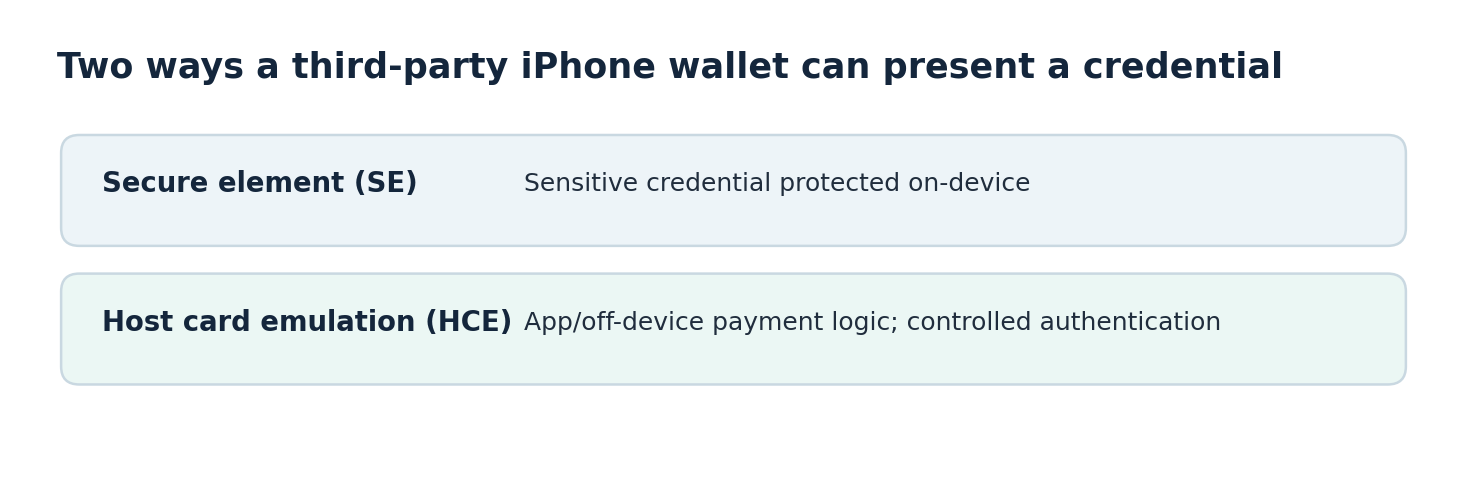
Figure 1. Two technical choices in the UK NFC debate; schematic, not a security ranking.
Why the Market Is Big Enough to Matter
UK Finance estimates that contactless transactions, across physical cards and mobile devices combined, reached 19.2 billion in 2025, or 39% of all payments. Ten years earlier, contactless accounted for about 3% of payments. The increase is 36 percentage points and a thirteen-fold increase in the share, though not a thirteen-fold increase in the absolute transaction count. It is important not to misstate this as 39% of payments occurring on phones: the figure includes plastic cards. [5]
UK Finance separately reports that nearly two thirds of the population are registered for a mobile wallet. The CMA cites a Which? survey finding that 62% of adults use a digital wallet and 50% use Apple Wallet. These measures have different definitions and study bases; neither allows a precise estimate of iPhone owners using Apple Pay from the numbers alone. Still, they establish that NFC access affects a mainstream payments channel, not a peripheral app feature. Apple Wallet’s prominence also means rivals face a distribution problem even after access is opened. [1][5]
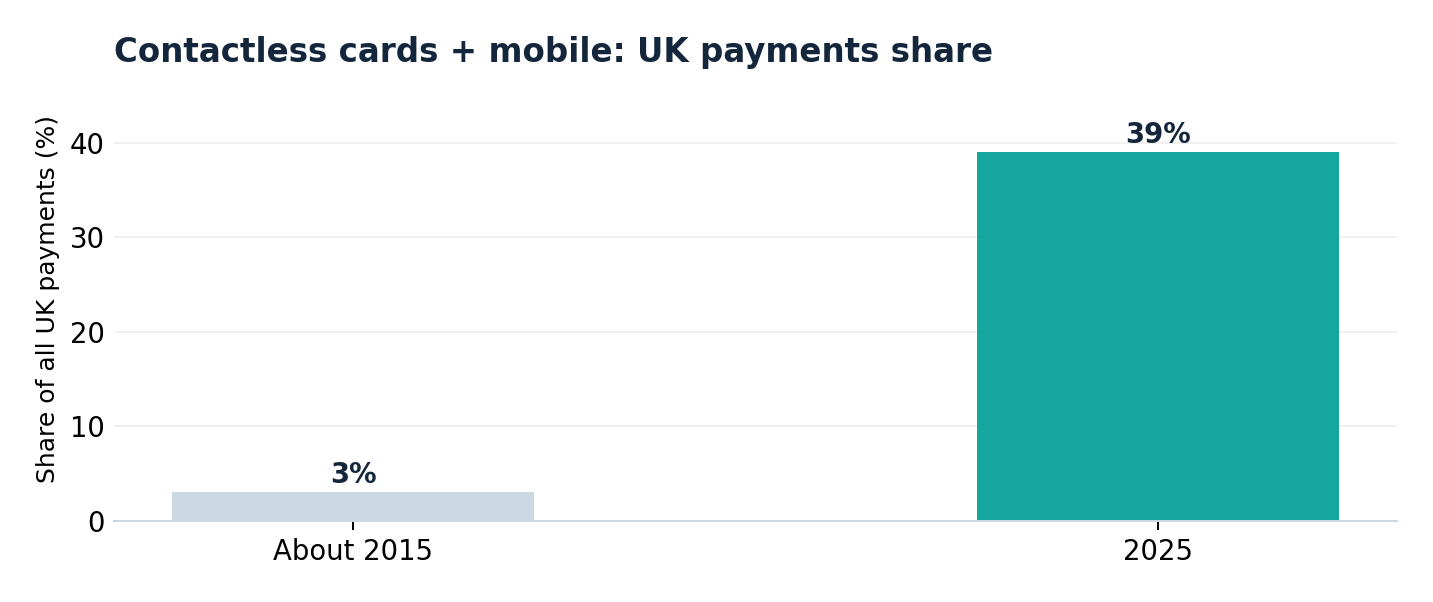
Figure 2. UK Finance / CMA reported shares. Includes plastic cards and mobile contactless.
The CMA argues there is no UK wallet-type product competing directly with Apple’s iPhone wallet despite the existence of several such products in the European Union. It names Vipps and subsequent European launches as evidence that opening the technical channel can support entrants. [1] This is suggestive but it is not a controlled experiment: uptake differs by payment habits, local bank integrations, merchant acceptance and the fees faced by issuers and wallet providers. A launch is evidence that access can be used, not proof of enduring market share or consumer savings.
The European Union Already Provides a Partial Test Case
In July 2024 the European Commission made Apple’s commitments to open iPhone tap-and-go functionality legally binding under EU competition rules for ten years. The EU solution centered on enabling rival mobile wallets to use HCE and giving users functions such as choosing a default payment app. [6] The UK authority is examining a different domestic legal obligation and appears interested in both HCE and secure-element routes, plus commercial terms. The EU result therefore supplies a useful comparison, not an automatic template that can be copied to Britain.
The distinction between hardware access and consumer choice is easy to overlook. A wallet that works only when launched manually is not equivalent to one that opens by double-click or automatically presents itself at a terminal. Nor can a wallet compete without issuer agreements, payment tokenization, identity verification, fraud controls and customer support. Visa and Mastercard rules, banking partners, scheme tokens and merchants all remain relevant. By allowing a default contactless app, Apple’s platform can reduce some friction; by deciding eligibility and technical implementation, it still affects the resulting market. This will be the real practical test.
Original Model: The Economics of a Rival Wallet
Suppose a new wallet attracts one million UK users who make an average of 15 contactless purchases monthly, at £25 each. That would produce 180 million transactions and £4.5 billion of annual payment value. Assume, purely for illustration, the wallet can capture a net contribution of 2 basis points of that value before NFC-access and platform-operation costs: £900,000 a year. Suppose fixed annual operating expenses are £400,000 and NFC-access, security certification and related charges total £600,000. The wallet would lose £100,000 despite handling billions in payments. These numbers are a model, not Apple’s published price or a forecast of a specific product.
To break even on the £1 million annual cost base, the wallet would need about 2.22 basis points of contribution on its modeled £4.5 billion annual flow. At 1 basis point, it would earn only £450,000; at 3 basis points, £1.35 million. If fixed costs were cut from £1 million to £500,000, break-even contribution would fall to 1.11 basis points. A seemingly small per-transaction change can determine whether a rival is commercially viable.
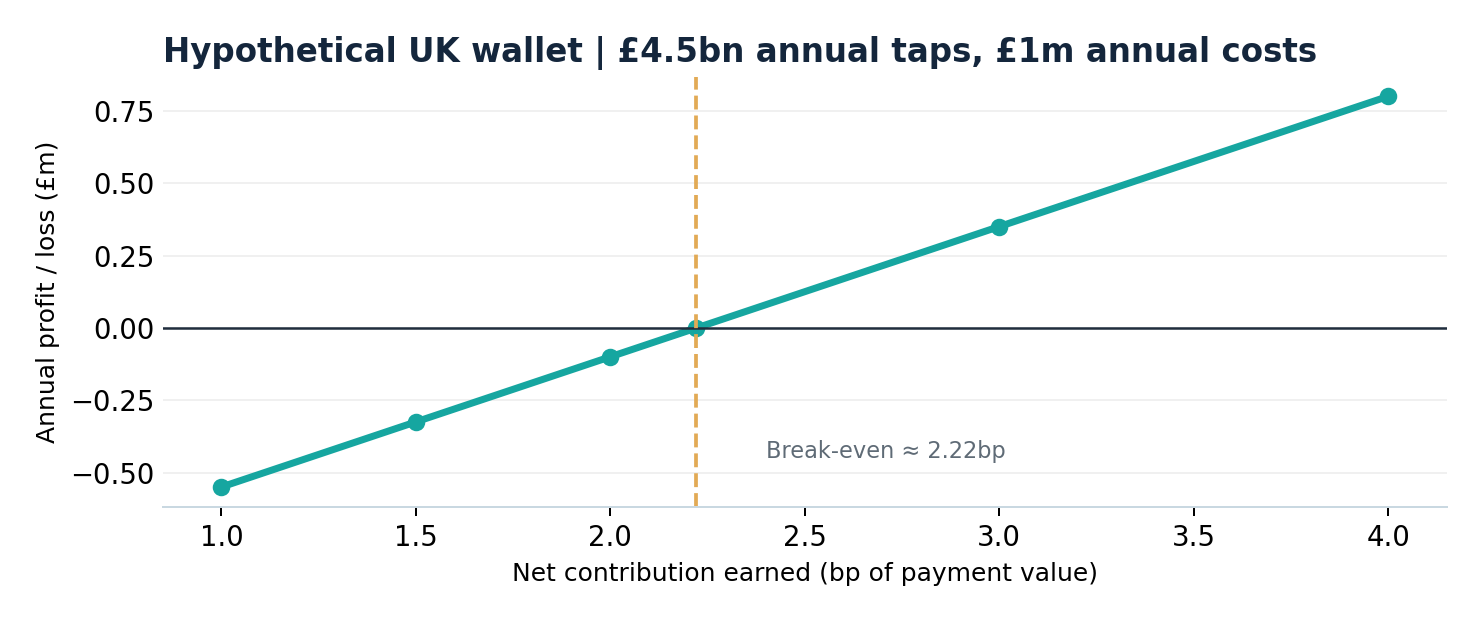
Figure 3. Illustrative access-fee economics. All inputs are hypothetical, not Apple pricing.
This is why the CMA chose not to prescribe one universal NFC access price. Its consultation instead sets proposed pricing principles intended to bring Apple’s fees substantially below current levels while allowing fair remuneration. [1] The authority has not published the effective rate each entrant would pay under a final requirement. A rival wallet might earn revenue from a bank service contract, merchant service, premium subscription, interchange-sharing agreement or wider customer relationship, rather than from every tap. All of those business models alter the break-even arithmetic. The model’s purpose is to expose sensitivity to tiny contribution margins, not to predict a winner.
Who Gains When a Wallet Has the Tap?
Apple has a defensible interest in secure-device integration and protecting a user experience that must work in a crowded checkout queue. Its NFC & SE terms include entitlement, privacy and operating requirements. The CMA is not alleging that security should be disregarded. It is asking whether access conditions go beyond what is necessary and become a barrier to distribution. Any final rule must therefore specify effective access, credible security controls and reasonable charges—not simply declare the chip open.
A rival wallet could potentially direct a payment from an ordinary debit card, a bank account through open banking, a prepaid product or, subject to applicable rules, a digital currency or stablecoin. The payment instrument makes a large difference. A card-based wallet may retain card-network economics and consumer protections. An account-to-account wallet may bypass some card processing fees but has to solve merchant acceptance, refunds, authentication and consumer dispute expectations. A stablecoin wallet faces extra conversion, custody and redemption questions. The NFC interface is a gate to checkout; it is not the entire payment product.
A practical example is the way Walmart’s rollout of Apple Pay and Google Pay acceptance changes the consumer choice at the point of sale without changing the underlying identity of the issuer or wallet provider. A related example is Binance.US adding Apple Pay and Google Pay as funding methods: payment convenience can coexist with card funding costs and withdrawal holds. Both examples come from the United States, not evidence of UK NFC access, but they make the distinction between interface convenience and the economics of the underlying rail concrete.
Would Rival Wallets Make Payment Acceptance Cheaper?
Not necessarily. Card interchange, acquiring markup, network assessment fees, fraud losses and merchant terminals do not vanish because the customer’s phone presents a different credential. A rival application could negotiate better commercial terms, build account-to-account payments, bundle merchant offers or give issuers more control over customer relationships. It could also add a new fee or raise costs through additional authentication, customer servicing and compliance. What matters is the complete payment chain, not the icon users tap.
The competition case is broader than payments. The CMA says access can support identity credentials, transit passes, building keys and other applications. These use cases can be valuable even without interchange revenue, and some need an exceptionally robust offline experience. Technical choice could increase innovation, although the availability of secure app interfaces, devices and commercial support will determine how much actually reaches the public. The relevant opportunity is much larger than simply creating another Apple Pay-like checkout button.
The OKX Pay digital-wallet approach shows how fintechs can place transfers and token balances inside a payment-focused interface. That example is not evidence that OKX has obtained the proposed UK iPhone access. It illustrates why the choice of wallet software increasingly intersects with the choice of underlying money, which may be fiat, a stablecoin or a bank-linked instrument.
The Tests the CMA Cannot Avoid
The CMA should be judged on what the requirement enables, not simply whether Apple complies on paper. First, can an independent wallet access both SE and HCE on workable security terms? Second, can a qualified developer implement default contactless presentation without disproportionate fees or repeated discretionary approvals? Third, can consumers choose and switch defaults without confusing or unsafe prompts? Fourth, can banks and merchants use alternative wallets at scale with comparable acceptance, reliability and fraud performance? Fifth, are access prices and dispute processes transparent enough for a startup to forecast its unit economics?
The regulatory risks run both ways. Too narrow a requirement could leave Apple controlling competition through technical exceptions or commercial charges. Too broad a mandate with weak security qualification could create fraud and device-integrity costs that ultimately hit consumers. The solution is neither to treat hardware controls as inherently anti-competitive nor to assume every competing app should receive unrestricted access. Interoperability under enforceable criteria is the difficult middle ground.
What Happens Next and What Would Change the Thesis?
The consultation closes on November 17, 2026; the regulator says a final decision follows consideration of responses. The published documents do not set a final mandatory go-live date for new UK rival wallets. Any article claiming Apple has already been ordered to open both technologies would be premature. The next filings to monitor are the final conduct-requirement notice, the technical and pricing terms, Apple’s responses and subsequent announcements by banks or payment apps about UK launches.
A strong outcome would combine new live wallet products, realistic developer fees, consumer switching and measurable use, without a rise in fraud or terminal failures. The thesis weakens if HCE remains unusable in practice, secure-element charges stay uneconomic, or rivals launch without attracting issuer and customer distribution. In that case, the regulator might achieve formal openness without competitive outcomes. A door on paper is not enough, and the CMA seems aware of that.
Bottom Line
Apple may have to broaden iPhone contactless access in Britain, but as of November 12 that is a regulatory proposal rather than a final imposed rule. The CMA’s unusual emphasis on both HCE and SE access and on pricing goes to the heart of the market problem: developers need technology that works and a business model that can survive. UK contactless is already a dominant everyday payment habit, representing 39% of all 2025 payments including physical cards. Whether UK consumers gain useful rival wallets will be determined by implementation costs, default-wallet usability, bank support and the economics of the underlying payment rails.
Methodology and Limitations
Research cut-off: 12 November 2026. UK contactless figures refer to payments by cards or mobile devices, not mobile-only wallet volume. The 2015 and 2025 comparisons use data quoted by CMA/UK Finance; the digital-wallet usage estimates come from distinct studies and must not be added. The unit-economics model assumes one million users, 15 taps monthly, a £25 basket, a hypothetical net contribution margin and hypothetical fixed costs. It does not represent Apple’s prices or an entrant’s disclosed plan. All graphics are original, and the market/economics exhibits are clearly labeled as historical source data or scenarios.
Sources
1. CMA, “CMA outlines proposals to unlock contactless technology on Apple iPhone,” 20 October 2026
3. CMA, Apple’s mobile platform case page, last updated 5 November 2026
4. Apple Developer, NFC & SE Platform for secure contactless transactions
5. UK Finance, 2026 Payment Markets Report summary on 2025 payments
6. European Commission, Apple NFC antitrust commitments, 11 July 2024
7. CMA, call for evidence on NFC access on iOS, 30 June 2026
8. CMA, programme of work across mobile platforms, 2026
9. Payment Systems Regulator, Big tech and digital wallets, FS25/1
10. Bank of England, RTGS and CHAPS extended hours consultation, 18 May 2026
11. Bank of England, sterling systemic stablecoin framework, 22 June 2026
12. Mastercard, Global Money Platform launch, 15 October 2026

Johan Shamshad is Editor-in-Chief at Dave Finances, covering financial markets, digital assets, trading platforms, brokers, fintech, payments and regulation. Since 2023, he has also worked as an editor at Gulf News, the UAE English-language newspaper published by Al Nisr Publishing LLC. His work focuses on market-moving developments, company disclosures, regulatory changes and trading infrastructure, with an emphasis on primary-source verification and practical context for traders and investors.