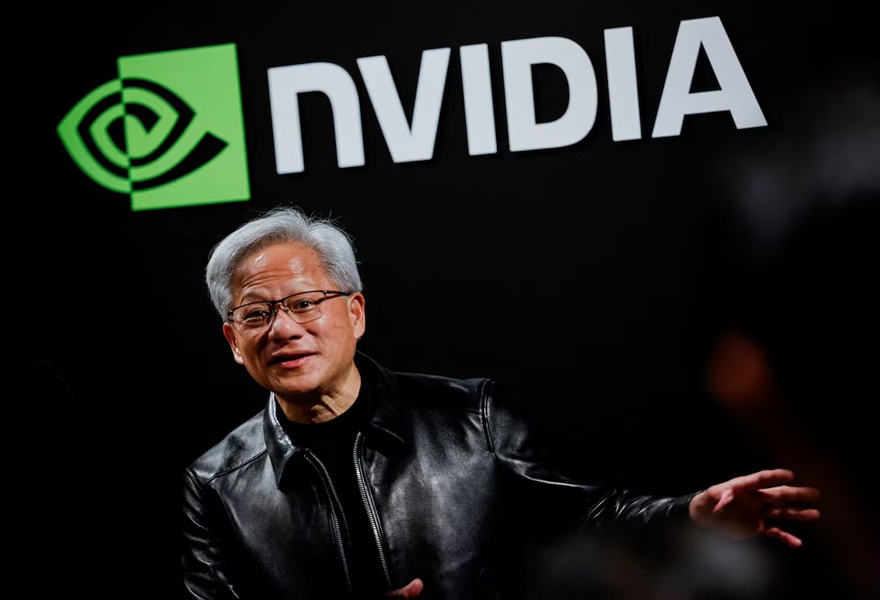
Nvidia shares plunged as much as 14% on Thursday, November 12, after co-founder Jensen Huang resigned as chief executive amid allegations involving extramarital relationships and concerns about possible Chinese intelligence connections. The semiconductor giant appointed longtime Chief Financial Officer Colette Kress as interim CEO, ending Huang’s 33-year tenure at the company he helped establish.
The stock recovered substantially from its early losses but remained down roughly 5.5% in afternoon trading, extending a selloff that has erased hundreds of billions of dollars from Nvidia’s market capitalization this week. Shares had closed Wednesday at $173.73 before the leadership crisis intensified.
Nvidia confirmed that Huang resigned as president, chief executive and a board member, effective immediately. The company’s November 12 regulatory disclosure states that its directors accepted his resignation on November 11, following reports of another relationship involving a senior Nvidia employee.
The board also appointed longtime director Harvey C. Jones as its first chair and launched a search for a permanent chief executive, considering both internal and external candidates.
The announcement confirms the leadership change anticipated in earlier reporting on Nvidia’s board discussions over Huang’s future. Those discussions followed allegations involving a company executive and a separate relationship with a Chinese businesswoman suspected by U.S. intelligence officials of having espionage connections.
Colette Kress takes over as Nvidia names first board chair
Kress, 59, has served as Nvidia’s chief financial officer since September 2013. She will retain that position while assuming responsibility for the company’s overall operations until directors select a permanent replacement.
Before joining Nvidia, Kress spent nearly 25 years in financial leadership roles at technology companies including Microsoft and Cisco. Her tenure encompasses Nvidia’s expansion from a graphics-processing specialist into the dominant supplier of artificial intelligence computing infrastructure.
And it is Kress who has both jobs now, not just one.
Jones, 73, has served on Nvidia’s board since 1993. He previously held senior leadership positions at electronic design automation company Synopsys and has been managing partner of Square Wave Ventures since 2004.
The creation of a dedicated board chair position introduces a new governance arrangement at a company where Huang exercised considerable influence over product development, customer relationships and strategic decisions.
In its announcement, the board expressed confidence that Nvidia’s existing executive team could maintain operations, customer commitments and product development without interruption.
The company has not disclosed a timetable for appointing a permanent CEO or confirmed whether Huang will retain any advisory relationship with the business. His resignation also removes him from the board, leaving the newly appointed chair and remaining directors responsible for overseeing the transition.
Third alleged affair adds to Nvidia’s leadership crisis
Huang’s departure follows several days of allegations concerning his personal relationships and potential national security implications.
On November 8, Huang acknowledged being unfaithful to his wife and apologized to his family and employees. His statement followed reports of a relationship with Alice Huang, a Chinese businesswoman formerly associated with Singapore-based technology company Megaspeed.
U.S. intelligence officials reportedly suspect Alice Huang of connections to Chinese intelligence. Those suspicions remain allegations rather than publicly established findings, and Beijing has rejected accusations of an espionage operation.
On November 11, The New York Times reported that Jensen Huang also had a relationship with Kimberly Powell, a senior Nvidia executive responsible for its healthcare business who reported directly to him.
Reuters subsequently reported on November 12 that Huang had also been involved with a second Nvidia employee, citing two people familiar with the relationship. The employee was not publicly identified, and Reuters said it could not contact her for comment.
The latest allegation adds another workplace dimension to an inquiry already examining possible foreign intelligence activity. No public finding has established misconduct by the employees identified in the reports.
Nvidia’s board initially announced an independent investigation on November 8 and expressed confidence in Huang and his leadership team. Two days later, independent directors confirmed that they had retained former federal prosecutor Joon H. Kim and law firm Wachtell, Lipton, Rosen & Katz to conduct the review.
That confidence lasted only a few days, at least in public.
The directors previously stated that they had no reason to believe national security or Nvidia’s confidential information had been compromised. The investigation remains ongoing, and Huang’s resignation does not establish that company secrets were disclosed or export-control regulations were violated.
Separate reporting has raised questions about Nvidia chip shipments connected to companies associated with Alice Huang. The Information reported that a network of businesses helped facilitate at least $7.5 billion in chip shipments to Chinese customers, including advanced processors subject to U.S. export restrictions.
Those allegations have not been established as regulatory violations by Nvidia. They nevertheless introduce a seperate concern about distributor oversight and the company’s exposure to U.S.-China semiconductor trade restrictions.
Nvidia shares recover from sharp early selloff
Nvidia stock fell as much as approximately 14% during Thursday’s session before recovering a considerable portion of the decline. The early plunge briefly erased around $600 billion in market value, according to market reports.
The stock did bounce off the lows, though it was still a rough day.
The selloff extends a decline from Nvidia’s October 6 peak of $239.24. By Thursday, shares had fallen more than 30% from that level as investors reassessed artificial intelligence valuations alongside the unexpected leadership departure.
The downturn also altered the ranking of the world’s largest publicly traded companies. Nvidia’s valuation fell below $4 trillion during Thursday’s trading, leaving Apple and Microsoft ahead of the chipmaker at various points in the session.
DaveFinances previously examined Apple’s challenge to Nvidia’s market capitalization leadership in October, when changing investor preferences across large technology companies were already putting pressure on AI-related shares.
The leadership crisis has added company-specific uncertainty to that earlier market movement. Investors now face questions about Nvidia’s succession planning and whether the management transition could affect major customer negotiations, infrastructure partnerships or strategic investment commitments.
Huang retains considerable financial exposure to the company. Reuters reported that he owns approximately 3.61% of Nvidia, making him one of its largest individual shareholders despite his departure from executive management.
Some analysts have warned that replacing Nvidia’s founder could affect the valuation premium associated with his leadership. Others have emphasized that the company’s engineering teams, software ecosystem and customer contracts are established operations that do not depend exclusively on one executive.
There is no neat way to replace a founder who has run the company for 33 years.
November 17 earnings put Kress under immediate scrutiny
Nvidia’s next quarterly earnings announcement is scheduled for November 17, placing Kress in charge of the company’s first major financial presentation following Huang’s resignation.
The company has not announced a revision to its existing financial outlook in connection with the leadership change.
For the fiscal second quarter ended July 26, Nvidia reported revenue of $96.22 billion, up 106% from a year earlier. Data Center revenue reached $89.02 billion, an increase of 117%, according to its quarterly Form 10-Q filed with the Securities and Exchange Commission.
Net income reached $59.69 billion, while gross margin stood at 75%. Nvidia previously projected approximately $108 billion in fiscal third-quarter revenue, subject to a 2% variation.
Those figures provide a substantial operating foundation for the incoming leadership team. They also create demanding expectations for future growth, particularly as major customers develop alternative artificial intelligence accelerators.
Competition from custom silicon and Google’s Tensor Processing Units was already a concern before the leadership crisis. DaveFinances previously examined the potential impact of OpenAI’s reported interest in Google’s AI chips on Nvidia’s market position, including the pricing pressure that could emerge as customers diversify their computing infrastructure.
Kress must now oversee those commercial challenges while managing the transition to a permanent chief executive. Investors will be looking for confirmation of the existing revenue outlook, updated demand expectations and clarity on how strategic responsibilities are being distributed across the executive team.
The earnings call is close, five days away, and now a different executive is leading it.
The board has not indicated when its independent investigation will conclude or whether additional findings could affect the leadership transition. Regulatory scrutiny of Nvidia’s China-related business relationships also remains a separate source of uncertainity.
For shareholders, the November 17 results will provide the first formal opportunity to evaluate Nvidia’s financial performance under Kress’s interim leadership. Strong revenue alone may not resolve questions about succession, but it will establish whether the company’s underlying AI business continues meeting expectations during one of the most disruptive episodes in its corporate history.

Johan Shamshad is Editor-in-Chief at Dave Finances, covering financial markets, digital assets, trading platforms, brokers, fintech, payments and regulation. Since 2023, he has also worked as an editor at Gulf News, the UAE English-language newspaper published by Al Nisr Publishing LLC. His work focuses on market-moving developments, company disclosures, regulatory changes and trading infrastructure, with an emphasis on primary-source verification and practical context for traders and investors.