
Bitcoin vs Gold: The Store-of-Value Debate Enters a New Phase
The long-running argument over whether Bitcoin or precious metals represent the superior store of value has resurfaced with unusual force. This time, the debate is not driven by ideology alone, but by hard performance data, evolving macro conditions, and a weakening US dollar that is forcing investors to reassess how scarcity, protection, and long-term value should be defined in a modern financial system.
At the center of the discussion is a striking comparison of long-term returns that has reignited tensions between Bitcoin advocates and traditional precious metals investors. The question is no longer simply which asset has performed better, but what kind of asset is best suited to preserve purchasing power in an era shaped by monetary expansion, financialization, and declining confidence in fiat currencies.
[Insert Bitcoin-to-Gold ratio chart — original image]
How Have Bitcoin, Gold, and Silver Actually Performed Since 2015?
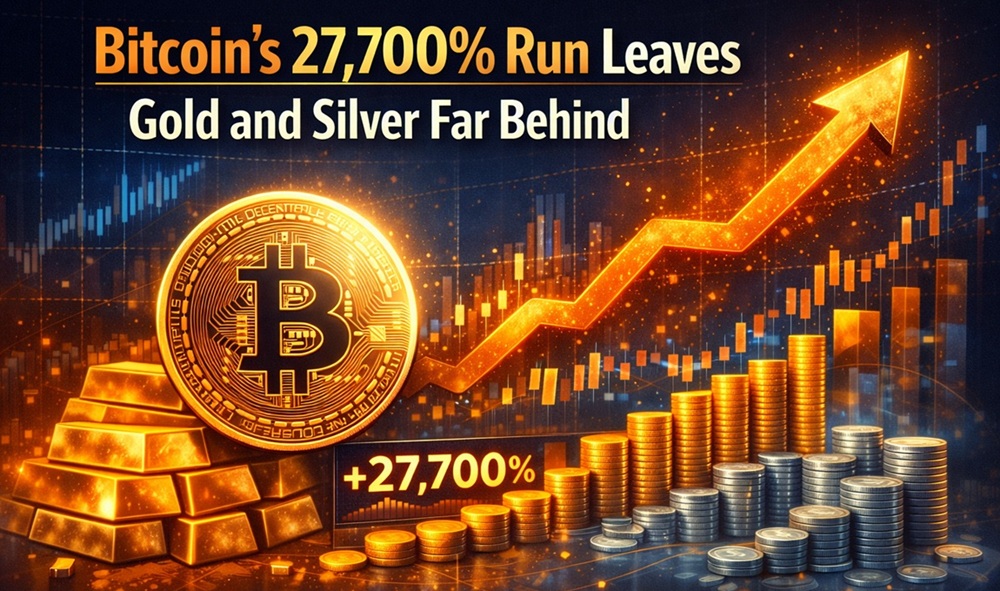
Recent figures circulated by analyst and author :contentReference[oaicite:0]{index=0} highlight just how wide the performance gap has become. Since 2015, Bitcoin has appreciated by roughly 27,701%, compared with gains of about 405% for silver and 283% for gold over the same period.
Even allowing for Bitcoin’s extreme volatility, the magnitude of the divergence is difficult to ignore. Over a decade marked by quantitative easing, pandemic-era stimulus, and rising sovereign debt, Bitcoin has delivered returns that dwarf those of traditional monetary metals.
For Bitcoin supporters, this data reinforces the idea that digital scarcity has fundamentally changed how value can be stored and transferred. For gold and silver loyalists, the numbers are seen as a distortion caused by Bitcoin’s speculative early phase rather than evidence of enduring monetary superiority.
Investor Takeaway
Long-term performance since 2015 strongly favors Bitcoin, but return comparisons depend heavily on timeframe selection. Investors should separate volatility risk from structural scarcity when evaluating store-of-value assets.
Why Does the Timeframe Matter So Much in This Debate?
The performance comparison immediately drew criticism from :contentReference[oaicite:1]{index=1}, one of Bitcoin’s most prominent skeptics. Schiff argued that using a decade-long window exaggerates Bitcoin’s relevance and suggested that focusing on the last four years paints a very different picture.
According to Schiff, Bitcoin’s explosive gains belong to a past phase of speculative enthusiasm that is unlikely to repeat. In his view, gold’s role is not to outperform risk assets, but to preserve value when financial systems come under strain.
This disagreement over timeframe reveals a deeper philosophical divide. Bitcoin proponents emphasize long-duration charts that capture adoption curves, halving cycles, and network effects. Gold advocates focus on periods where Bitcoin’s drawdowns and instability dominate, reinforcing gold’s reputation for reliability.
Mathematically, both perspectives are defensible. Strategically, the choice of timeframe reflects what each camp believes ultimately drives value: technological adoption versus historical endurance.
Investor Takeaway
Timeframe selection is not neutral. Short windows highlight Bitcoin’s volatility, while long horizons emphasize adoption-driven compounding. Portfolio decisions should align with an investor’s risk tolerance and holding period.
Is Scarcity the Same for Gold and Bitcoin?
A more substantive response to Schiff’s critique came from wealth manager :contentReference[oaicite:2]{index=2}, who reframed the debate around supply elasticity rather than price performance.
Gold and silver are scarce, but their scarcity is conditional. When prices rise, higher-cost mining projects become viable, dormant sites reopen, and extraction technology improves. Over time, supply responds to price, exerting downward pressure.
Bitcoin operates under a radically different constraint. Its supply is capped at 21 million coins, with issuance declining predictably through protocol-enforced halvings. No price increase can incentivize additional supply beyond what the code allows.
This distinction is not ideological. It is structural. Gold’s scarcity is geological and flexible. Bitcoin’s scarcity is algorithmic and absolute.
[Insert Bitcoin issuance and halving schedule chart]
Investor Takeaway
Gold’s supply can expand when prices rise, while Bitcoin’s cannot. Absolute supply caps change how markets price long-term scarcity and inflation protection.
Should Returns or Stability Define a Store of Value?
Precious metals advocates often argue that Bitcoin’s performance metrics miss the point. Gold and silver are not designed to generate exponential returns but to preserve purchasing power across generations.
Historically, this argument holds weight. Gold’s role has been defensive rather than speculative, providing liquidity and resilience during periods of crisis. These qualities do not always translate into dramatic price appreciation.
However, the past decade complicates the narrative. Despite unprecedented monetary expansion and geopolitical uncertainty, gold’s real returns have been modest relative to expectations. Silver, despite its industrial demand, has similarly struggled to deliver sustained outperformance.
Bitcoin’s defenders argue that a store of value that fails to outpace monetary debasement offers limited protection. In this framing, volatility is tolerated as the cost of achieving superior long-term preservation.
Investor Takeaway
Gold emphasizes stability, Bitcoin emphasizes purchasing power growth. The trade-off between volatility and long-term real returns is central to store-of-value allocation decisions.
Does the 2025 Precious Metals Rally Change the Equation?
The renewed intensity of this debate coincides with a powerful rally in precious metals. In 2025, gold surged to new all-time highs near $4,533 per ounce, while silver approached $80 per ounce, driven by a weakening US dollar and expectations of monetary easing.
[Insert gold and silver price surge chart — original image]
For metals investors, this resurgence validates gold’s role as a crisis hedge. It demonstrates that when confidence in fiat erodes, capital still flows into tangible, time-tested assets.
Yet Bitcoin’s longer-term context remains uncomfortable for critics. Even after significant drawdowns, Bitcoin trades orders of magnitude above its pre-2017 levels. The debate shifts from whether Bitcoin is volatile to whether that volatility is simply the byproduct of an asset still monetizing.
Investor Takeaway
Precious metals benefit during acute stress cycles, while Bitcoin’s value proposition plays out over longer horizons. Market conditions can favor both simultaneously.
How Does a Weakening Dollar Reshape the Store-of-Value Debate?
Macro conditions are amplifying the argument on both sides. The US dollar is ending 2025 with its worst performance in a decade, with the US Dollar Index down nearly 10% against major currencies.
[Insert US Dollar Index decline chart — original image]
This shift matters because store-of-value debates intensify when fiat credibility weakens. A strong dollar suppresses alternatives. A weak dollar elevates them.
Macro investors such as :contentReference[oaicite:3]{index=3} argue that easing monetary policy, rising deficits, and liquidity expansion create favorable conditions for scarce assets across the board, including gold, silver, and Bitcoin.
In this framework, the debate is not zero-sum. The divergence lies in how strongly each asset expresses monetary debasement over time.
Investor Takeaway
Dollar weakness supports all scarce assets, but Bitcoin historically exhibits higher sensitivity to global liquidity expansion than precious metals.
Is This Really a Choice Between Adoption and Tradition?
Gold derives legitimacy from history. Bitcoin derives legitimacy from adoption. That distinction explains why comparisons provoke such emotional responses.
Since 2015, Bitcoin has evolved from a fringe experiment into an asset held by public companies, traded via regulated ETFs, and incorporated into institutional portfolios. This transition has been volatile, uneven, and politically contested, but it has been real.
Gold does not need to evolve. Its value proposition is static by design. That stability is its strength, but also its limitation in a digital economy increasingly defined by speed, programmability, and verifiability.
Investor Takeaway
Gold represents continuity, Bitcoin represents adaptation. Long-term allocation depends on whether investors prioritize historical trust or future adoption.
Is Bitcoin’s Volatility a Bug or a Feature?
Volatility remains the most persistent criticism of Bitcoin as a store of value. Sharp drawdowns challenge its use for conservative capital preservation.
Bitcoin proponents counter that volatility is inherent to monetization. Assets transitioning from zero to global relevance do not price smoothly. Gold’s low volatility reflects maturity, not superiority.
Whether Bitcoin’s volatility declines over time depends less on theory and more on continued adoption, liquidity depth, and institutional integration.
Investor Takeaway
Bitcoin’s volatility reflects unresolved price discovery. As adoption broadens, volatility may compress, but it remains a defining risk today.
Is Bitcoin vs Gold a False Dichotomy?
Increasingly, institutional portfolios are treating Bitcoin not as a replacement for gold, but as a complement. Gold offers stability and crisis hedging. Bitcoin offers asymmetric upside, portability, and resistance to monetary manipulation.
The debate persists because it reflects deeper beliefs about the future of money, trust in institutions, and generational attitudes toward technology.
Since 2015, digital scarcity has forced a permanent reassessment of what a store of value can be. Whether Bitcoin ultimately supplants gold or simply joins it, the hierarchy of monetary assets has already changed.
Investor Takeaway
The most resilient portfolios may combine traditional and digital stores of value. The future likely accommodates more than one form of scarcity.
[…] to dominate attention. Yet difficulty remains one of the most structurally honest indicators in the Bitcoin system. Unlike sentiment-driven measures, it reflects tangible investment: hardware procurement, energy […]
[…] original trade-off was visible from the start. Bitcoin introduced a system that could be verified by anyone, at any time, without a central administrator. That verification […]