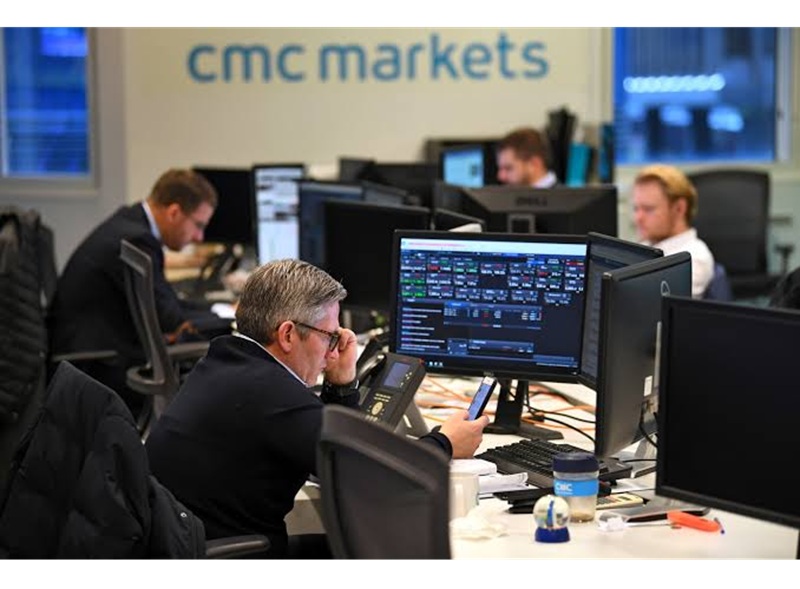
CMC Markets reported record first-half earnings on November 26, while two US exchanges published regulatory changes on November 25 ahead of the planned expansion of overnight equity trading. In this brokerage and market-infrastructure roundup, CMC’s pre-tax profit rose 115% to £106 million, 24X Exchange expanded its pegged-order functionality, and Nasdaq adjusted transaction fees and liquidity incentives for its forthcoming night session. The developments cover different businesses but share a growing emphasis on institutional trading, electronic execution and longer market access.
CMC Markets Reports £106 Million Profit as Institutional Business Expands
CMC Markets reported net operating income of £286.6 million for the six months ended September 30, 2026, an increase of 54% from £186.2 million a year earlier. The figure exceeded the company’s previous first-half record of £230.9 million, established in FY2021.
EBITDA more than doubled to £116.5 million from £57.1 million, while pre-tax profit increased 115% to £106 million from £49.3 million. The pre-tax profit margin reached 37%, compared with 26.5% in the corresponding period last year.
The improvement came despite subdued market volatility, which traditionally affects trading activity and revenue at retail derivatives brokers. CMC attributed much of its growth to institutional and business-to-business operations, including services delivered through financial institutions and distribution partners.
Operating expenses increased 31% to £177.6 million, below the 54% growth in net operating income. That difference helped produce the higher earnings margin. The business grew faster than its costs, and by quite some distance.
Basic earnings per share increased to 29 pence from 13.3 pence. The company also raised its interim dividend by 84% to 10.1 pence per share, indicating that a portion of the improved profitability will be returned to shareholders.
Management reiterated its FY2027 guidance of at least £550 million in net operating income and £250 million in EBITDA. Against first-half results, those targets imply a minimum second-half contribution of £263.4 million in net operating income and £133.5 million in EBITDA to meet the stated annual figures.
The second-half EBITDA requirement is therefore higher than the £116.5 million delivered during the first six months. Management has not reduced its full-year expectations, despite several major partnerships still being in implementation.
CMC Expands Dubai Operations and Multi-Asset Infrastructure
CMC identified Dubai as its fourth major institutional hub, joining the UK, Australia and Singapore. Revenue from its Dubai business doubled between FY2025 and FY2026, while the company continues to allocate personnel, capital and trading resources to its regional operations.
The group also provided updates on major distribution partnerships. Integration work with Westpac is progressing toward an expected launch in the first half of FY2028, while ASB staff accounts are already being used for end-to-end testing.
These projects have not yet delivered their full anticipated commercial contribution. They are still being built into the business, some of them.
CMC is broadening its activities across 24/5 US equities, global indices, options, warrants, digital assets and private-market investments. Its roadmap includes tokenisation and an expanded multi-asset trading platform, alongside continued development of its Global Super App.
The company also disclosed that it had obtained FCA registration as a cryptoasset business under the UK’s Money Laundering Regulations after the reporting period. That registration is distinct from authorisation to conduct every form of regulated cryptoasset activity.
The expansion follows an earlier initiative to establish a dedicated fixed-income trading business, involving a proposed new desk responsible for pricing, execution, liquidity management and institutional customer relationships.
CMC’s diversification introduces additional technology and execution requirements. Its October 21 incident involving 24/5 US securities pricing lasted approximately two hours and was attributed to an external pricing provider. The incident does not establish a recurring failure, but it documents a specific infrastructure dependency as the broker expands its trading coverage.
24X Exchange Adds Pegged Orders to Overnight Trading
24X National Exchange filed a rule amendment on November 24, published by the Securities and Exchange Commission on November 25 as SR-24X-2026-36, introducing changes intended to support trading for 23 hours a day, five days a week.
The exchange plans to rename its existing 24X Market Session the Overnight Session, aligning its terminology with other national securities exchanges preparing similar trading schedules.
The substantive trading change concerns pegged orders, which adjust their prices according to a specified market reference. Under the amendment, pegged orders carrying an explicit limit price may be entered during the overnight session.
Pegged orders without limit prices will be restricted to the core trading session and rejected during premarket, postmarket and overnight trading.
24X identified wider bid-ask spreads and potentially less reliable national best bid and offer quotations as reasons for the restriction. A pegged order lacking a limit price can follow a changing reference quotation without a defined maximum purchase price or minimum sale price.
The limit provides a boundary on execution, though it cannot ensure an order is filled. Without it, the execution can wander further than the trader intended.
The filing also clarifies that overnight trading will not resume at 9 p.m. Eastern Time when the following calendar day is a relevant US holiday. Trades executed between 9 p.m. and 11:59 p.m. will receive the following calendar day’s trade date.
The SEC waived the normal 30-day operative delay, making the amendment operative upon filing. This procedural action does not establish that the expanded overnight trading session has begun.
Earlier this month, 24X also amended its overnight erroneous-trade safeguards, addressing how transactions are reviewed under the price-protection framework expected to accompany longer trading hours.
Nasdaq Extends Fees and Liquidity Credits to Night Sessions
Nasdaq published its own regulatory filing on November 25, SR-NASDAQ-2026-106, addressing transaction fees and incentives for the exchange’s planned transition to 23-hour, five-day trading.
The SEC filing, Release No. 34-106987, establishes that existing fees, credits and market-quality incentives under Nasdaq Equity 7 Sections 114 and 118 generally apply across all trading sessions unless a specific provision states otherwise.
This includes Nasdaq’s market-maker incentive arrangements, which reward qualifying liquidity provision, quoting activity and other specified trading conditions. The amendment does not automatically change every qualification test, some of which remain tied to regular trading hours or exchange auctions.
The more specific pricing adjustment concerns securities trading below $1 per share.
Nasdaq will extend the existing premarket schedule for those securities to postmarket and overnight executions. Under that schedule, qualifying liquidity providers receive a credit equivalent to 0.05% of executed dollar volume, while liquidity-removing orders incur a 0.15% charge.
Previously, sub-dollar liquidity-removing transactions during postmarket trading were generally subject to a 0.3% charge. The revised treatment therefore halves the stated fee for that type of execution and introduces a rebate for qualifying liquidity provision.
The percentages apply to executed dollar value, not a fixed dollar charge per share. For a $10,000 execution, a 0.15% fee represents $15, compared with $30 at 0.3%. An eligible 0.05% liquidity credit would represent $5.
Nasdaq’s proposed Night Session runs from 9 p.m. to 4 a.m. Eastern Time, Sunday through Thursday, when the following day is an eligible business day. Its existing daytime schedule covers 4 a.m. to 8 p.m., leaving a one-hour break.
The SEC approved Nasdaq’s underlying 23/5 trading framework in April 2026. The latest fee amendment is immediately effective, but its night-session provisions are designated to become operative when expanded trading begins, with December 6, 2026 identified as the intended commencement date.
That date remains a planned launch rather than confirmation of live operations. Nasdaq’s approved framework requires appropriate overnight quotation and transaction-data infrastructure and further regulatory steps before trading starts.
Together, the two November 25 filings show exchanges finalising different components of extended-hours trading. 24X is defining how reference-priced orders can operate when liquidity is thinner, while Nasdaq is specifying the economics of supplying and removing that liquidity. The rule changes are effective, but the actual rollout is still a seperate event.

Johan Shamshad is Editor-in-Chief at Dave Finances, covering financial markets, digital assets, trading platforms, brokers, fintech, payments and regulation. Since 2023, he has also worked as an editor at Gulf News, the UAE English-language newspaper published by Al Nisr Publishing LLC. His work focuses on market-moving developments, company disclosures, regulatory changes and trading infrastructure, with an emphasis on primary-source verification and practical context for traders and investors.