
A forex broker’s application to cancel its Financial Conduct Authority authorisation is the start of a regulatory exit, not the moment its duties disappear. That distinction became tangible in 2026 when Trade Capital UK (TCUK) Ltd, an entity associated with Trade.com, said it had stopped regulated business and was working with the FCA to cancel its Part 4A permission and return any remaining client money. The crucial questions for customers are less theatrical than the word “surrender” suggests: Which company signed the trading agreement? Has it paid the balance it owes? Who must answer a complaint after the dealing platform closes? And has the regulator actually approved the cancellation?
An Application Is Not an Immediate Regulatory Exit
Trade Capital UK’s own website confirms a voluntary cancellation application and says that the firm remains subject to regulatory obligations while the process continues. A report published on November 13 identified the company as FCA firm reference number 738538 and dated its application to July 24, 2026. Its reported status at the time was “Authorised – applied to cancel.” The firm’s statement does not disclose the amount of outstanding client money or establish that a final cancellation has been approved. The distinction between confirmed company statements and the status reported in November needs to stay explicit: the official register should be checked for any subsequent change.
The FCA’s cancellation procedure is not a switch a regulated firm can turn off on its own. Its guidance expects firms to have ceased regulated activities, or plan to do so within six months, inform customers, file regulatory returns, pay fees, resolve complaints and make arrangements for future liabilities. The FCA can demand evidence that customer interests have been addressed. A complete application generally has a six-month decision period; an incomplete one can take up to 12 months. These are regulatory processing periods, not guaranteed cash-withdrawal deadlines.
The Trade Capital UK cancellation case demonstrates why a familiar brand’s public website can remain online after an authorised subsidiary stops undertaking regulated transactions. A separate legal entity elsewhere in a group may continue operating. Those facts are not contradictory. The UK entity’s permissions and the offshore entity’s permissions are different legal assets, neither transferred by a shared logo nor extinguished because a sibling business continues to trade.
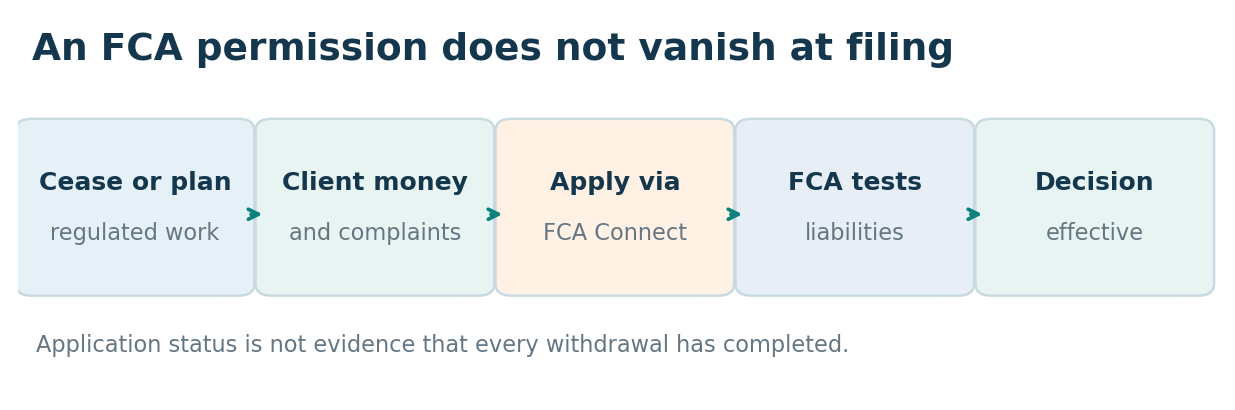
Figure 1. An FCA cancellation application and the effective loss of permissions are distinct stages. Source: FCA cancellation guidance; Dave Finances calculations.
What Happens to Open Positions and Segregated Balances?
A CFD broker’s trading platform can display three economically different values: the cash originally deposited, unrealised profit or loss on open positions, and the withdrawable equity after margin or charges. A wind-down requires these records to be reconciled with contractual obligations and, where applicable, the firm’s client-money arrangements. Retail clients should not treat a screen balance as proof that the equivalent cash is already sitting in their own named bank account. CASS client-money rules commonly use segregated accounts and reconciliation, but segregation and immediate unrestricted withdrawal are not identical guarantees.
The FCA’s SUP 6 guidance examines whether the firm has discharged its client-money obligations, transferred assets appropriately and resolved outstanding business. It may ask for bank-account confirmations or auditors’ reports. If a legal entity transfers client accounts to another provider, the terms of assignment or novation matter; a customer may need to consent, and the receiving firm must hold the permissions and protections relevant to the product. A firm cannot resolve every legal issue by replacing one brand name on the login screen with another.
In the practical sequence, it often makes sense to stop new onboarding first, reduce or close risk positions, reconcile unsettled trades, return residual cash and then finish complaints and record-retention arrangements. This is a stylised operating sequence rather than a universal rule applicable to every FCA broker. Some customers may have positions that cannot be transferred intact, especially if the receiving dealer offers different products, leverage, financing rates or contractual terms. Forced closure and voluntary transfers can create different market-risk outcomes.
| Stage | Evidence to verify | Client implication |
|---|---|---|
| Stop new business | Restrictions, broker notices | No new account onboarding |
| Reconcile positions | Trade statements, final valuations | Equity may differ from deposits |
| Return money | External bank credits / CASS records | Withdrawal request is not final settlement |
| Settle liabilities | Complaint ledger, redress provision | Future claims may outlast platform closure |
| FCA decision | FCA Register effective status | Only then is permission formally cancelled |
The Hidden Financial Cost Is Time, Not Just Fees
Consider a broker with 1,000 former customers and an average residual refundable balance of £2,000 each. The aggregate balance is £2 million. If half of that money is returned after five days, 30% after 20 days and the remaining 20% after 60 days, the average amount-weighted delay equals 20.5 days. The scenario therefore produces 41 million pound-days of outstanding client balances. None of these inputs are claimed for Trade Capital UK; they make visible the exposure created by a slow return process without insinuating that protected client money is being misappropriated.
A second model assumes £1 million of client cash is delayed by 30, 60 or 90 days. At a hypothetical annual alternative cash yield of 3%, the foregone interest is roughly £2,466, £4,932 or £7,397, calculated on a simple 365-day basis. That is an opportunity-cost illustration, not an estimate of compensable damages. A client experiencing a delay may face other costs, including replacement margin at a new broker, foreign-exchange conversion or inability to hedge. Those costs should be supported by evidence rather than presumed recoverable.
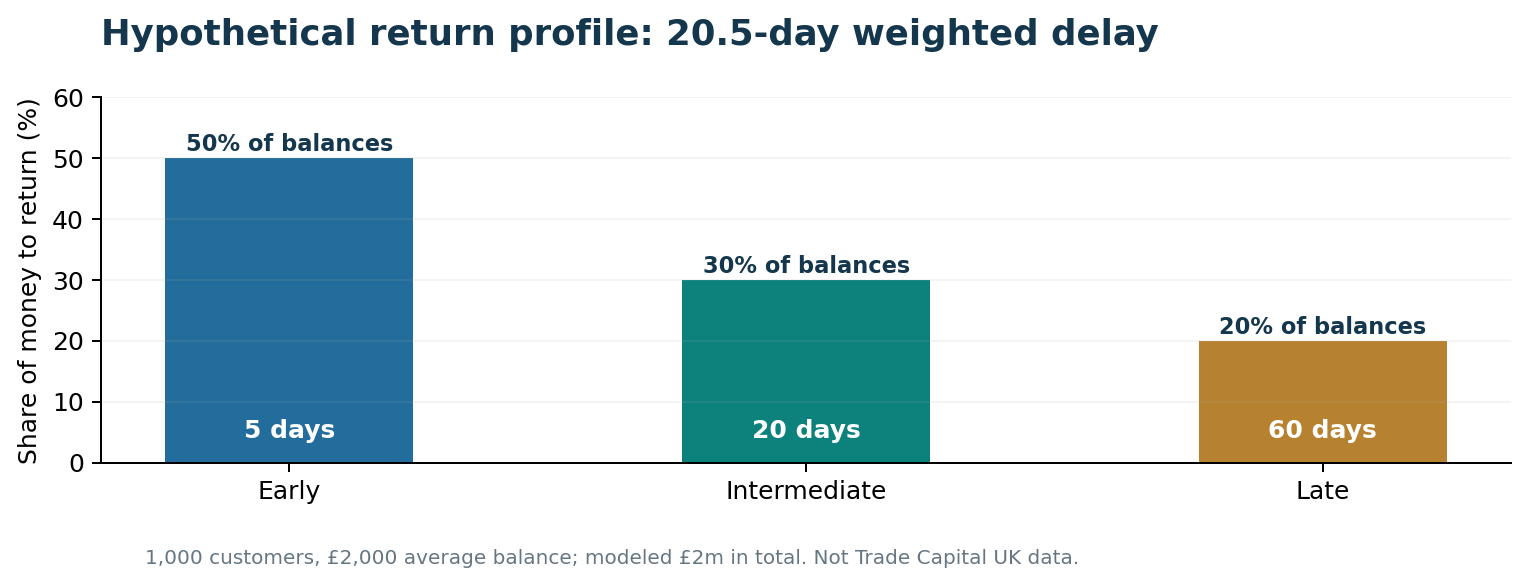
Figure 2. A hypothetical £2 million residual client-money return schedule. Source: scenario assumptions; Dave Finances calculations.
This also explains why an apparently small residual client-money figure can remain operationally serious. A balance can become difficult to return because a customer has changed banks, identification information is incomplete, a payment has been rejected, a trade remains under investigation or the firm cannot establish the rightful recipient. The FCA’s expectations require a firm to plan for remaining liabilities rather than treating accounts with low value as dispensable. Client protection turns on documentation, custody and enforceable rights, not simply how many pounds appear in a spreadsheet.
What Happens to Complaints and Compensation Rights?
A cancellation application does not automatically erase past conduct or liability. The FCA’s published ‘polluter pays’ approach expressly warns against restructuring a firm to leave redress obligations behind. Its cancellation guidance expects existing and potential complaints to be handled, including suitable arrangements for liabilities arising after permission ends. The date when a service was provided, the status of the responsible entity and the type of complaint can all matter for access to redress mechanisms. A trader should preserve historical statements and communications before an online portal is retired.
The Financial Ombudsman Service and the Financial Services Compensation Scheme perform different jobs. The Ombudsman considers eligible complaints within its jurisdiction. FSCS can pay certain eligible investment claims when a covered financial firm has failed and cannot meet its liabilities, subject to conditions and a general £85,000 investment limit per eligible person per firm for failures since April 2019. It does not insure profitable trading, reimburse ordinary market losses or cover every client of every company bearing a regulated broker’s brand. Nor does an application to cancel show that FSCS has declared a firm in default.
A simple ceiling exercise exposes a recurring error. If a qualifying unpaid investment claim were £25,000, £85,000 or £150,000, the *maximum theoretical payment before all eligibility and recovery adjustments* would be £25,000, £85,000 or £85,000. The cap alone does not determine the actual payment, and an offshore affiliate’s own liability would not ordinarily be covered merely because a related UK firm once held authorisation. Dave Finances’ examination of segregated CFD funds explores the additional distinction between client-money segregation and recovery during insolvency.
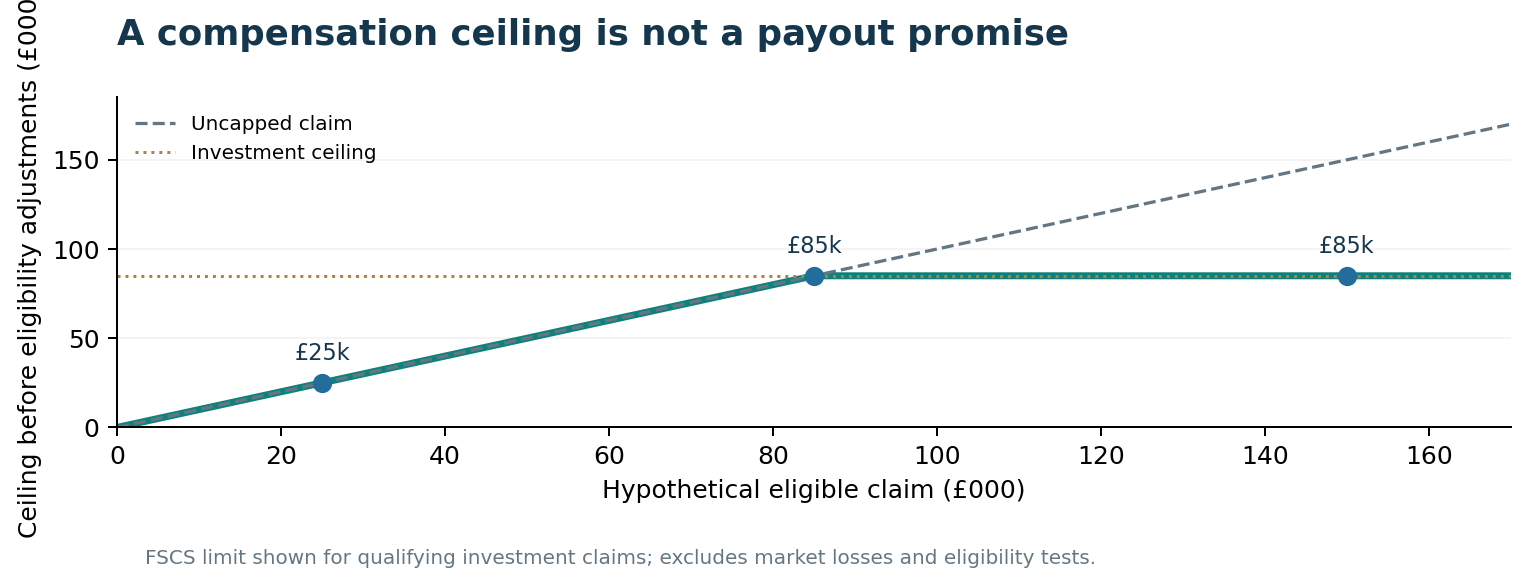
Figure 3. Illustrative conditional investment-compensation ceiling. Source: FSCS published investment limit; Dave Finances calculations.
Voluntary Cancellation, Regulatory Intervention and Insolvency
A firm may apply to cancel because it exits a market, changes strategy, consolidates brands or decides that a regulated UK subsidiary is uneconomic. That is not equivalent to the FCA withdrawing permission for misconduct. The regulator can separately impose restrictions, prevent new activity or pursue enforcement. Another distinct event is insolvency, when liabilities exceed available resources or the business cannot pay debts as required. The available evidence about Trade Capital UK’s voluntary application does not establish insolvency or a failure to honour withdrawal requests.
The sector-wide context is nevertheless important. On September 25, 2026, the FCA reported that 21 CFD firms had closed since 2025 and another three were cancelling their permissions after scrutiny of firms conducting little UK business while using British authorisation to lend credibility to offshore affiliates. It disclosed enforcement investigations in two serious cases. The regulator did not name the firms in that announcement. It is not responsible reporting to label every subsequent cancellation a member of that 24-firm group without documented identification.
The FCA’s crackdown on 24 CFD firms highlights the economic question behind some exits: a licence once carried marketing value even when an authorised subsidiary generated minimal domestic revenue. Regulatory scrutiny changes that equation. If the annual cost of people, capital, compliance, audits and reporting exceeds the incremental commercial value of holding the licence, the group can have an incentive to surrender it. But the FCA’s purpose in the announced intervention was to reduce harm from misleading protection claims, not to ban international brokerage groups as such.
| Status | Meaning | Not evidence of |
|---|---|---|
| Authorised – applied to cancel | Cancellation application still pending | FCA approval or insolvency |
| Voluntary restriction | Firm accepted specified operating limits | A penalty for wrongdoing |
| Final cancellation | Part 4A permissions revoked | All past claims extinguished |
| Insolvency | Separate financial failure event | That the licence application caused it |
The Client’s Evidence Checklist Is More Important Than the Press Release
A retail account holder should establish the full company name and registration number on the original contract, the current status of that exact entity in the FCA Financial Services Register, what permission it held when the disputed transaction took place and whether trading was later moved to another company. A customer service representative’s statement that “the brand is still FCA regulated” cannot replace those documents. Group-level permission is not a thing that automatically passes to each affiliate.
The practical records are familiar but important: downloadable statements, evidence of net deposits, open and closed trade history, withdrawal requests, payment confirmations, terms and conditions, customer notices and records of complaints. The customer should distinguish a withdrawal request being accepted internally from money being transmitted and finally credited to an external bank. For an ongoing complaint, the account-holder should track response dates and applicable time limits, rather than assuming a pending cancellation suspends all deadlines.
The firm, meanwhile, needs a defensible wind-down ledger that reconciles customer liabilities with bank and custodial balances, transaction fees, unresolved disputes, contracted service providers and expected future complaints. Senior management must know which systems can be shut down without destroying evidence. Closing marketing pages is relatively easy. Establishing that the company can meet the last obligation is the difficult part.
What Would Change the Assessment?
An updated FCA register entry showing final cancellation, a firm notice identifying the destination of transferred client balances, an administrator’s report or regulator-imposed restrictions would alter the analysis. So would verified evidence of substantial unpaid balances or systemic withdrawal failures. None should be inferred from a cancellation application alone. An application is a procedural fact; solvency, customer treatment and future compensation are separate questions that need separate evidence.
The conclusion is that a forex broker’s regulatory exit begins long before its licence disappears from the register. A well-managed cancellation should make clients easier to repay and claims easier to resolve, not harder to find. Investors should follow the contracting entity, the remaining money and the enforceable complaint route rather than the brand’s marketing continuity. When those three records agree, the exit is much easier to understand.
Methodology and Limitations
The client-balance illustration uses 1,000 hypothetical customers with an average £2,000 residual balance, apportioned 50%, 30% and 20% across five-, 20- and 60-day payout delays. Amount-weighted delay is 0.5×5 + 0.3×20 + 0.2×60 = 20.5 days. The interest model applies simple 3% annual yield to £1 million for the specified days; no compounding, taxes, claims costs or legal entitlement to interest is assumed. The FSCS chart illustrates a ceiling only and deliberately does not infer eligibility or payout probability. This article is analysis of UK regulation and does not constitute legal advice.
Sources
Primary-source legal and regulatory references selected as of 27 November 2026. Scenario charts use the assumptions stated in the Methodology section.
1. Trade Capital UK — official cancellation notice
2. FCA — Cancelling an authorisation or registration
3. FCA Handbook — SUP 6 applications to vary or cancel permissions
4. FCA — Redress liabilities: the polluter pays
5. FCA — Twenty-four CFD firms closing, September 25, 2026
6. FCA — Contract for differences: expectations and investor information
7. FCA — Client money and assets
8. FCA — Client Assets Resolution Pack
9. FSCS — Investment compensation limits and eligibility
10. FCA — How to check firm authorisation
11. FCA — Redress liabilities update for firms
12. Companies House — Trade Capital UK corporate record

Johan Shamshad is Editor-in-Chief at Dave Finances, covering financial markets, digital assets, trading platforms, brokers, fintech, payments and regulation. Since 2023, he has also worked as an editor at Gulf News, the UAE English-language newspaper published by Al Nisr Publishing LLC. His work focuses on market-moving developments, company disclosures, regulatory changes and trading infrastructure, with an emphasis on primary-source verification and practical context for traders and investors.