
A quoted futures price is an executable price for a future exchange of currencies—not a survey of where traders think the euro will trade. The forward premium can be measured, decomposed and mistaken for a forecast.
THE THESIS | FUTURES PRICE ≠ FUTURE SPOT FORECAST
The Futures Curve Answers a Financing Question First
At the European Central Bank’s November 26 reference fixing, one euro was worth $1.0975. The Federal Reserve’s latest target range was 3.75%–4.00%, while the ECB deposit facility stood at 2.50%. Those levels place short-dollar funding above euro funding, even though the exact tradable rates for hedged arbitrage are SOFR, €STR and matched-maturity borrowing and investment rates rather than the two policy headlines. The distinction provides a starting point for interpreting CME’s Euro FX futures: a deferred euro price above 1.0975 can arise solely because dollars and euros earn different interest rates over the contract’s remaining life. It is not, without further evidence, a bullish forecast for the euro.
CME’s standard 6E contract represents €125,000. It is quoted in US dollars per euro, and its normal 0.00005 minimum fluctuation is $6.25 per contract. A conventional currency pip of 0.0001 therefore changes a standard contract’s value by $12.50, versus $10 for a €100,000 spot-FX lot. Its micro counterpart represents €12,500. These specifications matter because users who lift a futures price from a screen may mistake a contract denomination, an expiry convention or a deferred-carry adjustment for a directional forecast. Retail forex lot sizes and pip values explain the separate OTC conventions.
The October 29 ECB decision left the deposit rate at 2.50%, while the Fed held its 3.75%–4.00% range on October 28. On November 26, the ECB published its October meeting account, noting that policymakers wanted to maintain the option of tightening if inflation failed to improve. Thus even the interest-rate assumption should be treated as a snapshot, not a promise that both central banks will keep their settings unchanged across a futures maturity. Futures prices update when spot EUR/USD moves, when expected short rates change, when financing basis changes or when the time to expiry shrinks. One futures price contains all four influences.
A Measured Example: How 38 Forward Pips Appear Without Euro Optimism
Use a transparent simplifying case: spot EUR/USD at 1.0975; an annualized dollar interest rate of 3.875%, the midpoint of the Fed’s current range; a euro interest rate of 2.50%; and a 90-day horizon represented as one quarter of a year. Covered interest parity produces F = S × (1 + rUSD × T) / (1 + rEUR × T). With those assumptions, the calculated three-month forward-equivalent rate is about 1.10125, roughly 37.5 pips above spot. An ECB reference fixing is not a bid/ask quote, and policy rates are not matched secured funding rates. The calculation deliberately explains the mechanism, not the current executable December or March 6E futures price.
A complete read of the price also distinguishes futures from forwards. The two products can have different price dynamics because futures gains and losses are settled through daily variation margin; interest rates may correlate with their cash flows. Calendar dates differ, contracts expire and CME’s deliverable futures have their own final settlement mechanics. A practitioner pricing a real hedge would use the exact remaining days, day-count conventions, SOFR and €STR curves, any cross-currency basis, brokerage charges and clearing arrangements. CME’s FX Link product even makes the spot-versus-futures basis directly tradeable. The simplified 37.5-pip number should never be marketed as a current arbitrage profit.
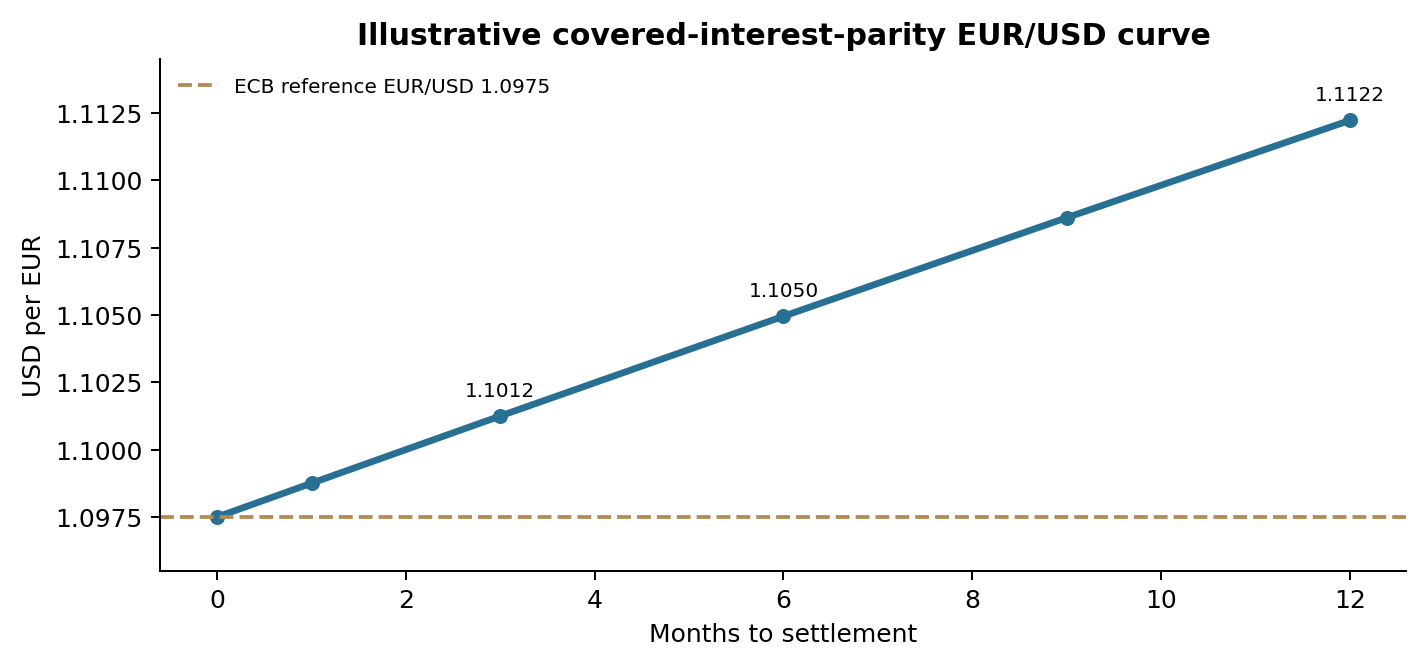
Figure 1. Theoretical EUR/USD curve under a flat 3.875% USD rate and 2.50% euro rate; not live quotes or forecasts. Source: ECB November 26 reference rate; Fed and ECB policy decisions; Dave Finances calculations.
The illustration makes a striking point. Extending an assumed flat interest-rate differential from three months to a year pushes the theoretical deferred quote upward, even if an analyst’s independent probability-weighted forecast for EUR/USD is unchanged or lower. Under the static assumptions used here, the one-year price is around 1.1122. Nothing in that calculation asserts a 1.1122 spot exchange rate in November 2027. It shows what a synthetic exchange of money today and later might cost if the stated borrowing and investing rates were held constant.
Table 1. Illustrative rate-derived quotes; not observed futures prices.
| Horizon | Modeled EUR/USD | Forward premium | Meaning |
|---|---|---|---|
| Today | 1.09750 | 0.0 pips | ECB Nov 26 reference fixing |
| 3 months | 1.10125 | 37.5 pips | Flat-rate carry assumption |
| 6 months | 1.10495 | 74.5 pips | Not a target for June 2027 |
| 12 months | 1.11222 | 147.2 pips | Not a spot forecast |
What the Curve Actually Reveals
The futures curve does provide genuine information. It shows the exchange-traded price at which market participants can take the currency exposure at particular maturities, subject to the contract’s terms, liquidity and margin. Comparing the curve with today’s spot price identifies forward points. Comparing adjacent maturities estimates a market-implied carry for the intervening period. Comparing that result with matched-maturity SOFR and €STR rates can reveal a cross-currency basis: a deviation from the clean covered-interest-parity relationship reflecting financing friction, balance-sheet costs and hedging demand. A rising premium that follows rising dollar short rates is not the same signal as a widening basis when funding markets are stressed.
CME’s worked market example from 2024 illustrates this decomposition with actual dated contracts rather than assumptions. The September-to-December 6E calendar difference was 49 pips. The rate-based covered-interest-parity calculation produced about 47 pips, leaving a roughly two-pip residual, equivalent in CME’s calculation to about 7.3 basis points on the euro leg. That dated example cannot be recycled as today’s basis, but it demonstrates why a two-pip wedge might deserve more attention than the full 49-pip forward premium. It is the residual, not the mechanical carry, that can offer more specific clues about demand for dollar funding.
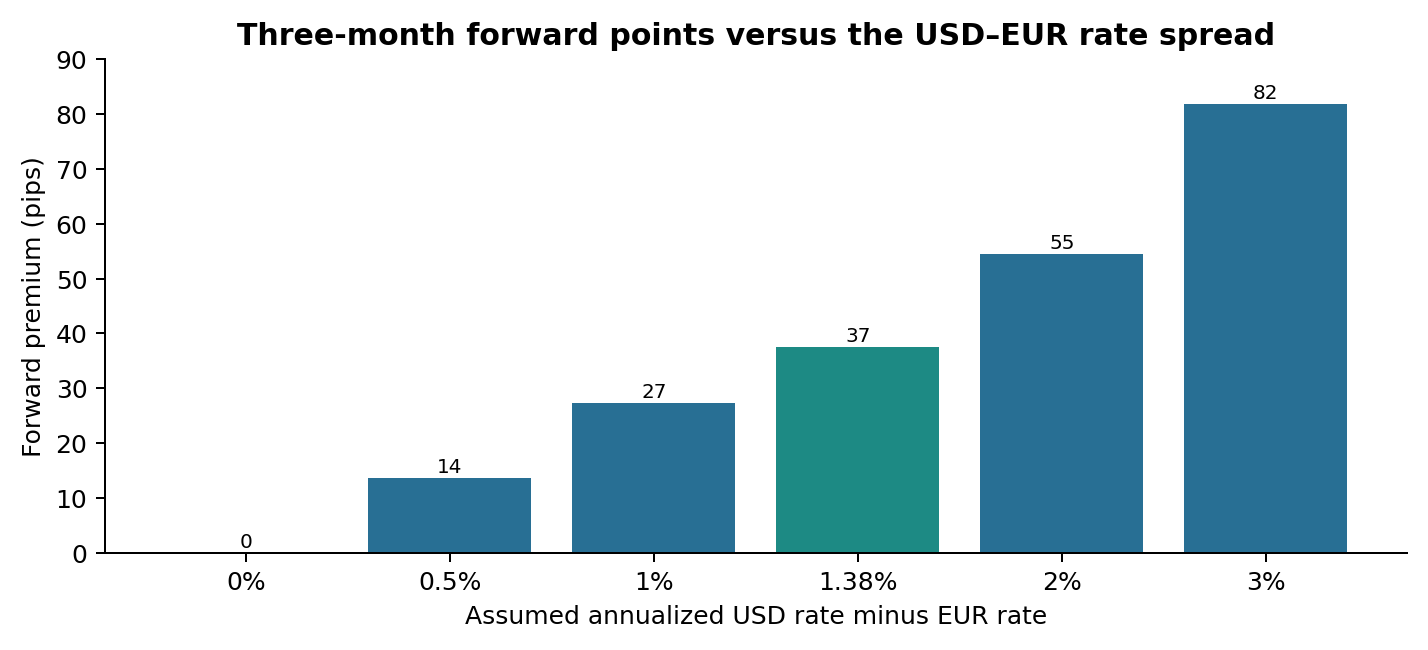
Figure 2. An interest-rate spread alone can create a positive EUR/USD forward premium, without a bullish euro prediction. Source: Assumed euro rate 2.50%, spot 1.0975, 90-day horizon; Dave Finances calculations.
Positioning is a separate dataset. The CFTC’s Commitments of Traders report shows the positions of categories of reportable futures-market participants. A leveraged-fund net short need not mean that all traders think EUR/USD will decline: every futures short is matched by a long, and some longs or shorts hedge forward cash flows or existing exposures elsewhere. The data are a lagged snapshot and report neither a probability-weighted price forecast nor the aggregate economic position of the FX market. Open interest describes outstanding contracts, not the percentage of people who expect a higher euro.
Price Discovery, Hedging and the User Who Needs Euros
Consider a US company contracted to pay €1.25 million to a European supplier in three months. Its immediate risk is that the dollar cost of the invoices rises before the payment date. Ten standard 6E futures represent the €1.25 million currency notional. If the company buys those futures, a euro rally increases the futures position’s value, partially offsetting the higher dollar cost of buying euros later. A falling euro generates futures losses but makes the physical euro payment cheaper. That is a hedge of exchange-rate exposure, not a claim that the euro will rise. In reality, futures variation margin has to be funded along the way and the final hedge may be imperfect because of date and basis differences.
A speculative long has an entirely different economic destination. If one standard contract is entered at the illustrative three-month equivalent 1.10125 and the expiry price is 1.0800, the gross marked price difference is approximately –$2,656. If the spot-equivalent settlement is 1.1200, the same arithmetic gives approximately +$2,344. Those figures exclude commissions, slippage and financing of margin, and they should not be confused with the full $137,656 notional dollar value of the underlying euro exposure. The cash margin posted can be a small fraction of that notional yet market losses still accrue on the full contract.
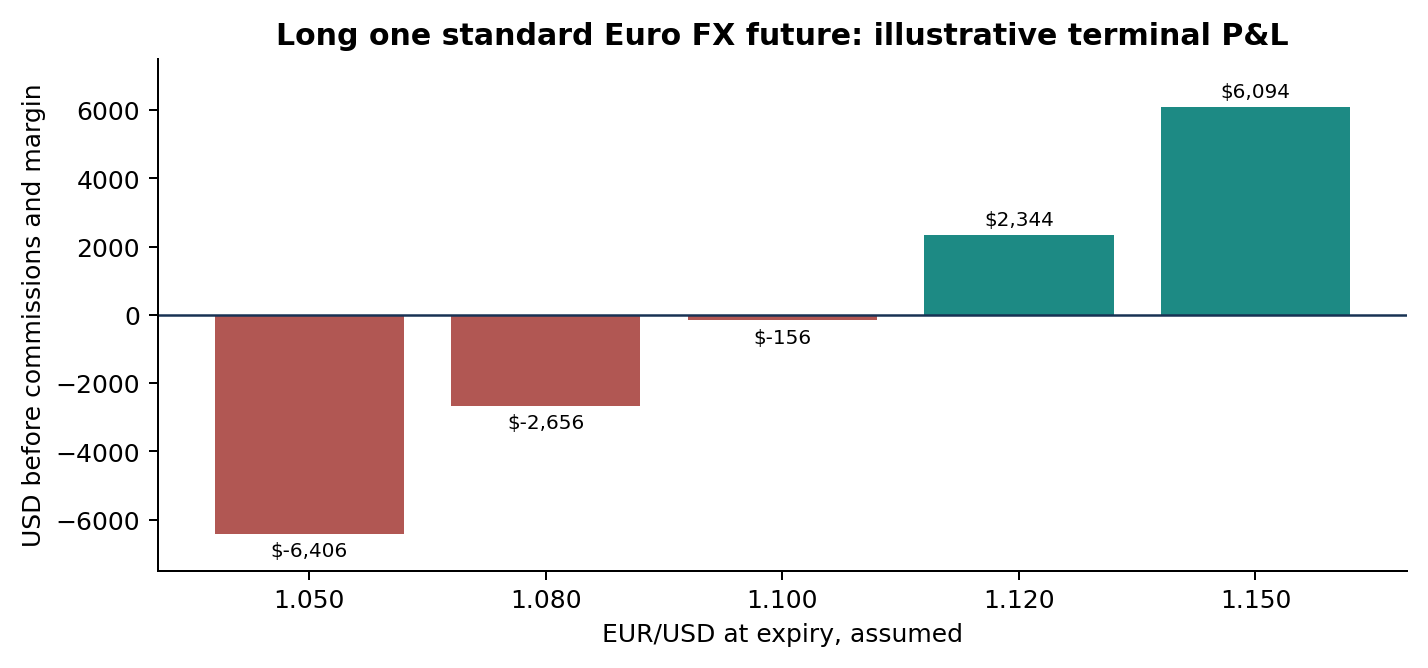
Figure 3. Illustrative standard 6E long-position payoff if held to the chosen horizon. Source: CME €125,000 contract; modeled 90-day entry price; Dave Finances calculations.
This also means a seemingly small forward premium is not a protective buffer against a sharp spot move. In the example, the 37.5-pip premium is worth about $469 on a standard contract. A 200-pip adverse currency move is worth $2,500. The example is deliberately comparable in scale: a trader who debates five pips of carry but ignores a 200-pip potential swing has reversed the hierarchy of risks. CME futures, a bank forward and an OTC CFD may have nearly identical directional exposure but materially different costs and counterparty, margin and liquidation arrangements. CME’s own research on futures versus CFD financing makes that distinction explicit.
Why a Forward Premium Is Not an Expected Currency Gain
A forward or futures transaction is an enforceable exchange contract, priced against arbitrage and hedging flows, not a direct survey of subjective exchange-rate expectations. The forward rate can be above spot because a dollar deposit earns more interest than a euro deposit. It does not follow that someone buying the euro forward has an expected risk-free profit; a corresponding borrowing-and-investing transaction adjusts the economics. The relevant expected excess return depends on the future spot rate, currency risk premium, margin financing, transaction costs and the investor’s own forecast. The long-standing empirical failure of a simple forward rate to predict future spot precisely is a warning against treating the curve as a directional oracle.
There is no contradiction in a market where the euro trades at a forward premium but investors anticipate spot depreciation. Under one path, euro-area rates stay low and dollar yields remain relatively high, sustaining positive forward points. A risk shock can simultaneously strengthen the dollar in the spot market. Under another path, ECB tightening beyond expectations raises euro yields and compresses the premium even while the euro strengthens immediately. In our analysis of conflicting Fed, ECB and BOJ policy, the same relative-policy logic explains why currencies often move before the central bank actually changes its rate.
Watch the direction of changes rather than memorizing the sign. If spot EUR/USD falls by 100 pips and a futures maturity rises by 20 pips relative to spot, the outright future can still decline by around 80 pips. If the observed 90-day futures premium widens while matched SOFR–€STR differentials are stable, the new information may be financing basis rather than the macro trend. Both cases are identifiable from a well-constructed dataset that records synchronous spot, futures and matched-rate observations, rather than asynchronous numbers copied from different websites.
Table 2. What each market variable can and cannot tell the observer.
| Signal | Meaningful reading | Incorrect shortcut |
|---|---|---|
| 6E outright price | Hedge price for a specific expiry | Probability-weighted spot forecast |
| Futures – spot | Forward points / carrying costs | Pure directional bullishness |
| Implied basis residual | Financing pressure versus rate parity | Risk-free arbitrage for everyone |
| CFTC positioning | Reported categories of open contracts | A market vote on future spot |
What Would Disprove a Bullish Reading of the Curve?
A bullish interpretation would be weakened if EUR/USD spot declines despite a positive futures premium, or if forward points grow mainly because dollar short rates rise rather than because traders demand euros. It would also be weakened if improving euro-area nominal yields are offset by worsening inflation compensation or sovereign risk. Conversely, evidence for genuine spot appreciation would include a repricing of relative expected policy paths in the euro’s favor, improving European growth relative to the US and broad currency strength beyond one bilateral pair. One futures price cannot establish those mechanisms on its own.
The latest Fed stance provides a useful guardrail. After its October hold, US rates were still 3.75%–4.00%, not a 0% funding environment. The ECB’s October deposit rate stood at 2.50%. Their relationship creates predictable theoretical forward points. The very same dollar yield advantage can support spot dollars today if expectations change in the US direction, a possibility explored in why higher US inflation can strengthen the dollar. A euro future is useful data, but its informational content comes from decomposing the quote.
How to Read a Real Trading Screen Without Inventing a Forecast
A sound market snapshot needs five columns: timestamp, spot EUR/USD, specific 6E expiry and last/settlement price, matched-dated USD and euro financing rates, and the forward premium in pips. The rate columns should have the same compounding and day-count conventions, with market observations sampled as closely as practical. For example, a 1.1000 futures quote against a 1.0975 spot reference shows 25 pips of premium, but the result is meaningless as a deviation from the theoretical 37.5-pip model if the futures price was observed on a different day or the future expires in three weeks rather than three months. The market calculation starts by matching dates, not by choosing a convenient headline rate.
Compare the observed premium with the covered-interest-parity value. Suppose, purely as an example, a contemporaneous 90-day futures/forward-equivalent premium is 45 pips while matched funding rates predict 38. The residual is seven pips. At a €125,000 notional, seven pips is about $87.50 in outright price terms. It is not necessarily a $87.50 free trading opportunity: an arbitrageur still needs access to both currencies at the assumed borrowing rates, collateral, settlement facilities, funding capacity and execution at both legs’ quoted prices. A dealer may rationally charge a basis because balance-sheet capacity has a cost. That is precisely why BIS research treats deviations from covered interest parity as meaningful financial-market conditions.
A second screen should show the same curve as changes rather than levels. Decompose a contract’s one-day price change into the change in spot, the change in forward points, and any quote or maturity adjustment. That accounting reveals whether EUR/USD moved because the euro spot appreciated, because dollar rates moved or because hedging demand shifted the cross-currency basis. It is a much stronger article or trading note than reporting that the December contract ‘expects’ a particular number, because the causal channels can be checked against observable instruments. If the decomposition fails to reconcile, the timestamps or tenor conventions probably do not match.
Finally, do not mix the hedge decision with a speculative signal. A US importer with a fixed euro invoice may rationally lock in a futures price it regards as an unattractive euro forecast because the business needs certainty. A speculative trader may avoid a long futures position even with positive euro fundamentals because carry, positioning and margin risks make the expected risk-adjusted return unfavorable. The difference is operational, not philosophical: a hedge minimizes exposure to an unwanted exchange-rate outcome; a directional trade adds exposure to seek return. Neither objective is disclosed by the shape of the curve alone.
Bottom Line for EUR/USD Traders
Euro FX futures reveal a tradeable hedge price, an embedded interest-rate differential, a possible cross-currency financing premium and the cost of taking a specific notional exposure. They do not reveal a single consensus EUR/USD prediction. At the November 26 ECB fixing, a 90-day forward-style calculation using simplified 3.875% dollar and 2.50% euro rates produced roughly 38 positive forward pips without introducing a euro-appreciation forecast. A responsible analysis shows spot, curve, carry, basis, timing and exposure together. Without those five elements, a high deferred euro quote is easily—and expensively—misread.
Methodology and Limitations
ECB reference spot 1.0975 (November 26, 2026), Fed midpoint 3.875% and ECB deposit rate 2.50% anchor a pedagogical covered-interest-parity calculation using T = months/12 and simple annual rates. Exact traded 6E prices, matched cash/secured rates, cross-currency basis, bid/ask and settlement calendar differ. A standard contract is €125,000; P&L = (terminal price – modeled entry price) × 125,000. Scenario prices and forward curves are illustrative, not trade recommendations or forecasts. Original charts and all modeled figures: Dave Finances calculations.
Sources
01 CME Group, Euro FX Futures Contract Specifications
02 ECB, Euro Foreign Exchange Reference Rates, November 26, 2026
03 ECB, October 29, 2026 Monetary Policy Decision
04 Federal Reserve, October 28, 2026 FOMC Statement
05 CME Group, Covered Interest Parity and Cross-Currency Basis
06 CME Group, Reconciling FX Spot and Futures Prices
07 CME Group, FX Link and the Spot-Futures Basis
08 BIS, Covered Interest Parity Lost: Understanding the Cross-Currency Basis
09 BIS, Global FX Markets When Hedging Takes Centre Stage
10 CFTC, Commitments of Traders Reports — Overview
11 CME Group, FX Financing Costs: Futures and CFDs
12 ECB, Account of October 28–29 Governing Council Meeting, Published November 26

Johan Shamshad is Editor-in-Chief at Dave Finances, covering financial markets, digital assets, trading platforms, brokers, fintech, payments and regulation. Since 2023, he has also worked as an editor at Gulf News, the UAE English-language newspaper published by Al Nisr Publishing LLC. His work focuses on market-moving developments, company disclosures, regulatory changes and trading infrastructure, with an emphasis on primary-source verification and practical context for traders and investors.