
A bank cutoff can stop dollar payments without switching off a cryptocurrency exchange. That distinction has become unusually concrete in November 2026: the US Treasury has ordered covered financial institutions to stop transferring funds to or from MEXC Global, with the restriction scheduled to take effect on December 10. The case exposes a financial-market dependency that on-chain transaction statistics obscure. An exchange may have active order books, substantial token reserves and working blockchains, yet still struggle to connect those balances to bank money, market makers and customers who need dollars rather than digital tokens.
MEXC Is a Test of the Difference Between an Order and a Shutdown
FinCEN announced its MEXC action on November 6 and published the operative notice in the Federal Register on November 10. Under section 9714 of the Combating Russian Money Laundering Act, FinCEN determined that the foreign exchange was a financial institution of primary money-laundering concern in connection with Russian illicit finance. The order prohibits covered US financial institutions from transmitting funds to or from MEXC Global beginning December 10, without a stated expiration date. It is not, on its face, an order directing all foreign exchanges to delist MEXC, freeze every customer balance or disconnect MEXC from public blockchains.
The scope is wider than a bank deciding not to renew an account. FinCEN considered indirect access to dollar correspondent accounts and concluded that narrower correspondent-account restrictions would not address the identified flows adequately. The text defines funds broadly enough to include value substitutes such as convertible virtual currency, and the operative prohibition applies to covered institutions rather than merely to branches of a single bank. The exact treatment of a particular cross-platform movement will depend on the parties, the institution and applicable law; an on-chain transfer cannot be assumed lawful simply because it avoids a bank wire.
FinCEN attributed at least $16.7 billion of likely illicit activity to MEXC between May 2021 and May 2026, drawing on public and nonpublic information and blockchain analysis. It separately described nearly $1.5 billion in direct and indirect Russian sanctions-evasion exposure and at least $1.99 billion associated with illicit cyber actors. These amounts should not be totaled: the underlying categories overlap, and none establishes a customer-loss amount or the share of all MEXC activity that was illegal. MEXC, in a November 7 statement, said it was reviewing the order with its legal and compliance teams, that operations were normal and that user assets remained secure. Those are company assertions, not independent verification of its reserves.
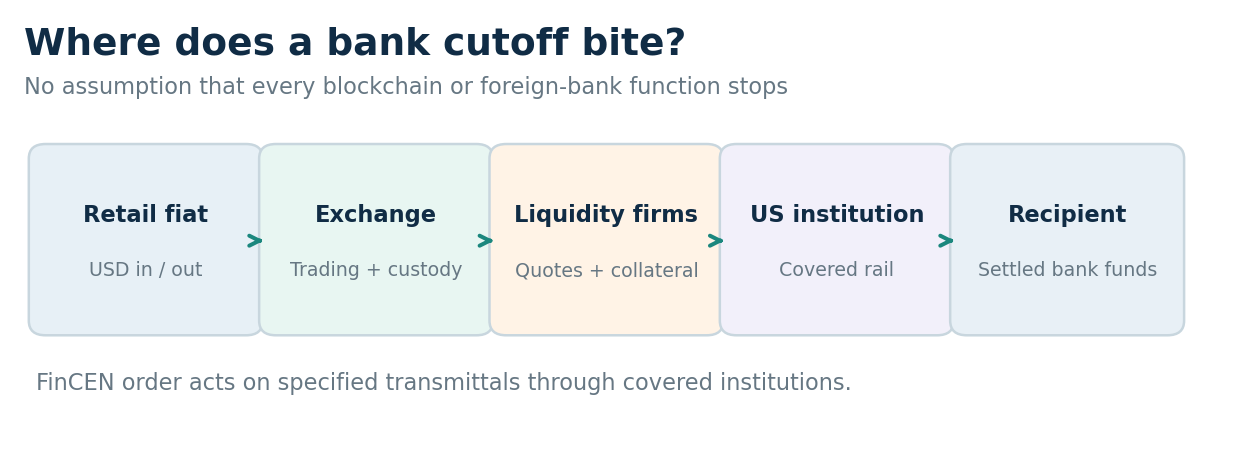
Figure 1. Payment-chain dependency map. Source: FinCEN order and Dave Finances interpretation; Dave Finances calculations.
Five Payment Functions That Can Fail Separately
A crypto exchange does not have one generic banking connection. It usually depends on a collection of commercial arrangements: customers sending fiat to the exchange, customers withdrawing fiat, counterparties delivering market-making liquidity, the exchange paying expenses and payroll, and banks or payment intermediaries settling between jurisdictions. Losing an arrangement may disable some functions while the rest continue. The practical bottleneck is the exact layer that goes dark.
An exchange with functioning spot and derivatives markets can still have no supported USD withdrawal path for a particular customer. Another might allow transfers of crypto but block direct dollar conversion. A third might process purchases through cards and payments firms while banking for corporate treasury remains inaccessible. These distinctions matter because trading an asset within the exchange’s ledger does not deliver redeemable bank funds outside its systems. A displayed USD value is not proof that the platform can release an equivalent USD bank transfer at that moment.
Binance.US provides a different, historical counterexample. In 2023 it removed many USD trading pairs after disruption to banking access; it restored ACH funding for eligible customers in a phased 2025 rollout. Its current help materials still describe crypto-only conditions in some states. These limitations were not the same type of legally binding FinCEN-wide transfer prohibition now facing MEXC. Bank availability, state rules, platform policy and regulatory action should not be lumped into one story.
A useful comparison is Kraken’s 24/7 dollar settlement arrangement, which shows the value an exchange can gain when additional banking rails become available. Another is the GMO Aozora payment disruption, where a bank-side security response affected fiat transfers without destroying the cryptocurrency networks themselves.
| Disruption | What may stop | What may remain |
|---|---|---|
| Bank partner exit | Fiat deposits or withdrawals at that partner | Trading, crypto transfers, alternative banks |
| Covered-institution transfer order | Specified funds transmittals involving restricted exchange | Some foreign/on-chain functions, subject to law |
| Blockchain outage | Deposits and withdrawals on affected network | Other networks, fiat banking, internal trading |
| Solvency / platform hold | Potentially all withdrawals | Displayed trading balances may persist |
The Replacement-Rail Cost Can Be Measured
The economic hit depends less on the theoretical size of an exchange than on the proportion of actual turnover that must pass through the affected rails. Consider an illustrative business handling $100 million in eligible settlement payments each day. Suppose 20%, 50% or 80% of that flow needs replacement routing, and the replacement increases the all-in cost by 10, 50 or 100 basis points. The resulting annual expense ranges from $7.3 million to $292 million. This is a sensitivity exercise, not a reconstruction of MEXC’s revenue or its US-connected payment flows.
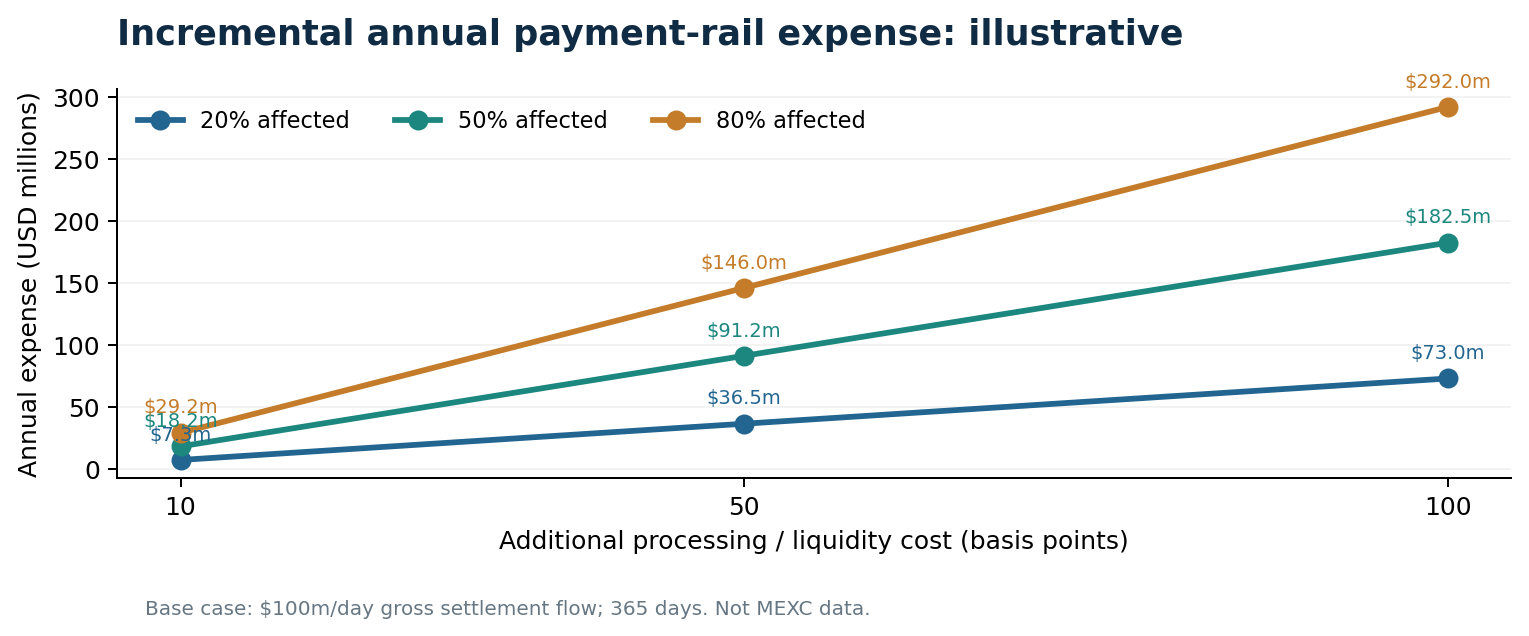
Figure 2. Replacement payment-rail cost sensitivities. Source: illustrative scenario; Dave Finances calculations.
The arithmetic is simple: daily settlement value multiplied by the affected share, incremental fee rate and 365 days. The difficult part is evidence. Neither an exchange’s gross trading volume nor an on-chain transfer count reveals how much client cash requires US banks, how many payments can be netted internally or what an alternative liquidity provider will charge. The right due-diligence question is not whether the exchange trades a billion dollars a day. It is how many dollars must physically change custodians or banking systems, with what timing, to sustain that trading.
Customer exit economics can look smaller but become acute in stressed markets. For a $10,000 account, an alternative route that adds a 25-basis-point spread costs $25 before blockchain, external-exchange and withdrawal fees. At 100 basis points it costs $100. If the route requires a volatile asset as an intermediate holding, price risk during the transition may swamp both amounts. If the route uses a dollar stablecoin, the customer still needs an issuer, a compliant intermediary and an off-ramp willing to turn that token into a usable bank deposit. A stablecoin merely shifts the point of dependency. It does not erase it.
An independent bank transfer also has a different risk profile from an internal crypto transfer. Banks may investigate origin and beneficiary details; correspondent banks may reject or return a wire; recipient banks can ask for supporting records. A payment that is technically broadcast does not guarantee recipient settlement. This is where account balances become hard to spend, even if they can still be traded.
Who Absorbs the Loss When the Dollar Path Closes?
For an exchange, the first loss can be margin rather than principal. Higher payment-processor fees, standby liquidity, additional compliance reviews and idle prefunded balances all erode earnings. If the exchange passes them to customers, competitive spreads and conversion rates may deteriorate. Market makers may demand discounts for settlement uncertainty. If a counterparty cannot move dollars on schedule, what appears to be abundant order-book liquidity may be less useful than it looks.
For a retail holder, three exposures must be distinguished. The price exposure is whether Bitcoin, Ether or a stablecoin changes value. The custody exposure is whether the exchange can return the crypto or fiat it owes. The access exposure is whether a lawful payment route exists now, not merely in theory. Those risks can move independently. A USDC price close to $1 would not prove that the customer can cash out at a local bank for $1 after fees, limits and screening.
There is also a legal difference between client fiat held as a qualifying deposit at an insured bank and a balance owed by a trading platform. FDIC insurance covers eligible deposits if an insured bank fails, subject to ownership and recordkeeping conditions; it does not insure cryptocurrency itself or rescue a customer because an exchange has lost banking partners. Pass-through insurance depends on specific requirements and is not a blanket guarantee for an exchange account.
The regulatory backdrop is not uniformly hostile to crypto banking. In 2025 the FDIC and Federal Reserve withdrew two earlier sectorwide crypto-risk statements, and US banking agencies published fresh risk-management guidance. Those changes do not compel any individual bank to maintain a relationship, override sanctions law or cancel FinCEN’s MEXC order. A prudent analysis separates discretionary bank risk decisions from legally binding transfer restrictions.
A Payment-Access Stress Test for an Ordinary Trader
Imagine a customer with $20,000 recorded as fiat and $10,000 in cryptocurrency on a platform whose bank partner departs. If crypto withdrawals still work, the customer may recover the crypto while being unable to move the $20,000 directly by bank transfer. If internal USD-to-stablecoin conversion is permitted, a route might exist, but price, fees, network support and counterparty screening have to be checked. If both fiat and crypto withdrawals are restricted, the problem is much broader and could reflect security controls, compliance, insolvency or service disruption. No single event label answers the customer’s rights question.
| What the screen shows | What must be verified |
|---|---|
| $20,000 fiat balance | Legal entity, supported bank-transfer route, withdrawal limits |
| $10,000 crypto balance | Network, destination screening, custody control |
| Internal conversion quote | Realized spread, fees, asset and counterparty claim |
| Withdrawal marked processing | Was payment sent externally or queued internally? |
| Stablecoin withdrawal available | Receiving venue accepts token and can redeem to bank funds |
A trader should therefore retain the contractual entity name, full statement, transaction IDs and the exchange’s public status notices. Before converting stranded fiat into a token, the trader needs to know whether the conversion itself is permitted, what claim it creates, what chain it uses, the receiving venue’s policies, and whether redemption can finish at the intended bank. Finding a cheaper quote on another exchange is not enough. The destination has to accept the assets and actually pay out.
The situation differs from FinCEN’s reported MEXC transaction findings, which concern specified regulatory restrictions on covered institutions rather than a blanket statement that every MEXC customer cannot withdraw. The narrower the claim, the more useful it becomes.
What Would Show That the Cutoff Is Working or Failing?
A transfer ban is intended to stop access to specified regulated financial channels, not necessarily to halt every public-chain transaction. Analysts should track verifiable facts: published bank and payment-processor changes, the exchange’s public funding options, withdrawal status by asset and jurisdiction, enforcement against attempted evasion and the quality of alternative liquidity. Exchange press releases deserve scrutiny alongside evidence of fulfilled withdrawals; neither alone describes the full picture.
A useful falsification test is whether legitimate customers continue using compliant alternatives with modest friction. If reliable independent bank withdrawals remain available to affected users, the predicted retail disruption may be limited. If spreads widen, fiat products disappear and market-making depth erodes for months, the economic effect is larger. Neither outcome should be inferred solely from token reserves or volume figures reported by the exchange itself.
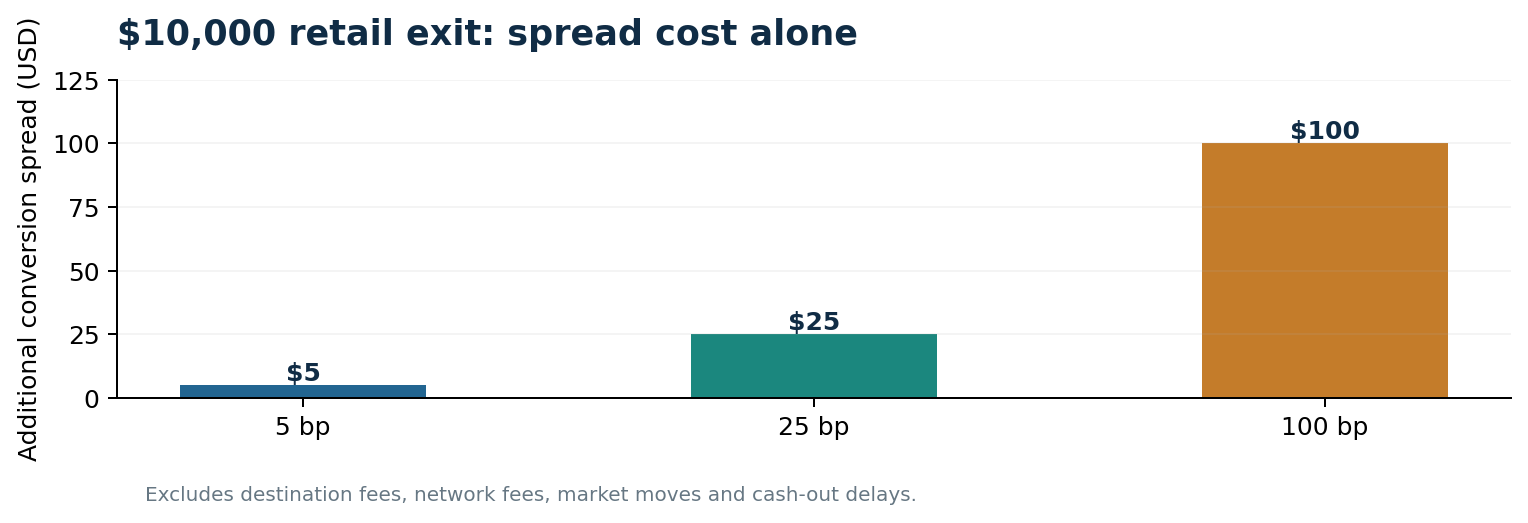
Figure 3. Retail conversion spread sensitivities. Source: illustrative scenario; Dave Finances calculations.
The Wider Market Might Route Around One Restricted Venue
Liquidity providers have choices that retail customers do not. They can quote prices at multiple exchanges, arrange bilateral settlement, hold capital in more than one currency and rebalance exposures through institutional networks. But these options consume capital and compliance resources. If an exchange is excluded from a major financial hub, a dealer could keep serving unrelated markets while reducing the size of its quotes on that venue. Lower displayed liquidity could then increase the cost of each remaining customer trade, creating a feedback loop between access and volume.
An exchange could also respond by steering business into tokens rather than bank money. The route might improve operational continuity but does not restore the legal protections of an ordinary deposit. Counterparties still consider issuer redemption risk, market depth, blockchain congestion and the legality of interacting with the exchange. These constraints differ by country. A transaction viable through a licensed institution in one jurisdiction may be unavailable to a recipient whose bank is required to reject the same counterparty.
One additional sensitivity illustrates the settlement-time effect. If a business ordinarily completes $50 million of daily payout obligations and must pre-fund three days of outbound liquidity rather than one, the extra idle cushion is $100 million. At an illustrative 5% annual funding cost that is $5 million per year before extra compliance and operating costs. This is a working-capital model, not an assertion that MEXC needs such a buffer. It demonstrates how lost banking access can hurt a firm even when its payment processor charges no higher explicit fee.
The strongest counterargument to the expected disruption is that most of the exchange’s economically important activity may occur entirely outside covered US institutions, with customers able to move assets legally through other regulated entities. That possibility must remain open. Analysts would need independently sourced payment-flow and geographic data to estimate how much business is actually at risk; public trading turnover cannot fill that gap. The absence of that data is a material limitation, not permission to assume a catastrophic loss.
Bottom Line
The most important asset a centralized exchange can lose may be not its crypto, but the institution willing and legally able to settle its customers’ money. MEXC’s forthcoming US transfer prohibition illustrates a regulator-enforced cutoff; Binance.US’s earlier disruption illustrates why separate banking relationships matter commercially. The correct question for customers is concrete: which currency, through which entity and intermediary, can I withdraw today? The answer may be very different from whether the trading screen still works.
Methodology
Original charts use illustrative assumptions, not estimated MEXC operating data. Replacement-rail expense assumes $100 million in daily settlement value, incremental costs from 10 to 100 basis points, affected volume shares of 20% to 80%, and 365 operating days; it ignores volume seasonality, tax, counterparty rebates and payment netting. Retail exit cost applies assumed spreads to a $10,000 account and excludes trading-market movements. FinCEN totals are presented as overlapping agency-assessed flows, not summed categories. Legal scope is taken from the November 10 Federal Register publication, with its December 10 effective date.
Sources
Reporting and analysis based primarily on regulatory documents, exchange notices, official technical advisories and product documentation. Accessed November 27, 2026.
1. FinCEN — MEXC Global special measure, November 6, 2026
2. Federal Register — Order prohibiting funds transmittals involving MEXC, November 10, 2026
3. US Treasury — Operation Economic Outcast statement
4. MEXC — Statement regarding FinCEN order, November 7, 2026
5. MEXC — User Agreement and restricted jurisdictions
6. Binance.US — Restoration of USD services, 2025
7. Binance.US — Trading in a crypto-only state
8. Binance.US — USD purchase restrictions, June 2026
9. FDIC/Federal Reserve — Withdrawal of crypto joint statements, April 2025
10. OCC — Permissible bank crypto activities, March 2025
11. FDIC — Pass-through deposit insurance conditions
12. FDIC — What deposit insurance covers
13. FDIC, Federal Reserve and OCC — Crypto safekeeping risk guidance, July 2025

Johan Shamshad is Editor-in-Chief at Dave Finances, covering financial markets, digital assets, trading platforms, brokers, fintech, payments and regulation. Since 2023, he has also worked as an editor at Gulf News, the UAE English-language newspaper published by Al Nisr Publishing LLC. His work focuses on market-moving developments, company disclosures, regulatory changes and trading infrastructure, with an emphasis on primary-source verification and practical context for traders and investors.