
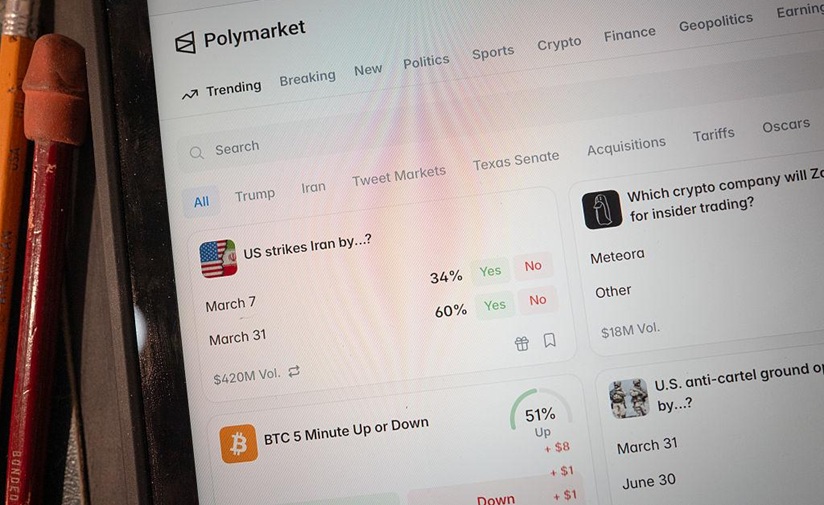
A bipartisan pair of senators is pressing the Commodity Futures Trading Commission to investigate Polymarket after reports that the prediction market platform paid social media creators to stage fake bets and promotional wins.
Sens. John Curtis, R-Utah, and Adam Schiff, D-Calif., sent a letter Thursday to CFTC Chair Michael Selig, raising concerns about whether the agency is properly enforcing existing law and whether it is equipped to oversee prediction markets as they expand into products that increasingly resemble gambling.
“We remain concerned that the Commission is neither enforcing the law appropriately, nor is equipped to serve as a federal gambling regulator,” the senators said in the letter.
The request follows reports that Polymarket paid dozens of social media creators to film themselves placing fake wagers, and in some cases faking wins on replicas of the company’s website. A review of 1,105 videos from 10 creators, spanning December 2025 to mid-May, found that a bet appeared in about 70% of the videos. None of the wagers, reportedly worth around $1.9 million, were real.
Polymarket said it is conducting a comprehensive audit of active promotional content to ensure it complies with its own standards and applicable legal and regulatory disclosure requirements.
“We are part of a rapidly growing industry and are constantly evaluating ways to improve how we’re engaging and earning the trust of our audience,” a Polymarket spokesperson said.
The CFTC has not confirmed whether it is investigating Polymarket. A spokesperson for the agency said it cannot confirm or deny the existence of an investigation.
The controversy comes as prediction markets have grown rapidly, with Polymarket reportedly reaching a valuation of $15 billion. The sector has attracted retail traders, political bettors, crypto users and mainstream attention, but its growth has also forced regulators to confront a messy question: where does financial market regulation end and gambling oversight begin?
Polymarket has faced regulatory scrutiny before. In 2022, it settled with the CFTC over offering event-based binary options, agreeing to pay a $1.4 million penalty and block U.S. users. In 2024, federal agents seized the phone of Polymarket CEO Shayne Coplan, and the company was reportedly facing a Department of Justice investigation over alleged U.S. user access.
The latest pressure is broader than one company’s promotional campaign. Schiff and Curtis asked whether the CFTC would preserve state and tribal authority over sports betting and casino-style gaming products, warning that companies should not be allowed to use federal commodities oversight to bypass gambling laws.
“The Commission should not allow companies to invoke CFTC oversight as a way to avoid state and tribal gambling laws, weaken consumer protections, or promote betting-style products through deceptive campaigns,” the senators said.
The letter also arrives as prediction markets face growing questions over insider trading and market integrity. In one case, an anonymous Polymarket user made more than $400,000 by betting that Venezuelan President Nicolás Maduro would be removed from power before the end of the month. Prosecutors later arrested active-duty U.S. Army soldier Gannon Ken Van Dyke, 38, alleging he used confidential information to place the wager.
That incident has sharpened concerns in Washington over whether prediction markets can be monitored like traditional derivatives markets, particularly when some contracts touch politics, war, public policy, sports, elections or sensitive government information.
The CFTC has asserted jurisdiction over several prediction market operators, but that posture has triggered conflict with state regulators, especially over sports-related contracts. Some states view those products as gambling. The CFTC has treated some event contracts as federally regulated derivatives. The tension is not theoretical anymore. It is now a direct fight over who gets to police the fastest-growing corner of speculative online markets.
Consumer advocates are also moving against Polymarket. On Friday, the National Association of Consumer Advocates sued the platform in the Superior Court of the District of Columbia, alleging that it misled college students through deceptive and unfair marketing.
The lawsuit claims Polymarket used influencer materials, including content tied to creators such as Clavicular and Logan Paul, to target younger users while obscuring the likelihood that consumers could lose money.
“Defendants have engaged in unfair business practices while marketing the opportunity to place bets on the Polymarket platforms,” the group said in the lawsuit. “They have used manipulative forms of advertising to promote their gambling opportunity to college-aged Americans, while obscuring the odds that these consumers will lose their money.”
The mounting political, regulatory and legal pressure puts Polymarket in a difficult position. Its growth has made it one of the most visible names in prediction markets, but that visibility has also made it a test case for how regulators handle products that sit between trading, gambling, political forecasting and social media speculation.
For the CFTC, the challenge is just as large. The agency is already expected to play a larger role in digital asset regulation. Lawmakers are now questioning whether it has the resources, authority and enforcement culture to supervise prediction markets as well.
The fake-bet allegations could become a defining test. If creators were paid to show fake trading activity without clear disclosures, regulators may look not only at advertising standards but also at whether users were misled about liquidity, market participation or potential returns.
For now, Polymarket says it is reviewing its promotional content. Lawmakers want more than a review.
They want the CFTC to prove it can police the market.
# Polymarket’s Real Problem Is Not Fake Bets. It Is That the Whole Category Is Starting to Look Like Regulatory Arbitrage
The fake-bet videos are bad.
Let’s not dance around that.
If creators were paid to film staged wagers, fake wins, or replica-site activity that made Polymarket look more liquid, exciting or profitable than it actually was, that is not just sloppy marketing. That is casino-influencer behavior with a fintech wrapper.
And I don’t care how fast the prediction market sector is growing. You don’t get to manufacture trust with fake action.
That is the whole point.
Prediction markets already ask users to suspend disbelief. They say: this is not gambling, it is information aggregation. This is not a casino, it is a market. This is not just betting, it is price discovery.
Fine.
Then act like it.
Because once fake bets enter the marketing stack, the “we are a serious market structure company” argument gets weaker fast.
Short version?
Polymarket wanted the upside of finance, crypto and gambling culture all at once.
Now it is getting the regulatory heat from all three.
The Curtis-Schiff letter matters because it is bipartisan. That is rare enough. A Republican from Utah and a Democrat from California do not need to agree on much to agree that the CFTC may be outmatched here.
And honestly, I think they have a point.
The CFTC was built to oversee commodities derivatives, futures markets, swaps, market manipulation, clearing, intermediaries, and institutional risk. It was not designed to become the national referee for every app that lets users bet on politics, sports, celebrity drama, war outcomes, elections, court cases, crypto headlines and whatever else goes viral by Thursday afternoon.
That is not a small difference.
A futures exchange and a viral prediction app may both use contracts. But the user psychology is not the same.
A farmer hedging wheat exposure is not the same as a college kid watching an influencer fake a winning bet.
And that is where the whole debate gets nasty.
Polymarket and the wider prediction-market crowd want legitimacy. They want to be treated as market infrastructure, not offshore gambling sites. They want intellectual cover from economists, traders, political analysts and crypto people who love saying markets are better than polls.
Sometimes they are.
But the moment the growth engine starts looking like influencer-driven betting content, that polished “information market” pitch starts to crack.
I’ve seen this pattern before in crypto.
First, the category wraps itself in a serious idea.
Then growth teams chase attention.
Then creators start exaggerating returns.
Then the company says it is “auditing promotional content.”
By then, retail already got the message: easy money, fast wins, smart people are doing this, don’t miss it.
That is not market education.
That is funnel design.
And the 1,105-video review is brutal for one reason: scale. This was not one random creator going rogue. The reported review covered 10 creators over months, and about 70% of the videos showed bets. None of the wagers, worth about $1.9 million on paper, were real.
That is not a foot fault.
That is a marketing machine.
Now add the college-student lawsuit.
That is where the story gets sharper. Because the legal risk is no longer just “Did Polymarket violate CFTC rules?” It becomes: did the platform use manipulative advertising to push betting-style products toward younger users while hiding the real odds of loss?
That is a more dangerous question.
Regulators understand that question. Courts understand that question. Parents understand that question. Senators definitely understand that question.
And politically, this is a terrible lane for Polymarket to be in.
Nobody in Washington wants to be the person defending fake-win influencer ads aimed at college-aged Americans.
Nobody.
The company’s response — that it is auditing promotional content — is the obvious move. It had to say that. It needed to show control, compliance, standards, maturity.
But I’m not sure that solves the deeper issue.
The deeper issue is that prediction markets are now too big to keep pretending they are niche crypto toys, but too messy to fit neatly into the regulatory box they want.
Polymarket at a $15 billion valuation changes the conversation.
At that size, the platform is not just an experiment. It becomes a political object. A consumer-protection issue. A gambling-law issue. A national-market-structure issue. Maybe even an election-integrity issue, depending on the contracts.
And that is before we even get to insider trading.
The Maduro bet is the kind of story that regulators hate because it makes the abstract risk concrete. An anonymous user reportedly made more than $400,000 betting on a sensitive geopolitical outcome. Then prosecutors arrested an active-duty U.S. Army soldier, alleging he used confidential information to place that bet.
That is not just “alpha.”
That is a warning sign.
Prediction markets love to argue that prices reveal information. True. But sometimes the information is not public wisdom. Sometimes it is leaked, stolen, privileged or classified.
Then what?
If someone trades on confidential military or government information, is the platform just a neutral venue? Does it need surveillance systems like a securities or derivatives exchange? Does the CFTC have the staffing to monitor this at scale? Do law enforcement agencies need real-time access? What happens when the market itself becomes a bounty for inside information?
This is the part people skip because it ruins the fun.
But it is the whole ballgame.
Prediction markets create incentives to monetize knowledge before the public has it. In sports, that could mean injury leaks. In politics, campaign information. In geopolitics, military or diplomatic knowledge. In corporate events, maybe deal information. In crypto, listings, hacks, enforcement actions.
Every market creates incentives.
Prediction markets just create them around everything.
That is why the state-versus-federal fight matters. States and tribal authorities see sports betting and casino-style gaming as their turf. The CFTC, meanwhile, has become the route some platforms prefer because federal commodities oversight can look cleaner, more scalable and more prestigious than a patchwork of gambling licenses.
I get why companies want that.
But from the outside, it can look like regulatory arbitrage.
Call it a derivative when the gambling rules are inconvenient. Call it a market when the betting optics get ugly. Call it information discovery when users lose money. Call it entertainment when influencers need clicks.
Pick one.
The senators are basically saying: don’t let these companies use the CFTC as a passport out of state gambling law.
That is the line to watch.
If the CFTC becomes the umbrella regulator for prediction markets, the agency needs more than jurisdictional confidence. It needs enforcement capacity. Advertising standards. Market surveillance. Consumer-protection coordination. Rules for sports contracts. Rules for political contracts. Rules for manipulated promotional activity. Rules for conflicts, disclosures and insider activity.
That is a lot.
And the agency is already expected to take on a larger digital-assets role.
So my read is blunt: the CFTC either proves it can regulate this category aggressively, or Congress and the states will start boxing it in.
The worst outcome for prediction markets would be a major scandal involving fake promotions, underage-adjacent marketing, insider trading and weak enforcement all at once.
Polymarket is not there yet.
But it is walking close to that cliff.
What would I do if I were Polymarket?
Stop treating influencer growth like a crypto launch campaign.
No staged bets. No fake wins. No replica-site nonsense. No ambiguous disclosure. No creator content that implies easy profit. No targeting younger users with gambling-coded clips while hiding behind “market” language.
Then I would publish a real promotional-content standard.
Not vibes.
Actual rules.
Creator disclosures. Prohibited claims. Real-money trade verification. No simulated wins unless labeled. No return exaggeration. No college-targeted campaigns. Clear loss-risk language. Archived audit trail. Penalties for creator violations.
Boring?
Yes.
Necessary?
Also yes.
Because the industry’s biggest threat is not that prediction markets fail to attract users. They already did.
The threat is that they attract users too well, too fast, with growth tactics that make regulators treat the whole thing like gambling in a hoodie.
And once that frame sticks, it is hard to shake.
Polymarket wants to be the future of event markets.
Fine.
Then it needs to stop acting like a casino affiliate program with better UX.
The only move that makes sense now is discipline.
Not louder marketing.
Not more creator hype.
Discipline.