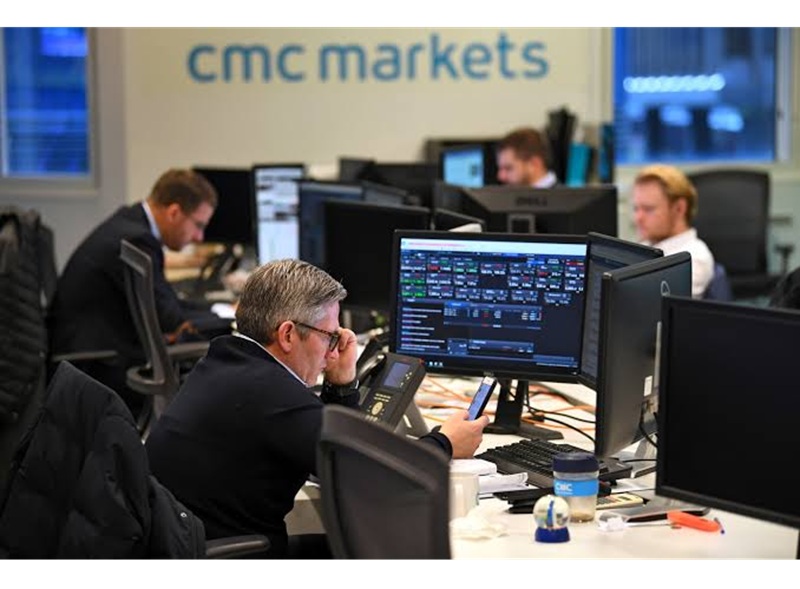
CMC Markets experienced a trading-platform incident lasting seven hours and 37 minutes after incorrect client positions were reported on its web and mobile platforms between November 1 and November 2, 2026. The London-listed broker warned that the technical difficulties could affect customers’ ability to trade, but has not disclosed whether underlying positions, order executions or account balances were affected.
According to CMC Markets’ official incident record, the problem was first reported at 21:43 UTC on November 1 and marked resolved at 05:20 UTC on November 2. The incident was classified under CMC CFD Global, specifically identifying the web and mobile trading platforms.
CMC described intermitent technical difficulties and said it was working to resolve them as a priority. Customers requiring assistance were directed to live chat. The broker subsequently confirmed resolution without publishing a technical explanation or details of the customer impact.
The disruption lasted substantially longer than two other trading-system incidents reported by CMC in October. Yet the public notification does not establish whether incorrect positions were continuously displayed throughout the entire period or whether the problem affected customers intermittently.
CMC has not explained which positions were incorrect
The incident’s central unresolved issue is the nature of the position-reporting errors. CMC’s notice does not specify whether customers encountered missing positions, nonexistent positions, incorrect trade quantities or inaccurate information about existing exposure.
There is also no confirmation that actual positions held within CMC’s trading infrastructure differed from the positions recorded in its internal systems.
A trader might have had the correct position underneath, but the screen was telling a different story. That possibility is materially different from an error affecting the underlying trading records, although the available evidence cannot establish which occurred.
For customers trading leveraged contracts for difference, incorrect position information can complicate decisions involving exposure, position closures and available margin. A customer relying on an inaccurate display might misjudge the size or direction of an existing trade.
Still, CMC has not confirmed that customers submitted orders based on incorrect information, experienced unexpected liquidations or suffered losses. Nor has it established whether stop-loss instructions, margin calculations or order-management functions were affected.
The incident record identifies only the web and mobile platforms within CMC CFD Global. MetaTrader, institutional APIs and DMA IRESS were not listed as affected components. Their exclusion does not independently establish that those services operated without interruption throughout the incident.
Another unanswered question concerns reconciliation. CMC has not explained whether it conducted a review of position discrepencies after restoring the platforms, how many accounts were affected or whether customers would be contacted regarding any identified errors.
Third CMC trading incident in just over a month
The November disruption follows two separately documented CMC Markets incidents involving different aspects of its trading infrastructure.
On October 1, the broker experienced a 65-minute order-processing disruption between 02:25 and 03:30 UTC. CMC acknowledged technical difficulties that could affect the processing of orders but did not disclose whether customers experienced rejected transactions, delayed executions or unsuccessful attempts to close positions.
A further US securities pricing disruption on October 21 affected the broker’s 24/5 trading offering for approximately two hours. CMC attributed that incident to an external pricing provider, with its status notification identifying multiple potentially affected systems, including web and mobile platforms, MetaTrader and institutional APIs.
Those were different problems, and CMC has not connected them, not publicly.
The November incident concerns displayed client positions rather than a specifically identified pricing-feed or order-processing problem. No common technical cause has been established across the three events.
The distinction between a display problem and an execution failure is illustrated by a separate IG Securities Japan incident involving incorrect trade executions on October 29. That broker explicitly acknowledged that some orders had been executed at unintended prices and that certain executions were delayed. IG subsequently began identifying affected customers and reviewing their transactions.
CMC’s November disclosure contains no comparable confirmation of incorrect executions. Without transaction-level evidence, treating the position-display incident as an execution failure would go beyond the available facts.
Incident adds scrutiny to CMC’s platform reliability
Technology reliability is a closely watched operating measure for CMC Markets, which provides trading infrastructure for both individual and institutional customers.
For the financial year ended March 31, 2026, CMC reported group-wide platform uptime of 99.98%, compared with 99.93% in the previous financial year. The company defines this metric as the percentage of trading hours during which customers can trade on its Next Generation and Invest platforms.
The November disruption occurred during the following financial year, FY2027, and cannot be included in the previously reported figure. Nor can the full seven-hour-and-37-minute incident window be treated automatically as equivalent trading downtime, because the disclosure does not establish that trading was unavailable for every affected instrument throughout that period.
CMC’s FY2026 financial results showed net operating income of £392.6 million and pretax profit of £101.3 million. The group reported 55,081 active trading clients and 281,442 active investing clients, demonstrating the scale of the customer operations supported by its technology.
UK regulators have also placed greater emphasis on the ability of financial firms to maintain essential services during operational disruptions.
In its March 2026 operational-resilience review, the Financial Conduct Authority highlighted the need for firms within the relevant regulatory framework to assess disruption tolerances using measures of potential customer and market harm, rather than relying solely on elapsed time.
The FCA also emphasized effective incident communications, scenario testing and lessons learned from actual service interruptions. Those expectations provide a framework for evaluating operational reliability, although CMC’s incident notification does not establish a regulatory breach or demonstrate that any applicable impact tolerance was exceeded.
Customer impact remains unquantified after resolution
CMC has confirmed that the immediate technical problem was resolved, but its public notice leaves several operational details outstanding.
The broker has not identified the underlying cause, the affected instruments or the number of customers who recieved incorrect position information. It has also not disclosed whether order activity continued normally during the incident.
Any customer disputes would need to be examined seperately against actual transaction records, including order instructions, execution timestamps, position histories and the information visible to the customer at the relevant time.
What CMC repaired during those hours, exactly, has not been explained.
The available record also contains no announced compensation arrangement, trade-adjustment program or commitment to publish a detailed incident review. That absence should not be interpreted as confirmation that customer losses occurred or that remedial action is required.
For investors assessing CMC Markets’ technology performance, the November event adds a third distinct trading-related incident to the broker’s recent operating history. The duration is documented, and service restoration is confirmed. Whether the incorrect displays remained an interface problem or extended into customers’ actual trading activity is still undetermined.
Further disclosure identifying the affected accounts, the nature of the position errors and the integrity of order execution would provide a firmer basis for assessing the incident’s financial and operational consequences.

Johan Shamshad is a financial markets writer at Dave Finances covering cryptocurrencies, trading platforms, brokers, fintech, financial regulation, and developments across global markets. He previously worked at Gulf News, adding newsroom experience to his coverage of fast-moving financial and digital-asset markets.
His work focuses on identifying market-moving events, company developments, regulatory changes, product launches, and shifts in trading and financial infrastructure.
Johan contributes news and analysis designed to help readers understand not only what happened, but why a development matters and how it may affect the wider financial landscape. You can reach out to him via his social media accounts:
Linkedin: https://www.linkedin.com/in/johan-shamshad-742851262/
X: https://x.com/Yasmine_FX
Investing: https://www.investing.com/members/contributors/279781574