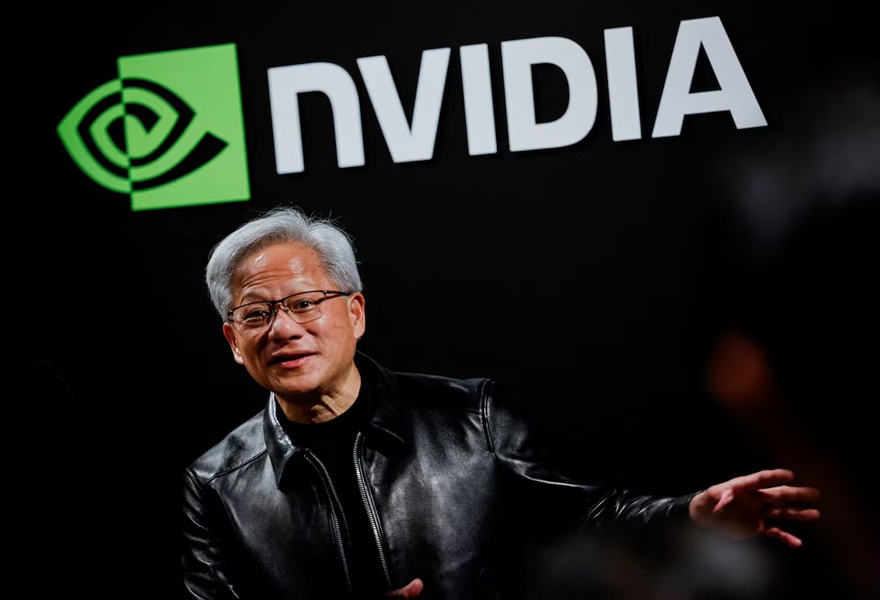
The founder’s exit puts execution, customer concentration and the AI hardware cycle—not personality—at the center of the investment case.
A Founder Leaves; the Economic Engine Does Not
Jensen Huang’s departure from Nvidia removes the executive most closely associated with the AI infrastructure boom, but it does not remove the orders, software ecosystem or manufacturing partnerships that turned the chipmaker into a central supplier of computing capacity. Nvidia confirmed the leadership transition on November 12, naming chief financial officer Colette Kress interim chief executive and launching a search for a permanent replacement. Its SEC filing places the effective resignation on November 11. The immediate investment question is whether Nvidia’s premium depended disproportionately on Huang’s personal authority, or on a commercial system capable of delivering without him.
The circumstances are serious, but several claims surrounding them remain unresolved. Nvidia’s board launched an investigation following reports that Huang had been targeted by a foreign intelligence effort. On November 8 it said it had no reason to believe company secrets or national security had been compromised; independent directors subsequently retained outside counsel. Reuters reported allegations involving Huang’s personal relationships, while also noting that US authorities had not concluded that the woman described in the reporting was a spy. None of those uncertainties should be converted into a finding of espionage or a quantified financial loss.
Shares fell 4.3% on November 12, according to Reuters, after trading much lower intraday. That reaction is understandable for a business whose founder personally helped coordinate product strategy, suppliers, customers and government relations. Yet a share-price decline is not evidence that customer demand has deteriorated. The distinction matters because a governance shock can lower the market’s willingness to pay for earnings even when the earnings themselves initially remain intact.
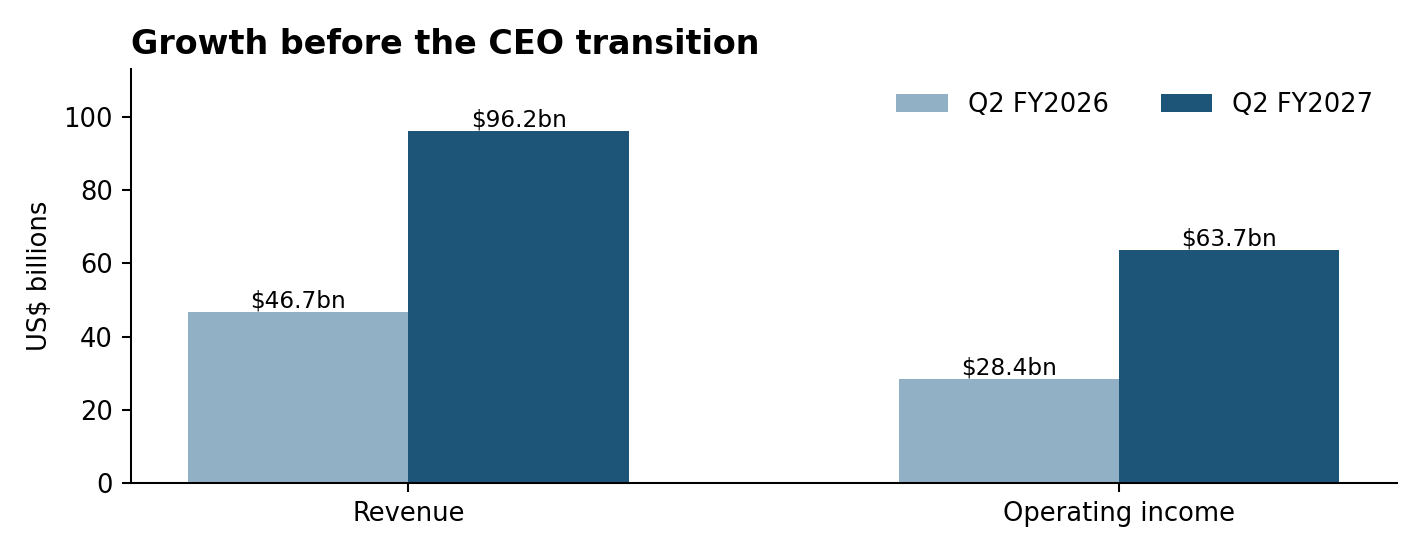
Figure 1. Nvidia revenue and GAAP operating income, second fiscal quarters of 2026 and 2027. Source: Nvidia Q2 FY2027 earnings release.
The Results Set a Demanding Baseline for the Successor
Nvidia’s latest completed quarter provides unusually strong evidence of the franchise a successor inherits. Fiscal second-quarter 2027 revenue reached $96.2 billion, up 106% from $46.7 billion a year earlier, while GAAP operating income rose to $63.7 billion from $28.4 billion. Operating income therefore grew about 124%, faster than sales, and its ratio to revenue increased from roughly 60.8% to 66.2%. Those figures describe operating leverage already achieved under Huang; they do not establish that management can sustain it through a transition.
The concentration behind that performance is both strength and vulnerability. Data Center sales were $89.0 billion, or approximately 92.5% of company revenue, and increased 117% year over year. Nvidia is no longer primarily a diversified graphics-chip maker whose weak segment can be offset by unrelated demand. A delay in large AI clusters, a switch in accelerator procurement or weaker returns on customers’ capital expenditure can affect nearly the whole investment thesis. Leadership continuity must therefore be assessed through delivery schedules and customer economics rather than comparisons with famous founders alone.
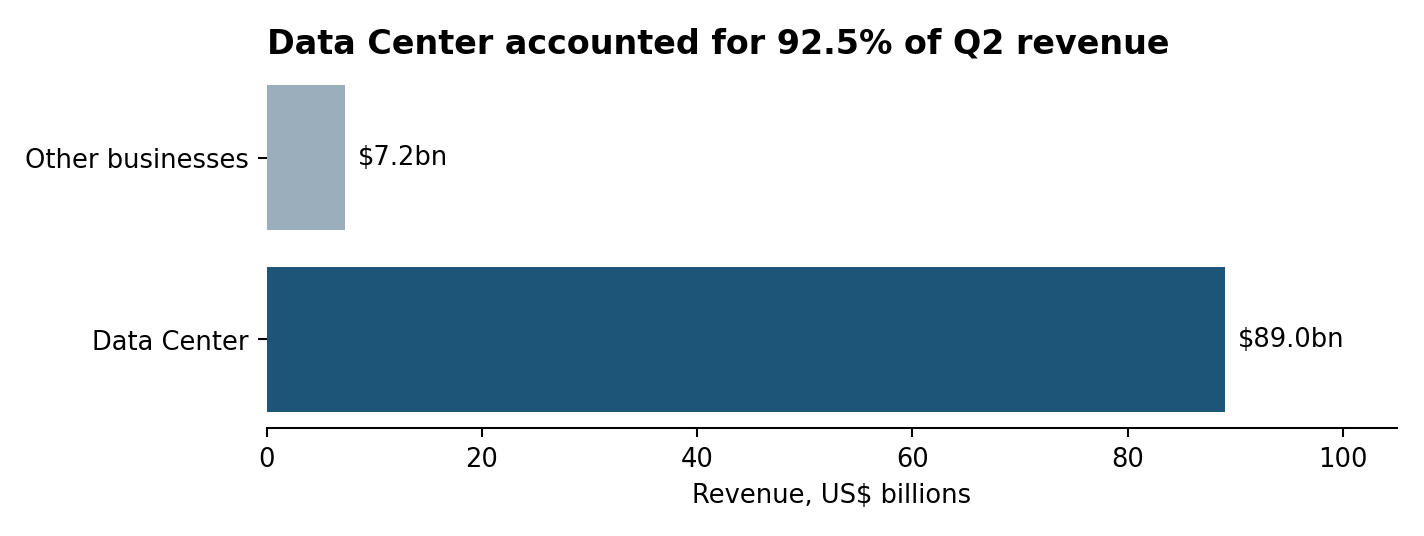
Figure 2. Revenue composition in Nvidia Q2 FY2027; “other businesses” is total revenue less Data Center. Original calculation from Nvidia earnings release.
Management’s pre-transition outlook called for third-quarter revenue of $108 billion, plus or minus 2%, and a 74% gross margin, plus or minus half a percentage point. Those targets were issued before Huang’s exit; they are benchmarks to test when Nvidia reports on November 17, not forecasts newly endorsed by Kress. The next report will also be too early to measure most long-term effects of leadership change. More informative will be whether the company maintains its product timetable, explains major customer commitments and offers credible guidance beyond the immediate quarter.
Why Nvidia Is Harder to Disrupt Than One Executive
Nvidia’s moat is not reducible to a charismatic chief executive or an individual graphics processor. Its competitive offering connects accelerators, networking, software libraries, developer tools and rack-scale designs. The company’s August release described Rubin systems ramping across major cloud partners, alongside networking and inference products. Customers designing large clusters must manage compatibility, system performance, software development and operational reliability. Those requirements create switching costs that survive a change in the executive office, although they do not immunize Nvidia against cheaper or more efficient competitors.
The August quarterly filing adds another constraint on the bullish argument: one direct customer accounted for 16% of total revenue in the quarter, and Nvidia warned that sales are concentrated among a limited number of direct and indirect customers. Large buyers have negotiating leverage and increasingly compelling reasons to develop alternatives. A successor who preserves engineering execution but loses influence over strategic accounts could still see pricing, customer mix or future orders deteriorate. It is therefore inaccurate to treat the existence of a strong ecosystem as proof that leadership is economically irrelevant.
Kress does offer continuity in an area where the market can verify results. She has been finance chief since 2013 and remains CFO while serving as interim CEO. She knows the company’s financial commitments, reporting framework and demand profile, but financial expertise alone does not settle questions about technical authority or external relationships. The board’s appointment of Harvey Jones as its first separate chair also creates a clearer governance distinction between oversight and executive management. Whether that institutional structure improves decision-making will depend on the permanent appointment and the organization built around it.
A Lower Multiple Could Be Opportunity or a Warning
Reuters reported on November 12 that Nvidia traded around 12 times expected earnings, its lowest forward valuation since 2012. An apparently cheap multiple is meaningful only if the earnings estimate is defensible. At an unchanged share price, a 20% fall in forecast earnings would lift a 12-times multiple to 15 times; a 40% fall would lift it to 20 times. These are arithmetic sensitivities, not predictions, and they show why the market can discount a rapidly growing company without necessarily making a valuation error.
The upside case is more precise than the claim that adversity makes the AI trade stronger. If Nvidia delivers products and sustains customer demand without Huang, investors can place more weight on recurring competitive advantages and less on founder-specific execution risk. That could justify a higher earnings multiple even without accelerating revenue growth. Conversely, a prolonged search, departures from the engineering leadership, contract disruptions or renewed export restrictions could cause both estimated earnings and the multiple applied to them to fall. A lower stock price alone cannot distinguish those outcomes.
The Steve Jobs–Tim Cook analogy is useful only within limits. Apple possessed mature products, a branded consumer distribution system and established operational processes when Cook became CEO. Nvidia must keep coordinating fast-moving hardware generations with power-hungry data-center projects and a narrow group of sophisticated buyers. That exposes it to different timing, supply-chain and capital-budget risks. Founder succession demonstrates whether a company has institutionalized its capabilities; it does not prove beforehand that every visionary founder can be replaced without cost.
What Would Confirm the Hidden Upside?
Four developments would provide stronger evidence than a relief rally: adherence to the announced platform roadmap, sustained gross margins as new systems scale, stable or expanding commitments from major customers, and a credible permanent leadership structure retaining technical decision-makers. Investors should also follow the independent investigation for findings rather than treating rumors as settled, and compare AI customers’ spending with the revenue they generate from deployed compute. Nvidia benefits when spending creates productive capacity; an industry buying hardware faster than it earns returns is a distinct risk no executive can talk away.
The possibility that Nvidia can succeed without Huang is real, but its value is conditional. The company enters this period with record operating scale and an integrated platform that customers cannot readily replace overnight. It also enters with exceptional customer concentration, dependence on data-center capital investment and the loss of an unusually influential external advocate. If the November 17 report and subsequent quarters show unchanged execution, the scandal may ultimately reveal that the franchise is stronger than its founder’s reputation. Until then, the supposed hidden upside is a hypothesis to test against operating results, not a gain investors have already earned.
Sources and Methodology
Nvidia, CEO transition press release (Nov. 12, 2026)
Nvidia, Form 8-K confirming resignation effective Nov. 11
Nvidia, board investigation statement (Nov. 8)
Nvidia, independent board investigation statement (Nov. 10)
Nvidia, Q2 FY2027 earnings release and guidance
Nvidia, fiscal Q2 2027 Form 10-Q and customer concentration
Reuters, Huang exit and market response (Nov. 12)
Reuters, valuation report (Nov. 12)

Johan Shamshad is Editor-in-Chief at Dave Finances, covering financial markets, digital assets, trading platforms, brokers, fintech, payments and regulation. Since 2023, he has also worked as an editor at Gulf News, the UAE English-language newspaper published by Al Nisr Publishing LLC. His work focuses on market-moving developments, company disclosures, regulatory changes and trading infrastructure, with an emphasis on primary-source verification and practical context for traders and investors.