
A merchant may see a customer press Pay only once, while three separate institutions decide whether that attempt ultimately produces usable cash. Payment orchestration promises to make the paths interchangeable: route a transaction to the appropriate processor, switch during an outage, and retry selected failures. The financial case is less obvious. A second processor cannot overrule a card issuer, and recovering $100 of sales is not the same as earning $100 of profit. Using public technical guidance and a transparent merchant model, this article examines where orchestration creates value, where it moves the failure point, and how to measure the difference.
What the Orchestrator Actually Controls
Payment orchestration is an application and decision layer between the merchant and the infrastructure that processes a transaction. It can coordinate multiple payment service providers (PSPs), gateways, acquirers, local payment methods and fraud services; select an eligible route; normalize response messages; and record what happened. The selected provider still performs its processing role. A processor does not stop being responsible for its own contract, settlement, disputes or compliance merely because a new system sent it the instruction. Stripe distinguishes the routing layer from the gateway and Adyen likewise calls it a coordinating rather than a replacement function. [1][2]
Three failures are commonly bundled together, although they require different remedies. A technical failure occurs when a gateway, acquirer or network path fails to deliver a reliable response. A payment-method failure occurs when the card credential is expired, the local method is unavailable or authentication is missing. An issuer decline is a decision by the customer’s issuing bank. Orchestration has its strongest direct role in the first category, an indirect role in the second, and very limited power over the third. A new acquirer can sometimes send a better formatted or locally acquired request, but the underlying issuer may still refuse it. [3][4]
A merchant’s control choices consequently matter more than how many processor logos appear in a vendor presentation. Routing is a policy: take card geography, transaction currency, issuer identification, merchant category, fraud signals, cost, uptime and payment-method support as inputs; exclude prohibited routes; then choose one eligible processor. If the first attempt fails, the orchestrator must interpret both the reason and the current transaction state before doing anything else. “Try another route” is not a substitute for checking what the first route actually did.
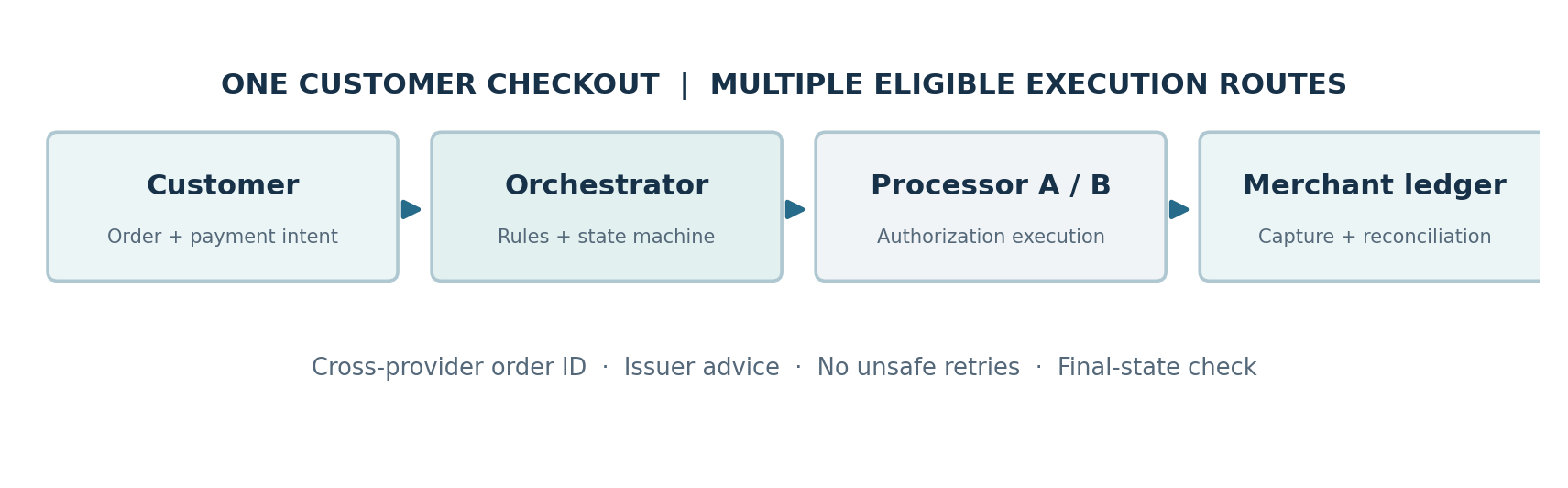
Figure 1. Conceptual routing architecture showing separate decision, execution and reconciliation layers. Drawn from public processor documentation, not an illustration of a particular vendor’s internal code.
A payment vault is related but distinct. It holds reusable credentials or tokens so cards need not be re-entered on each purchase; a vendor-independent vault may support routing to multiple processors where the applicable tokenization arrangement permits it. Stripe’s August 2026 comparison explains why a vault can improve recurring billing even without orchestration, while orchestration without portable credentials can have little capacity to move an existing subscription portfolio. Card-network payment tokens, merchant/acquirer tokens and virtual card numbers are not the same object. PCI SSC explicitly distinguishes these categories. [5][6]
This distinction has real commercial consequences. An online business receiving 50,000 brand-new card payments per month can compare provider availability at each checkout. A subscription platform holding 500,000 saved cards may be constrained by how those credentials were tokenized and which processors are allowed to use them. Token ownership, migration contracts, 3-D Secure authentication continuity and refund support become part of the switching cost. More routing rules alone won’t fix those.
The Decline You Must Not Retry
Processor error codes need classification before any recovery strategy is measured. Stripe explains that issuer network advice can say do_not_try_again, try_again_later or confirm_card_data; different card networks expose different guidance and card schemes restrict repeat attempts. Adyen publishes raw acquirer response advice and warns that some “do not retry” conditions can carry penalty fees. A repeated request after a hard decline can worsen acceptance and risk metrics rather than reclaim a purchase. [4][7]
Consider four examples. When the issuer rejects a card because the account is closed, switching the acquiring route is normally beside the point. When an EEA issuer requires strong customer authentication, the correct response is to complete authentication, not quietly route around it. When the customer typed an incorrect expiry date, the customer needs to correct the details. When the processor cannot be reached and its payment state is unresolved, an alternate attempt is tempting—but making it before resolving the original status can charge the customer twice. These cases all show as unsuccessful attempts on an early dashboard, but they are not operationally equivalent. [4][8]
This is why a payments team should separate authorization rate from final checkout conversion and from net recovered revenue. Authorization rate uses successful attempts as its numerator; a single order may have multiple attempts. Checkout conversion uses orders or customers. Payment recovery should identify genuinely incremental completed orders that would otherwise have failed, not another attempt on an order that was later paid anyway. Otherwise the dashboard can improve simply by adding retries to a denominator it has redefined. The denominator work is boring, and it matters.
| Failure or constraint | Best first response | Suitable for immediate alternate routing? |
|---|---|---|
| Gateway times out, final state unknown | Query status; protect with idempotency and reconciliation | Only after safe-state check |
| Acquirer/processor unavailable, confirmed no authorization | Route to a healthy eligible processor | Often, with controls |
| Issuer says do not try again | Stop; seek another customer payment method | No |
| Authentication required | Re-authenticate the customer | Not as a bypass |
| Expired card or invalid data | Update card details or payment method | Not without correction |
| Soft issuer decline permitting later retry | Respect issuer/network advice and timing | Sometimes; not automatically |
There is an economic ceiling even for sophisticated systems. A backup acquirer does not make an insolvent cardholder solvent. An optimized card vault cannot create a customer’s permission to buy. Routing can increase the probability that a valid payment reaches the issuer cleanly, but it cannot manufacture a valid instrument or an authorized customer. That’s the edge of the model.
An Original $15 Million Monthly Payments Model
Take a hypothetical international merchant with 250,000 monthly attempted checkouts, a $60 average order, and an initial authorization success rate of 91.5%. These inputs are illustrative assumptions, not reported Stripe, Adyen or Spreedly merchant results. The baseline is 228,750 approved orders and 21,250 failures. Suppose 35% of failed orders are technically eligible for a safe alternative route after failure classification, and 18% of those eligible orders succeed on the backup. The incremental result is 21,250 × 35% × 18% = 1,338.75 additional successful orders, about $80,325 in gross sales and 0.5355 percentage points of approval uplift, assuming each additional authorization completes a previously lost order.
To value this, assume a 28% incremental contribution margin after product costs, returns and normal transaction expenses. The recovered sales then provide $22,491 of contribution, not $80,325 of profit. Deduct an illustrative orchestration charge of $0.018 on all 250,000 routed attempts ($4,500), a $0.10 incremental fee on 7,437.5 eligible backup attempts ($744 rounded), and $3,500 of monthly engineering, reconciliation and vendor-management expense. The modeled monthly net contribution is approximately $13,747. No published vendor tariff or measured authorization uplift is being implied. The model deliberately excludes any change in chargebacks, which could swing the outcome. [9]
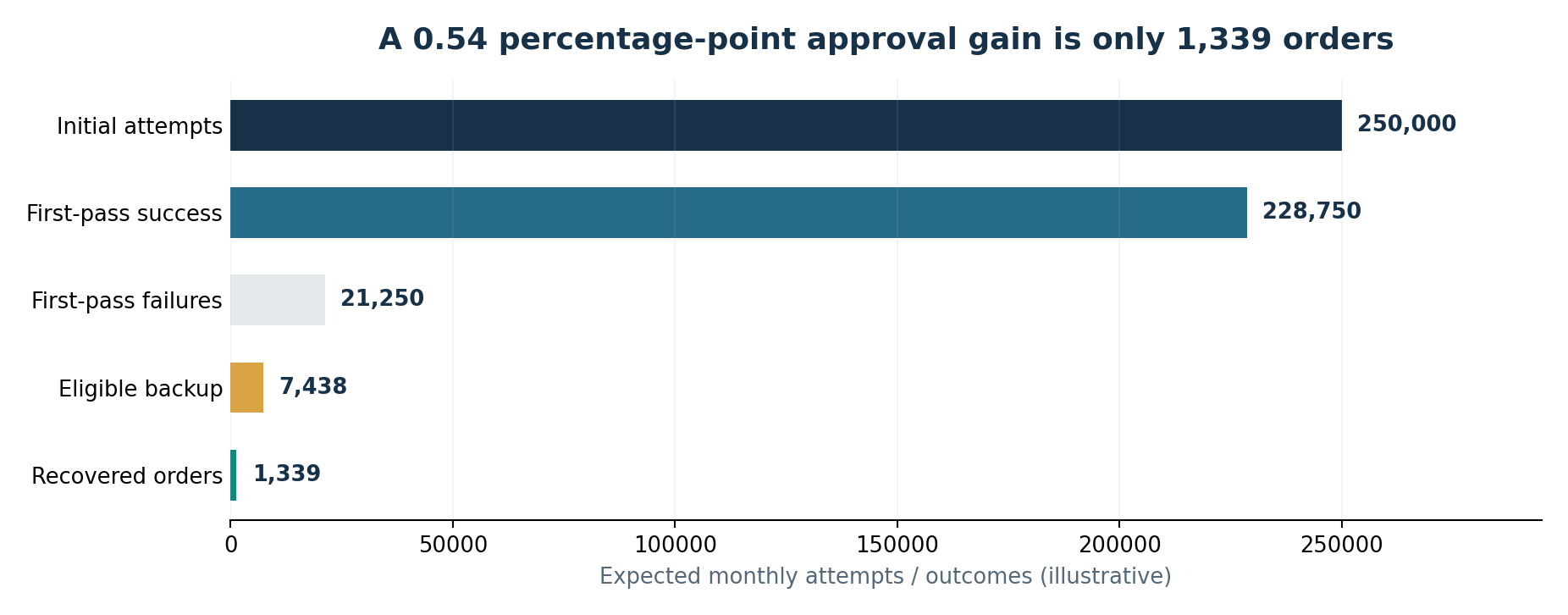
Figure 2. Illustrative transaction waterfall: 250,000 initial attempts, 21,250 failures, 7,438 eligible backup attempts and 1,339 recovered orders. Fractions arise from expected values, not literal fractional orders.
The break-even recovery rate within the eligible cohort is calculated by dividing the monthly incremental cost of about $8,744 by the maximum contribution available from eligible failures (7,437.5 × $60 × 28%). The result is approximately 7.0%. At a 5% eligible-cohort recovery rate, the program loses money under these assumptions; at 18%, it contributes around $13,747. If the extra routing cost instead includes 30 basis points on all processed volume, the economics deteriorate much more sharply: 0.30% of $15 million is $45,000 before operational costs. Merchants should not assume that per-transaction and ad-valorem orchestration pricing are interchangeable.
| Eligible failed attempts recovered | Incremental orders | Contribution before added costs | Net after $8,744 added costs |
|---|---|---|---|
| 5% | 372 | $6,248 | -$2,496 |
| 10% | 744 | $12,495 | $3,751 |
| 18% | 1,339 | $22,491 | $13,747 |
| 25% | 1,859 | $31,238 | $22,494 |
| 35% | 2,603 | $43,733 | $34,989 |
These are scenario sensitivities, not predictions. They assume the backup approves orders that would otherwise have been lost, that average order value remains $60, and that incremental fraud/returns do not increase. If half the apparent recoveries are actually orders that customers would have completed later, the commercial value is nearly halved without changing the headline authorization metric. A growth team needs the control group, not a prettier graph. The hidden assumption is causality.
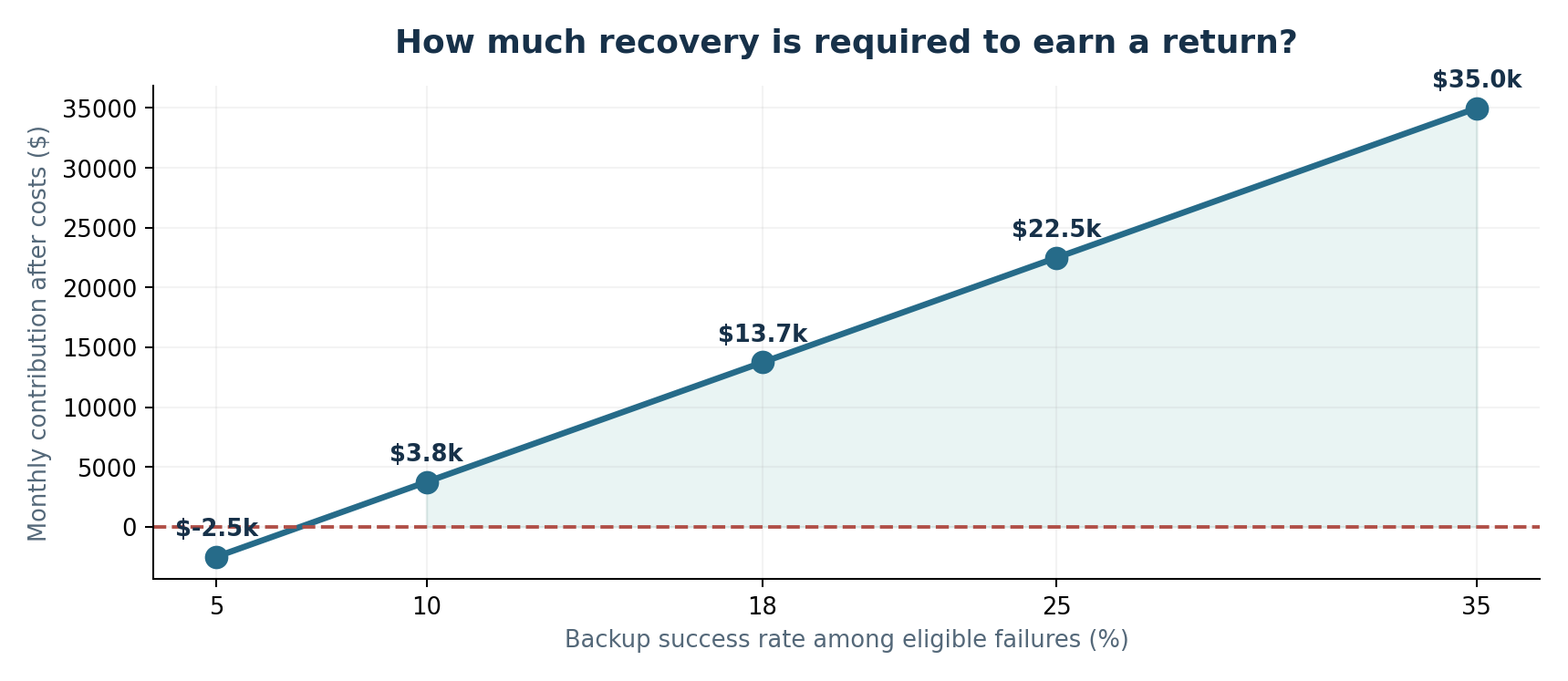
Figure 3. Expected monthly incremental contribution at alternative backup-success rates, holding all other merchant assumptions constant.
The Outage Argument Has a Common-Mode Problem
Resilience is the strongest intuitive case for two processors. If provider A is genuinely unavailable while provider B has independent connectivity, the merchant can redirect eligible transactions and preserve some sales. But independence is an assumption to test, not a property conferred by the word “multi”. Both processors may depend on the same cloud region, token service, card scheme, customer authentication service, DNS provider, front-end script or bank. If that upstream dependency fails, dual acquirers can still fail together.
Adyen’s April 2026 account of merchant payment architecture offers a useful counterexample to marketing claims: one media business adopted a third-party orchestrator for resilience but experienced orchestration-layer reliability problems and moved away from it. That story is an experience shared at an Adyen event, not a broad controlled study; it nevertheless proves that the additional coordinating service can itself become a single point of failure. The fact that orchestration makes topology more flexible does not make any specific deployment more robust. [2]
Repeated payment failures in Indonesia and the Philippines offer a reminder of how merchant-visible errors can emerge from multiple underlying rails. It would be wrong to infer that all such failures could have been avoided with one more orchestrator. Some failures originate in regional banking networks or wallet dependencies shared by every route. A resilience test needs to inject provider failures, shared-dependency failures and an orchestration-control-plane failure separately.
Assume a different merchant produces $50 million in monthly card revenue, spread evenly across 30 days. A two-hour outage covers about $138,889 of order value on a uniform-demand basis. If the backup truly saves 60% of otherwise lost orders, that preserves about $83,333 of gross sales, or $23,333 at a 28% contribution margin before contingency operating costs. The calculation does not establish a typical outage frequency and excludes peak-hour concentration. During a product launch, the same two hours could be worth far more. The model’s usefulness is that it puts a price on what reliability is trying to protect.
There is a more dangerous timeout scenario. A processor may return no response even though an issuer authorization succeeded. Sending the same order to provider B can create a second authorization unless the merchant has a cross-provider order identifier, a state machine and a process to void or reconcile ambiguous attempts. An individual provider’s idempotency key does not automatically coordinate calls to a separate provider. A merchant may end up protecting availability by creating accounting and customer-service incidents. The duplicate can sit unnoticed until settlement or a refund request.
Fraud, Data and the Price of Independence
An orchestrator promises a unified dashboard, but its providers often retain distinct chargeback evidence, fraud models, customer identifiers, settlement schedules and local reporting standards. Routing a customer between processors can fragment risk history. Adyen explicitly warns that splitting data across providers may reduce fraud-system context, while Stripe’s guidance recognizes the more complicated technical and operational structure. [2][10]
Consider a simple adverse-case calculation. If the modeled $80,325 of recovered sales carries an additional 1% unrecoverable loss that was not present in the baseline, the merchant gives back about $803, reducing the modeled contribution to $12,944. At an adverse 5% gross loss, the haircut is $4,016. These are gross loss-rate hypotheticals, not observed orchestration fraud. In reality some losses arise in originally routed transactions rather than recoveries, and some involve chargeback fees, penalties or future monitoring costs. A useful profit report must reconcile net returns and loss cohorts by route, not celebrate all approvals equally.
PCI DSS is another boundary. Outsourcing card storage to a token vault may reduce the merchant’s direct card-data footprint, but PCI SSC says merchants remain responsible for managing and validating their outsourced service providers. The identity and portability of tokens matter. A gateway’s private token is not necessarily portable, and a network token may come with provisioning, domain and transaction-use restrictions. The architecture needs a genuine security assessment; adding a component never removes a compliance duty by magic. [6][11]
The risk is not hypothetical in its software form. A documented Hyperswitch refund-routing problem shows how missing routing metadata can interrupt later refunds even after the original payment succeeded. And separately reported Hyperswitch control-plane bugs illustrate why routing systems require both startup resilience and well-defined payment-state logic. These reports have different evidence levels; they should not be treated as proof of a widespread exploit. [12][13]
How to Test a Vendor Without Buying the Headline
A robust experiment starts by defining an order-level outcome and holding back a representative control group. Segment by issuer country, card network, card type, device, stored versus new payment method, time of day and the reason for the first failure. Include marginal processor costs, orchestrator charges, finance labor, fraud, disputes, refunds and 3-D Secure completion. Measure latency and the 95th- or 99th-percentile checkout time as well as average approval; some lost purchases are caused by waiting rather than a formal decline.
Demand proof of three capabilities before committing a large transaction share. First, classify failures using scheme advice and authentication requirements, making ineligible retries impossible. Second, keep a processor-independent record of the business order and its payment state; a router must be able to distinguish an approved, captured, pending, reversed and unknown payment. Third, test failover under deliberately broken conditions, including the router’s own outage and the inability to retrieve a token. The most polished dashboard is no substitute for a chaos test.
Also compare the orchestrator with smaller changes. Token refresh, 3-D Secure tuning, updated billing data, local payment methods, single-processor routing improvements or issuer outreach may lift acceptance without paying for a fully independent routing layer. Stripe’s vault/orchestration comparison and Adyen’s Auto Rescue documentation show that some gains can come from credential lifecycle or scheduled recurring retries rather than instant processor switching. [5][14]
The thesis would be falsified if controlled testing found that most declines are issuer-driven; if cross-provider credentials are not usable; if improvements disappear after removing customers who would have retried anyway; or if the cost of running the orchestration control plane and reconciliation exceeds the incremental contribution. Another falsifier is correlated outages. If both routes fail simultaneously, redundancy exists mostly on the architecture slide.
Bottom Line
Yes, payment orchestration can reduce failed transactions, but only the subset that are recoverable, eligible to retry and not already recoverable through simpler changes. Its real financial benefit is additional contribution margin plus the option value of independent routes—not a promise to eliminate declines. In the illustrative $15 million monthly merchant model, around 0.54 percentage points of additional approvals generate $80,325 of recovered sales but only about $13,747 of net monthly contribution after assumed incremental expenses. A merchant with thinner margins, more expensive routing or limited credential portability could see the opposite result. The right measure is net economic improvement per original checkout order, audited across the whole payment lifecycle.
Methodology and Limitations
Research cut-off: 13 November 2026. The operational discussion draws on processor documentation, PCI SSC standards and reported platform incidents. Merchant volumes, attempt counts, margins, failure mix, retry eligibility, backup success, charges, recovery rates and outage scenarios are wholly illustrative assumptions and are not derived from a merchant dataset. This is not a causal estimate of orchestrator effectiveness. Waterfall values are expected values, and displayed whole transactions are rounded. The baseline does not include incremental taxes, currency spread, refunds, chargebacks or variable processing charge differences unless otherwise stated. A controlled merchant trial with order-level deduplication is required before assigning commercial value to observed recovery.
Reproducing the Result in a Merchant’s Own Ledger
To make the hypothetical business case reproducible, start with an immutable population of original checkout orders, not payment attempts. Every order must have a first attempt, a definitive commercial outcome and a flag showing whether it was assigned to the orchestration treatment or to the control route. Attempt-level approval is a diagnostic metric; incremental successfully completed orders are the economic outcome. Count an order as recovered only when the payment would not otherwise have completed under the established comparison procedure. That cannot be inferred from a second processor returning an approval. The order may already have been retrying, waiting for customer authentication or resolved by a later payment method.
Next, allocate the full transaction stack to that original order. This includes any primary and secondary authorization charges; incremental cross-border and local-acquiring fees; token-vault and network-token costs; orchestration platform charges; chargeback and fraud expense; refunds; taxes; and the hours required to reconcile exceptions. The model above uses a 28% contribution margin to represent the economic value of incremental revenue before those new routing costs. A business with 8% contribution margin would produce only about $6,426 from the same $80,325 of recovered sales, not enough to cover the $8,744 cost assumption. A 40% margin would produce $32,130 and a substantially stronger case. The approval-rate uplift would be identical in all three cases. That distinction can change an investment decision.
Finally, use an evaluation window that captures deferred outcomes. A transaction may be approved today but later reversed, disputed or refunded. A short real-time test can identify operational failures, yet it cannot fully establish the long-run loss rate of a particular route. Publish results with the exact denominator, eligibility logic and treatment size, including any countries or card types excluded. If a routing experiment appears to lift approvals while increasing duplicated charges or delayed refunds, the ledger has to net those effects. Payment orchestration is successful when the merchant collects more contribution per original order after all downstream events—not when one subsystem reports a higher number of green check marks.
Sources
[1] Stripe, Payment orchestration vs payment gateway, updated March 16, 2026 — Source
[2] Adyen, Payment orchestration in practice, April 27, 2026 — Source
[3] Spreedly, The complete guide to payments orchestration — Source
[4] Stripe Docs, Card declines and network advice codes — Source
[5] Stripe, Payment orchestration or vault, August 19, 2026 — Source
[6] PCI Security Standards Council, Difference between acquiring, issuer and payment tokens — Source
[7] Adyen Docs, Raw acquirer responses and merchant advice — Source
[8] Adyen, Do Not Honor explained, April 23, 2026 — Source
[9] Stripe, Evaluating and managing multiple payment providers — Source
[10] PYMNTS / Spreedly, The orchestration advantage, 2026 survey — Source
[11] PCI SSC, Outsourced payment processing and merchant compliance responsibilities — Source
[12] Dave Finances, Hyperswitch refund-routing incident, October 2, 2026 — Linked contextually in article body
[13] Dave Finances, x402 and Hyperswitch reports, October 29, 2026 — Linked contextually in article body
[14] Adyen Docs, Auto Rescue — Source
[15] Stripe, 2025 product changelog, cross-processor retries — Source
[16] PCI SSC, Payment Card Industry Data Security Standard — Source

Johan Shamshad is Editor-in-Chief at Dave Finances, covering financial markets, digital assets, trading platforms, brokers, fintech, payments and regulation. Since 2023, he has also worked as an editor at Gulf News, the UAE English-language newspaper published by Al Nisr Publishing LLC. His work focuses on market-moving developments, company disclosures, regulatory changes and trading infrastructure, with an emphasis on primary-source verification and practical context for traders and investors.