
A cryptocurrency exchange may have only minutes to decide whether abnormal transactions are a technical malfunction, a compromised signing system or a genuine theft. Waiting for forensic certainty can allow more assets to leave. Freezing customers’ withdrawals too quickly, meanwhile, can trap legitimate money, amplify rumors and punish people who did nothing wrong. South Korea has put this dilemma into unusually explicit regulatory terms in November 2026, while Bithumb’s recent CYBER suspension shows how a narrow precautionary freeze can work without closing an entire exchange.
A Verified Suspension Before the Final Explanation
On November 22, Bithumb said it would suspend CYBER deposits and withdrawals from approximately 2:18 a.m. Korea time because it had detected circumstances suggesting a possible security problem. The exchange cited a provision of South Korea’s Virtual Asset User Protection Act enforcement decree and said trading could continue during the transfer suspension. Its notice warned that pending requests would require additional system checks and that deposits broadcast before the cutoff might not be credited immediately. That is a more precise description than saying ‘Bithumb froze the coin.’ Customers could, according to the notice, still trade while movements onto and off the exchange were restricted.
Bithumb updated the same notice on November 24 to schedule withdrawals to resume at 8 p.m. Korea time. CYBER deposits remained suspended while the asset was designated for investment caution. The announced withdrawal window therefore stretched roughly 65 hours and 42 minutes from the original cutoff to the stated restoration time, assuming the published schedule was met. It is not proof of a confirmed exchange-wallet compromise, a finalized loss estimate or resolution of the underlying bridge issue. The publicly documented security concern related to CYBER’s cross-chain ecosystem, not a finding that Bithumb’s own treasury had been hacked.
One exchange, one token, two directions. The original freeze restricted deposits and withdrawals together; restoration of one function did not automatically restore the other. The difference matters to any investor attempting to move to a competing platform. Buying more CYBER internally would not recreate the missing ability to move the token on-chain.
On November 12, South Korea’s Financial Services Commission discussed issuing a formal no-action position allowing exchange operators to impose preventive deposit and withdrawal blocks when hacking was suspected, rather than delaying until a breach was confirmed. That is not equivalent to unrestricted permission to immobilize customer assets indefinitely. The regime, and the legal duties that accompany it, have to be evaluated against the particular cause, scope and duration of the pause.
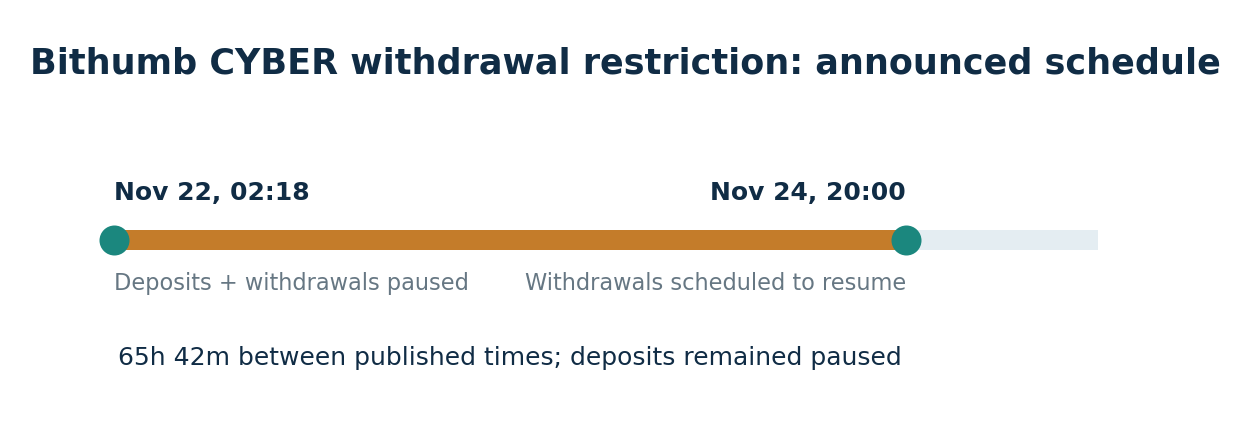
Figure 1. Bithumb CYBER published service-status timeline. Source: Bithumb notice; Dave Finances calculations.
Which Sort of Freeze Are We Talking About?
The word freeze covers at least five operationally different decisions. An exchange may pause withdrawals of one token because its blockchain is not producing blocks; pause one chain’s deposits while a bridge exploit is investigated; restrict a specific account after suspicious login activity; stop withdrawals from all hot wallets after compromised signing credentials; or suspend trading and withdrawals because of a broader solvency crisis. The evidence needed to justify one restriction does not automatically justify the others.
For example, Bithumb’s CYBER notice specified an affected asset, a suspected security cause, treatment of pending transfers and continued trading. In contrast, an account-specific compliance hold may arise from screening, fraud prevention or disputed documentation. Kraken’s public support material says temporary restrictions can protect accounts from scams and meet legal obligations, while its terms reserve powers to restrict redemptions or withdrawals under defined circumstances. The availability of that contractual power does not establish that a given customer’s freeze is proportionate or has been administered correctly.
An exchange’s separate restrictions following the Binance incident illustrate another form of precaution. Operational dependencies and shared risk signals can transmit restrictions across businesses even when custody is represented as separate. It is still necessary to identify which entity makes the final decision.
| Restriction | Typical trigger | Consequence |
|---|---|---|
| Single token/network | Bridge anomaly or chain disruption | Other assets can still transfer |
| Deposits only | Uncertain incoming minting/settlement | Transfers out may remain available |
| Single account | Fraud, sanctions or account protection | Other users unaffected |
| All hot-wallet outflows | Signing compromise suspected | Platform-wide crypto cash-out stops |
| Trading + withdrawals | Severe technical, legal or financial threat | Hedging and exit both impaired |
The Economic Case for Acting Before Certainty
Suppose a security desk sees anomalous transfers from a wallet exposed to $20 million of client assets. It cannot yet determine whether the activity is malicious, but every additional hour of processing creates possible exposure. A simple sensitivity model assumes $500,000 per hour of outgoing withdrawal requests and that 10%, 25% or 50% of those flows would be unrecoverable in a worst-case compromise. Delaying a pause for six hours yields $300,000, $750,000 or $1.5 million of potential exposure, respectively. The figures describe assumed risk, not actual Bithumb transactions or a predicted theft.
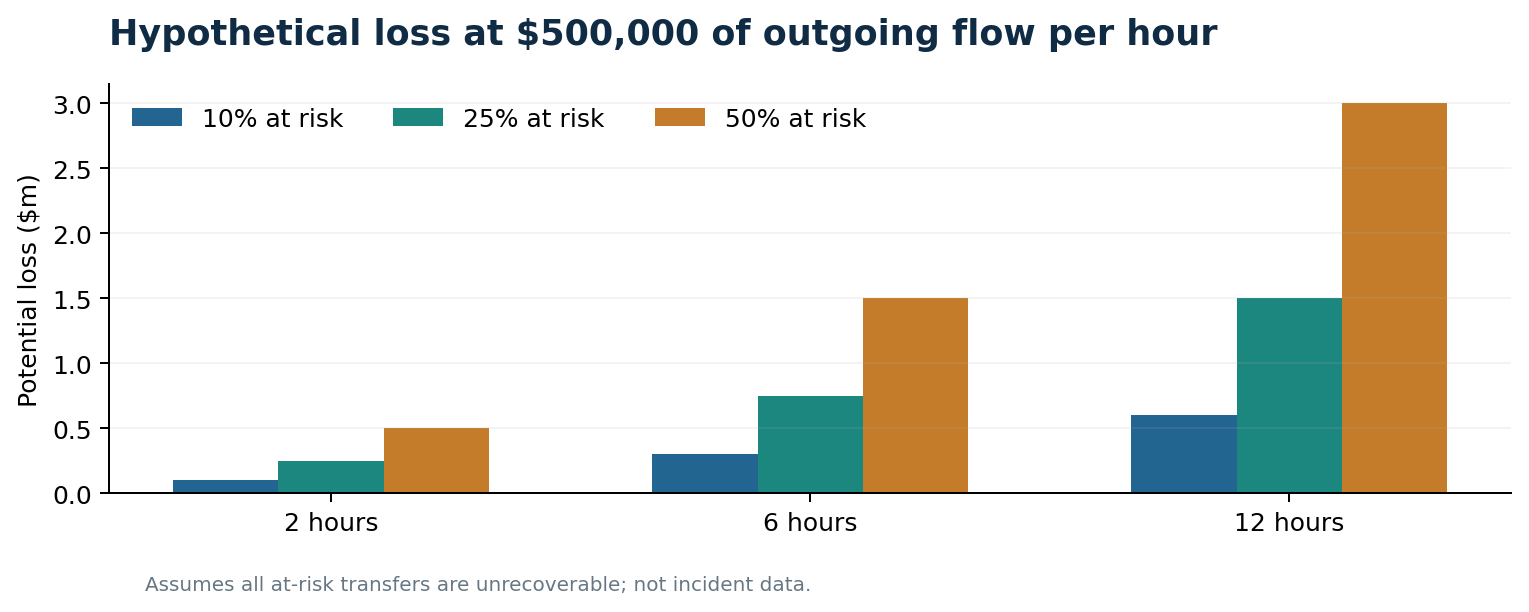
Figure 2. Conditional exposure while withdrawals remain open. Source: hypothetical scenario; Dave Finances calculations.
This model is intentionally not an accusation that regular customer withdrawals are theft. It isolates the downside if an attacker is able to blend malicious instructions into genuine processing. The expected-loss version is smaller: multiply potential loss by the probability of actual compromise. If the probability is only 5%, an estimated $1.5 million contingent loss has an expected value of $75,000. Whether to halt withdrawals therefore depends on the credibility of the alarm, the speed of further evidence and the cost of a false positive.
The cost of a mistaken freeze is harder to quantify because it falls on different participants. Market makers may lose the ability to arbitrage price differences. A hedged trader may be unable to transfer collateral before a margin call. A long-term holder may face little immediate cost if the token’s price is stable, while a trader with directional exposure may lose substantially in a sharp market move. It is not enough to compare a hypothetical hack loss against zero. The customer cost of an unnecessary suspension belongs in the decision.
Consider a $10,000 position in a token that moves 15% during a 66-hour pause. A customer who could have exited at the start but could not trade would face a $1,500 price exposure under that simple assumption. If trading remains available, as Bithumb said it did for CYBER, the problem changes: the user may be able to sell within the exchange but cannot move the asset to another venue or withdraw the corresponding fiat instantly. The comparison must preserve the services that actually remained available.
Security, Liquidity and Solvency Are Not Synonyms
A defensive withdrawal pause is compatible with fully backed customer balances; it can also be the first visible sign of serious problems. Customers cannot diagnose the underlying financial position from the pause alone. A proof-of-reserves snapshot, even a cryptographically verifiable one, says something about specified assets at a specified time. It does not by itself reveal all liabilities, related-party claims, encumbrances, future withdrawal commitments or the legal terms governing access.
An exchange confronting a real hot-wallet intrusion may need to revoke credentials, rebuild signing controls and verify addresses before reopening. Other systems may remain functional. Bithumb’s latest notices, like earlier staged Bitget withdrawal restorations, demonstrate why reopening often proceeds by asset and network rather than one universal switch. The comparison does not imply the same underlying breach type or scale.
A solvency-driven freeze requires a different response: claims reconciliation, independent financial information and possibly insolvency proceedings. Customer demands for an immediate ETA can conflict with the need to publish only supportable estimates. Still, an exchange should not use the vague term ‘security’ to avoid identifying which services and assets are unavailable. A precise notice can preserve confidence better than a long optimistic statement that omits operational boundaries.
What Good Preventive Controls Would Look Like
A defensible response should begin with a transaction- or asset-specific restriction wherever technically safe. The risk team should record the triggering evidence, approvals, affected customers, custody systems, planned review schedule and criteria for reopening. The platform should maintain evidence about transactions queued before cutoff and distinguish broadcast transactions from internal requests still awaiting approval. These facts can later determine whether a transfer should have been blocked, retried or returned.
| Control | Audit question |
|---|---|
| Scope | Is the block limited by asset, network, account and direction? |
| Trigger | What observable event justified immediate action? |
| Review | Who approves a continuation, and when is it reconsidered? |
| Communication | Are pending transfers and reopened services separately described? |
| Reconciliation | Were customer funds and queue status independently checked? |
There is a practical reason to avoid open-ended freezes. Every hour makes it harder for customers to differentiate a careful security response from a liquidity failure, particularly when they cannot inspect the exchange’s private wallet configuration. Public updates need not reveal exploit details or attacker-sensitive thresholds. They can still specify which currencies, networks, account classes and payment methods are working. One well-scoped status table can answer more than a dozen reassurance posts.
South Korea’s November 24 draft framework separately proposes licensing, segregation, incident disclosure and liability requirements for digital-asset providers. Those proposals should not be confused with already-enacted duties or treated as identical to laws in the United States or the European Union. The chronology matters: a November 12 regulatory no-action discussion, a November 22 suspension and a November 24 legislative proposal are three different events with different degrees of legal effect.
A Decision Model That Can Be Audited
An exchange can formalize the decision as a trade-off: expected loss from continuing to process potentially compromised withdrawals against legitimate customer cost from suspending service. For a stylized incident, suppose the probability of compromise is 20%, potential unrecoverable value while monitoring for two hours is $1 million, and the aggregate customer cost of a two-hour pause is estimated at $60,000. The expected cyber loss without the pause is $200,000, making a brief halt economically defensible under those assumptions. If the probability is 2% instead, expected loss is only $20,000; the comparison reverses, absent other considerations. The inputs must come from the incident and risk policies, not from arbitrary numbers chosen after the fact.
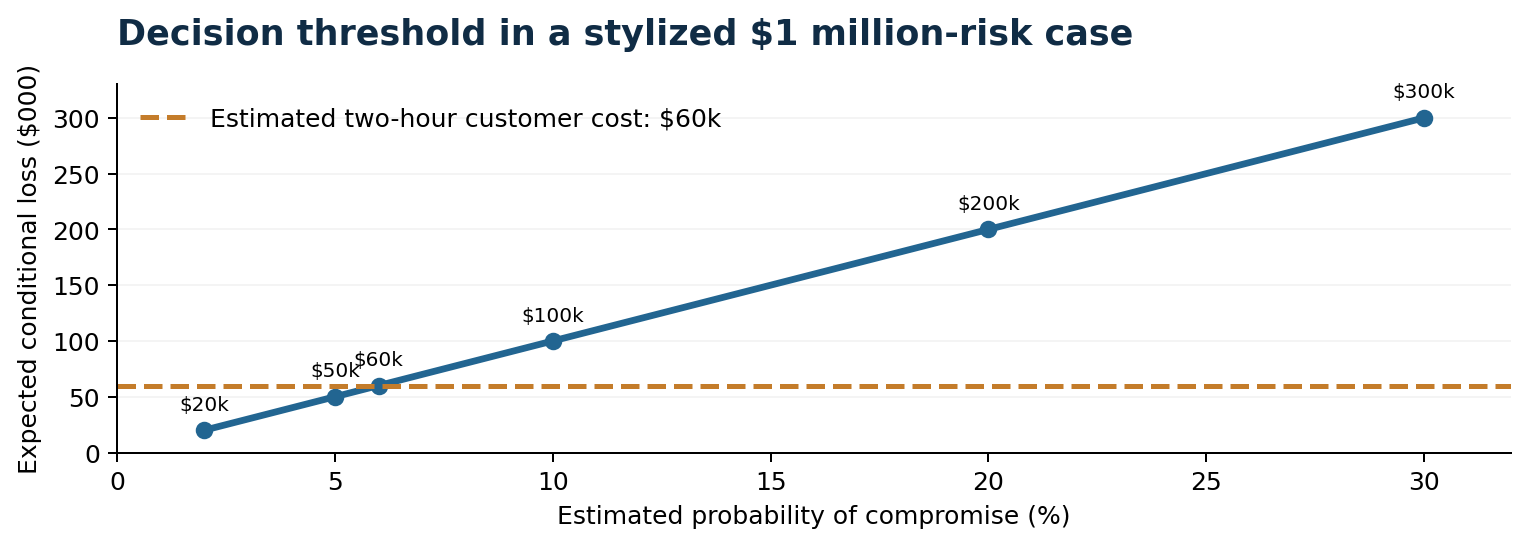
Figure 3. Simplified expected-loss decision threshold. Source: hypothetical scenario; Dave Finances calculations.
That model is not a legal safe harbor or a substitute for consumer protection. Some loss types—privacy breaches, irreversible signing compromise, failure to obey an emergency regulatory order—cannot be reduced neatly to expected dollars. Moreover, a trading halt and a withdrawal halt can produce different customer-cost curves. Their costs should not be aggregated without disclosing what each control stops.
A customer facing a pause should preserve the original notice and its timestamp, open-order information, account statement, transaction hash or pending withdrawal reference, support correspondence and the asset/network designation. This helps establish whether the transfer was submitted before the cutoff and whether the exchange made the promised processing distinctions. A complaint alleging that a Bybit account remained restricted after a flagged withdrawal is not proof of wrongdoing, but it illustrates why duration, review status and scope of an individual hold deserve independent attention.
The Hardest Cost Is the Customer Who Cannot Rebalance
Not every trading strategy depends on the ability to transfer coins continuously. A buy-and-hold investor can often tolerate a short, clearly explained deposit pause. A customer who uses one venue for hedging and another for borrowing may not. If the exchange blocks collateral withdrawal just as volatility rises, that customer could face liquidation elsewhere despite showing a positive account balance on the first platform. The loss is generated by a funding mismatch, not necessarily by a decline in the asset’s fundamental value.
For an illustrative example, take a trader owing $8,000 of collateral within six hours. The funds are available as $10,000 of tokens on an exchange but cannot be moved on the relevant network. Buying replacement collateral on another venue could require $8,000 of separate cash or credit. If the trader must borrow at an emergency rate of 3% for one week, financing costs roughly $56 before fees; if replacement funding is unavailable, the liability can be considerably larger. The numbers are assumptions, not estimated Bithumb customer damage. They show why an exchange should distinguish a safety pause from the secondary liquidity pressure it may impose.
The obvious alternative—never suspending withdrawals unless a hack is proven—has its own flaw. A signing-key compromise can permit irreversible transfers while a forensic team is still verifying the cause. The strongest argument for precautionary measures is therefore not that every alarm deserves a platform-wide freeze, but that some failure modes create an asymmetric choice: delay creates potential permanent loss, while a brief and narrow suspension creates temporary access cost. Governance matters because staff under stress may overestimate a threat or preserve a restriction long after the reason for it has disappeared.
For customers, a restoration announcement is only the first test. Track the network, transaction type and actual completion status. A notice saying withdrawals have ‘reopened’ may coexist with queue backlogs, new address verification, limited assets or deposit restrictions. An independent record of resumed successful transfers is more informative than a dashboard changing color. None of that excuses speculative claims that a frozen venue is insolvent: it calls for evidence proportional to the allegation.
Bottom Line
Exchanges can have credible security reasons to halt withdrawals before proving a hack. Bithumb’s CYBER case provides an unusually transparent illustration of a limited suspension and partial reopening. But speed is only one dimension of a legitimate response. The restriction should be proportionate, documented, reviewed and communicated accurately. Customers deserve to know the difference between protecting a vulnerable transaction path and being unable to return their assets at all.
Methodology
The Bithumb timeline uses the exchange’s stated cutoff and scheduled withdrawal-restoration times in Korea Standard Time; it does not claim independent confirmation of the exact time every customer regained access. The exposure model assumes $500,000 of outgoing requests each hour and hypothetical loss fractions of 10%, 25% and 50%, with no relationship to Bithumb’s actual balances. Expected-loss figures apply independently assumed incident probabilities to conditional losses and contrast them with a hypothetical customer disruption cost. All financial figures are illustrative, not actuarial forecasts.
Sources
Reporting and analysis based primarily on regulatory documents, exchange notices, official technical advisories and product documentation. Accessed November 27, 2026.
1. Bithumb — CYBER deposits and withdrawals suspension, November 22, updated November 24
2. Bithumb — CYBER investment caution announcement, November 22
3. South Korea FSC — Virtual asset cybersecurity response meeting, November 12, 2026
4. South Korea FSC — Virtual asset regulatory draft, November 24, 2026
5. South Korea FSC — Financial sector cybersecurity discussion, November 5, 2026
6. South Korea FSC — Binance-related virtual-asset risk meeting, November 2, 2026
7. Bithumb — ACE security-suspicion temporary deposit/withdrawal stop, November 23
8. Kraken — Global terms of service and suspension powers
9. Kraken — Why an account can be restricted
10. Kraken — Routine withdrawal-hold explanations
11. Coinbase — User agreement and account restrictions
12. Reuters — Bitget withdrawal suspension after hack, September 25, 2026

Johan Shamshad is Editor-in-Chief at Dave Finances, covering financial markets, digital assets, trading platforms, brokers, fintech, payments and regulation. Since 2023, he has also worked as an editor at Gulf News, the UAE English-language newspaper published by Al Nisr Publishing LLC. His work focuses on market-moving developments, company disclosures, regulatory changes and trading infrastructure, with an emphasis on primary-source verification and practical context for traders and investors.