A stablecoin balance that earns 3.75% or 4% can look remarkably similar to a savings account that pays interest. The number rises; the app calls it a reward; the balance is displayed in dollars. But the legal position is different. An eligible depositor at an FDIC-insured bank holds an insured deposit claim, within coverage limits and conditions. A holder of a payment stablecoin holds a digital asset with issuer, platform, custody and redemption risks. An exchange’s reward adds another commercial agreement on top. [1][2][3]
A new regulatory deadline sharpens the comparison. The Office of the Comptroller of the Currency finalized its GENIUS Act implementation rule in October 2026, with an effective date of January 18, 2027. The rule strengthens reserve, redemption, risk-management and disclosure requirements for regulated payment-stablecoin issuers under the OCC’s remit. It does not turn tokens into FDIC-insured savings balances. That is the distinction the headline yield should not hide. [4]
This article adds a different question to Dave Finances’ earlier comparison of stablecoins and savings accounts: after subscription charges, redemption friction and a plausible adverse event, how much additional money does a reward actually provide, and who is legally obligated to pay it?
The Same APY Can Represent Three Different Promises
A savings account ordinarily promises to repay a deposit and pay interest under its deposit contract; the bank is the obligor. Deposit insurance provides a statutory backstop when a covered bank fails, generally up to $250,000 per depositor, per insured bank, per ownership category. The insurance is not a guarantee of a particular future interest rate, but it does protect qualifying principal and accrued interest within the limit when the institution fails. [1][5]
A payment stablecoin such as USDC instead represents a claim governed by the issuer’s legal terms and regulatory arrangements. Circle’s October 15, 2026 USDC terms say that reserve assets back the token, but ordinary holders do not receive the interest earned on reserves. The terms also distinguish directly eligible Circle Mint customers from ordinary holders who may need an eligible intermediary to redeem. On a trading venue, a one-dollar redemption promise is not a guarantee that every sale fills at exactly one dollar. [6]
A platform reward sits on top of that asset. Coinbase describes USDC Rewards as a loyalty program funded by Coinbase rather than bank deposit interest. Its help page says USDC balances are not FDIC- or SIPC-insured, and reward rates depend on location, account type and program terms. PayPal’s PYUSD terms similarly call the product a crypto balance rather than a deposit; its rewards program may be altered or discontinued. [2][3][7]
This is why the shorthand ‘stablecoin savings’ can mislead. A customer may face the issuer to obtain dollar redemption, the wallet platform to recover account access and a separate rewards contract to receive the advertised return. In a bank savings account these functions are comparatively consolidated into the deposit contract and statutory insurance scheme, although banks can also change variable rates and impose account restrictions.
| Instrument | Who pays return? | Primary asset claim | FDIC insurance for holder? |
|---|---|---|---|
| FDIC-insured savings deposit | Insured bank | Deposit liability of bank | Generally yes, within limits |
| USDC held with exchange rewards | Exchange or rewards sponsor | USDC plus platform custody relationship | No for USDC |
| PYUSD with PayPal rewards | PayPal rewards program | PYUSD held via crypto service | No for PYUSD |
| Stablecoin lent in DeFi | Borrowers and protocol economics | Lending/pooled position, not plain token | No |
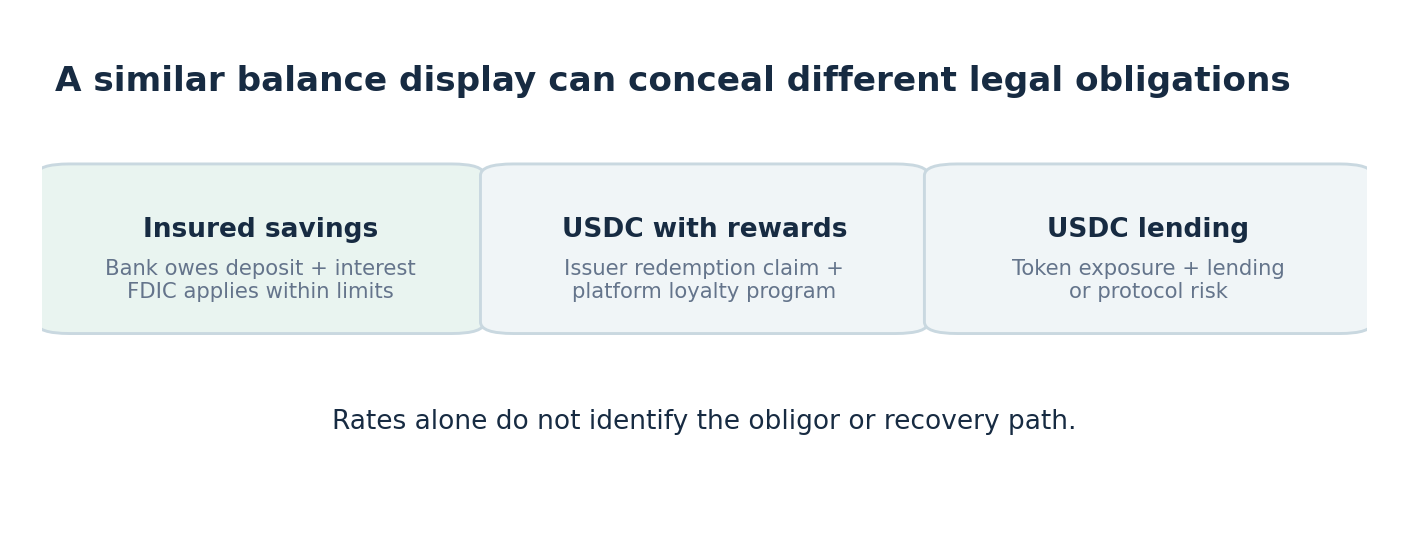
Figure 1. Three dollar-denominated balances, three fundamentally different legal arrangements.
The GENIUS Act Restricts Issuer Yield, Not Every Incentive
The GENIUS Act prohibits a permitted payment-stablecoin issuer from paying yield solely for holding, using or retaining a payment stablecoin. That does not mean a user can never encounter a stablecoin reward: exchanges and other third parties have operated loyalty or incentive programs with distinct contractual structures. Whether a particular arrangement is permitted depends on applicable law, agency interpretation and the facts, not just which entity writes the marketing copy. [4][8]
The October 21 final OCC rule adds substance to reserve quality and liquidity, redemption, custody, supervision and disclosures for issuers it regulates. The final rule takes effect January 18, 2027; readers should not treat every rule provision as though it already governs every product on November 12, 2026. Nor should they confuse GENIUS authorization with government backing of a token’s market price. [4][9]
The FDIC separately proposed rules in April addressing certain stablecoin issuers and deposits held as reserves. The proposal would not treat a token holder as an insured depositor merely because an issuer keeps reserve cash at an FDIC-insured bank. The FDIC distinguished that from a tokenized deposit, where a genuinely recorded bank deposit may retain its deposit character regardless of whether records use blockchain technology. These are legally different instruments even if both appear in a digital wallet. [10]
That legal analysis matters because reserve composition is only one protection. A regulated issuer holding Treasury bills and cash may be materially more robust than an opaque unbacked token. But reserve backing principally asks whether assets can support redemption. Deposit insurance asks whether a statutory insurer covers a depositor’s loss from a covered bank failure. A token’s price in an exchange order book adds a third question: what can the holder sell it for right now? Dave Finances covers those mechanics in how a stablecoin can depeg despite reserve disclosures.
The Extra Yield Is Smaller Once Membership Costs Count
Coinbase’s public USDC page advertises 3.75% rewards for eligible Coinbase One members, while the Basic plan starts at $4.99 per month. The public display is a product offer and can change. A simple calculation can show why looking only at the 3.75% figure is incomplete. [11]
Assume a customer considers paying $4.99 per month only to access a 3.75% USDC reward instead of a hypothetical 3.50% no-fee insured savings account. The headline advantage is 0.25 percentage points, or $25 a year for every $10,000 held. Twelve monthly subscription payments cost $59.88. At $10,000, the incremental reward is therefore $25 and the net disadvantage is $34.88 before any token trading, network or withdrawal costs. The break-even balance is $59.88 / 0.0025 = $23,952.
This is an incremental-cost model, not a claim that every Coinbase One customer must pay the full $59.88 to earn rewards. A person already buying the plan for its other benefits may reasonably allocate less or none of the fee to the reward. A person using a $49.99 annual plan would have a different threshold. The hypothetical 3.50% savings benchmark is a scenario input, not a verified current best savings offer.
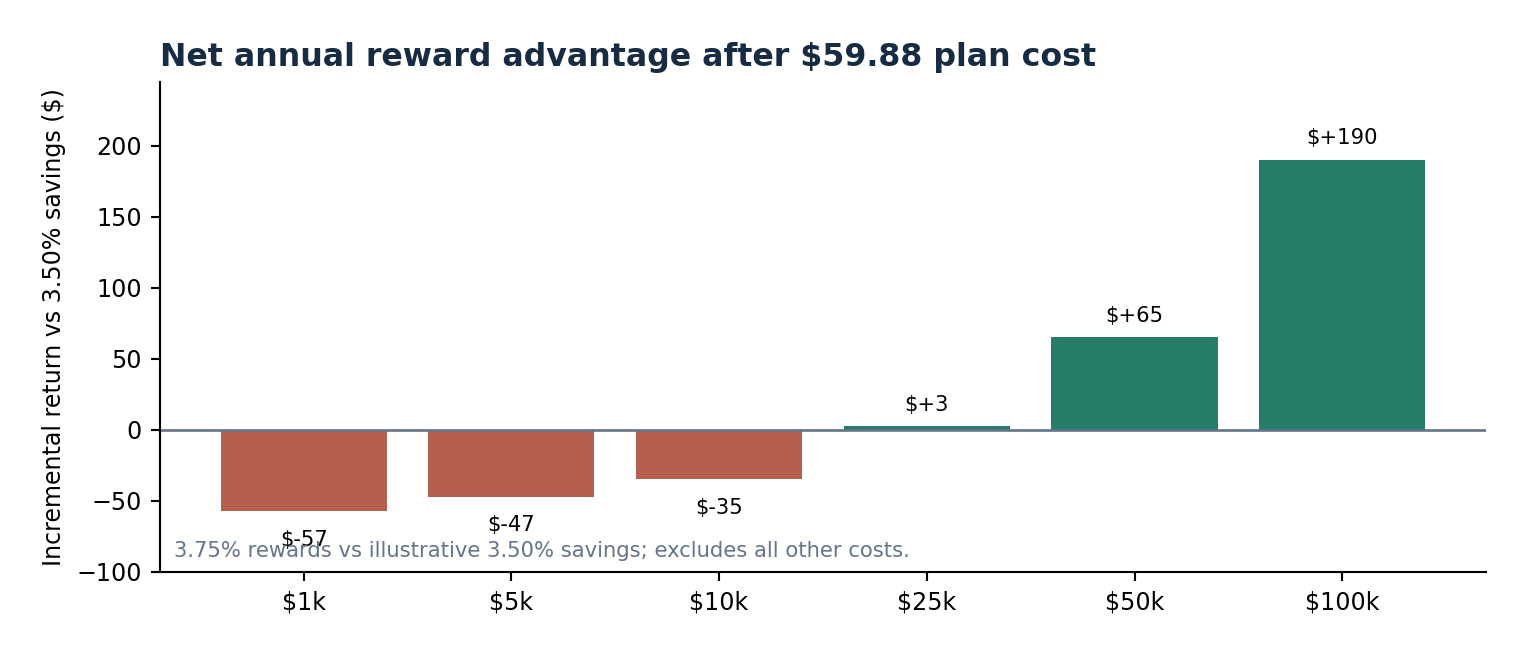
Figure 2. An original membership-adjusted yield comparison; the 3.50% bank savings rate is hypothetical.
The result changes again if the displayed APYs are different, if the exchange charges a conversion spread or if the money is needed suddenly. For $50,000, a 25-basis-point advantage is $125 a year; subtract $59.88 and the net is $65.12. That extra $65 is compensation for a materially different asset and risk structure, not a bonus provided free of trade-offs.
PayPal publicly markets 4% annual rewards on PYUSD, but its terms say the rate is discretionary and may change; rewards are not guaranteed to continue. A user can therefore begin with a rate advantage and end a year with a different average rate. Compare realized, after-fee return rather than the rate on the day of sign-up. [3][12]
The Stress Test: How Much Reward Does a Small Loss Erase?
Consider $10,000 held for one year. A 3.75% reward generates roughly $375 before fees, taxes and rate changes; a hypothetical 3.50% insured savings rate generates $350, a $25 difference. A 1% realized discount to par when selling the stablecoin means $100 of principal-value loss. That is four years of $25 annual yield advantage, ignoring compounding and future rate changes. A 2% loss costs $200, or eight such years; a 5% loss costs $500, or twenty. [6]
Those are illustrative exit-price shocks, not a prediction that USDC will depeg or that every holder would incur the loss. A holder eligible for direct redemption might recover par under applicable terms even when a secondary market trades lower; an exchange customer might be unable to access that route immediately. Timing, liquidity, platform withdrawals and issuer redemption rights determine which price is actually available to a user. [6]
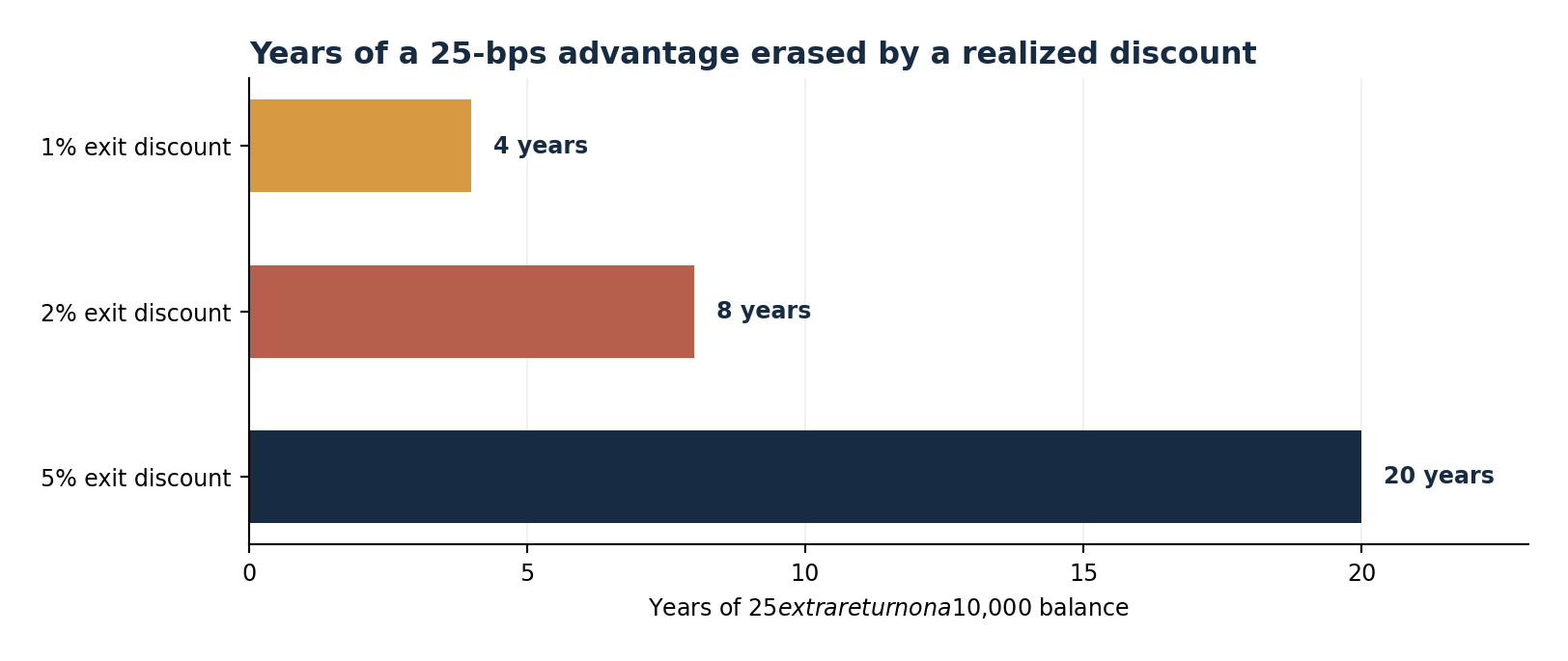
Figure 3. A simple loss-offset test using hypothetical realized exit discounts, not predicted defaults.
There are non-price losses too. Sending tokens to the wrong address can be irreversible. A platform may halt withdrawals, compliance reviews may freeze an account and an onchain lending position may suffer smart-contract or liquidation losses that a plain held token does not. Calling all of these outcomes ‘stablecoin risk’ is too broad. The reader needs to follow the asset chain: wallet platform, token issuer, custodian, reserve banks and any lending protocol. [6][13]
A reserve-attestation report is useful but limited. Circle publishes reserve composition and third-party assurance, which can help readers assess whether USDC is backed by liquid assets. Such reporting does not insure the user against the bankruptcy of an unrelated exchange or mean that every exchange customer has a Circle Mint relationship. The assurance answers a reserve question, not every operational question. [14]
What Happens When a Bank Fails Versus a Token Issuer?
When an FDIC-insured bank fails, qualifying depositors can rely on a statutory insurance and resolution process up to the applicable limit. The insured bank’s failure is the event that matters; market yields and the bank’s portfolio do not determine whether a qualifying $10,000 savings balance is insured. Dollar balances above coverage limits may be exposed. [1][5]
When a stablecoin issuer encounters distress, the relevant issues include eligible reserve assets, segregation, priority of holder claims, issuer redemption procedures and applicable insolvency rules. When an exchange fails instead, the investor’s custody terms and the treatment of omnibus balances matter. Even if the token issuer remains solvent, customer access may depend on a separate intermediary. The reader should identify every legal debtor in the arrangement. [6][10]
There is an important distinction between the ‘reward’ and the ‘coin’ in a failure. A platform’s reward program could stop while the stablecoin keeps functioning. Conversely the platform could remain solvent while the token temporarily trades below par or is frozen. A consumer holding the token in a self-custodied wallet has removed one type of platform custody exposure, but added private-key, network and recovery responsibilities.
Risk can be modest for short periods and still be badly matched to an emergency fund. Saving for a house deposit, payroll or upcoming tax liability is an exercise in being able to access a specific number of dollars at a specific time. A token that transfers 24/7 may be useful for cross-border settlement, yet that advantage has little value if the user will cash out through a bank only once a year. The function of the money should lead the product choice.
The Retail Checklist and the Limits of the New Rules
Start with the asset name rather than the app label. Is it an insured deposit, a token issued by a regulated stablecoin company, or a claim on a lending pool? Then identify the entity paying the advertised reward and whether that entity can reduce the rate without the token issuer changing its terms.
Next, establish the redemption path. Can the user redeem at par with the issuer, or must they sell on an exchange? Does the service require a membership fee or impose spreads, minimums, withdrawal delays or restrictions? What happens when a bank holiday, blockchain congestion or platform outage occurs at the time cash is required?
Finally, test the legal fallback. For a deposit, verify the bank and insurance category. For a stablecoin, read the issuer terms and the platform’s custody agreement. For a yield strategy involving lending or staking, identify smart-contract, borrower and liquidation risk in addition to the token’s underlying reserve structure. [1][2][6]
The January 2027 rule should improve the quality of regulated issuer obligations, but it cannot make unrelated third-party promises risk-free. That is the major conclusion of Dave Finances’ related explanation of 2027 reserve, redemption and custody requirements. The rules matter. So does the chain through which a retail investor actually holds the asset.
A Better Comparison Than Looking at Two Rates
There are at least three decisions that a saver should make separately. The first is where to maintain an emergency reserve whose amount must be available at par. The second is whether to hold a digital dollar for payments, trading or cross-border movement. The third is whether to accept additional investment or lending risk to pursue a larger return. A product can be useful for the second task while being unsuitable for the first. An onchain loan earning 7% is not the same risk category as an exchange loyalty reward of 3.75%, even if both are advertised alongside the same token balance.
The comparison can also reverse if membership is already paid for other reasons. If the full $59.88 membership fee has no incremental cost because a customer wants unrelated features, the modeled $10,000 balance yields the full $25 advantage. But if a customer needs to pay a 0.30% round-trip spread to buy and sell tokens, that same $10,000 position incurs $30 in transaction cost, already more than the $25 annual advantage. The 0.30% spread is a scenario input, not a measured Coinbase or PayPal quote; it illustrates why a live execution price is required for an honest comparison.
The worst comparison is between an onchain headline yield and a bank’s base interest rate without examining the contracts on either side. Rates are only the first line of an economic claim. The rest consists of whose balance sheet is responsible, how quickly dollars can be obtained and what protections remain if the relationship breaks down.
Bottom Line
Stablecoin rewards can be real and valuable, especially for someone already holding digital dollars for trading or payments. They are not the same instrument as insured bank savings. The headline rates may look almost identical while the rights to redeem, regulatory protections, ability to withdraw and entities paying the return differ substantially.
For a $10,000 illustrative balance, a 25-basis-point advertised advantage amounts to just $25 a year before membership and transaction costs. That is the economically relevant scale. When the objective is safe, readily accessible dollars, insurance and redemption certainty matter more than a fraction of a percentage point. When the objective is onchain utility, the reward is one benefit to weigh against the whole risk stack.
Methodology
Research cutoff November 12, 2026. Public rates of 3.75% for Coinbase One USDC and 4% for PayPal PYUSD were observed in provider pages and are variable offers, not forecasts. The insured savings benchmark of 3.50% is an illustrative comparison. Membership assumes twelve $4.99 monthly payments, allocated entirely to rewards in the base case. Net incremental benefit equals balance × (3.75% − 3.50%) − $59.88. Break-even equals membership cost divided by rate spread. Price-shock models treat 1%, 2% and 5% discounts as realized capital losses on $10,000 and divide each loss by the $25 annual yield advantage; they do not estimate default probabilities. Tax, foreign-exchange, changing APY and unobserved transaction charges are excluded.
Sources
[1] FDIC, Deposit Insurance Basics
[2] Coinbase Help, USDC Rewards Overview
[3] PayPal, Cryptocurrency Terms and PYUSD Rewards
[4] OCC, GENIUS Act Regulations: Final Rule, October 21, 2026
[5] FDIC, Coverage Under the Standard Insurance Limit
[6] Circle, USDC Terms, October 15, 2026
[7] Coinbase Help, USDC Rewards Rate and Terms
[8] Congressional Research Service, The Stablecoin Yield Debate, March 6, 2026
[9] Federal Register, OCC GENIUS Act Final Rule, October 23, 2026
[10] FDIC, Proposed GENIUS Act Rule and Reserve Pass-Through Insurance, April 2026
[11] Coinbase, USDC and Coinbase One Marketing Terms
[12] PayPal, PYUSD and Rewards
[13] FDIC, Advisory on Deposit Insurance and Crypto Firms
[14] Circle, Transparency, Reserve Disclosures and Assurance
[15] FDIC, Deposit Coverage and Nondeposit Products

Johan Shamshad is Editor-in-Chief at Dave Finances, covering financial markets, digital assets, trading platforms, brokers, fintech, payments and regulation. Since 2023, he has also worked as an editor at Gulf News, the UAE English-language newspaper published by Al Nisr Publishing LLC. His work focuses on market-moving developments, company disclosures, regulatory changes and trading infrastructure, with an emphasis on primary-source verification and practical context for traders and investors.