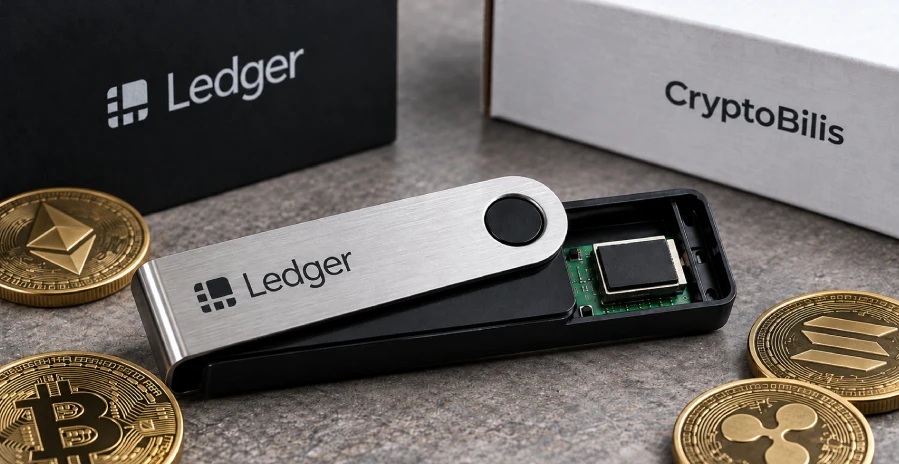
Two owners of Ledger hardware wallets say cryptocurrency was stolen from devices purchased at Virgin Megastore in Dubai, with reported losses of about 1,300 Solana (SOL) and 507,000 Tether (USDT). A public hardware-tampering registry has classified the first device, a Ledger Flex, as containing an unauthorized implant based on photographs. The second device, a Ledger Stax, has not been independently shown to contain one.
The combined loss is approximately $604,000 when the reported SOL amount is valued at about $74 per token, alongside the stated USDT amount. It is an indicative conversion at a recent quoted SOL price, not an independently audited loss valuation at the time of the transfers. The first case has physical evidence in photographs; the second, for now, has the owner’s account.
Ledger Flex photos show an extra board and antenna
An X user known as Rewinsky reported the loss of roughly 1,300 SOL on November 15, then posted pictures of an opened Ledger Flex on November 16. Mark Karpelès’ Ledger Implant OSINT case report classified the device as having a confirmed hardware implant, identifying an added circuit board and antenna on the inside of its rear cover.
The antenna was marked V1.3, compared with V1.2 markings documented on earlier modified Flex devices, according to the registry. That observation helps distinguish the physical example from older cases; it does not establish a new attacker, a manufacturing source or a specific batch of compromised retail inventory. No manufacturer-conducted laboratory examination of this Dubai device has been publicly established.
Rewinsky subsequently identified Virgin Megastore in Dubai as the purchase channel. The source of the photographs and the researcher’s classification provide evidence of tampering, but do not by themselves prove which person modified the device or that the implant caused every reported transfer.
A second account, New Babylon Order Worldwide, said on November 17 that 507,000 USDT was stolen on November 14 from a Ledger Stax purchased new at Virgin Megastore in Dubai on October 11. The owner said the recovery phrase had been generated on the device and was never entered elsewhere, reported filing a police complaint and asked Tether to freeze the funds. Those claims have not been independently verifed; no comparable internal photographs or physical examination have established an implant in the Stax.
Authorized retail status leaves the custody chain unanswered
Ledger’s UAE buying guide lists Virgin Megastores among the brand’s authorized sellers, alongside Dubai Duty Free and other retail channels. That status confirms a recognized commercial relationship. It does not document the chain of custody of a particular box between factory, distributor, store and buyer. It was reportedly bought at a familiar store; that is not the same as a documented unit history.
There is no verified evidence identifying where either Dubai device may have been modified, whether returned goods were involved, or whether an employee or distributor was responsible. Nor has a connection between the two incidents been established beyond the claims about their purchase channel. Ledger and Virgin Megastore were asked for comment by media reporting the cases, without a published response at that point.
The UAE reports follow Ledger’s October investigation into altered devices sold through Southeast Asian reseller CryptoBilis. In a previously published DaveFinances review of the CryptoBilis case, blockchain analytics firm Bitquery had estimated about $102 million in suspected losses across 324 wallets by October 13. That was a research estimate for an earlier group of wallets, not an amount independently confirmed by Ledger or an appropriate total to which the Dubai claims can simply be added.
Genuine Check cannot rule out a hidden implant
Ledger has explained that criminals in the earlier investigation purchased genuine devices, added unauthorized components and returned them to distribution. The identified implants could observe recovery words displayed during normal setup, potentially letting someone reconstruct access to a wallet without breaking the legitimate Secure Element’s cryptography.
The company’s Donjon security documentation states that its Genuine Check authenticates the Secure Element but cannot detect extra physical hardware if that original chip remains intact. The device could pass a real authenticity check and still contain unwanted electronics. That is the awkward part of this threat model.
As explained in DaveFinances’ technical examination of the hidden cellular implant mechanism, an added component can capture recovery information separately from the legitimate signing process. No published evidence establishes that the same internal design and communications channel operated in both Dubai cases, particularly the unexamined Stax.
More than one market now faces supply-chain questions
Earlier reports of suspicious devices in Europe and confirmed tampering linked to Southeast Asia prompted changes in reseller controls. Rival wallet maker Trezor has also documented implants in three Safe 5 devices and reduced its reseller network. Similar attack methods across brands do not prove a single operation, and the UAE purchase reports do not establish widespread contamination of Virgin Megastore stock.
For an owner worried that a recovery phrase was exposed, merely replacing the device while restoring the same phrase would preserve that risk. Funds would need to be moved to addresses derived from a newly generated phrase on independently trusted hardware. Buyers should retain reciepts and product details, contact official support and relevant authorities, and preserve potentially affected devices as evidence instead of attempting an improvised teardown.
That leaves two seperate questions for the ongoing inquiry: how an altered Flex reached the buyer who reported it, and whether the Stax owner’s losses involved the same kind of physical compromise at all. The reported thefts occured days apart, but temporal proximity is not proof of a common source.

Johan Shamshad is Editor-in-Chief at Dave Finances, covering financial markets, digital assets, trading platforms, brokers, fintech, payments and regulation. Since 2023, he has also worked as an editor at Gulf News, the UAE English-language newspaper published by Al Nisr Publishing LLC. His work focuses on market-moving developments, company disclosures, regulatory changes and trading infrastructure, with an emphasis on primary-source verification and practical context for traders and investors.