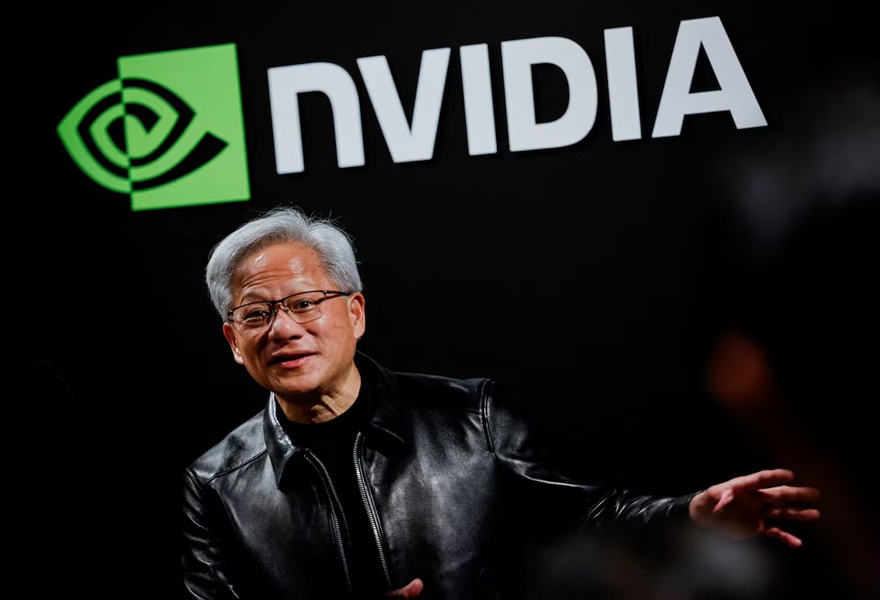
Nvidia has stopped shipping licensed Hopper-generation artificial intelligence processors to China, despite reporting $2.4 billion in sales of the products during its fiscal third quarter. Interim chief executive Colette Kress disclosed the halt on the company’s November 17 earnings call, saying the next-quarter forecast includes no further sales of licensed Hopper data center products to Chinese customers.
The statement marks a break in shipments under a US export-licensing arrangement intended to permit restricted sales of advanced processors, including H200 chips, to approved Chinese buyers. Kress did not say what caused the halt, whether customers had canceled orders or when deliveries might resume. The shipments have stopped. The licensing framework itself has not necessarily disappeared.
China’s $2.4 billion contrasts with a zero-revenue forecast
Nvidia’s fiscal third quarter ended October 25, 2026, with total revenue of $115.8 billion, up 103% from a year earlier. Data Center revenue reached $107.6 billion, a 110% annual increase. The reported $2.4 billion of licensed Hopper sales to China equals about 2.1% of company revenue and 2.2% of Data Center revenue for the quarter.
The November 17 earnings release filed with the SEC forecasts $130 billion of revenue for the fiscal fourth quarter, within a 3% range, while assuming no Data Center compute revenue from China. The top-line forecast therefore rests on sales elsewhere even though China contributed billions in the period just completed.
Zero in a forecast is not quite the same as zero forever. A future shipment approval or import decision could change sales opportunities, but neither Kress’s comments nor the SEC-filed guidance provides a timetable or a contractual value for any resumption. A forecast assumption also should not be interpreted as proof that every type of Nvidia product is banned from sale in China.
The $2.4 billion figure is sales recognized for a completed quarter, not the value of an order backlog waiting for customs clearance. The company has not broken out the gross profit attributable to those licensed China sales, so their disappearance cannot be translated directly into a precise earnings loss.
American licenses have not ensured Chinese import approval
Washington eased its review approach for certain H200 exports in January 2026, allowing license applications to be considered case by case under security conditions. That arrangement followed earlier restrictions on advanced US AI chips. Approval from US authorities, though, does not guarantee approval from China to import the same equipment.
Reuters reported on November 5 that roughly 600,000 H200 chips were being held in Hong Kong as Beijing withheld permission for large-scale mainland imports. The report cited people familiar with the arrangements. It did not establish that Nvidia owned all of the waiting inventory, and those processors should not be added to the $2.4 billion of recognized quarterly sales as though they were a second confirmed revenue figure.
Earlier US clearances reportedly covered ten Chinese companies, including Alibaba, Tencent and ByteDance. Some technology groups reportedly received smaller batches of processors, while broader deliveries remained constrained. A buyer’s desire for high-performance chips and a supplier’s ability to export them are seperate from the importing country’s final decision.
The competing pressures create an awkward situation for Nvidia. Chinese cloud operators want more AI computing capacity, but Beijing also wants to reduce reliance on advanced US technology. The halt may reflect regulatory or commercial constraints, or a mixture of both; the company has not publicly specified a single cause.
Kress delivers the outlook after Huang’s resignation
The announcement came in Nvidia’s first earnings call since Jensen Huang resigned as chief executive and director on November 12. Kress, previously chief financial officer, is serving as interim CEO while retaining the finance role. DaveFinances covered the leadership change and the market’s immediate reaction when the company confirmed the succession.
The company’s November 17 financial report shows continued expansion outside the restricted China business. Third-quarter GAAP net income reached $65.3 billion, up from $31.9 billion a year earlier, while Data Center sales rose 21% from the previous quarter. Stronger results do not make the lost China route irrelevant, but they reduce the case for treating it as a halt to Nvidia’s overall growth.
There is a leadership task here, too: maintain supply and customer commitments while investors seek clarity on export access. An earlier DaveFinances analysis of Nvidia after Huang examined the importance of Nvidia’s existing software ecosystem and orders, even as a new chief executive takes charge. A change in leadership does not, by itself, explain the shipment decision.
AI demand remains strong as China access narrows
Nvidia’s outlook relies on continuing AI infrastructure investment beyond China. The company highlighted shipments of Vera Rubin NVL72 systems and demand from major cloud operators, illustrating how sales to other regions and products can sustain revenue even with the restricted Hopper business absent from its near-term forecast.
Demand is not equivalent to a completed export, however. A chip can be manufactured, ordered and licensed in one jurisdiction while still waiting for an import authorization in another. That timing uncertainity affects distributors, customer deployment plans and the prospect of converting pent-up demand into recognized sales.
Chinese buyers also have reasons to pursue alternative suppliers or architectures if access to Nvidia hardware remains unreliable. DaveFinances previously examined Google’s AI-chip competition with Nvidia in the context of large customers diversifying their computing suppliers. That comparision concerns a different market and does not establish that Chinese firms have already replaced Hopper processors at scale.
Nvidia has not disclosed an expected restart date or given a detailed explanation for the shipment halt. Investors therefore have two distinct indicators to watch: whether US-approved H200 units actually recieve Chinese import clearance, and whether future Nvidia guidance begins to assume China Data Center compute revenue again. For now, the next-quarter guidance assumes none.

Johan Shamshad is Editor-in-Chief at Dave Finances, covering financial markets, digital assets, trading platforms, brokers, fintech, payments and regulation. Since 2023, he has also worked as an editor at Gulf News, the UAE English-language newspaper published by Al Nisr Publishing LLC. His work focuses on market-moving developments, company disclosures, regulatory changes and trading infrastructure, with an emphasis on primary-source verification and practical context for traders and investors.