
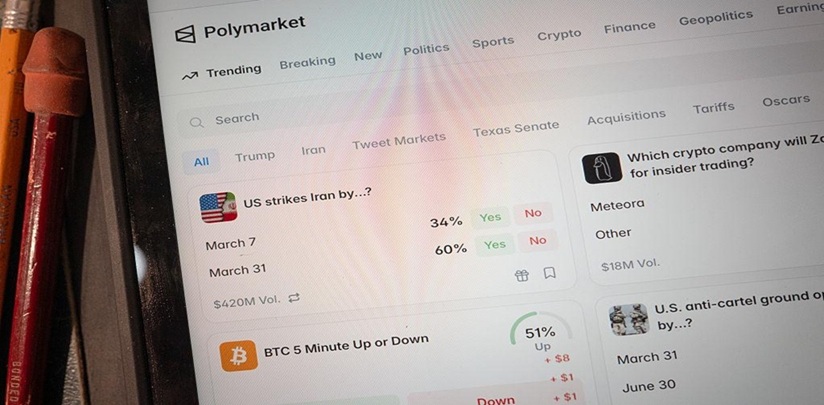
Prediction markets love calling themselves truth engines. Prices as probability. Collective intelligence distilled into a number.
Then six wallets turned roughly $1 million into $1.2 million betting the United States would strike Iran — hours before the bombs fell.
That’s not abstract theory anymore.
That’s a stress test.
The Trade That Lit the Fuse
On Polymarket, six accounts piled into a contract titled “US strikes Iran by February 28, 2026?” just hours before coordinated US and Israeli airstrikes began.
Later, President Donald Trump confirmed what he called “major combat operations,” reportedly branded “Operation Epic Fury.”
The trading wasn’t subtle.
- Most wallets funded within 24 hours of the strike
- All created in February
- Concentrated almost entirely in the February 28 contract
- Activity stopped after resolution
One wallet dropped about $60,800 at roughly 10.8 cents per share and walked away with nearly $500,000 when the contract resolved at $1.
Another put in about $30,000 at 20 cents and cleared roughly $120,000. A third logged a reported 900% return on under $10,000.
Blockchain analytics firm Bubblemaps mapped the wallets and showed clustering in funding paths — suggesting coordination, possibly shared control.
This wasn’t someone casually aping in on a hunch.
This looked surgical.
And The Market Reacted
The strikes didn’t just resolve a contract.
Bitcoin slid on confirmation. Risk-off reflex. Oil futures on Hyperliquid spiked as traders priced in supply risk and regional instability.
That’s the part policymakers notice.
Prediction markets are no longer weird side bets. They intersect with real asset flows — crypto, commodities, equities. If someone has advance knowledge of a military strike, the edge multiplies across markets.
You’re not just winning a binary contract.
You’re front-running oil.
You’re shorting BTC.
You’re stacking asymmetric trades.
That changes the scale of concern.
Forecasting Skill Or Insider Trading?
Here’s the core fight.
Are these traders just sharp geopolitical forecasters? Or did they access non-public intelligence?
Polymarket’s CEO, Shayne Coplan, has argued before that informed traders improve price discovery. It’s a classic Hayekian take — markets aggregate dispersed knowledge, even if some participants know more.
In theory, that’s elegant.
In practice, US law doesn’t care about philosophical elegance. Trading on material non-public information is illegal in regulated markets.
The Commodity Futures Trading Commission has already warned that insider trading in event contracts can violate federal law. Chairman Mike Selig recently said exchanges are the “first line of defense.”
But how does an onchain venue detect classified intelligence misuse?
There’s no corporate insider list here. No earnings calendar. The information might sit inside a government agency or military command.
That’s qualitatively different from a leaked merger memo.
Polymarket vs Kalshi: Two Philosophies Colliding
This episode also throws a spotlight on the contrast with Kalshi.
Kalshi is registered with the CFTC as a designated contract market. It has publicly disclosed insider investigations — nearly 200 of them — and recently suspended users for trading on privileged knowledge tied to entertainment outcomes.
Its CEO, Tarek Mansour, leans hard into NYSE-style standards. Kalshi has publicly backed legislative efforts like the Public Integrity in Financial Prediction Markets Act of 2026.
Polymarket, while securing regulatory progress in late 2025, has historically taken a more open stance toward informed trading.
That divergence matters politically.
Senator Chris Murphy has said he is working on legislation to restrict what he calls destabilizing war-related prediction markets.
Kalshi has distanced itself from “war markets.” Polymarket has not.
That difference could define the regulatory split in this industry.
This Isn’t An Isolated Incident
The Iran strike contract isn’t the first suspicious episode.
Earlier this year:
- A Venezuelan regime-change market produced a $400,000 gain for a newly created wallet
- Israeli prosecutors indicted individuals for allegedly using classified intelligence to bet on strike timing during the 2025 Twelve-Day War
- Multiple wallets piled into a contract tied to an investigation teased by ZachXBT before details were public
The pattern is uncomfortable.
When markets revolve around discrete geopolitical events, the probability of information asymmetry skyrockets. The timing windows are tight. The payouts are binary. The incentives are enormous.
This is fertile ground for insiders.
Why Binary Markets Are Especially Vulnerable
In equities, insider information nudges valuation.
In binary event contracts, insider information determines the outcome.
There’s no partial edge. If you know the strike is happening, the contract isn’t “slightly undervalued.” It’s mispriced by definition.
Liquidity is thinner. Expiry is fixed. The profit window is narrow.
In the Iran case alone, the February 28 contract saw nearly $90 million in volume — part of over $529 million wagered across related strike contracts.
That’s not hobbyist money anymore.
That’s systemic exposure.
The Moral Hazard Nobody Wants To Own
There’s also an optics problem that goes beyond legality.
Betting directly on military escalation hits differently.
Yes, oil futures price geopolitical risk. Defense stocks rally on conflict. That’s reality. But explicitly wagering on whether a country will be bombed feels like crossing a psychological boundary.
Even if it’s legal.
Even if it’s “just probability.”
For lawmakers, that boundary matters. And once it becomes political, regulatory responses accelerate.
“Blockchain Transparency” Isn’t A Shield
Some defenders argue that onchain transparency solves the problem. Analysts like Bubblemaps can trace clusters and funding paths.
That’s useful — after the fact.
It doesn’t stop someone from exploiting privileged information before resolution.
Unless platforms implement:
- Strong identity verification
- Real-time anomaly detection
- Clear insider definitions
- Cooperation with regulators
the edge remains exploitable.
Decentralization doesn’t neutralize asymmetry. Sometimes it amplifies it.
Why Platforms List These Markets Anyway
Because they print volume.
Geopolitical contracts generate attention, headlines, engagement spikes. In a competitive crypto environment, that’s oxygen.
But high-engagement markets invite high-intensity scrutiny.
If retail traders start believing insiders systematically extract value, trust erodes fast.
And retail tolerance has limits.
The Hard Question Nobody Can Dodge
In markets tied to classified decisions, is fairness even structurally possible?
Corporate markets have disclosure rules. Earnings releases are scheduled. Insider lists are defined.
Military operations are secret until execution. By design.
That means natural insiders always exist.
Prediction markets assume reasonably equal access to relevant public information. War contracts violate that assumption from the start.
That’s not a Polymarket flaw. It’s a structural tension inside geopolitical event betting.
This Feels Like An Inflection Point
The $1 million headline isn’t huge in crypto terms. But symbolically? It’s massive.
It crystallizes everything critics worry about:
- Information asymmetry
- Regulatory ambiguity
- Ethical discomfort
- Enforcement gaps
Prediction markets want to evolve into mainstream forecasting infrastructure. To do that, they need legitimacy.
Legitimacy requires enforceable insider standards. Not vibes. Not philosophy. Actual guardrails.
If exchanges truly are the “first line of defense,” this is where they prove it.
Right now, prediction markets price the future.
But their own future hinges on whether they can convince regulators — and users — that those prices aren’t quietly shaped by privileged intelligence.
Six wallets.
A million dollars.
And a war contract that may end up defining the regulatory arc of the entire sector.
Disclaimer
This article is for informational and educational purposes only and does not constitute financial, investment, trading, or legal advice. Cryptocurrencies, memecoins, and prediction-market positions are highly speculative and involve significant risk, including the potential loss of all capital.
The analysis presented reflects the author’s opinion at the time of writing and is based on publicly available information, on-chain data, and market observations, which may change without notice. No representation or warranty is made regarding accuracy, completeness, or future performance.
Readers are solely responsible for their investment decisions and should conduct their own independent research and consult a qualified financial professional before engaging in any trading or betting activity. The author and publisher hold no responsibility for any financial losses incurred.