
A foreign introducing broker does not escape United States registration rules simply because it operates outside America, receives affiliate commissions instead of customer deposits or relies on a white-label trading platform. The Commodity Futures Trading Commission reinforced that principle on November 9, 2026, when it sanctioned eight individuals for acting as unregistered associated persons of unregistered foreign introducing brokers involved in soliciting US customers for leveraged off-exchange trading. The practical boundary is the conduct and customer involved, not the corporate address printed on the website. But the shorthand that all “unregistered brokers are banned” needs qualification: exemptions, the specific products and who actually solicits an order matter.
What the November Enforcement Orders Actually Establish
The CFTC’s November 9 release describes eight separate settling orders against individuals who solicited US customers who were not eligible contract participants. The agency said the respondents acted as unregistered associated persons of foreign introducing brokers. The orders required them to cease the unlawful conduct and barred them for two years from CFTC registration or certain roles with registrants. The release also refers to penalties in related Securities and Exchange Commission proceedings. It does not disclose a new aggregate restitution payment to the affected forex customers or say that every unregistered foreign affiliate falls under precisely the same facts.
This action followed the CFTC’s June 29 order against Netrios LP Ltd. and Red Acre Ltd. for facilitating illegal off-exchange leveraged or margined retail commodity transactions involving US customers. Netrios was ordered to pay $1.75 million and Red Acre $750,000, a combined $2.5 million. The conduct in that earlier matter included infrastructure and support for offshore branded trading platforms. These are related enforcement facts, not interchangeable charges: the June firms were sanctioned for the activities specified in their order, and November’s individuals for their own unregistered solicitation roles.
Dave Finances’ reporting on the eight CFTC sanctions traces that enforcement sequence. The deeper analytical question is why a regulator cares about an affiliate who neither signs the CFD contract nor takes custody of the customer’s money. The answer lies in the distribution chain: solicitation can determine which retail investor is exposed to a leveraged transaction, what claims are made about the product and who receives commissions for bringing the order. The market can hide multiple regulated functions behind one landing page.
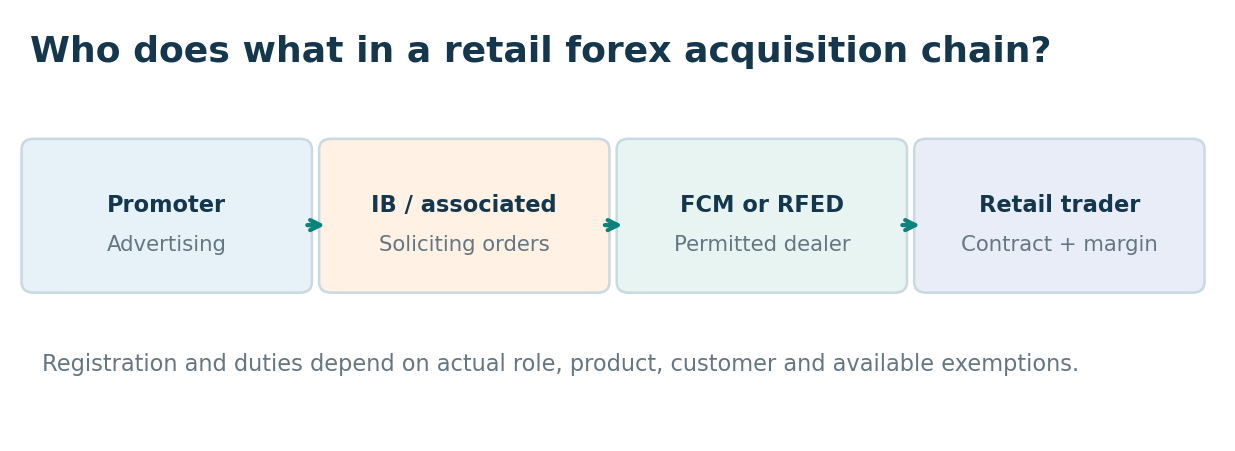
Figure 1. Distinct distribution, introducing and counterparty roles. Source: NFA forex regulatory guide; Dave Finances calculations.
An Introducing Broker Is Not Just a Marketing Label
The National Futures Association defines an introducing broker as a person or organisation that solicits or accepts orders for futures, commodity options, retail off-exchange forex or swaps but does not accept customer funds to support them. The lack of custody is part of the role’s definition, not an exemption from registration. The NFA’s forex guide states that entities introducing retail forex customers to registered futures commission merchants or retail foreign exchange dealers generally must register as IBs and become NFA members unless a specific exception applies. Individuals soliciting orders or supervising solicitation can need associated-person registration and forex approval.
A registered introducing broker also does not become an authorised principal counterparty merely by registering. The customer trades with an appropriately permitted FCM, RFED or other legally permitted entity. The registered IB may originate and service the relationship, and the dealer is responsible for its own counterparty obligations. Retail traders should find the precise executing firm, the introducer’s regulatory status and the individual salesperson’s status rather than conflating all of them with the group name.
The rules are also not identical for every type of marketing. An independent publisher discussing economic news, a passive website selling generic advertising, a firm arranging introductions to qualified institutional counterparties and a compensated salesperson soliciting US retail forex accounts may have materially different legal analyses. The boundary depends on actual communications, order activity, compensation, control and product. Rebranding a soliciting agent as a “consultant” does not change those underlying facts, but ordinary commentary should not automatically be characterized as regulated solicitation either.
| Role | Activity | Regulatory distinction |
|---|---|---|
| Passive media publisher | General information / advertising | Facts may fall outside regulated solicitation |
| Introducing broker | Solicits or accepts covered orders | Registration / NFA membership generally required |
| Associated person | Individual soliciting or supervising | AP and forex approval can apply |
| FCM / RFED | Executes as permitted retail OTC counterparty | Separate counterparty permissions apply |
| Account manager | Exercises trading authority | May require CTA registration |
Why Foreign Incorporation Does Not Neutralise the US Customer Connection
An offshore company may be lawfully incorporated and licensed somewhere else. Neither fact automatically authorises it to solicit US retail customers for leveraged off-exchange forex contracts. The NFA’s own introducing-broker registration page includes a narrow exception for certain non-US residents or firms with *only non-US customers* and specified clearing arrangements. That wording matters. An offshore introducer intentionally onboarding US retail customers cannot simply claim the non-US-customer exception on the strength of its incorporation address.
The Commodity Exchange Act and CFTC rules govern retail leveraged forex contracts under a defined US regulatory framework. The NFA guide identifies the principal authorised counterparty categories, including RFEDs and qualifying FCMs, along with certain financial institutions. It also distinguishes introducing entities, associated persons, account managers and pool operators. Financial status and eligible-contract-participant criteria can change the legal regime, but a trader’s self-description as “professional” on an offshore form should not be assumed sufficient. The legal ECP definition and the actual instrument determine the treatment.
For customers, this structure creates a practical difference between sending money to a legitimate registered retail forex dealer through a registered introducing broker and sending funds to a foreign CFD platform promoted by an unregistered salesperson. Registration is not a guarantee of profits or full protection against loss. It provides supervisory mechanisms, accountability and rules for promotional conduct, conflicts, risk disclosure and the identity of the regulated counterparty. Dave Finances’ broker licensing comparison explains why a licence held in one jurisdiction should not be marketed as unrestricted authority to serve every customer globally.
The Commission Incentive Is Quantifiable
Suppose a foreign affiliate network recruits 500 retail customers, and a hypothetical offshore promoter earns $250 for each funded account. The gross acquisition commissions would be $125,000. If the compensation instead pays $8 for every standard lot traded and each customer places 20 lots over a period, the resulting gross commission is $80,000. If both structures apply, the modeled receipts total $205,000. These are hypothetical revenue arrangements, not the compensation figures in the November 2026 orders.
The difference matters because commission design shapes incentives. A flat sign-up commission rewards rapid onboarding; a volume rebate rewards continuing trading activity. Neither payment structure automatically proves misconduct, but both can create conflicts when the promoter encourages excessive leverage, understates loss statistics or conceals that the customer is trading with an offshore firm lacking applicable US permissions. Economic incentives are relevant to the risk of unsuitable solicitation even when a salesperson never touches customer money.
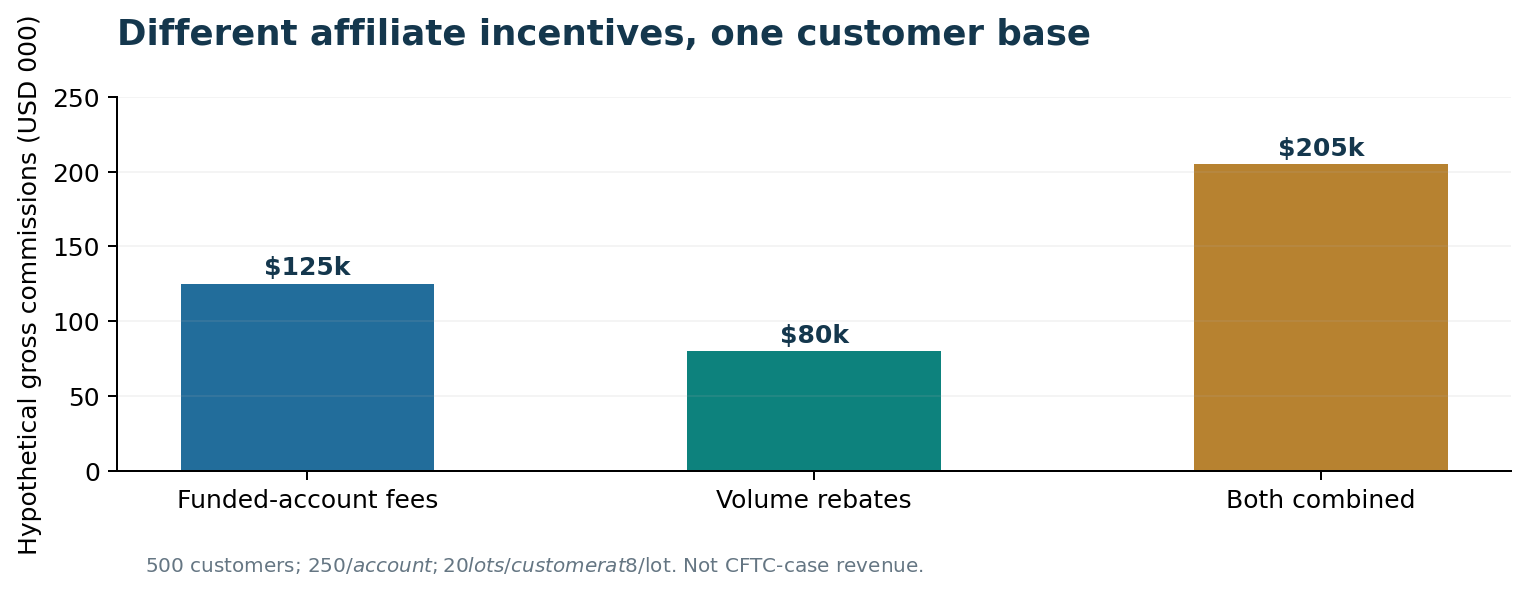
Figure 2. Hypothetical gross commission incentives. Source: scenario assumptions; Dave Finances calculations.
There is another reason enforcement can reach beyond a branded exchange or broker: technology outsourcing fragments the process. One company may operate the website, another set prices, a third supply matching and account infrastructure, and a network of individuals recruit customers. The CFTC’s June and November orders illustrate that these participants can have separately assessable roles. A regulator is not obliged to accept the marketing diagram as the legal diagram. An offshore platform can be operationally complex and still have a straightforward US retail-solicitation problem.
What Does Registration Change for the Customer?
A retail trader should be able to identify the counterparty actually executing the transaction, where customer funds are held, what leverage terms apply, which body supervises the introducing broker and whether the customer has a defined complaint process. NFA registration allows verification through its BASIC database, including membership and disciplinary history. It does not turn retail spot forex into a bank deposit or provide federal deposit insurance against trading losses. OTC leveraged forex is exposed to market and counterparty risks even when sold through properly registered institutions.
Registered FCMs and RFEDs must comply with requirements applicable to their businesses, including certain financial, disclosure and supervision rules. Introducing brokers must comply with their own registration and member requirements. The system’s economic purpose is not merely to collect a licence fee; it allocates responsibility to the people and businesses capable of influencing retail traders’ decisions and handling their orders. For an offshore intermediary, the question becomes whether the customers it actively seeks, the products it markets and its activity bring it within that framework.
Dave Finances’ explanation of the distinction between prop firms and brokers helps make the related product question concrete. A simulated trading evaluation does not necessarily create the same legal activity as the solicitation of an actual retail forex order, although a firm’s labels cannot substitute for examining how it operates. It is the true relationship and flow of orders or funds that must be assessed.
| Question | Supporting evidence |
|---|---|
| Who solicited the account? | Email, referral links and calls |
| Who accepted the order? | Trade confirmation; counterparty contract |
| Is US retail business being targeted? | Eligibility, address and marketing records |
| What product is traded? | Off-exchange leveraged forex vs other instruments |
| Who is registered? | NFA BASIC / CFTC records |
| Who gets paid? | Referral contract, per-lot or CPA schedule |
A Geographic Filter Has a Business Cost, but It Is Not a Legal Shortcut
A firm with an international audience might find US retail customers commercially attractive because of their purchasing power and trading activity. The regulatory alternative is not simply to accept them and add a disclaimer at the bottom of the webpage. A business seeking to serve US retail forex customers must structure its counterparties, introducing relationships and individual registrations appropriately, or avoid activities for which it lacks the necessary permissions. Restricting sign-ups by country is one operational control, but compliance also requires review of promotional targeting, account records, payments and how affiliates are compensated.
A model can show why companies might be tempted to ignore a boundary. If an affiliate expects to recruit 1,000 US accounts at a hypothetical $300 commission each, the gross fee opportunity is $300,000. If customer screening reduces eligible acquisition to zero, the near-term forgone gross commission is the same amount. The number says nothing about net profit, lawful potential alternative products, enforcement probability or damages. Comparing this figure directly with a named enforcement penalty would be careless: penalties depend on statutory and case-specific factors and cannot be priced as a routine cost of business.
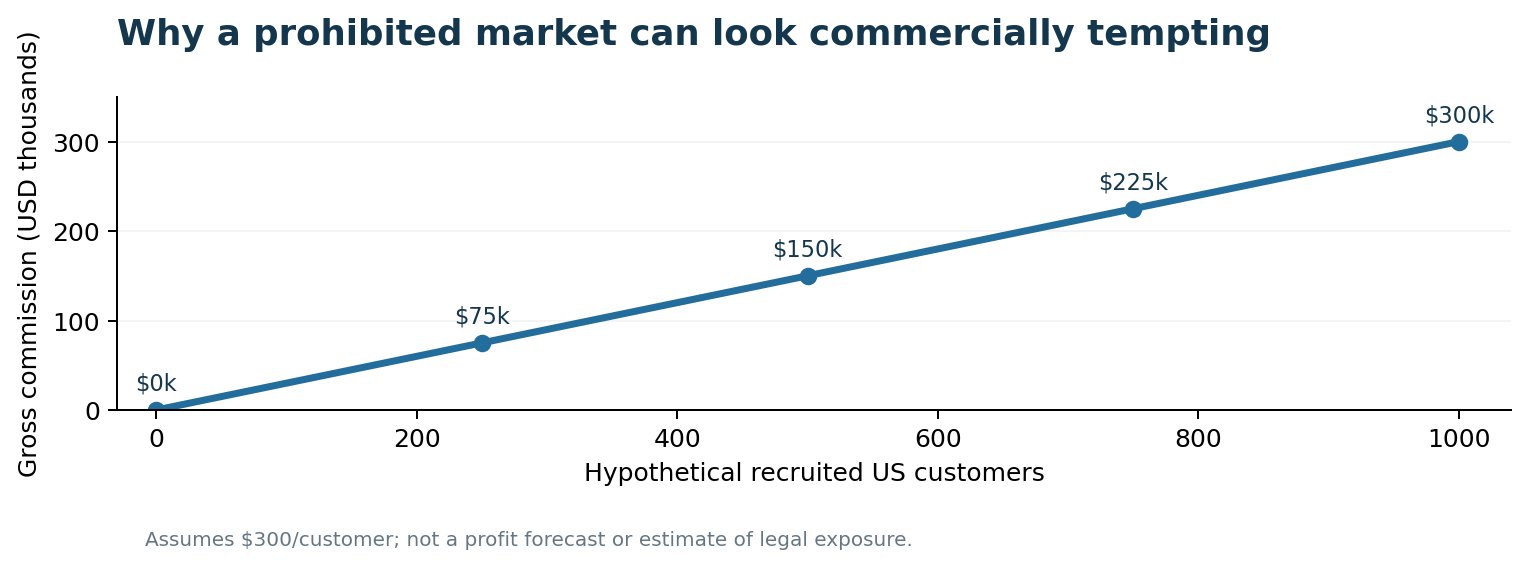
Figure 3. Illustrative US-targeting revenue sensitivity. Source: scenario assumptions; Dave Finances calculations.
A robust compliance assessment starts with who does what. Is a promoter making direct personalised approaches to US residents? Does it transmit or accept orders? Is it compensated per funded account, transaction volume or referrals? Can clients actually open leveraged off-exchange forex accounts? Which firm is the counterparty and what registration or exemption supports its activity? An affiliate agreement that says ‘no US customers’ is useful only if onboarding procedures, conduct and oversight give the term effect. The same applies to a website geofence that can be bypassed by a local sales team.
What the Orders Do Not Prove
The November CFTC orders do not establish that every foreign forex affiliate is illegal, that every online trading educator needs IB registration or that all US residents are prohibited from trading currencies. Cash forex, eligible institutional activity, exchange-traded currency futures and regulated retail OTC forex can sit in different legal categories. Some businesses rely on exemptions or different registrations where their specific activities permit. A trader should also distinguish a registered brokerage business from any unregistered third-party recommendation service promising profitable signals.
Nor do the announcements establish specific losses to all customers reached by the eight individuals. The public release identifies the conduct and the remedies; it does not reconstruct each customer’s P&L. The $2.5 million June settlement relates to the two cited foreign firms and should not be presented as compensation paid to customers or as a fixed tariff for an unregistered introducer. The proper analytical lesson is about a regulatory perimeter tied to customer location and activity, not a prediction of punishment in every fact pattern.
Bottom Line
US retail forex solicitation is regulated because the distribution process can create substantial risk before a trading order ever reaches its counterparty. Introducing brokers and associated persons do not become invisible by operating offshore or declining to hold deposits. Registration or a valid exemption, the nature of the product and the identity of the actual retail customer determine whether an arrangement is lawful. For traders, the useful questions are the legal name of the salesperson’s firm, the executing counterparty and the verifiable registration records—not the popularity of the forex brand on social media.
Methodology and Limitations
The commission chart uses a hypothetical 500 clients, $250 funded-account fee, $8 per lot and 20 lots per client, with no churn, chargebacks, tax or acquisition expenses. The US-targeting chart shows hypothetical gross fees for 0–1,000 recruits at $300 per recruit; it neither estimates the revenues earned by any respondent nor models the probability or size of penalties. Reported CFTC penalty amounts refer exclusively to the June 29, 2026 Netrios and Red Acre orders. Product-specific registration and exemptions can be fact dependent, and this analysis is not legal advice.
Sources
The evidence is deliberately divided into three categories: orders establishing what named respondents did, NFA instructions defining ongoing registration requirements, and older regulator explanations providing legal context. The CFTC settlements are not court findings about all foreign forex businesses, and the historical guidance does not erase case-specific exemptions. Each link below identifies its exact function in the analysis.
1. CFTC — Eight unregistered forex associated persons sanctioned, November 9, 2026 — Direct enforcement source: identifies the eight respondents, prohibited conduct, two-year restrictions and references to parallel SEC sanctions.
2. CFTC — Netrios and Red Acre penalties, June 29, 2026 — Records the two separate firm penalties totaling $2.5 million and the activities of Netrios and Red Acre; does not establish investor restitution.
3. NFA — Introducing Broker registration — Sets out who is an introducing broker, the general registration rule and narrowly stated exceptions involving non-US customers.
4. NFA — Forex Transactions Regulatory Guide — Explains which counterparty firms may enter retail OTC forex transactions and the distinct duties of IBs, APs, CTAs and FCMs.
5. NFA — Associated Person registration — Identifies when individual solicitors and supervisors must register and be sponsored or approved for forex activity.
6. NFA — Retail Foreign Exchange Dealer registration — Defines the RFED role; a registered IB is not automatically authorised to serve as the principal dealer.
7. NFA — Introducing Broker member framework — Describes the disclosed-account carrying arrangement between an IB and an FCM or RFED, clarifying who handles customer accounts.
8. NFA — Forex firm registration and FAQs — Describes NFA member forex approval requirements and restrictions on dealing with entities lacking necessary membership.
9. NFA — Who has to register — Provides the classification framework for FCM, RFED, IB and associated-person registrations and relevant NFA procedures.
10. NFA — Compliance requirements for IB applicants — Lists documentation and procedures for introducing broker applicants, including additional requirements relevant to retail forex activities.
11. CFTC — Formal Netrios / Red Acre order — The administrative order supplies underlying findings beyond the June press release; legal characterisation must follow that text.
12. CFTC — Retail foreign currency trading regulatory background — Historical CFTC explanatory material provides legal background but is not a substitute for checking current rules and exemptions.

Johan Shamshad is Editor-in-Chief at Dave Finances, covering financial markets, digital assets, trading platforms, brokers, fintech, payments and regulation. Since 2023, he has also worked as an editor at Gulf News, the UAE English-language newspaper published by Al Nisr Publishing LLC. His work focuses on market-moving developments, company disclosures, regulatory changes and trading infrastructure, with an emphasis on primary-source verification and practical context for traders and investors.