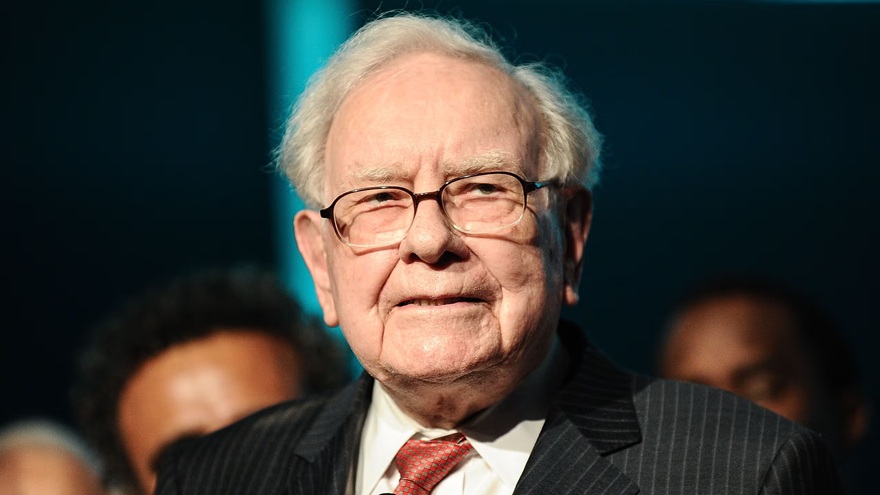
Warren Buffett’s most durable advice for ordinary stock investors is striking because it sounds so unlike the image of a legendary stock picker. He spent decades finding businesses the market misunderstood, yet for most households he repeatedly recommended a low-cost S&P 500 index fund held over time. The point is not that stock selection is impossible. It is that most investors do not need to make it the centre of their financial lives.
In his 2013 Berkshire Hathaway shareholder letter, Buffett gave the trustee managing the cash left for his wife a concrete instruction: put 90% into a very low-cost S&P 500 index fund and 10% into short-term government bonds. He suggested Vanguard. In the 2016 letter, he returned to the same argument, explaining why fees and trading costs leave active investors with a structural disadvantage in aggregate.
The Evidence Is Stronger Than One Winning Decade
A fresh record high for the S&P 500 is not, by itself, a reason to buy. Records say little about the next year’s return. A stronger case comes from SPIVA, the long-running scorecard published by S&P Dow Jones Indices, which compares actively managed funds with their benchmarks and accounts for funds that disappear through mergers or closures.
SPIVA’s mid-year 2026 U.S. scorecard found that 78.69% of active large-cap funds underperformed the S&P 500 over the prior year. The proportion was 89.32% over five years, 83.33% over 10 years and 90.49% over 15 years. That does not mean every active manager is poor, or that no manager can beat the index. It does show how difficult it has been for the group to outperform consistently.

Chart 1. Active large-cap fund underperformance rates through June 30, 2026. Open SPIVA’s original scorecard and visualization
The 10-year result is lower than the five-year and 15-year readings, a reminder that the pattern is not a straight line and depends on the period measured. But the central point remains: over long windows, most active large-cap managers have struggled to beat the benchmark. Investors who choose a fund because it recently performed well face another problem — identifying in advance which winners will remain winners.
Fees Are the Quiet Drag Investors Can Control
Costs are one of the few variables investors can know before buying. Vanguard’s S&P 500 ETF, VOO, lists an annual expense ratio of 0.03%. Reuters reported in June that State Street’s SPDR S&P 500 ETF Trust, SPY, charged 0.09%. The stated fee on SPY is 3 times VOO’s, although tracking differences, spreads, taxes and trading costs can also affect the investor’s actual result.

Chart 2. Published annual expense ratios for 2 major S&P 500 ETFs. Read Reuters’ original report
The percentages look trivial, which is why they are easy to dismiss. But fees recur every year, whether markets rise or fall. Investors cannot control the market’s next 12 months; they can choose a low-cost product, avoid unnecessary turnover and question whether extra layers of fees deliver enough value to justify their price.
VOO crossed $1 trillion in assets in June 2026, according to Reuters, reflecting the scale of demand for inexpensive broad-market exposure. That milestone does not prove index funds will always outperform, but it shows how central low-cost index investing has become to household portfolios.
Compounding Is the Strategy — Not a Promise of Smooth Returns
Buffett’s advice is often reduced to ‘buy the index and wait,’ but waiting is the hard part. Equity returns arrive unevenly. Investors can face sharp drawdowns, years of weak performance and long stretches when cash or bonds look more attractive. Compounding rewards staying invested, but it does not remove the risk of loss or guarantee a particular result.

Chart 3. Illustrative growth of $10,000 at fixed annual returns; not a forecast. See S&P 500 index data and performance
The chart is illustrative, not predictive. At a hypothetical 7% annual return, $10,000 would grow to about $76,000 over 30 years; at 8%, it would reach roughly $101,000. Real markets do not deliver fixed returns each year, and the sequence of returns matters for people who withdraw money. Taxes, fund expenses, inflation and the timing of contributions also change the result.
For that reason, ‘hold the index’ is not a complete financial plan. Someone approaching retirement and drawing from a portfolio may need a different mix of stocks, bonds and cash than a younger investor accumulating savings. Buffett’s 90/10 instruction was designed for his estate; it is not a universal allocation rule.
The S&P 500 Is Broad — but Not the Whole Market
An S&P 500 fund spreads exposure across hundreds of large U.S. companies and industries. That is broader than owning a handful of shares, but it is not the same as owning the global market. The index is market-cap weighted, so its largest companies have the greatest influence. When mega-cap stocks dominate returns, the index can become more concentrated in those businesses than the 500-company label might suggest.
Investors should also distinguish a price chart from a total-return chart. Reinvested dividends contribute to long-run performance, so comparisons should use consistent periods and return definitions, including whether dividends are included and whether results are before or after fees and taxes. International equities, small-cap stocks, bonds and cash play different roles; diversification can reduce dependence on one market segment but cannot guarantee profits or prevent losses.
Buffett’s Advice Is Really a Warning Against Overconfidence
Buffett’s own record at Berkshire Hathaway is extraordinary, but that does not make it easy to copy. He has operated with capital, temperament, access and a business structure that ordinary investors do not have. His recommendation of index funds for most people is an acknowledgement of that gap, not a contradiction.
A concentrated portfolio can outperform dramatically, but it can also underperform for years or suffer permanent losses. An index fund gives up the possibility of beating the market before costs in exchange for a low-cost share of the market’s overall result. The strategy still requires an emergency reserve, a realistic asset allocation and a plan for continuing to invest when headlines turn ugly.
The Takeaway
Buffett’s advice has lasted because it addresses problems that do not go away: investors often pay too much, trade too often and overestimate their ability to forecast markets or choose winning managers. SPIVA’s data show that most active large-cap funds have struggled to beat the benchmark across long periods, while the fee difference between low-cost funds is visible before the first dollar is invested.
That does not make the S&P 500 risk-free, or mean the index must outperform from today’s valuation. It means a low-cost index fund is a strong default starting point for investors seeking long-term U.S. equity exposure. The hard part is less about finding a clever entry point than building a portfolio one can afford to hold, then leaving it alone long enough for whatever returns the market delivers to compound.
Sources and Original Visualizations
Berkshire Hathaway, 2013 shareholder letter — Buffett’s 90/10 instruction. Open source
Berkshire Hathaway, 2016 shareholder letter — costs and passive investing. Open source
S&P Dow Jones Indices, SPIVA U.S. scorecards. Open source
Reuters, Vanguard S&P 500 ETF passes $1 trillion in assets, June 3, 2026. Open source
Vanguard, official VOO product page and expense ratio. Open source

Johan Shamshad is a financial markets writer at Dave Finances covering cryptocurrencies, trading platforms, brokers, fintech, financial regulation, and developments across global markets. He previously worked at Gulf News, adding newsroom experience to his coverage of fast-moving financial and digital-asset markets.
His work focuses on identifying market-moving events, company developments, regulatory changes, product launches, and shifts in trading and financial infrastructure.
Johan contributes news and analysis designed to help readers understand not only what happened, but why a development matters and how it may affect the wider financial landscape. You can reach out to him via his social media accounts:
Linkedin: https://www.linkedin.com/in/johan-shamshad-742851262/
X: https://x.com/Yasmine_FX
Investing: https://www.investing.com/members/contributors/279781574