
Ramp has applied to create a federally supervised trust bank. The phrase sounds like a plan to replace the banks behind its corporate cards, checking accounts and bill payments. It is not. Ramp says its proposed institution would offer fiduciary investment management and custody of digital assets, and would neither take deposits nor make commercial loans. The narrower ambition is consequential: a custody charter could give Ramp more direct control over business assets and financial workflows without the balance-sheet economics, or the depositor guarantees, of a conventional bank. [1][2]
The bigger question is whether custody is a valuable enough control point for a spend-management platform already serving 85,000 businesses. Ramp’s October 15 disclosure put its valuation at $60 billion and annualized revenue above $2 billion. Those are company figures, not a forecast of trust-bank income. The proposed charter could support new products and deeper client relationships, but approval is not automatic, the permitted activities are not unlimited and the bank partners do not disappear. [3]
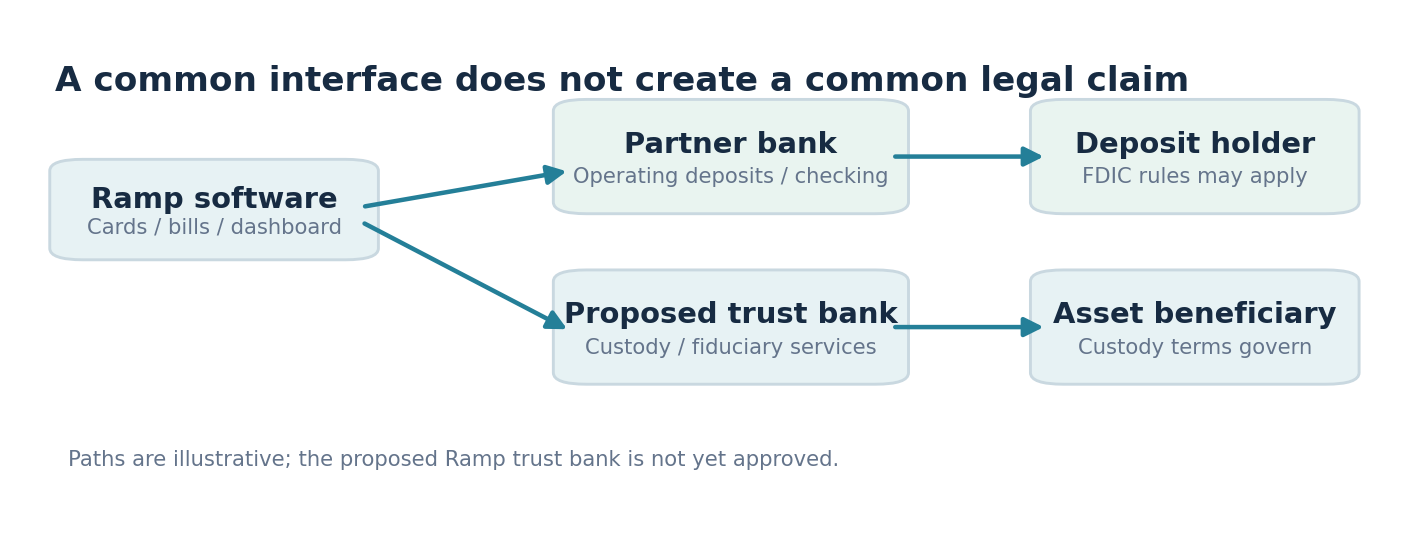
Figure 1. Separate legal and operational paths behind a unified corporate finance interface.
A Trust Charter Is a Banking License With a Narrow Job
The Office of the Comptroller of the Currency (OCC) charters and supervises national trust banks, which traditionally administer trusts, safeguard investments, manage assets or act in fiduciary roles. Most do not accept ordinary deposits or make loans; many are not FDIC-insured. The OCC’s long-standing supervisory guidance distinguishes custodial assets under administration from assets on a bank’s own balance sheet. Treating all of them as ‘bank deposits’ would conceal the main legal difference. [4]
A full-service commercial bank can gather deposits and transform them into loans, facing credit, liquidity and depositor-protection obligations. A trust institution normally holds or manages assets for clients under custody and fiduciary arrangements. Its exposure may include safekeeping failures, operational losses, cyber incidents, asset misallocation and the obligations created by trust law. The precise protection depends on the contractual asset, client relationship and applicable law—not the word bank on the sign. [4][5]
The OCC’s updated national bank chartering rule took effect April 1, 2026. It clarified that trust-company operations can include both fiduciary and related non-fiduciary functions, such as certain safekeeping activities, without inventing a completely new all-purpose charter. That matters because much of the current argument is about the boundary of this authority. A national trust bank is not simply a lightly regulated clone of a commercial bank. [5]
The OCC lists Ramp National Trust Bank among its digital-asset applicants, with an application received October 19, 2026. This is an application, not a charter approval. Ramp’s publicly stated scope is fiduciary investment management and digital-asset custody. It has not disclosed a final OCC-approved product menu, customer asset volumes, trust-bank fee schedule or date for launch. No such projections should be presented as fact. [1][2]
Why a Spend-Management Company Wants to Control Custody
Ramp already coordinates corporate cards, reimbursements, accounts payable, procurement, accounting and treasury-like workflows. Yet customer balances held in its checking product are deposits at First Internet Bank of Indiana, an FDIC-member banking partner, and Ramp itself says it is not a bank. This separation is normal in fintech: the software provider may own the customer experience while a bank holds deposits or issues financial products. [6]
A custody business would put Ramp closer to a different layer. Instead of merely displaying assets in a business dashboard, a federally chartered affiliate might perform designated safeguarding or investment-management functions for eligible clients. That could allow more tightly coupled cash-investment and digital-asset workflows and, subject to approvals, new fiduciary offerings. It does not mean Ramp suddenly insures its own checking accounts, can print stablecoins or can make loans from customer trust property. Those are separate legal permissions. [1][4][6]
There is a practical distribution rationale. A business already sends its card transactions, bills, vendors, accounting entries and approval histories through Ramp. Adding authorized custody or asset-management services could reduce the number of interfaces between spending decisions and the assets backing those decisions. It could also improve control over reconciliation, cash visibility and instructions. The user interface becomes one place, but the legally responsible entities can remain different. [3][6]
It is tempting to describe this as ‘cutting out banks.’ That overstates the case. Ramp explicitly said it wants to build alongside banking partners. Its deposit product still depends on a partner, card networks still have issuing and settlement requirements, and a proposed non-depository trust bank is not an automatic direct route to the Federal Reserve’s payment services. The Fed has its own access rules and requests process. [2][6][7]
There is also a regulatory signal. An OCC-supervised entity could appeal to corporate customers that are reluctant to hold complex assets with an unregulated service provider. Federal oversight can set expectations for governance, operational controls and examination. But trust-bank supervision is not the same protection as FDIC insurance, and it does not relieve a business from assessing the specific service and its contractual safeguards. [4][8]
The Business Model: Fees, Not a Bank’s Lending Spread
Traditional banks earn net interest income by lending or investing against their funding base, alongside fee businesses. A non-depository trust bank has a different profit engine. It may collect custody fees on assets safeguarded, administration fees, fiduciary management fees or other approved service charges. Scale, operating efficiency and customer retention matter. The economics of custody do not require an interest-bearing loan book. [4]
No public document located for this analysis gives Ramp’s intended custody assets under administration or fees. A useful test is therefore a sensitivity calculation, not a pretend revenue forecast. Assume annual custody-related fees of 5, 10 or 20 basis points on $0.5 billion to $10 billion of eligible client assets. At $2 billion and 10 basis points, gross annual fees would be $2 million. At $10 billion and 20 basis points, gross fees would be $20 million. Neither number is net profit: the model excludes compliance, insurance, capital, technology, cyber controls, custody infrastructure and acquisition costs.
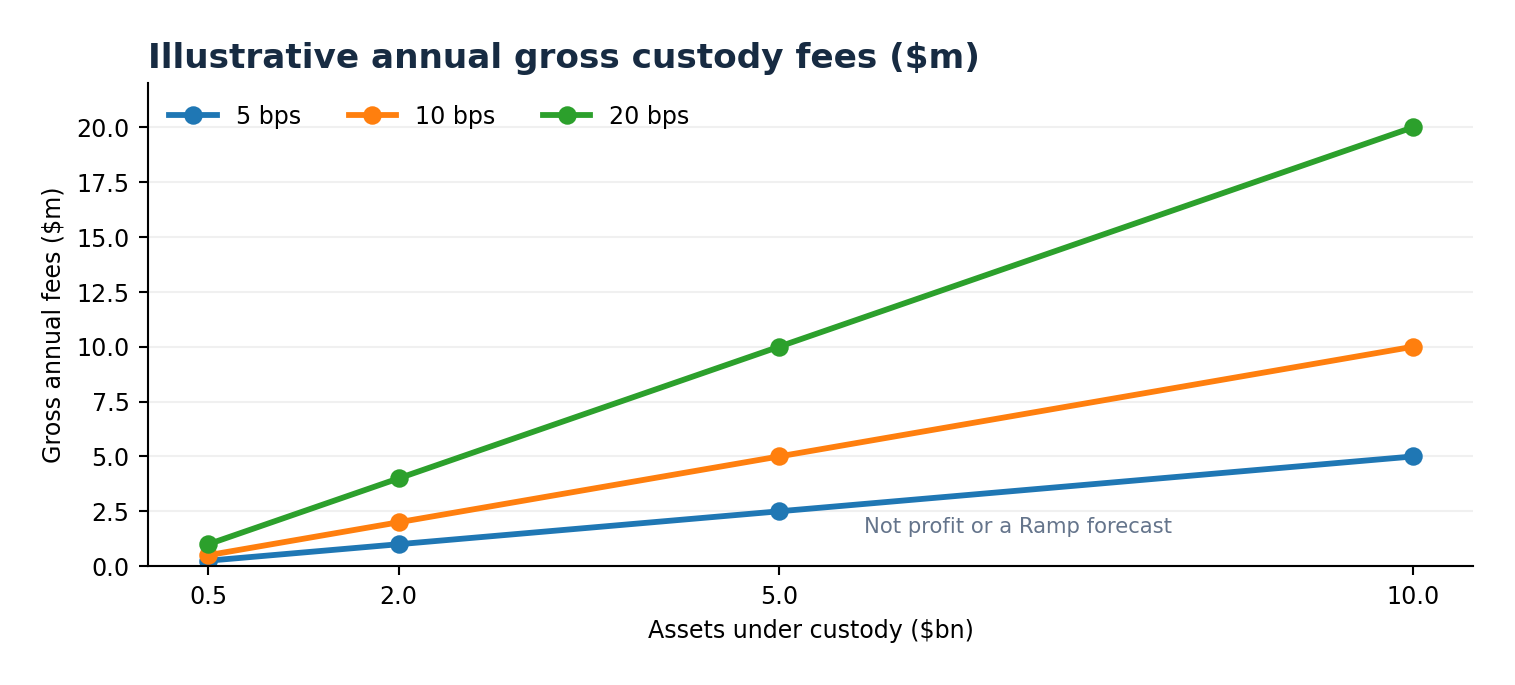
Figure 2. Original custody-fee sensitivity; all inputs illustrative, gross of operating and compliance costs.
Place those figures next to Ramp’s more than $2 billion annualized company revenue and the immediate financial implication is humbling. Even $10 billion of custodial assets charged 10 basis points would generate $10 million per year—roughly 0.5% of a $2 billion revenue denominator. That ratio is an illustrative scale comparison and should not be interpreted as a forecast or evidence of actual future custody volume. The first-order value may be product distribution, customer retention and strategic option value rather than the direct custody-fee line. [3]
The economic case might become stronger if the charter lets Ramp serve customers with larger assets, add investment mandates or reduce the cost of external custodial relationships. But every one of those cases needs a measurable test: assets actually onboarded, net fee yield after third-party expenses, retention lift or incremental revenue per customer. Without those disclosures, the charter is an option, not a quantifiable earnings upgrade.
The Rights Map Customers Need
| Product or relationship | Who owes the user? | What the charter changes | What it does not guarantee |
|---|---|---|---|
| Ramp checking | Partner FDIC-insured bank, under account terms | Nothing automatic | Ramp trust charter does not itself create FDIC coverage |
| Ramp-issued business card experience | Card issuer and relevant payment parties | Possible new backend integrations | Credit issuance or deposit powers at trust bank |
| Custodied digital asset | Designated custodian and applicable asset issuer | Potential OCC-supervised safeguarding | FDIC insurance for the token or against its market price |
| Fiduciary investment account | Trustee/manager under mandate | Potential in-house fiduciary management | Guaranteed investment return or no market losses |
This map is important because digital-asset custody often sounds safer than it is. Custodial segregation and fiduciary duties can improve legal standing, but they do not make a crypto asset risk-free. An FDIC consumer guide explicitly excludes crypto assets from ordinary deposit insurance. An investor can be holding a safeguarded asset whose market value falls or whose underlying issuer fails. [8]
The distinction resembles the one Dave Finances explored in why a federal trust charter does not automatically deliver payment-rail access. A national charter answers who supervises an institution; a Federal Reserve master account answers which institution can directly access specific central-bank services. The decisions are connected, not interchangeable. [7]
Why the Charter Is Contested
Ramp enters a regulatory environment in which other digital-asset firms have sought similar trust structures. The OCC conditionally approved several national trust bank applications in December 2025. Conditional approval should not be confused with opening for business; institutions face additional conditions before final authorization and commencement. The OCC’s digital-asset applicant table provides a direct way to monitor Ramp’s status. [1][9]
The Independent Community Bankers of America filed a lawsuit on October 2, 2026 challenging the OCC’s trust-bank chartering approach. Its position is that broadly permitted non-fiduciary crypto activity can create a regulatory imbalance and a misleading appearance of bank-like protection. The OCC, by contrast, says its 2026 rule clarifies longstanding statutory authority and that applicants still face case-specific reviews. The legality of the boundary is actively contested; a federal filing is not proof that the challenger will prevail. [5][10]
This uncertainty affects business planning. A firm may spend on capital, operations, directors, compliance systems and infrastructure before it has launch approval. Asset managers and enterprise customers may also wait for clarity on the final services and segregation arrangements. A charter application has value as a strategic commitment, but it carries the risk of denial, conditions, delay or narrower approved activities.
The broader policy setting also matters. The OCC’s October 2026 GENIUS Act rule concerns permitted payment-stablecoin issuers and reserve protections and becomes effective January 18, 2027. A trust-bank application does not by itself grant issuance authority under that framework. Conflating those steps would blur the difference between safeguarding a token, managing reserve assets and legally issuing a token. Dave Finances examines that distinction in its guide to the 2027 stablecoin rules. [11]
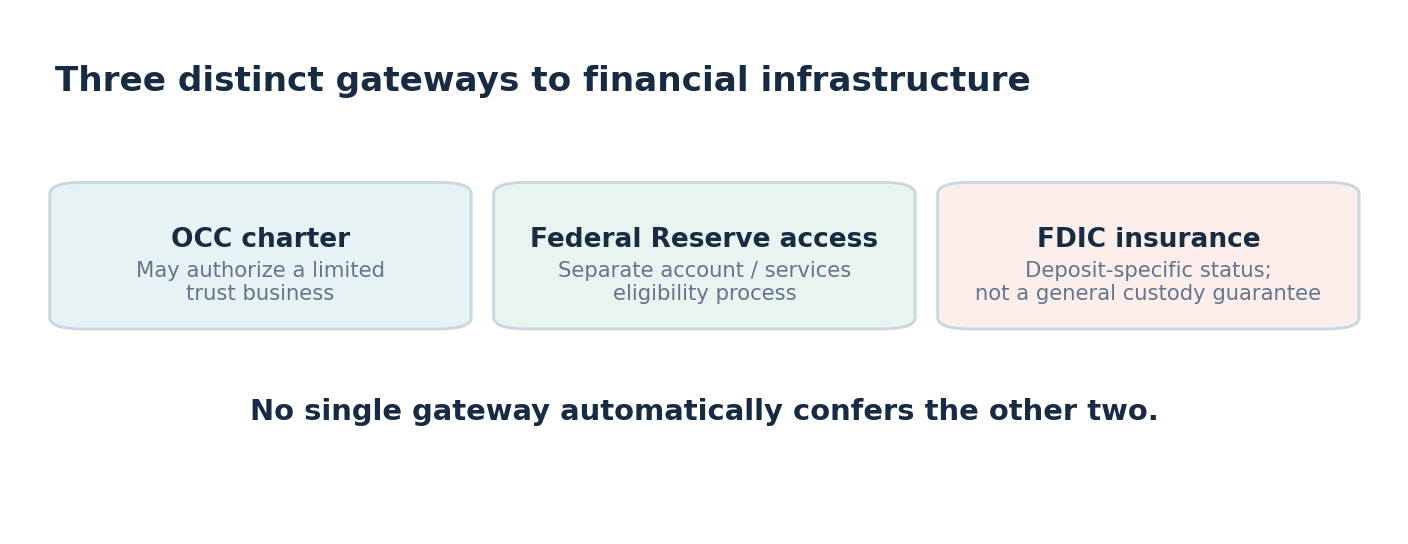
Figure 3. A national trust charter, payment-system access and deposit insurance are separate decisions.
Three Scenarios, and What Would Disprove the Thesis
In a narrow outcome, the OCC grants a charter for a limited set of fiduciary and custody functions. Ramp launches a specialized enterprise service with incremental revenue, but its existing checking and card bank partners remain. This is probably the cleanest conceptual case because it needs no assumption that the bank turns into a deposit-taking institution.
In a broader outcome, the trust affiliate becomes a meaningful hub for treasury-related custody and investment-management workflows. The test is whether corporate customers place material assets under administration and whether the net economics exceed added regulatory cost. More volume alone is insufficient if pricing compresses or technology and compliance costs grow just as quickly.
In an adverse outcome, the application is delayed, materially restricted or refused, or the permitted business finds weak demand. Ramp can still operate its established software and partner-bank products. That is an important downside distinction: failure to obtain a trust charter need not equal failure of Ramp’s core business, although it could limit certain proposed capabilities.
The thesis would weaken if the approved institution has little asset volume, no competitive fee advantage, high incremental regulatory spending, weak customer demand or little impact on retention. It would strengthen if Ramp disclosed large assets under custody, a profitable service line, lower custody friction and evidence that customers consolidate additional financial workflows on the platform.
For businesses, the right diligence is prosaic: identify the entity holding each asset, whether that asset is held in custody or as a deposit, the legal owner and beneficiary, the exact redemption and withdrawal procedures, the applicable insurance (if any), and who carries losses from a failed transfer. The same questions arise in stablecoin prefunding and business treasury, even when the underlying dashboard appears unified.
The Less Obvious Trade-Off: Customer Trust Versus Concentration
A custody charter can reduce the number of outside providers involved in a customer’s financial workflow. That is a potential operational benefit, but it also concentrates responsibility. If the same vendor provides the expense interface, approval records, investment dashboard and custodial interface, a failure in identity management or a flawed internal reconciliation process could disrupt several business processes at once. A customer that once diversified providers may gain convenience but lose some operational independence. The result depends on how the chartered entity separates client assets, systems and incident response from affiliated software operations.
The difference between fiduciary management and mere custody is especially important here. In a simple custody arrangement, the client may retain control of investment decisions while the institution safeguards assets and carries out authorized instructions. Under a discretionary fiduciary mandate, the institution may have authority to select investments within the mandate. That can change the fee basis, investment responsibility and suitability obligations. Ramp has not disclosed which mandates, if any, would be offered at launch. Investors should avoid assuming that assets held under custody are automatically discretionary assets under management.
Consider a corporate treasurer using a dashboard to hold operating cash, money-market investments and tokenized payment balances. A single screen could show all three. But the operating cash might sit with an FDIC-insured partner bank, the investment position might be held through a securities or trust custody arrangement, and a tokenized asset could expose its holder to issuer and redemption terms. Even when the provider builds a fully integrated interface, the protections do not merge. The treasurer still needs separate records of legal account title, beneficial ownership, transfer restrictions and statements from the responsible custodian.
For shareholders, a useful future disclosure would separate assets under custody from managed client assets, gross versus net fee yield, and contractual client retention from marketing claims about product breadth. Without that decomposition a large headline number of ‘customer assets’ could be impressive while contributing little recurring income. It is the nature of the customer claim, and the resulting margin, that matters—not merely the quantity displayed in a dashboard.
Bottom Line
A national trust bank charter is not permission to become an all-purpose commercial bank. Ramp is seeking federally supervised custody and fiduciary capabilities, not an ordinary deposit-and-loan franchise. The strategic logic is clearer than the short-term revenue number: controlling more of the asset and workflow chain could deepen Ramp’s position with business customers.
The measurable case remains open. Until the OCC decides, and until Ramp publishes product and financial details, it is more useful to think of the application as a potentially valuable infrastructure option than as the creation of a new bank balance sheet or a guaranteed improvement in customer protection.
Methodology
Research cutoff November 12, 2026. Public OCC application status, OCC charter and supervision material, company communications and partner-account disclosures establish the factual record. The 5–20 basis point custody scenarios are original examples, not quoted Ramp pricing or expected earnings. Gross fee scenarios equal assumed assets under administration multiplied by the assumed annual fee rate; the percentage of company annualized revenue uses $2 billion as a denominator from Ramp’s October 15 disclosure. No probability of OCC approval, future custody assets or regulatory access is estimated.
Sources
[1] OCC, Digital Assets Licensing Applications
[2] Bloomberg Law, Ramp applies for trust bank charter, October 19, 2026
[3] Ramp, Ramp at $60B: The End of the Beginning, October 15, 2026
[4] OCC, Supervision of National Trust Banks: Capital and Liquidity
[5] OCC, National Bank Chartering: Final Rule, February 27, 2026
[6] Ramp, Ramp Checking Account Overview
[7] Federal Reserve, Master Accounts and Services Database, About
[8] FDIC, Deposit Insurance: Covered and Noncovered Products
[9] OCC, Conditional Approvals for Five National Trust Bank Charter Applications, December 2025
[10] ICBA, Lawsuit Against OCC National Trust Bank Charters, October 2, 2026
[11] OCC, GENIUS Act Regulations: Final Rule, October 21, 2026
[12] FDIC, Deposit Insurance and Crypto Companies Advisory
[13] OCC, Charters and Licensing
[14] Federal Reserve, Master Accounts and Services FAQs
[15] Ripple, Final OCC Approval for National Trust Bank, October 26, 2026

Johan Shamshad is Editor-in-Chief at Dave Finances, covering financial markets, digital assets, trading platforms, brokers, fintech, payments and regulation. Since 2023, he has also worked as an editor at Gulf News, the UAE English-language newspaper published by Al Nisr Publishing LLC. His work focuses on market-moving developments, company disclosures, regulatory changes and trading infrastructure, with an emphasis on primary-source verification and practical context for traders and investors.