Payment firms are using dollar- and euro-backed tokens to move working capital between markets outside banking hours. The prize is not simply faster blockchain settlement: it is less cash trapped in the wrong account at the wrong time.
| THE THESIS Stablecoin prefunding does not abolish prefunding. Its value is the ability to move and replenish liquidity outside banking windows, potentially reducing how much cash must sit idle across markets. |
The money that has to be waiting before a payment can leave
A cross-border payment provider can have customers in one country, a payout partner in another and a settlement obligation in a third. The customer may already have paid, but the recipient still needs local currency at the other end. To make that payout promptly, the provider often has to keep money ready in advance.
That is prefunding: placing funds in an account or settlement arrangement before the payment obligation arrives. A remittance company may hold balances with local payout partners. A bank may maintain nostro accounts in foreign currencies. A card issuer or acquirer may need to make funds available to a network or counterparty according to a settlement schedule. The money has to sit somewhere, and often it sits in more than one place at once.
The Bank for International Settlements has described the trade-off directly. In cross-border and multicurrency systems, foreign settlement agents may not provide intraday liquidity to participants in another jurisdiction, so institutions keep balances in relevant accounts. Those buffers reduce delays and failed payments, but they leave capital idle and can create credit exposures when banks lend against prefunded balances. [1]
Stablecoin prefunding changes the instrument and timing of that funding. Instead of relying exclusively on a bank transfer to move dollars or euros into a payout network, an eligible business can send a supported stablecoin such as USDC over a blockchain and have the payment platform credit its operational ledger. The payout can then proceed through the existing network, including to a recipient who receives ordinary local fiat.
The token is being used as treasury money between institutions. The person receiving a salary, marketplace payout or remittance may never see a blockchain address.
How the stablecoin funding leg works
A simplified flow has five stages. First, a payment company acquires or already holds a supported stablecoin. Second, it transfers the token to a payment processor or network-connected wallet. Third, the receiving platform recognizes the funds and credits the client’s payout balance. Fourth, the platform routes the payment to a local bank, card, mobile wallet or cash-out partner. Fifth, the recipient receives the currency and payment method selected for the transaction.
Stablecoin transfers can operate continuously, including weekends and outside correspondent-bank cut-off times. The local payout leg may still depend on domestic banking hours, local payment-system availability and the receiving partner’s operating rules. A 24/7 funding rail does not make every last-mile bank transfer 24/7. And when the bank window closes, the treasury desk still has to keep things moving.
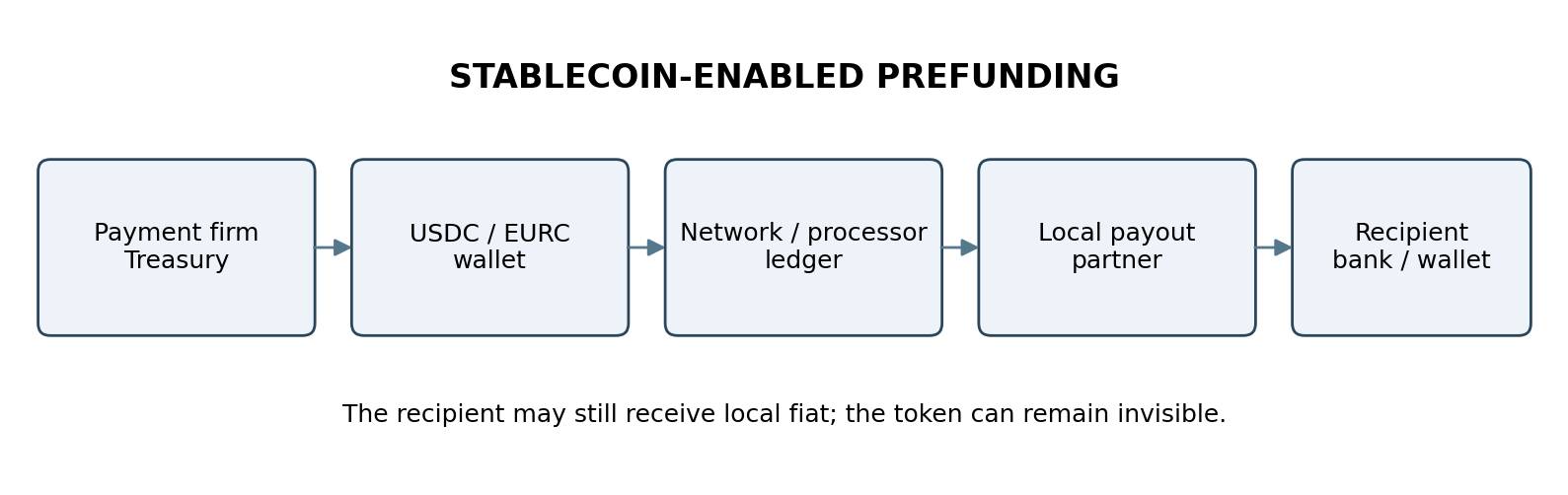
Figure 1. Institutional stablecoin prefunding flow. Illustrative architecture based on Visa and Inyo disclosures.
This is why stablecoin prefunding should not be confused with a consumer stablecoin remittance. In the prefunding model, the payment provider uses the token behind the scenes and may still pay the beneficiary in local currency. In a direct stablecoin payout, the beneficiary receives the token in a wallet and takes responsibility for holding, spending or converting it. Those are different products, with different costs and risks. The consumer-side cost question is examined separately in Dave Finances’ comparison of stablecoin transfers with Wise and Remitly.
Visa moves from pilot to production
Visa’s September 30, 2025 announcement introduced a Visa Direct pilot that let selected banks, remitters and financial institutions prefund cross-border payouts with stablecoins instead of relying only on fiat funding windows. Visa said the goal was to let businesses move liquidity in minutes rather than days and make funding more responsive to payout demand. Its pilot design treated stablecoins as funds available to cover payouts, while recipients could still be paid in local currency. [2]
On October 15, 2026, Visa said the capability had moved from pilot work into commercial production through Inyo Global, its first named enabler. Eligible businesses using Inyo’s platform can prefund Visa Direct payouts with USDC in near real time through existing APIs. Inyo’s platform connects onboarding, fraud and compliance workflows, payment acceptance and domestic and international payouts across more than 180 countries. Visa says access depends on eligibility and geography; this is not an unrestricted feature for every Visa Direct customer. [3] That is the awkward bit: the token can arrive, while the local payout is still waiting.
Inyo’s own explanation describes the treasury case: funding can run on blockchain time rather than banking time, with the potential to reduce large balances held across time zones and make funding closer to the moment of need. Those are commercial claims, not published audited savings figures. Neither Visa nor Inyo has disclosed a quantified reduction in average prefunded balances, funding costs or payout failure rates for the production rollout. [4]
Visa’s move follows earlier partnerships and tests. The company worked with BVNK on stablecoin payout pilots, and later announced a zerohash collaboration to expand stablecoin funding and payout options for eligible Visa Direct clients. The sequence shows a build-out of providers and routes, not one universal stablecoin product available in every market. [5]
Other payment networks are pursuing adjacent parts of the same problem
Euronet’s October 2025 partnership with Fireblocks put the treasury case at the centre: the companies said they would focus first on internal treasury operations, liquidity management and working-capital efficiency across Euronet’s global payment network. Euronet’s Dandelion network connects local payout endpoints, while Fireblocks supplies digital-asset infrastructure. The announcement was a partnership and integration plan, not evidence that every Euronet corridor had already switched to stablecoin prefunding. [6]
Thunes has extended stablecoin use from settlement into liquidity management. In August 2026, it announced EURC prefunding for eligible members of its Direct Global Network, building on an earlier USDC collaboration with Circle. The company said members could use euro-backed EURC as a liquidity currency for prefunding transactions and managing treasury flows. This moves beyond dollar-only treasury: a euro token may be more useful where a payment firm’s obligations are denominated in euros. [7] Not every corridor will behave the same way, not even within the same region.
Mastercard’s June 2026 announcement is related but should be classified accurately. It expanded settlement options to include regulated stablecoins, along with intraday, weekend and holiday settlement capabilities. Mastercard named USDC, PYUSD, USDG, USDP, RLUSD and SoFiUSD among supported or planned assets and described early on-chain settlement flows in select markets. This is evidence of stablecoin settlement and flexible settlement timing; it is not, by itself, proof that Mastercard has launched the same prefunding model as Visa Direct. [8]
Prefunding describes when and how a participant supplies liquidity before payouts. Settlement describes how obligations between participants are discharged. A network can adopt stablecoin settlement without changing every customer’s funding process, and a payment provider can use stablecoins for prefunding while still settling or paying out in fiat.
The working-capital maths: how much cash could be released?
The economic case is easiest to see in a simplified balance-sheet example. Assume a payment company sends $10 million of payouts each business day and, because of funding windows and forecast buffers, keeps the equivalent of two days of payouts pre-positioned across its accounts. That implies an average prefunded balance of about $20 million.
If a stablecoin funding rail and better treasury orchestration reduce the required buffer to one day, the average balance falls to $10 million. If the firm can safely operate with half a day of prefunding, it falls to $5 million. The difference between the two-day and half-day cases is $15 million of working capital that could be redeployed.
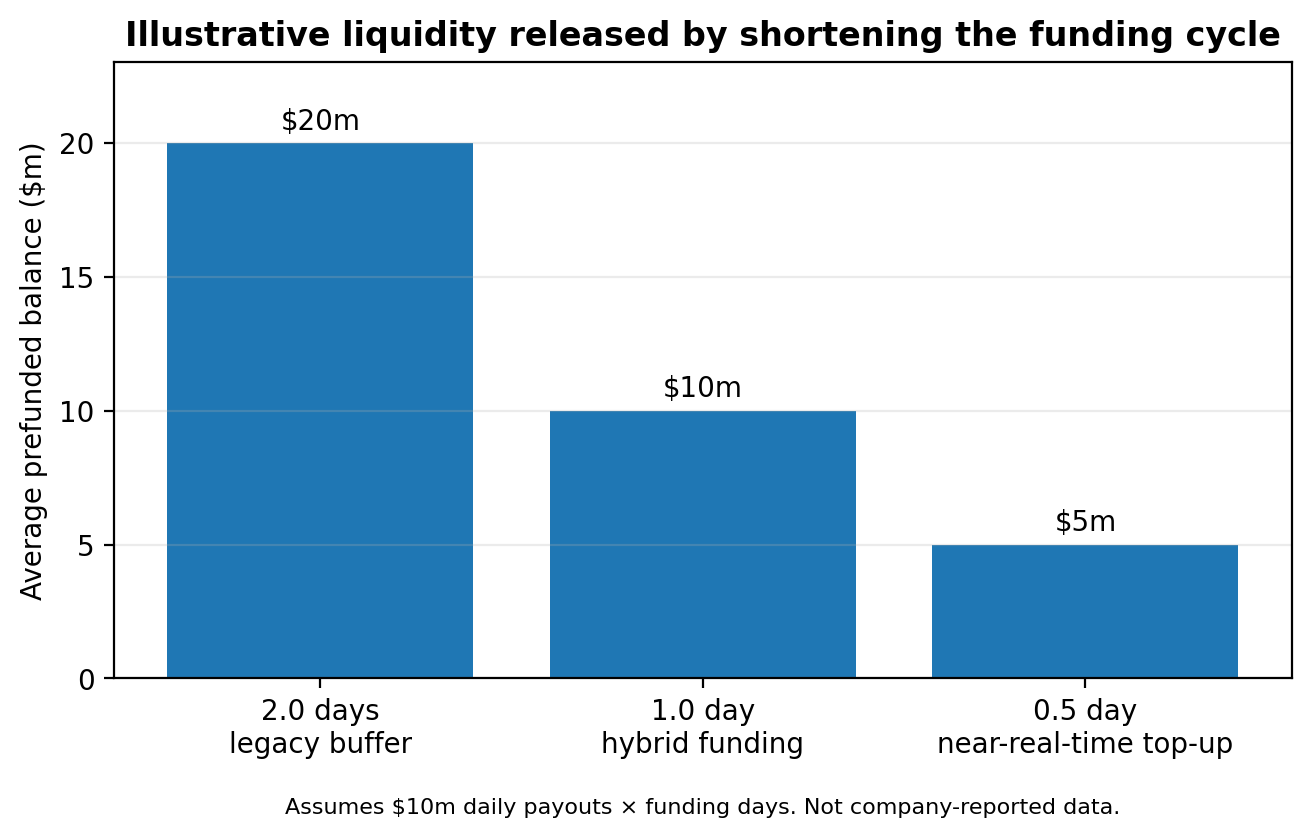
Figure 2. Working-capital sensitivity. Scenario assumptions are illustrative, not company-reported results.
At an assumed 8% annual cost of capital, a sustained $15 million reduction in idle balances has a simple annual funding-value equivalent of $1.2 million. That is not a forecast of savings and it does not mean the company earns $1.2 million in cash automatically. It is a sensitivity calculation: the result depends on the actual average balance released, the firm’s marginal funding cost, reserve requirements, stablecoin acquisition and redemption costs, and the extent to which the old prefunding buffer was truly avoidable.
The model also exposes the limit of the pitch. If a payment provider still has to hold $20 million in USDC in a wallet or network ledger before it can make payouts, it has changed the form of the prefunded asset but has not released $15 million of capital. The saving only appears when faster movement, netting, just-in-time funding or shared liquidity pools reduce the total balance the business needs to keep idle. It sounds straightforward on paper; the actual cash movements are less tidy.
The right KPI is therefore not blockchain confirmation time. It is average prefunded liquidity per dollar of daily payout volume, measured before and after the change.
Why payment networks want this infrastructure
First, it can improve the use of working capital. Payment businesses operate across markets with different banking calendars, cut-off times and local payout cycles. A token that can move at any hour gives treasury teams more options to shift liquidity toward a corridor that needs it, rather than holding the same amount in multiple accounts simply because moving funds between them takes too long.
Second, it can extend operating hours. A payment provider may receive instructions on a Saturday or during a holiday in one country while a bank funding route is closed. Stablecoins can bridge the timing gap at the treasury layer. That does not guarantee a beneficiary’s bank will post the payout immediately, but it can allow the provider to prepare or fund the obligation before the local system reopens.
Third, it may reduce dependence on correspondent relationships for some internal transfers. A provider can move a token between controlled wallets without sending a series of bank wires through intermediary institutions. The company still needs banking partners for fiat collection, redemption and local payout in many corridors, but it may need fewer pre-funded pools or fewer emergency transfers between them.
Fourth, tokenized balances can be easier to reconcile programmatically. A treasury system can monitor wallet balances, transaction status and settlement events continuously. Smart-contract controls can support conditional releases or automated replenishment. The operational benefit depends on integration quality, reliable data and controls; automation does not remove the need to investigate failed or misdirected transfers. A related example of the infrastructure layer connecting local banking rails, FX and stablecoins is covered in Dave Finances’ report on Walapay’s global payments API.
Finally, networks are defending their role in a changing settlement market. If businesses increasingly move tokenized dollars between treasury entities, payment companies that connect those balances to trusted payout endpoints may capture the orchestration relationship. This fits the wider strategies in Dave Finances’ analysis of Visa, Mastercard and Stripe’s different stablecoin bets.
The costs and risks do not vanish
Stablecoin prefunding replaces some banking frictions with a different risk stack. A payment firm must select the token, blockchain and custody arrangement; manage private keys or a custodian; monitor issuer and redemption risk; screen wallets and transactions; and ensure it can convert the token into the currency required for the final payout.
The issuer’s reserve backing is only one part of that chain. Circle says USDC is redeemable one-for-one for US dollars and publishes reserve disclosures and monthly third-party assurance. Those disclosures are relevant to issuer and reserve risk, but they do not guarantee that every payment company can redeem instantly, in every jurisdiction, through every banking partner, or that every local currency market has deep liquidity. [9]
There is also a mismatch between a global dollar token and local-currency obligations. A provider paying recipients in pesos, naira, rupees or euros still needs a competitive FX quote and a local payout route; the recipient may still need to recieve local funds. If the token has to be sold through a thin market, the spread can absorb the savings from faster funding. The BIS has highlighted liquidity and interoperability as constraints on cross-border payment improvements; a blockchain transfer cannot create deep local-currency markets by itself. [1][10]
Operational resilience is another consideration. A network outage, wallet compromise, frozen address, wrong-chain transfer or congestion event can interrupt the funding leg. A firm may need backup chains, counterparties and conventional bank balances. Those buffers can reduce the amount of capital released. In stress, stablecoin redemption depends on issuer arrangements, reserve liquidity and access to banking partners; the token does not become central-bank money simply because it settles on a public blockchain. [11]
Compliance requirements also remain. Institutions still need customer due diligence, sanctions screening, transaction monitoring, recordkeeping and controls around suspicious transfers. Public-chain transparency can help trace flows, but wallet pseudonymity and cross-border seperate regulatory regimes create their own complications. The CPMI’s 2023 report cautioned that stablecoin arrangements raise governance, legal, financial-integrity and interoperability questions that must be addressed before they can function as safe cross-border payment infrastructure. [12]
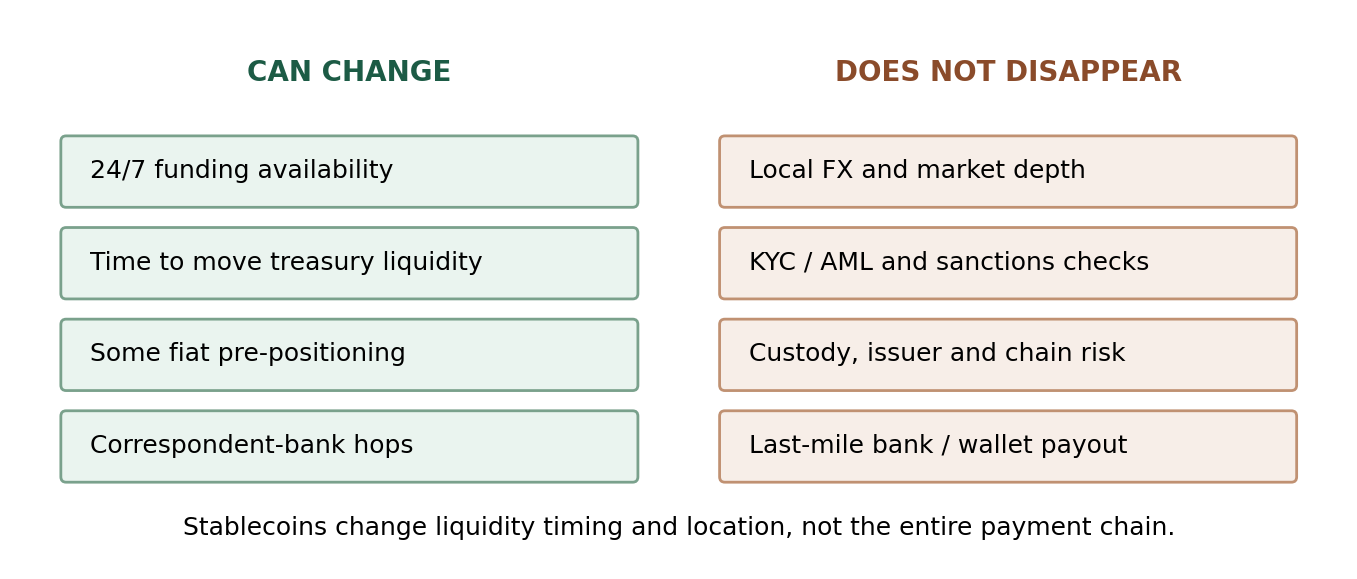
Figure 3. What stablecoin prefunding can change—and which constraints remain.
A final risk is concentration. If a network relies on one stablecoin issuer, one blockchain or a small group of liquidity providers, an operational problem at that point can affect multiple payment corridors simultaneously. Diversification is not free: supporting more tokens and chains creates additional integration, monitoring and liquidity-management work.
What would prove the model is working?
The public announcements establish that payment firms are building and commercializing stablecoin funding and settlement capabilities. They do not yet establish industry-wide savings, and no comparable reduction has yet occured across the market. A serious assessment needs metrics that most announcements do not disclose.
The first is the reduction in average prefunded balances, normalized by daily payout volume. A company should disclose the number of days of payout liquidity it previously held and the number it holds after adoption. The second is the effective cost of liquidity: funding spread, stablecoin acquisition and redemption charges, custody, network fees and the opportunity cost of reserves. The third is payout reliability, including failed transfers, delays, reversals and the time from customer instruction to final local-currency availability.
The fourth is corridor coverage. A service advertised across 180 countries does not mean every currency, payout method or customer type is availble in all 180. The fifth is the share of payouts that can actually use the new funding route, rather than the theoretical number of endpoints in the network.
Investors should also distinguish announced partnerships from live commercial activity. Visa’s October 2026 production announcement with Inyo is a meaningful step beyond the 2025 pilot, but eligibility and geographic restrictions still apply. Euronet’s partnership, Thunes’ EURC expansion and Mastercard’s settlement roadmap represent different stages and different use cases. Treating all of them as equivalent launches would overstate adoption.
The bottom line
Stablecoin prefunding is not simply a faster way to send money. It is an attempt to reduce the amount of cash payment companies must immobilize in local accounts and to move treasury liquidity across borders when banks are closed.
Visa’s production rollout with Inyo gives the model a concrete commercial example. Euronet and Thunes show that the same logic is spreading through payout networks and treasury operations, while Mastercard’s settlement expansion demonstrates a related but distinct route into tokenized money movement.
The economic test is whether these systems let a payment provider make the same payouts with a smaller average liquidity buffer, lower funding cost or better service availability. If the company still needs to hold the same amount of value in advance, stablecoins may improve speed and flexibility without producing a large working-capital release.
For payment networks, that can still be valuable. The network that connects tokenized treasury assets to local banks, cards and wallets can remain central even when the money itself moves on a different rail. The winners will be those that make liquidity more mobile without making compliance, redemption and last-mile payout less dependable.
Prefunding, settlement and payout: three different jobs
| Function | What it answers | Stablecoin use | What remains |
| Prefunding | Where is liquidity placed before payouts? | USDC/EURC can fund a network or processor ledger | The business may still need a buffer; token balances are still capital |
| Settlement | How are obligations between participants discharged? | On-chain stablecoin transfer can settle institutional obligations | Counterparty, legal finality and network rules still apply |
| Payout | How does the recipient get spendable value? | Recipient may receive a token or local fiat | Local FX, bank, wallet and cash-out availability remain |
Sources
- 1. BIS, Payments without borders – prefunding, foreign-currency liquidity and idle buffers.
- 2. Visa, Visa Direct Taps Stablecoins to Unlock Faster Funding for Businesses, 30 September 2025.
- 3. Visa, Visa Direct Launches Stablecoin-Powered Money Movement as Pilots Move to Production, 15 October 2026.
- 4. Inyo Global, first enabler of Visa Direct stablecoin prefunding, 15 October 2026.
- 5. FinanceFeeds, Visa Partners With Zerohash to Expand Stablecoin Payments Worldwide, 5 August 2026.
- 6. FinanceFeeds, Euronet Partners with Fireblocks to Power Stablecoin Cross-Border Payments, 20 October 2025.
- 7. Thunes, EURC prefunding for euro treasury funding, 13 August 2026.
- 8. Mastercard, settlement capabilities with stablecoin, intraday, holiday and weekend options, 3 June 2026.
- 9. Circle, USDC transparency, reserves and redemption disclosures (accessed 9 November 2026).
- 10. BIS, Cross-border payment technologies: innovations and challenges, 11 March 2026.
- 11. BIS, Foreign currency funding risk and cross-border liquidity, 12 March 2026.
- 12. CPMI/BIS, Considerations for the use of stablecoin arrangements in cross-border payments, 31 October 2023.
- 13. FinanceFeeds, Visa Direct Moves USDC-Powered Payments From Pilots to Production, 16 October 2026.
- 14. FinanceFeeds, Fireblocks Brings Stablecoin OTC Quotes Into One Trading Market, 16 October 2026.
Methodology and limitations
Research current through 9 November 2026. The article prioritizes BIS/CPMI material and official company disclosures. Commercial announcements are attributed to the companies; their claimed benefits are not treated as independently measured savings.
The working-capital example assumes $10 million of payouts per day and compares 2.0, 1.0 and 0.5 days of required prefunding. The 8% cost-of-capital assumption is illustrative, not a company performance estimate.
Prefunding, settlement and payout are treated as separate stages. A stablecoin transfer may fund a payment processor without changing the recipient’s payout currency or the legal form of the recipient’s claim.
Country coverage, eligibility, token support, custody arrangements and redemption access vary by provider and jurisdiction. No claim is made that the named services are universally available.

Johan Shamshad is Editor-in-Chief at Dave Finances, covering financial markets, digital assets, trading platforms, brokers, fintech, payments and regulation. Since 2023, he has also worked as an editor at Gulf News, the UAE English-language newspaper published by Al Nisr Publishing LLC. His work focuses on market-moving developments, company disclosures, regulatory changes and trading infrastructure, with an emphasis on primary-source verification and practical context for traders and investors.