
Sea’s consideration of a stock-market listing for Monee invites a seemingly straightforward valuation exercise: separate the fast-growing digital-finance unit from Shopee and Garena, apply a fintech multiple, and calculate what Sea shareholders gain. The November 10 results complicate that story. Monee earned $1.62 billion of quarterly revenue and $298.3 million of adjusted EBITDA, yet reported credit-loss expenses are rising even faster than sales. The interesting question is not whether Monee is large enough to list. It is what buyers should pay for an expanding lender whose distribution advantage is tied to another company in the same group. [1][5]
An IPO is a possibility, not an announced transaction
An October 20 internal memorandum from founder Forrest Li, reported by Reuters and other major publications, raised the possibility of giving Monee its own listing and greater room to expand. It did not establish a prospectus, chosen exchange, offering size, listing date, exact carve-out boundary, proposed shareholder stake or IPO price. Calling this an imminent IPO would turn a strategic signal into a transaction that has not been disclosed. Sea continues to report Monee as one of three operating businesses alongside Shopee and Garena. [5][6]
The timing matters. The memo preceded Sea’s third-quarter earnings publication by three weeks. Analysts initially worked with June 30 loans outstanding of $11.1 billion and second-quarter revenue of roughly $1.4 billion. By September 30, disclosed consumer and SME loan principal had reached $12.6 billion; revenue was $1.622 billion. A valuation that simply repeats a late-October estimate without incorporating the November filing is now using a stale operating baseline. [1][2]
A standalone quote would create price discovery, but it would not automatically create money for Sea investors. The parent might sell a minority stake, issue new Monee shares to finance growth, distribute shares in a spin-off, or combine those approaches. Each route changes control, cash, dilution, and how the residual parent is valued. It is worth stating plainly: valuation and shareholder value are not the same calculation.
Four quarters show a high-growth lender, not a pure payments platform
Sea calls Monee a payments and financial-services business, with wallets, credit, banking and other offerings. Its filings say revenue and operating income are primarily attributable to consumer and small-business credit. For valuation purposes, that sentence matters more than the fintech label: a lender requires underwriting, loss provisioning, collection capacity, regulatory capital and reliable funding. A payments processor is normally assessed with a different earnings-quality framework. [1][7]
ANALYTICAL TABLE
| Period | Revenue, US$m | Adj. EBITDA, US$m | EBITDA margin |
| Q4 2025 | 1,131.9 | 263.1 | 23.2% |
| Q1 2026 | 1,241.8 | 275.2 | 22.2% |
| Q2 2026 | 1,402.8 | 288.0 | 20.5% |
| Q3 2026 | 1,621.9 | 298.3 | 18.4% |
Quarterly Monee adjusted EBITDA rose from $263.1 million in the fourth quarter of 2025 to $298.3 million in the third quarter of 2026. Revenue accelerated more dramatically, from $1.132 billion to $1.622 billion. The implied quarterly EBITDA margin narrowed from 23.2% to 18.4%, despite the volume growth. That does not mean the business suddenly became unprofitable; it means that each new dollar of sales was not accompanied by the same rate of incremental segment EBITDA. [1][2][3][4]
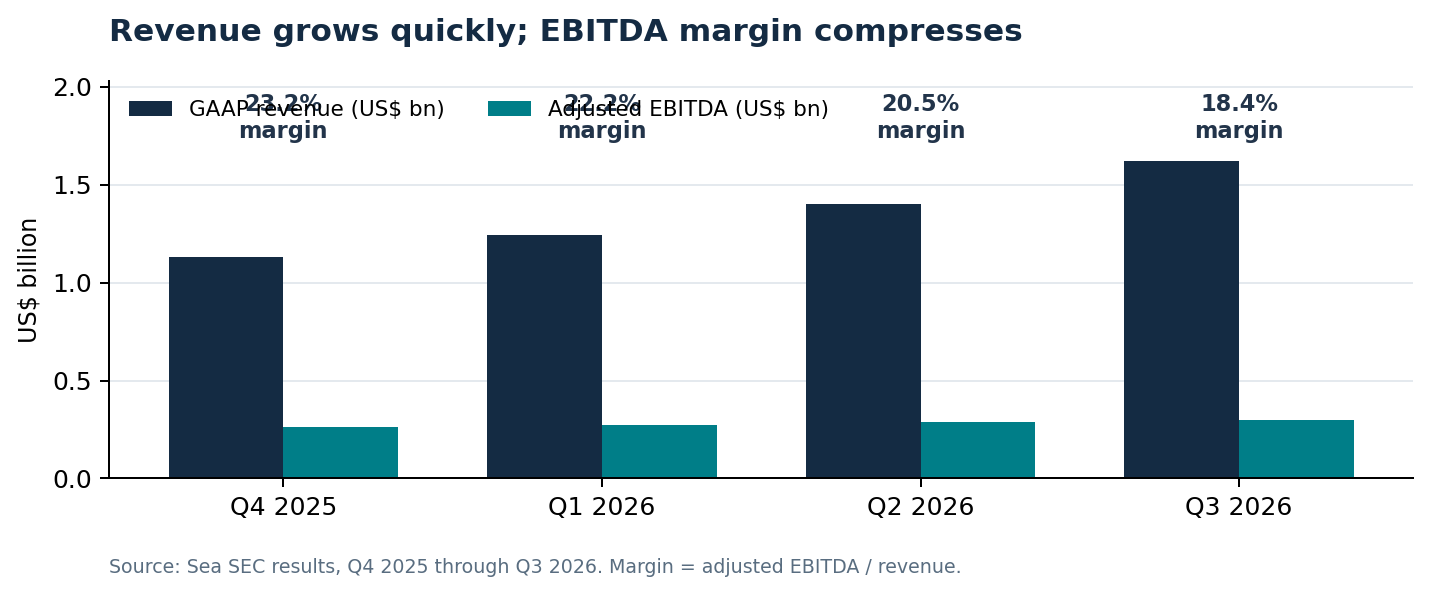
Figure 1. Reported Monee revenue and adjusted EBITDA, with original computed segment margins.
The third-quarter comparison is sharper. Revenue climbed 63.9% year on year, but EBITDA gained only 15.5%. The margin fell from about 26.1% in Q3 2025 to 18.4% in Q3 2026, a decline of approximately 7.7 percentage points. That margin compression makes a static revenue multiple difficult to defend. A buyer should model how interest income, funding expense, acquisition spending and defaults develop as loans mature, especially after moving beyond Shopee-originated borrowers. [1]
There is another distinction behind the headline $12.6 billion loan number. It is gross consumer and SME principal outstanding, including $11.2 billion on-book and $1.3 billion off-book at the reporting date. It is not cash, not consolidated net loans receivable, and not Monee shareholder equity. Likewise, comparing gross loan principal with adjusted EBITDA is a rough scale check, not a conventional price-to-book valuation. [1]
The credit-loss bill is the essential valuation adjustment
In the third quarter, Sea attributed $678.7 million of credit-loss provision to Monee in its segment reconciliation, versus $372.3 million in the year-earlier quarter. That is an increase of about 82%, outpacing Monee revenue growth. The provision was equivalent to 41.8% of Monee’s quarterly revenue, versus about 37.6% a year earlier. This ratio is a deliberately rough expense intensity measure, not an official net credit-loss rate or a cohort loss forecast. [1]
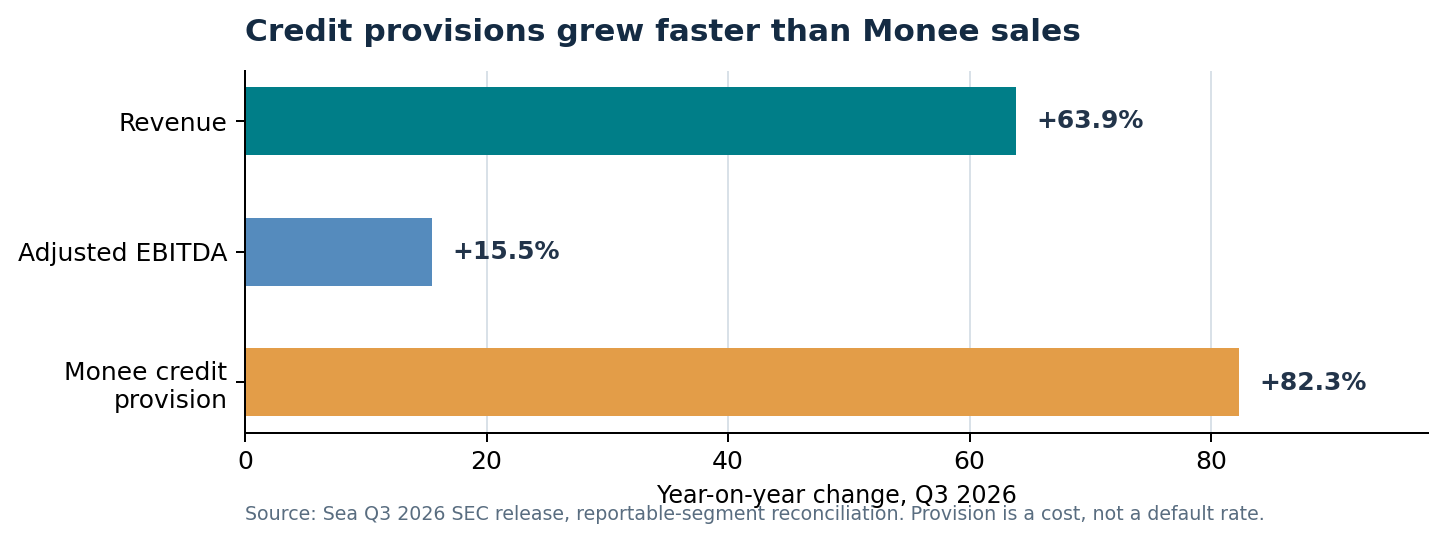
Figure 2. Q3 year-over-year growth: provisioning outran both sales and adjusted EBITDA.
The separate 90-days-past-due ratio increased from 1.1% in Q3 2025 to 1.3% at September 2026. These two facts cannot be collapsed into one claim that borrowers are defaulting at 41.8%. Provisioning reflects expected losses and accounting timing, whereas the delinquency figure describes a stock of loans past due at a date. Rapid portfolio growth also changes denominators. A more revealing prospectus would publish vintage curves, write-offs, recoveries, roll rates, funding sources and loss rates separately for Shopee users, off-Shopee users, Brazil and other markets. [1][8]
The weakness that an equity analyst cannot observe well today is cohort seasoning. A new receivable can contribute recognized revenue before its full repayment behavior becomes evident. Loans written in an aggressive growth quarter might look healthy on an early delinquency metric while future collections worsen. But the opposite is also possible: if recent cohorts perform better than earlier ones, provision expense could stabilize while a larger receivables base produces more earnings. An IPO prospectus could finally show the data needed to discriminate between those paths.
This is why credit businesses should not be valued as if their revenue is chiefly recurring software subscriptions. There is a real balance-sheet exposure behind the growth. The interface looks like fintech; the financial engine, quite substantially, is lending. To compare it with other financial apps, Dave Finances’ guide to digital-bank structures and deposit protection helps distinguish the customer-facing product from the underlying legal and funding model.
Three valuation frames give different answers
The first method is a trailing operating-earnings multiple. Adding the four reported quarters from Q4 2025 through Q3 2026 gives approximately $1.125 billion of Monee adjusted EBITDA. Applying illustrative 8x, 12x, 16x and 20x multiples yields about $9.0 billion, $13.5 billion, $18.0 billion and $22.5 billion respectively. These are multiple-times-segment-EBITDA reference values, not a concluded IPO equity value or a share-price target. [1][2][3][4]
ANALYTICAL TABLE
| Multiple on LTM EBITDA | Operating value proxy | Implied / gross loans |
| 8x | $9.0bn | 0.71x |
| 12x | $13.5bn | 1.07x |
| 16x | $18.0bn | 1.43x |
| 20x | $22.5bn | 1.79x |
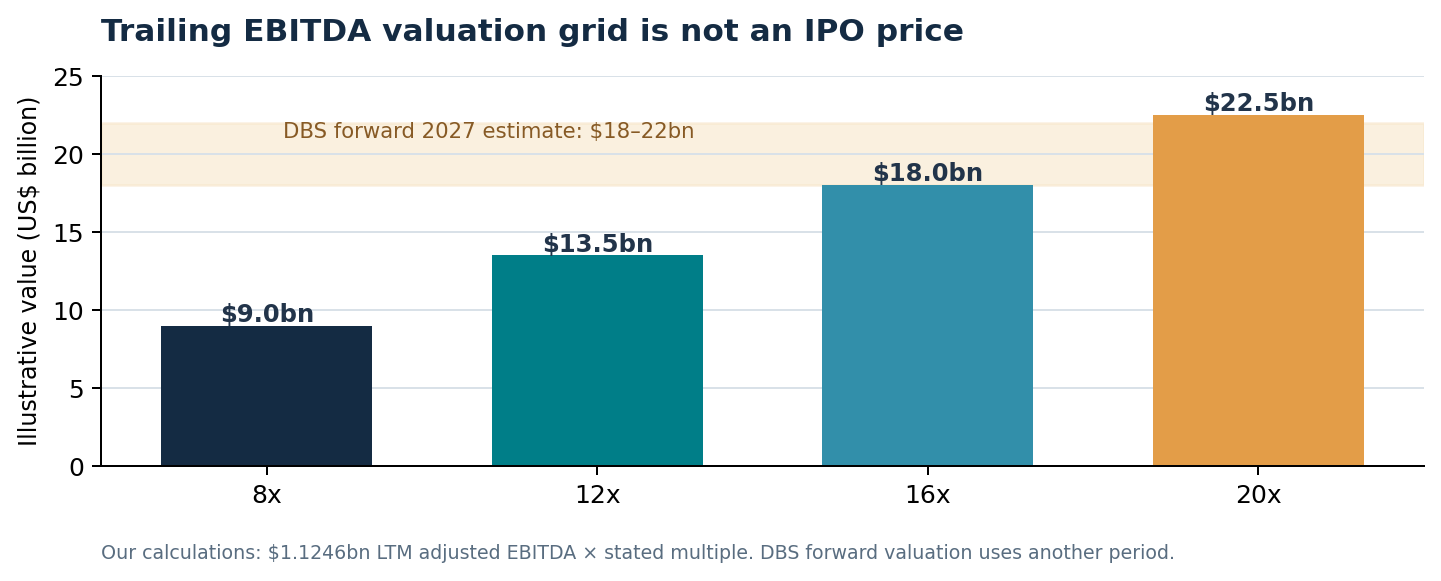
Figure 3. Trailing-EBITDA valuation scenarios alongside DBS’s separately dated forward estimate.
The second frame is forward earnings. DBS published a $18 billion–$22 billion Monee estimate in October based on roughly 12–15 times its projected 2027 adjusted EBITDA of $1.472 billion. That is a defensible published analyst scenario, not a company forecast or an announced IPO valuation. It uses a different earnings denominator from our trailing calculation. Presenting $22 billion from forward 2027 profit beside $13.5 billion from trailing profit without labeling the denominator would create a false discrepancy. [6]
The third is credit-business equity valuation. Banks are conventionally analyzed through sustainable earnings, cost of equity, return on tangible equity, book value and regulatory capital. Monee contains bank entities and nonbank lenders across jurisdictions; detailed standalone net tangible equity, required capital, funding and intercompany positions have not been disclosed in a form sufficient for a full price-to-tangible-book calculation. A lender’s interest-bearing debt is raw material for production, not merely financing added to enterprise value in the same fashion as an industrial company. Therefore, adjusted EBITDA multiples are useful for a first look but can mislead when treated as completed bank valuations.
A fourth cross-check is value relative to credit assets. An $18 billion–$22 billion figure is roughly 1.43–1.75 times September’s $12.6 billion of gross loan principal. That does not mean investors would own $12.6 billion of unencumbered receivables. The loans carry expected losses and are financed by liabilities, deposits or external partners. Any comparison with another fintech’s purchase multiple must put the same assets, legal entities, and net debt or capital on each side. Loan multiples reveal how demanding a price might be, not whether that price is justified. [1][6]
A credit-cost sensitivity that changes the headline value
The sensitivity most worth modeling is not another five points of revenue growth. Suppose, strictly for illustration, that incremental annual net credit losses equal 0.5 or 1.0 percentage point of the current $12.6 billion principal base, with no offsetting repricing, provision release, reserve or funding changes. The incremental annual earnings burden would be $63 million or $126 million. That is equivalent to 5.6% or 11.2% of the approximately $1.125 billion trailing adjusted EBITDA base. It is not a projection of reported provision expense, which already includes management’s estimate of future losses. [1]
ANALYTICAL TABLE
| Illustrative extra annual loss | USD amount | Share of LTM EBITDA | At 12x; value sensitivity |
| +0.5% of principal | $63m | 5.6% | −$0.76bn |
| +1.0% of principal | $126m | 11.2% | −$1.51bn |
If a buyer mechanically capitalized those incremental earnings reductions at 12 times, the corresponding reference-value difference would be $756 million or $1.512 billion. That arithmetic deliberately holds everything else constant; real lenders respond by changing pricing, approval rates, exposure, funding and collections. Moreover, book growth can change credit quality and income simultaneously. The exercise shows how little additional loss pressure it takes to absorb a material part of an apparently attractive valuation premium.
There is a counterargument. Consumers using Shopee may provide years of transaction and repayment signals, potentially improving segmentation and underwriting. Monee may also profit by integrating merchant financing, wallets and payment acceptance. Yet an ecosystem advantage is only economically meaningful if it improves the net return after acquisition, funding, fraud, loss and servicing costs. Dave Finances has previously dissected non-trading revenue economics at digital financial platforms; the analogous question for Monee is which activities contribute after risk-adjusted costs, not just which products exist.
A listing unlocks value only under the right ownership structure
Consider a hypothetical $18 billion equity value for Monee, solely to show deal mechanics. Selling 15% of existing shares would raise $2.7 billion for the selling shareholder, leaving an 85% stake worth $15.3 billion at the same price. The combined value, before fees and tax, remains $18 billion. The proceeds and retained stake cannot both be added to an already complete $18 billion calculation. Conversely, if 15% of post-money shares are newly issued, $2.7 billion of gross proceeds generally enters Monee itself, increasing its balance-sheet resources, rather than being paid directly to the parent. [6]
ANALYTICAL TABLE
| Offering mechanics at $18bn price | Proceeds | Value of retained 85% | Who receives cash |
| 15% secondary sale | $2.70bn | $15.30bn | Sea (selling parent) |
| 15% primary post-money issue | $2.70bn | $15.30bn | Monee (new equity) |
Neither example accounts for transaction fees, tax, minority interests, reserved shares, capital regulations or shifts in investor multiples. The actual value attributable to Sea ADS holders depends on Sea’s post-listing economic interest, any distribution of Monee shares, the cost of the retained holding-company structure, and the market’s valuation of Shopee, Garena and the newly announced Sea Cloud venture. An IPO can clarify segment valuation, but can also introduce an additional listed-company discount, duplicated overhead or funding constraints.
Arm’s-length trading with Shopee is perhaps the most consequential hidden change. Monee currently benefits from marketplace traffic, transaction signals and merchant relationships. A standalone public company would need transparent commercial agreements for data, distribution, settlement, servicing and possibly customer acquisition. Who pays what, and at which market rate? A favorable current transfer arrangement might flatter one segment and depress another. In a separated structure, the economics can no longer remain vague.
That matters for the payments side too. The strategic differences among networks, processors and customer-owned wallets have been explored in Dave Finances’ comparison of Visa, Mastercard and Stripe payment models. Monee’s own value depends on the activities that actually capture spread and servicing revenue, rather than the size of payments routed through its ecosystem.
Regulatory capital and market composition could set the timetable
DBS highlighted listing complications across the eight markets where the business operates, including Singapore ownership controls, Indonesia’s forthcoming buy-now-pay-later affordability restrictions and the recent licensing of MariBank Philippines. Those are concrete constraints on a carve-out, not proof that a 2027 transaction will occur. The legal perimeter of the offer could exclude some regulated subsidiaries, use a holding company, or impose governance requirements that affect economic ownership and transferability. [5][6][8]
Brazil matters as more than a high-growth geographic footnote. DBS estimated Brazil at about 15%–16% of Monee’s loans around mid-2026 and identified credit provisioning there and outside Shopee as areas of concern. If newly originated off-platform cohorts have higher losses, consolidated growth can appear stronger even while the incremental risk-adjusted return is weaker. Investors should ask for the cohort yields and realized losses by geography, not a single group NPL percentage. [6]
The bigger test may be how much capital Monee needs to support $12.6 billion of exposure and further growth. Issuing shares for expansion could increase resilience while diluting the parent’s percentage stake. Selling secondary shares could monetize ownership but leave the business’s balance sheet unchanged. Neither deal is economically equivalent to a tax-free distribution. Capital, not just multiple selection, shapes the fair value for the remaining Sea shareholder.
What would prove the bullish interpretation wrong?
Three signs would challenge a premium valuation: successive quarters of faster provision growth than revenue without an improvement in cash collection; a persistent EBITDA-margin decline despite scale; or a formal carve-out requiring significant new equity merely to maintain capital and funding. A fourth would be evidence that Shopee-sourced clients and intercompany arrangements account for more of the economics than the standalone business can retain on market terms.
The converse case is measurable as well. A company filing that disaggregates the loan vintages, shows better risk-adjusted margins outside Shopee, demonstrates durable funding at acceptable cost and provides credible standalone regulatory capital could justify higher growth assumptions. The market would then be purchasing more than the hope that a famous e-commerce group can market financial products cheaply.
For retail Sea investors, the question is not simply, ‘What is Monee worth?’ It is: what part of that value is new relative to the consolidated stock price, what stake will Sea retain, and what cost or dilution accompanies the separation? The high end of a valuation range has little significance until those mechanics are disclosed.
Bottom line
A practical current reference range is roughly $9 billion–$22.5 billion at 8–20 times Monee’s $1.125 billion trailing adjusted EBITDA; DBS’s independent, forward-looking estimate is $18 billion–$22 billion. These are illustrative markers, not reliable estimates of what an IPO will raise. Monee has extraordinary revenue momentum, but its latest credit-loss provision and margin trends justify substantial diligence before assigning the richest multiple. What a listing might reveal about the loan book could be more valuable to investors than the listing itself.
Methodology and limitations
All quarter-end operating figures come from Sea’s SEC-filed company results as of November 10, 2026. Trailing EBITDA equals the sum of Q4 2025, Q1 2026, Q2 2026 and Q3 2026 reported Monee adjusted EBITDA, without further normalization. The 8x–20x grid applies hypothetical multiples to this sum, with values rounded to one decimal billion. Loan-ratio and credit-cost sensitivities use September 30, 2026 gross on-book plus off-book principal and do not claim to model legal capital, default distributions, amortization, or expected loss reserves. The provision-to-revenue ratio divides the quarterly Monee segment provision by quarterly Monee GAAP revenue, not by average loans. IPO structures assume a fixed illustrative equity price and deliberately exclude fees and taxes. No prospectus or standalone Monee regulatory capital statement was verified by the cutoff date. This is research, not investment advice.
Sources and verification
Numbered evidence references used in the text. Original documents are linked below; accessed on November 12, 2026.
[1] Sea Limited: Third Quarter 2026 Results (SEC, Nov. 10)
[2] Sea Limited: Second Quarter 2026 Results (SEC, Aug. 11)
[3] Sea Limited: First Quarter 2026 Results (SEC, May 12)
[4] Sea Limited: Fourth Quarter and Full Year 2025 (SEC)
[5] Reuters: Sea plans Monee listing, internal memo, Oct. 20
[6] DBS Research: Value unlock from potential Monee IPO? Oct. 20
[7] Sea Limited: Investor Relations, business description
[8] Sea Limited: FY2025 Annual Report, SEC Form 20-F
[9] DBS Research: Sea Cloud, sum-of-parts approach, Oct. 22
[10] The Business Times: DBS assessment of Monee valuation
[11] Business Wire: Sea full-year 2025 results and segment metrics
[12] The Wall Street Journal: Sea considers Monee listing, Oct. 20

Johan Shamshad is Editor-in-Chief at Dave Finances, covering financial markets, digital assets, trading platforms, brokers, fintech, payments and regulation. Since 2023, he has also worked as an editor at Gulf News, the UAE English-language newspaper published by Al Nisr Publishing LLC. His work focuses on market-moving developments, company disclosures, regulatory changes and trading infrastructure, with an emphasis on primary-source verification and practical context for traders and investors.