
A small-business owner can now ask an AI assistant to prepare an invoice, generate a payment link or issue a refund through a connected payment platform. The change is no longer just a future-commerce slide deck. On October 21, 2026, Stripe and Anthropic said Claude Duet’s research preview uses Stripe’s Model Context Protocol (MCP) connection for invoicing, products, payment links, revenue analysis and refunds. Buyers can also approve purchases through Link’s wallet for agents. The word ‘approve’ is the important constraint. [1]
The business case is strong: a plain-language instruction can replace a sequence of back-office screens. But the agent does not own money, invent legitimate refunds or acquire authority simply because a model can call an API. The real innovation is a controlled tool connection between natural-language requests and established payment systems. A system that merely drafts an invoice is operationally different from one that sends an irreversible payout. [2][3]
This article focuses on the seller’s operational side of agentic payments: refunds, invoice creation, payment collection and reconciliation. The related Dave Finances examination of authorization-scope failures in agentic commerce addresses the buyer’s permission to spend; a merchant agent adds a separate set of permissions over customer money and financial records.
The Three Powers That Should Never Be Confused
An AI assistant can work at three levels. First, it can read account information: list unpaid invoices, summarize delinquency, retrieve a transaction or explain a customer account balance. Second, it can prepare a reversible object such as a draft invoice or suggested credit note. Third, it can execute a financially consequential action such as sending a finalized invoice, refunding a payment or transferring business funds. [2][4]
Stripe’s documentation makes the difference explicit. Its invoice-creation API begins with a draft, which must be finalized before normal collection or sending. The hosted Stripe MCP server supports creating and finalizing invoices as distinct calls. Refunds are another API entirely, and Stripe’s MCP list labels the refund-creation action as requiring human confirmation. Treasury money movements—including transferring and sending funds—also carry human confirmation in the documented preview. [2][4]
The distinction matters under stress. An accidental invoice draft may be deleted or corrected before the customer receives it. An emailed invoice with the wrong tax or bank details can create an accounting and customer-service problem. A refund is a real movement of funds in the opposite direction. A payout to an attacker-controlled account can turn an ambiguous prompt into an actual cash loss. The labels read, draft, send, refund and pay should be separate entries in a permission matrix.
| Action | Financial effect | Reversibility | Appropriate default |
|---|---|---|---|
| Read payments and invoice statuses | None directly | N/A | Read-only agent |
| Create draft invoice | Creates an editable billing object | High before finalization | Allowed inside template |
| Finalize or send invoice | Creates customer demand/collection workflow | Partial; may require corrections | Review amount, tax and customer |
| Issue refund | Returns funds and changes ledger | Depends on rail; cannot assume undo | Human confirmation or strict policy gate |
| Send treasury payment | Transfers business value | Often difficult to reverse | Human approval and beneficiary controls |
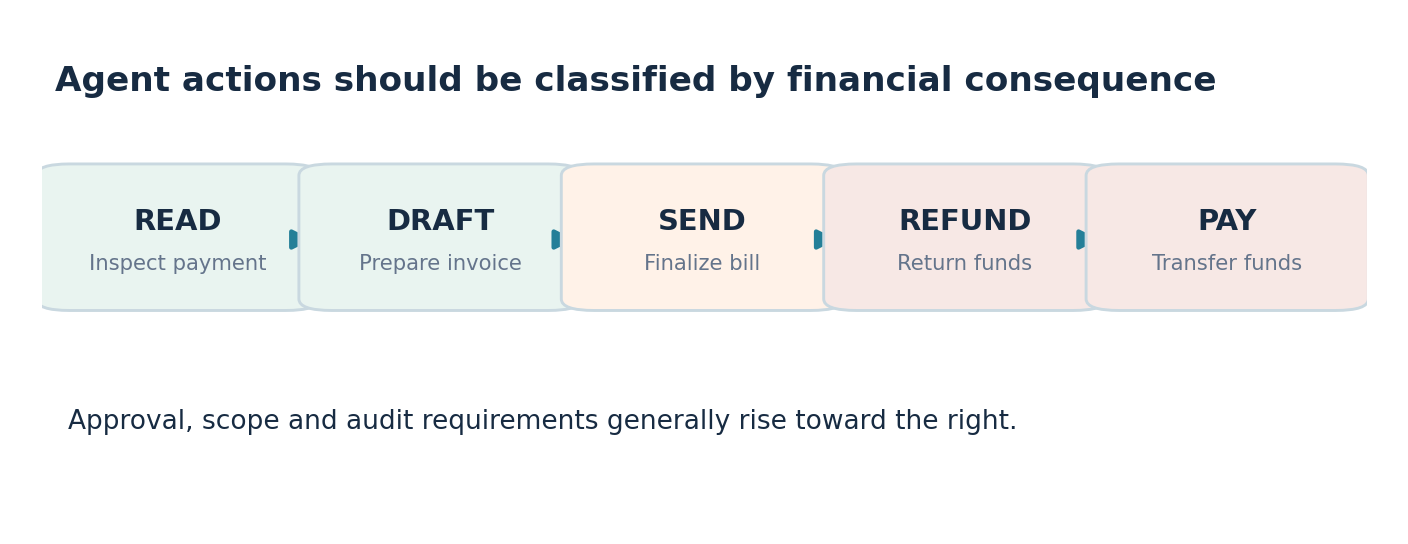
Figure 1. The agent permission ladder from information retrieval to actual money movement.
What Stripe, PayPal and the Protocol Layer Actually Provide
The Stripe MCP server offers a normalized way for an agent to find approved API operations and act through authenticated access. Its published tools include reading and writing Stripe API resources, finding and creating customers, retrieving charges, creating refunds, creating or finalizing invoices, generating payment links and interacting with Treasury functionality in preview. The API does the payment operation; the language model decides which tool to request and supplies parameters subject to controls. It is not a new banking system underneath the card network. [2]
Stripe recommends OAuth for interactive clients and dedicated agent API keys for autonomous programs, with only the permissions necessary for the job. Its documentation says full-access secret keys and restricted keys without the Agent designation stop being accepted by Stripe MCP starting in December 2026, after a November 30 migration deadline. That is a concrete sign that treating an AI assistant as a privileged, audited software principal is becoming part of payment infrastructure. [2]
PayPal also documents an Agent Toolkit and MCP-based payment integrations using existing invoicing, payment, subscription, refund and tracking APIs. Its own materials describe broad possibilities, but a developer’s capability depends on configured API scopes, geographic eligibility, product access and application safeguards. A provider blog describing what a toolkit can support is not evidence that every connected assistant can perform every task in every country today. [5]
For a business owner, a realistic workflow may be: ‘Find unpaid invoices older than 30 days; prepare reminders; draft a $1,200 invoice for customer X using our standard tax settings; show me any refund requests above $100.’ Those tasks can be useful even if nothing is sent until a human confirms the final actions. In many organizations the approval queue, rather than unlimited autonomy, is the product.
There is an important separation from consumer checkout. Stripe’s Link wallet for agents is designed to let an individual approve a purchase and provide a controlled virtual card to execute it. Merchant-side invoice and refund permissions belong to the merchant’s account and require different audit trails. Dave Finances’ account of tokenized Visa credentials for AI agents illustrates the buyer-side credential problem; merchant refunds require a separate permission structure. [1]
Where the Economic Value Comes From
Consider a merchant with 800 monthly refund requests and 500 invoices, each involving relatively repetitive steps. A support worker who spends two minutes validating and entering each refund request devotes 1,600 minutes, or 26.7 hours, each month. At a fully loaded $35 hourly cost, the gross clerical expense is about $933. This is an illustrative cost-of-work model, not a measured saving from Stripe or Anthropic.
If an agent accurately prepares eligibility evidence, account details and calculations, it could reduce much of that work. But the real net saving must subtract supervision, software cost, exception handling, erroneous refunds, chargebacks and the cost of correcting customer accounts. If 1% of the 800 requests were incorrectly approved at an average $60 refund, the expected face-value leakage would be $480 a month. At 2%, it would be $960—more than the modeled $933 of clerical work. That comparison assumes the errors are incremental and unrecoverable, and does not count reputational or dispute costs. [6]
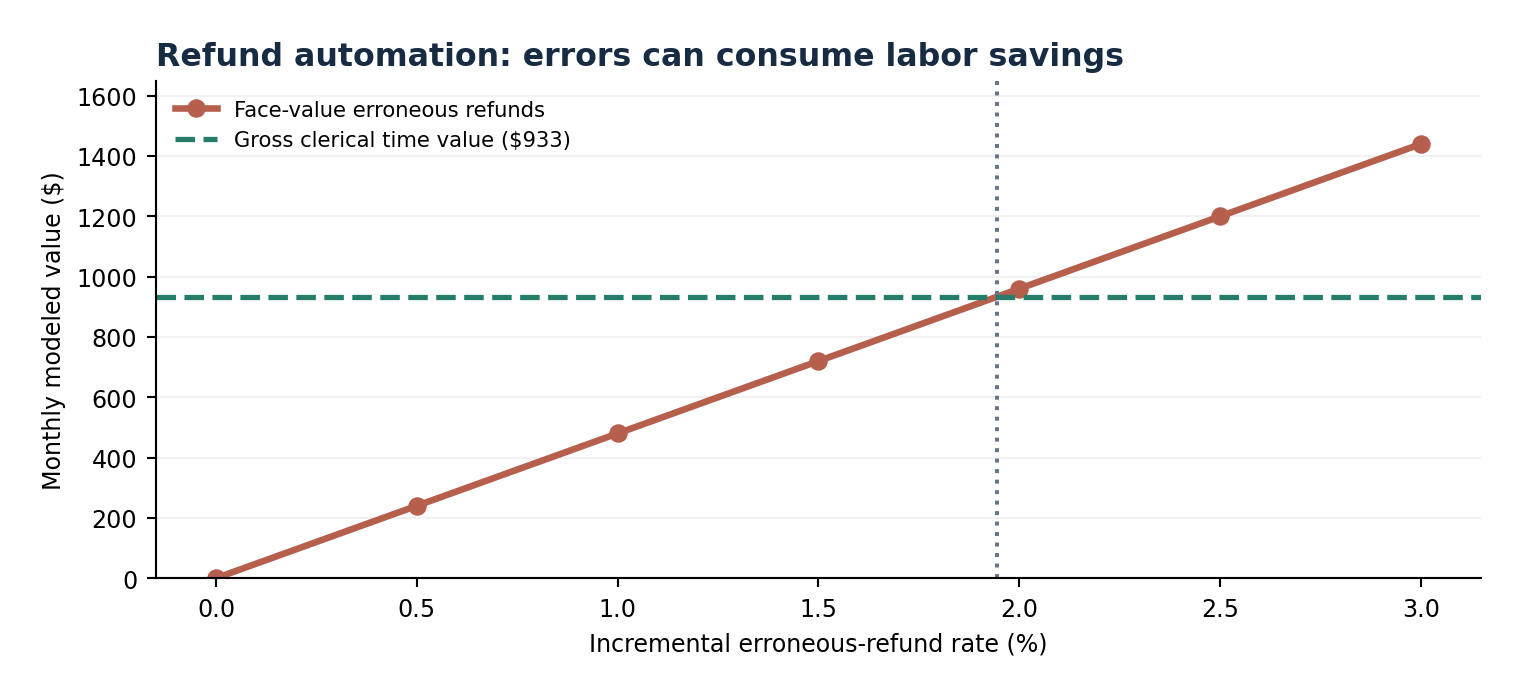
Figure 2. Original refund-automation stress test: cost of false approvals versus clerical time value.
The rough break-even error rate is $933 / (800 × $60), or 1.94%. That is not a safety target: losing $900 through improper refunds is often unacceptable even if an automation saves $933 of staff time. Some refunds are also much larger than $60, so an error rate measured by transaction count can obscure losses concentrated in expensive transactions. The model is useful precisely because it shows why a ‘95% accurate’ classification score says little about financial risk.
Invoice efficiency has another dimension. A faster invoice can shorten the time between service completion and payment request, but only if the customer, amount, tax and due date are right. The payment method also affects fees and days sales outstanding. Stripe’s invoicing product supports payment links, billing automation and reconciliation; it does not guarantee that a customer pays simply because a message was drafted by AI. [7]
A more serious model would track actual average resolution time, the proportion of cases requiring human review, the cost of incorrect refunds, invoice corrections per thousand bills and collection days. A demo that successfully sends ten test invoices demonstrates technical capability. It does not prove the agent is economically safer at a million payment instructions.
The Safe Architecture Is a Policy Engine Between Language and Money
A natural-language instruction can be ambiguous: ‘Refund the unhappy customers’ does not identify which customers, the amount, how to handle partially shipped orders or whether promotional credits count. The LLM should extract a proposed intent; a rules engine should independently validate it against trusted purchase records, return eligibility, customer identity, amount caps, duplicate-refund status and sanctions or fraud checks where applicable.
The execution layer then calls the payment API with narrow credentials and an idempotency key where supported. Idempotency prevents retries of the same request from accidentally creating duplicate transactions; it does not establish that the first request was authorized or fair. Webhooks and reconciliation should check the provider’s final status rather than assuming that a successfully submitted API request means funds arrived. [8]
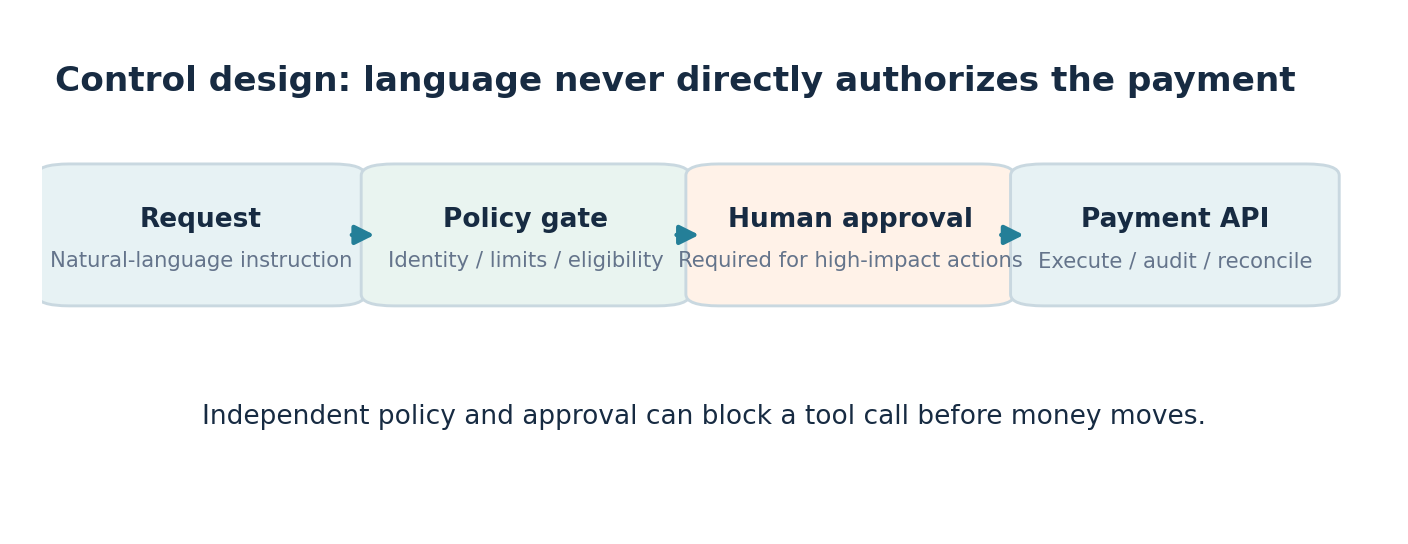
Figure 3. Safe execution architecture with policy, confirmation and reconciled API outcomes.
A robust policy might let the assistant automatically draft any invoice under the correct customer contract, but require review before it is sent; automatically recommend refunds below $25 for confirmed duplicate charges, while requiring human approval for all other refunds; and never permit changes to bank beneficiaries without independent verification. Those are example controls, not Stripe or PayPal default thresholds. The correct policy depends on customer volume, risk appetite and legal obligations.
An assistant also needs separation of duties. The same agent should not be allowed to create a fake customer, invent a charge, approve its own refund and mark the ledger reconciled. A dual-control process requires an independent human or independently enforced workflow to approve exceptional actions. A prompt saying ‘make sure not to do anything risky’ is not equivalent to a server-side spending limit.
The OWASP GenAI Security Project identifies prompt injection and excessive agency as distinct risks. A malicious invoice attachment, support email or merchant note could contain instructions that try to override an agent’s real task and trigger a payment tool. Tool permissions, trusted-data boundaries and approval gates must prevent instructions from low-trust documents from becoming authority. [6][9]
Refunds Also Have a Legal Owner
One reason agentic-payment announcements can mislead is that buyers, sellers and infrastructure providers have different obligations. Stripe’s agentic-commerce service terms state that the seller is responsible for fulfillment and customer-facing post-purchase duties including returns, refunds and exchanges in relevant configurations; they also allocate responsibility for certain unauthorized agentic transactions to the provider operating the agent interface. Terms vary by product and relationship, and should not be generalized as a universal rule for every payment system. [10]
For merchant-side automation, even a technically correct refund may violate internal policy or consumer law if the wrong person authorized it or if a product is ineligible. Similarly, tax handling, VAT invoices and credit-note compliance vary across jurisdictions. The agent can prepare documentation, but the legal person issuing the invoice remains the business. The merchant should retain an audit trail of the source instruction, applicable policy, transaction identifiers, approvals and any changes made after execution.
A refund request must also be tied to a real charge. A phishing support email that says ‘I paid twice’ is not itself enough evidence. The agent should retrieve the original PaymentIntent or charge, verify merchant/customer linkage and identify refunds already processed. These are deterministic data checks, not questions of whether the model sounds confident. [2][8]
A payout or purchase on the customer side creates another authorization question: did the user approve this specific merchant, amount and time window? Dave Finances’ overview of the different roles of Visa, Mastercard and Stripe in programmable payments helps explain why authentication, settlement and merchant operations remain separate layers even when an assistant presents them in one conversation.
What a Responsible Small Business Deployment Looks Like
The strongest initial deployment is not ‘AI runs finance.’ It is a narrow assistant connected to one payment system, with read-only access by default and a limited menu of reversible actions. Start with invoice discovery, dunning drafts, categorization, draft invoice preparation and refund recommendations. Use a sandbox and test against duplicate requests, customer-name collisions, tax errors, partial-refund edge cases, currency mismatches and manipulated inbound messages. [2][6]
Only after measurable performance should the business grant bounded write capabilities. The access should be scoped to the task and environment, with separate keys or permissions for different departments, prompt-independent limits, logging and a way to disable the agent quickly. Users should see the exact proposed payment side effect before confirming it. An approval button that shows only a vague narrative is not meaningful approval of a $5,000 transfer.
A finance team should compare the output with bank statements, processor dashboards and general-ledger postings. Payment APIs can reject, reverse or delay requests. The confirmation of a tool call is not the same thing as reconciled settlement. For recurring flows, a human owner should review exception rates and mismatched balances, not merely the agent’s success messages.
One more subtle point: an AI system can make routine transactions more accessible to a small-business owner, but it can also magnify a small policy error across every customer. A mistaken tax template applied to 500 invoices is no longer one clerical mistake. It is 500 customer-facing records to repair. Controls that constrain scale and require review are therefore core product features, not friction added after launch.
What Would Prove This Is More Than a Demo?
The evidence to watch is operational: how many invoices an assistant correctly drafts and finalizes, how much of the workflow requires correction, how often refunds fail policy tests and how much cash can be lost in a worst-case batch before the controls stop it. Merchant-reported gains should be adjusted for review labor and downstream accounting work. Security disclosures and independently assessed controls matter more than a polished conversational interface.
The broader product trend is established: Stripe’s October 2026 Claude integration and its detailed MCP tools show that these actions can be exposed to AI clients through authenticated financial APIs. What is not established is that autonomous execution without supervision is universally safe, widely available or commercially superior. Different merchants will reach different conclusions because their invoice sizes, dispute rates, staff costs and regulatory obligations differ. [1][2]
Bottom Line
Yes: AI assistants can create invoices, issue refunds and help manage payment operations when connected to supported tools and authorized accounts. But every action carries a distinct financial risk. Reading transaction history is not transferring funds; creating a draft is not sending a bill; requesting a refund is not proving eligibility; and an API response is not final settlement.
The real competitive advantage lies in safely compressing administrative work while preserving the human and institutional controls that make payments trustworthy. For merchant finance, a permission-aware assistant is much more valuable than a model simply allowed to press every button.
Methodology
Research cutoff November 12, 2026. Product capabilities were verified against Stripe’s October 21 company announcement, its current MCP documentation, API reference, PayPal’s developer materials and OWASP security guidance. Features described as research preview or region-dependent are not treated as universally launched. The refund model assumes 800 cases per month, two minutes of clerical effort each, $35 full labor cost per hour, $60 average refund and 0.5%/1%/2% erroneous approvals; these are invented model inputs, not observed provider performance. Gross labor value = cases × minutes / 60 × hourly cost. Face-value leakage = cases × error rate × average refund. Break-even error rate = labor value / total potential refunds. No tax, implementation, integration, financing or customer-service costs are included.
Sources
[2] Stripe, Model Context Protocol: Tools, Permissions and Agent Keys
[3] Stripe, MCP App Marketplace Permissions
[4] Stripe, Create an Invoice API Reference
[5] PayPal Developer, Accelerating Agentic Payments with PayPal
[6] OWASP, LLM06 Excessive Agency, 2025
[7] Stripe, Invoicing and Accounts Receivable
[8] Stripe, Create Refund API Reference
[9] OWASP, Prompt Injection Security Guidance
[10] Stripe, Services Agreement: Agentic Commerce Agent Terms
[11] Stripe, Stripe AI and MCP Repository
[12] Stripe, Stripe API Keys and Agent Authentication
[13] Stripe, Stripe Payment Links
[14] Stripe, Idempotent Requests
[15] Stripe, Finalize an Invoice API

Johan Shamshad is Editor-in-Chief at Dave Finances, covering financial markets, digital assets, trading platforms, brokers, fintech, payments and regulation. Since 2023, he has also worked as an editor at Gulf News, the UAE English-language newspaper published by Al Nisr Publishing LLC. His work focuses on market-moving developments, company disclosures, regulatory changes and trading infrastructure, with an emphasis on primary-source verification and practical context for traders and investors.