
Stripe’s October 21 announcement has moved financial agents beyond writing invoice drafts or explaining cash balances. Under Treasury for Agents, supported AI clients can inspect balances, set up recipients, initiate money movement and request currency conversions through Stripe’s infrastructure. That is a consequential change: the software has a path to live financial instructions, not just a view of a ledger. But neither a model’s ability to request a transfer nor the label “Treasury” makes it a bank officer. The practical question is where the agent’s authority starts, where the bank and Stripe remain responsible, and which actions a business can afford to delegate.
Five Tools, Not a General Banking Power of Attorney
Stripe announced Treasury for Agents on October 21, 2026, positioning it as a way for startups to manage operational finance inside software they already use, including ChatGPT and Claude. The company’s documentation identifies five Treasury-specific tools currently labeled public preview: get_balance_summary, setup_recipient, send_money, transfer_money and convert_currency. The first reads account data; the remaining tools can change financial state if permission is granted. That is more concrete than a demo that simply drafts payment instructions. [1][2]
There is a critical boundary in the product’s scope. Stripe Treasury for Agents operates on eligible Stripe-supported balances, financial accounts and transactions, with rights selected at the authorization step. It is not a universal API by which an AI assistant can withdraw money from any bank account a company happens to own. Stripe Financial Connections can make external bank balances and transaction data available in supported configurations, but access to that data is not equivalent to payment-initiation authority at the external institution. The terms and permission models of each service remain separate. [2][3]
Stripe says businesses can choose the accounts available to an agent and whether it may read or write particular categories of data. The public-preview documentation says live money movement requires approval by default. Its developer guide adds a distinction between an agent acting through a user’s OAuth authorization and an independent agent identified by an agent-tagged API key. Human confirmation and approval rules are not the same mechanism, and neither grants a blank check. [2][4]
| Treasury-specific tool | Listed permission category | What a sensible operator must still decide |
|---|---|---|
| `get_balance_summary` | Balance and Money Management Financial Accounts: Read | Which legal entities, currencies and accounts the agent can view |
| `setup_recipient` | Recipient Configuration: Write | Whether new payees need independently verified bank details |
| `send_money` | Money Management Outbound Payments: Write | Recipient, amount, permitted rail and human approval |
| `transfer_money` | Money Management Outbound Transfers and Payouts: Write | Which internal balances can move and whether liquidity is available |
| `convert_currency` | Currency Conversions: Write | Currency pair, quoted rate, spread and execution threshold |
Even within the same account, checking liquidity and setting up a supplier represent radically different risks. A balance query reveals private financial information but cannot by itself misdirect funds. Recipient setup creates a target to which funds might later be sent. An outbound payment turns that target and an amount into an instruction to move money. Currency conversion adds a market price and often an FX spread. A robust permission model separates the tools because each can cause a different failure.
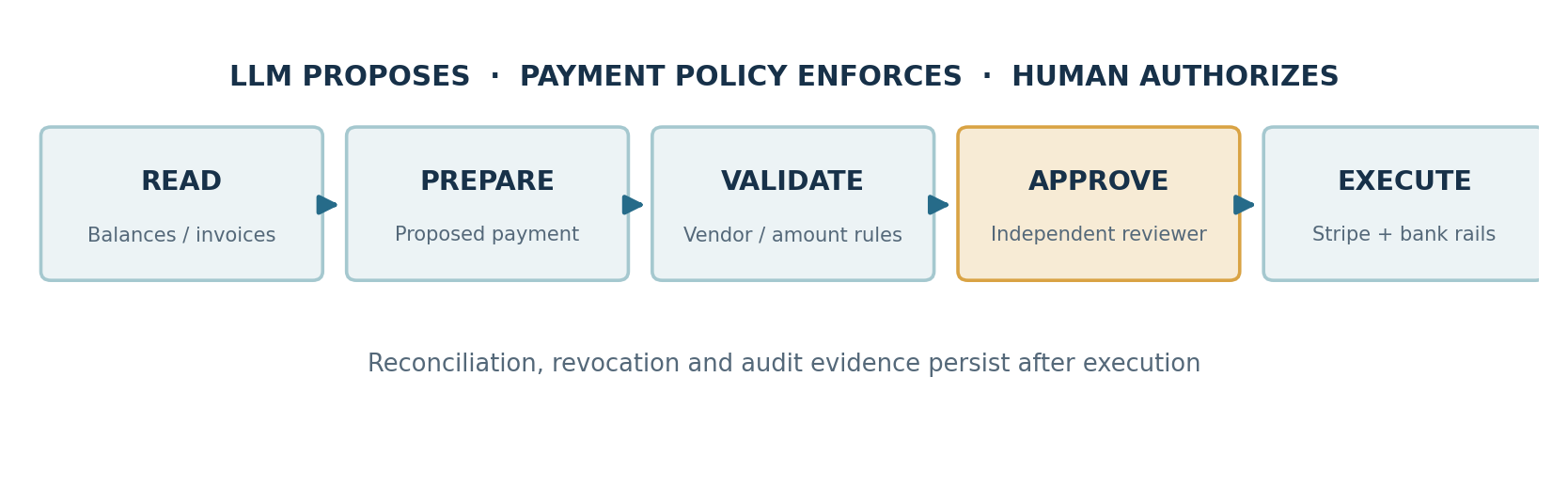
Figure 1. Proposed agent treasury control chain. Access selection, deterministic mandate validation and independent approval are separate layers; the diagram is an analytical control design, not Stripe’s proprietary implementation.
Stripe Is the Interface, Fifth Third Is the Bank
The word “bank” in a headline is easy to over-read. Stripe says explicitly that it is not a bank, and that checking accounts under the cited US Treasury product are provided by Fifth Third Bank, National Association, Member FDIC. That makes the legal account provider different from the user-facing software company and different again from the AI model producing an instruction. Product availability, eligible account holder, balance type and bank terms matter. The name of a fintech interface does not determine the legal nature of every dollar shown within it. [1][5]
A business has to map at least four relationships: the customer that owns or is entitled to the funds; the regulated bank that holds relevant deposits; Stripe and other service providers providing software and ledger functions; and the authorized operator—or agent—submitting account instructions. Depending on the product, the firm may have a direct bank account or an eligible interest represented through an intermediary. These are not identical from a recordkeeping or insolvency perspective. It is necessary to read the applicable customer agreement rather than infer an all-purpose guarantee from an FDIC logo.
FDIC guidance distinguishes bank failure from nonbank service-provider failure. Deposit insurance generally addresses covered funds at an insured bank within applicable ownership categories and limits; it does not compensate a business for every erroneous authorized transfer, lost commercial opportunity, or the bankruptcy of a nonbank technology supplier. Where money is placed via third parties, pass-through coverage has specific ownership and recordkeeping requirements. US banking regulators have also warned that fintech-bank arrangements can create operational and reconciliation risks even where the bank remains subject to supervision. [6][7][8]
Now introduce AI execution. If an agent selects the wrong vendor from two similarly named records and a designated employee approves it without checking the destination, deposit insurance is not the remedy for that operational mistake. If the agent cannot reconcile a pending payment and sends a duplicate instruction, the issue is not that a bank deposit suddenly became a stablecoin. It is a payment-operation failure. The banking wrapper and the software authorization rules protect different things. These distinctions are what an actual treasury-control policy must address.
The Payment Is a Series of Permissions, Not a Prompt
A plausible invoice workflow begins with the agent reading an approved invoice, matching it to a purchase order or vendor record, retrieving permitted account balances, selecting a payment date, then preparing a send_money request. For a new vendor it might invoke setup_recipient first. The human reviewer should see the intended legal payee, verified bank details, currency, total amount, invoice references and any FX rate—not merely a green button beside a model’s assurance that everything looks correct. Only then is the instruction allowed to reach the payment API. [2][4]
Stripe’s October 21 developer guidance offers two execution patterns. An OAuth-connected assistant acts on behalf of a logged-in user. Sensitive live actions such as refunds and payouts require the person to confirm, even when the AI client itself is configured not to interrupt for tool calls. An independently identified agent can instead use an agent-tagged key and configured approval rules; Stripe describes default controls for refunds, payouts and outbound transfers. One example allows small refunds while routing larger ones to designated reviewers. When approval is required, the API can return approval_required; an approval request is created, and a reviewer can approve or reject it. Stripe says an approved request then attempts the captured action rather than asking the agent to improvise the instruction anew. [4]
This is a more precise security model than saying a business has put a human “in the loop.” The reviewer must approve *the actual structured parameters* that the system will later execute. If approval is for “pay Alex $1,400” but the payee bank account or amount can be changed afterward by a prompt, the control has not bounded execution. A well-designed mandate binds account, beneficiary, currency, amount, invoice identifier, expiry and permitted tool to a single auditable action. That design requirement is analytical guidance; public documents do not disclose every internal check in Stripe’s implementation.
A separate Visa–BILL–Billtrust invoice-payment pilot offers a useful comparison. There, the agent enters an approved supplier-payment flow without inheriting a portal password. Stripe Treasury addresses a different execution route: instructing transfers or payments through a company’s own supported treasury infrastructure. Both demonstrate the need to distinguish agent identity, human approval and the actual money-moving credential. Neither turns a good-sounding invoice summary into proof that the supplier deserves payment.
The agent also needs an authoritative state machine. “Sent,” “processing,” “completed,” “returned” and “failed” have different meanings across payment rails. After a timeout, it must check the original payment record before trying again, and it needs an idempotent business instruction ID that survives handoffs among systems. Otherwise one invoice can create two payment requests. Again, this is ordinary accounting and distributed-systems discipline, not a property of language modeling. It’s not glamorous, this part.
Original Model: Is an Agent Cheaper Than the Finance Clerk?
Consider a hypothetical company processing 250 supplier invoices per month, at an average value of $1,400, for $350,000 in monthly payables. A worker spends seven minutes preparing and checking each payment; an agent-assisted process reduces routine preparation to two minutes, while the human still approves money movement. Assume an all-in accounting labor cost of $40 an hour. The five-minute difference saves 1,250 minutes, or 20.83 hours, worth $833 per month. These figures describe an illustrative internal workflow, not performance measured by Stripe or any of its customers.
Now assume 8% of invoices generate exceptions that require eight extra minutes of human investigation. That is 20 invoices × eight minutes = 160 minutes, or $107 of labor. Suppose the tools, monitoring and integration create a further $250 monthly cost. The modeled net benefit is $833 − $107 − $250 = $476 monthly, about $5,720 annualized. The model assumes the human-review burden is already included in the reduced two-minute workflow and that automation introduces no extra payment losses. If the company must retain full manual verification on every payment in addition to paying for AI software, there may be no net saving. [9]
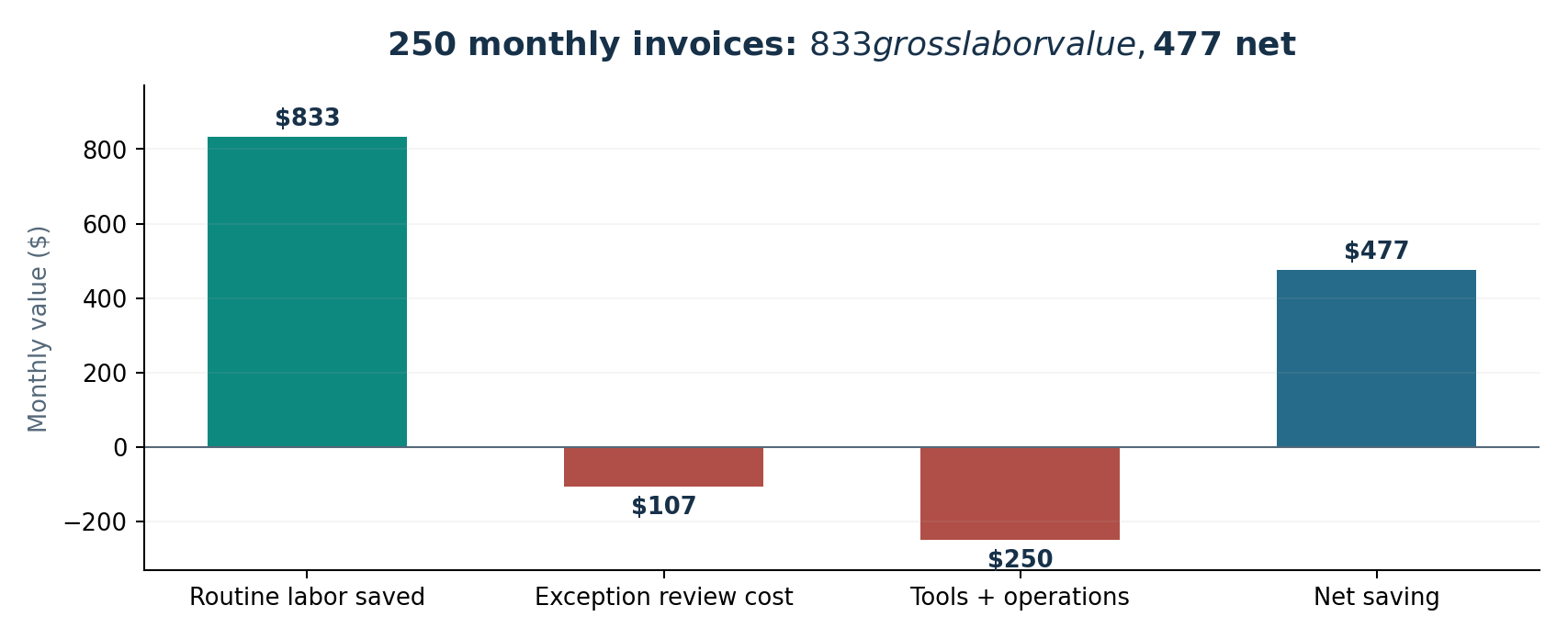
Figure 2. Illustrative monthly labor and operating benefit for 250 supplier invoices. The chart is an original scenario calculation, not Stripe performance data.
A second way to view the same model is per invoice. The automation saves about $3.33 of routine labor and costs about $0.43 in exception labor plus $1.00 of fixed allocated tools, leaving approximately $1.90 of benefit per invoice. The small size is important. A single mistaken $20,000 outbound transfer—if unrecoverable—would wipe out roughly 42 months of the modeled savings. That is not an expected loss estimate; it compares potential severity against the ordinary monthly economic prize. A startup’s desire to cut back-office work is reasonable, but it cannot decide approval thresholds by asking whether the user interface feels safe.
| Assumption | Illustrative value | Interpretation |
|---|---|---|
| Invoices each month | 250 | Approved payables requiring preparation |
| Mean invoice amount | $1,400 | $350,000 in monthly instructed value |
| Routine time saved | 5 minutes/invoice | 20.83 hours/month |
| Fully loaded hourly labor | $40 | $833 routine labor benefit |
| Exception workload | 8% × 8 minutes | $107 additional labor |
| Tools, monitoring and operations | $250/month | Incremental fixed assumption |
| Modeled net savings | $476/month | Before any additional error, FX or banking costs |
There is another cost that disappears from an AI dashboard: the exchange rate. For a company converting $100,000 to a foreign currency for suppliers, an all-in spread of 0.35%, 0.65% or 1.00% implies $350, $650 or $1,000 in conversion expense, before any separately quoted fixed fees. These are hypothetical effective spreads, not Stripe quotes. Even the middle conversion charge is larger than the modeled monthly labor saving. The decision to convert is therefore a price-sensitive treasury action. The agent should obtain and preserve the rate quote, compare it with a policy benchmark, and route above-threshold differences to a qualified reviewer. [2][3]
Error Exposure Rises Faster Than Staff Savings
Suppose the company has $350,000 of payment instructions each month. Applying a hypothetical erroneous-instruction incidence of 0.05%, 0.10%, 0.25%, 0.50% or 1.00% to that value produces $175, $350, $875, $1,750 and $3,500 of *gross payment value requiring investigation* on an expected-value basis. These are not measured AI error rates or expected unrecoverable losses: controls may intercept some mistakes before release; other payments might be reversed; and some incidents may cost more than the erroneous principal because of disruption. [10]
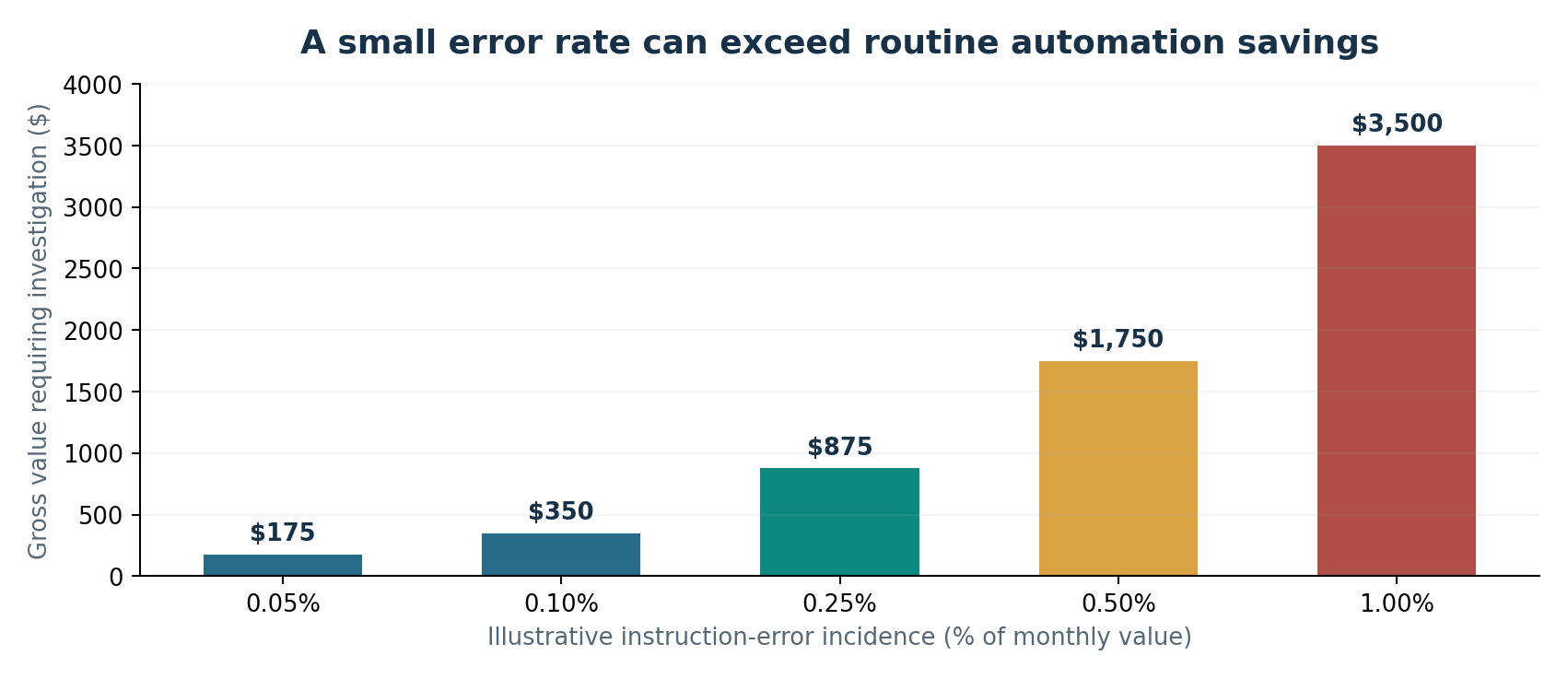
Figure 3. Illustrative gross instruction value exposed under alternative error incidence assumptions, not empirical fraud probabilities or realized loss forecasts.
More consequential than a random small mistake is a concentrated control failure. Imagine an invoice PDF that includes instructions to replace the supplier’s payment account. A language model processing it may confuse external document content with directions to operate its API tools. OWASP calls this *indirect prompt injection*, a class of risk for systems that act on untrusted retrieved content. Deterministic restrictions—known supplier records, recipient-change cooling periods, independently verified bank details and separation of payee creation from payment approval—are therefore more reliable boundaries than a polite system prompt asking the agent to be careful. [10][11]
The emerging problem of payment-permission fraud makes this distinction concrete. An agent can be authenticated, operate within a technically valid API session and still pursue an action that the business did not intend. A specific payment mandate has to be tested against the original business authorization rather than the model’s generated explanation. Having a human reviewer only works if that person sees the salient facts, including changed bank details and prior payments.
An independent agent identity matters for another reason: revocation. When a temporary employee leaves, their OAuth grants can be cut off, but an unattended service may continue to run using long-lived credentials. Agent-tagged API keys can be scoped, rotated and expired. Stripe says administrators can also revoke OAuth MCP sessions. The organization still needs to maintain an inventory of automated identities, owners, audit logs and alerts. Its security team should be able to stop the agent without shutting down the company’s normal payroll and customer payments. [2][4]
What Could Actually Be Automated—and What Should Stay Manual?
Not all agent use cases carry equal economic and legal risk. A read-only daily cash report that flags low balances and refunds has clear productivity upside with relatively limited direct financial exposure; Stripe’s announcement describes a founder using a Grok agent for precisely this sort of daily reporting. Preparation of a draft supplier payment is the next step. Recipient setup and currency conversion require tighter policy. Unrestricted outbound money movement is a different category altogether. [1]
A conservative operational design would separate four roles. The *observer* sees selected account balances and reports exceptions. The *preparer* extracts invoice data and constructs proposed instructions. The *validator* checks approved vendor master data, invoice duplication, policy ceilings and bank account changes using rules external to the language model. Finally, the *authorizer* is a human or tightly constrained approval mechanism with independently authenticated credentials. For high-value or new-recipient payments, two authorized people can be required. The agent may generate the reasoning, but it should not silently approve its own reasoning.
If the business uses different banks in several countries, it also needs to distinguish account visibility from account execution. Stripe supports Treasury balances and payments according to product availability and permissions. Access to a third-party institution’s transaction data through a connection service should not be marketed as unlimited access to send transfers from that institution. Nor does being able to query balances mean the model can issue a new card, despite Stripe saying that further card-related functionality is planned or described across its product pages. Launch announcements, product pages and public-preview tools can have different scopes on the same date. The documentation for the particular account and environment is the binding source. [1][2][3]
Commercial incentives are worth examining. Stripe already sits near merchant collections, subscription billing, financial accounts, payout rails, issuing and foreign exchange. Adding agent-accessible finance tools can make these services easier to use and more deeply embedded in everyday workflows. The business customer may save time, while Stripe benefits from transaction activity and a stickier infrastructure relationship. Stripe’s broader stablecoin and embedded-finance strategy shows how multiple products can sit underneath a simple account experience without making them the same regulated service. This is an incentive analysis, not evidence that all current agents automatically route transactions into particular Stripe products.
What Would Prove the Thesis Wrong?
The product’s strongest claim would weaken if founders discovered that real payments still require so much manual checking that the savings disappear; if agent instructions increase duplicate transfers or wrong-recipient exceptions; if account and geography eligibility is too narrow for multinational finance; or if live-action controls are too coarse to support separation of duties. A useful public dataset would show error and reversal rates by tool, agent identity, approval threshold, payment value and human intervention, plus measured hours saved and average all-in FX costs. Stripe’s public launch materials do not report that longitudinal dataset. A founder case study is not a controlled cost-benefit trial.
The converse would be meaningful evidence: lower time per approved invoice without more loss events, reliable reconciliation across payment states, fast revocation, low false approvals, clear vendor-identity verification and a demonstrable decline in operational exceptions. Risk can be bounded only if exposure is measured, not merely promised. The appropriate pilot starts with read-only use and low-risk preparations; the authorization perimeter expands only as logs show that the underlying process works.
Bottom Line
Yes, Stripe Treasury for Agents makes it technically possible for eligible businesses to let AI assistants analyze balances, set up recipients, move funds and convert currencies through scoped Stripe tools. But “manage the bank account” is imprecise: the bank, the fintech operating layer, the agent’s identity and the human principal are different parties with different obligations. Stripe says it is not a bank, Fifth Third supplies the cited checking accounts, and live money movement requires approval by default. In the illustrative 250-invoice model, automation saves only about $476 a month after routine exception and tooling costs; one serious payment error could outweigh that benefit. The useful breakthrough is bounded execution with records and approvals, not a model being trusted with an unrestricted transfer button.
Methodology and Limitations
Research cut-off: 13 November 2026. Product capabilities and the list of five public-preview tools are verified against Stripe’s October 21 announcement and Treasury for Agents developer documentation. Bank and deposit-risk descriptions follow Stripe disclosures and FDIC guidance. The 250-invoice example, hourly rates, preparation minutes, exception rate, tooling expense, FX spread and error scenarios are original illustrative assumptions, not Stripe customer statistics or forward forecasts. Amounts have been rounded to whole dollars in prose. Payment-loss exposure is gross instructed value requiring review and is not treated as actual loss. Availability, legal contracts, bank partner and features may vary by geography and account type. Readers should review product terms and consult legal/security specialists for implementation.
A Pre-Deployment Failure Drill
The launch checklist is best tested as a sequence of controlled failures before enabling wider live access. Present an invoice whose payee name matches the vendor master but whose bank account has changed; the agent should propose a hold, not edit the master record and approve its own change. Present the same invoice number twice under different filenames; the payment policy should reject the duplicate independently of how the model paraphrases the documents. Present a real pending transfer followed by a timed-out API response; the system should retrieve the original state and resist sending an untracked replacement. Then revoke the agent credential and confirm that all new payment requests fail while normal employee activity continues.
The final test is economic, not technical. Have a controller compare one full month of agent-assisted invoices with a conventional workflow using identical approval requirements. Record total minutes saved, exceptions, realized FX spreads, unauthorized or misdirected requests intercepted, payment returns and reconciliation lag. Report the number of actions that a human approved, not just the number the agent drafted. An automation feature can work exactly as designed and still be uneconomic for a particular business. The difference only emerges when the control and finance ledgers are reconciled together.
Sources
[1] Stripe Newsroom, Introducing Stripe Treasury for agents, October 21, 2026 — Source
[2] Stripe Docs, Treasury for agents: permissions and supported tools — Source
[3] Stripe, A founder’s guide to delegating finance work to agents — Source
[4] Stripe Developer Blog, Your AI agent can move money—here’s how to stay in control, October 21, 2026 — Source
[5] Stripe, Treasury product disclosures and account descriptions — Source
[6] FDIC, Banking with third-party apps, June 2024 — Source
[7] FDIC, Pass-through deposit insurance coverage — Source
[8] FDIC, Federal Reserve and OCC, Joint statement on third-party deposit arrangements, July 25, 2024 — Source
[9] Stripe, Financial account and agent workflow descriptions — Source
[10] OWASP GenAI Security Project, Prompt injection — Source
[11] OWASP, Prompt injection prevention cheat sheet — Source
[12] Stripe, General service terms and Treasury for Platforms — Source
[13] FDIC, Importance of deposit insurance and coverage — Source
[14] Stripe, 2026 Sessions product announcements — Source
[15] Stripe Docs, Model Context Protocol — Source
[16] OWASP, RAG security and tool-invocation safety — Source

Johan Shamshad is Editor-in-Chief at Dave Finances, covering financial markets, digital assets, trading platforms, brokers, fintech, payments and regulation. Since 2023, he has also worked as an editor at Gulf News, the UAE English-language newspaper published by Al Nisr Publishing LLC. His work focuses on market-moving developments, company disclosures, regulatory changes and trading infrastructure, with an emphasis on primary-source verification and practical context for traders and investors.