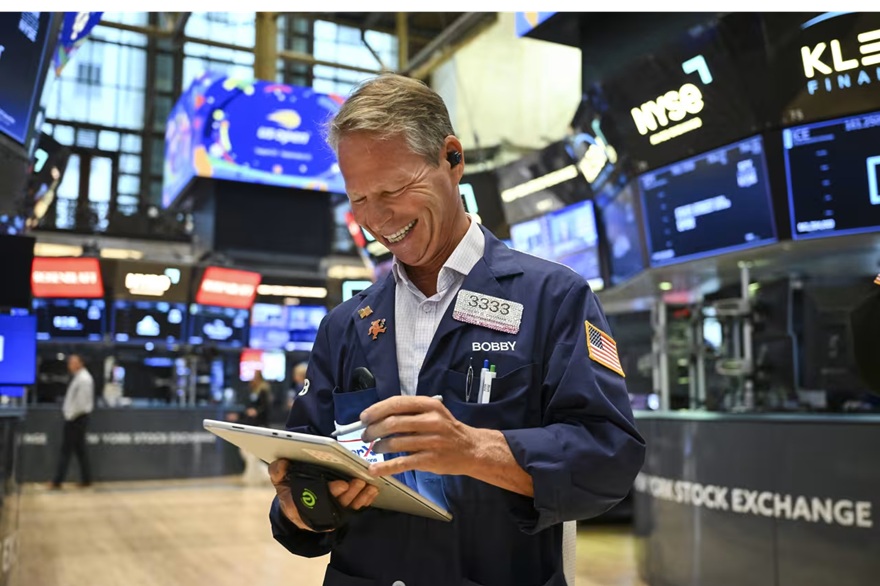
Cboe Exchange has increased transaction fees for options market makers executing trades on its trading floor, while introducing new rebates and raising incentive limits for brokers handling institutional options orders.
The changes, detailed in a Securities and Exchange Commission (SEC) notice dated November 13, 2026, raise the fee for manual market-maker transactions in non-Penny options from $0.45 to $0.95 per contract, an increase of 111%. Fees for equivalent Penny-class transactions rise more modestly, from $0.45 to $0.50.
Cboe is also increasing its monthly Qualified Contingent Cross (QCC) initiating-credit cap from $350,000 to $500,000, establishing a new floor-broker rebate program and introducing reduced charges for certain binary index options.
The SEC’s November 13 filing, Release No. 34-106897, identifies the changes under SR-CBOE-2026-085. Cboe submitted the rule change on November 2 and specified November 1 as its intended effective date. The November 13 publication therefore documents an immediately effective filing rather than announcing changes scheduled to begin that day.
The revised pricing affects different trading participants in different ways. Market makers face higher charges on certain floor executions, while brokers initiating qualifying transactions can earn larger credits.
Non-Penny market-maker floor fees more than double
Cboe’s most substantial fee increase concerns manual market-maker executions in multiply listed options classes that are not included in the Penny trading category.
Previously, the exchange charged market makers $0.45 per contract for manual transactions regardless of whether the options belonged to Penny or non-Penny classes.
Under the revised schedule, Penny-class transactions carry a $0.50 fee, using existing fee code MB. Non-Penny transactions are charged $0.95 per contract under the newly introduced ME fee code.
For a market maker executing 10,000 non-Penny contracts, the transaction charge increases from $4,500 to $9,500. That represents an additional $5,000 in exchange fees for the same volume, before accounting for other applicable charges.
The increase is much larger for non-Penny contracts, and that is where the real change sits.
Cboe argues that non-Penny options generally have wider bid-ask spreads and greater potential profitability for market makers. The company also points to comparable charges already introduced by competing exchanges.
NYSE American raised its market-maker manual transaction fee for non-Penny options to $1 per contract effective November 1. Nasdaq PHLX and BOX also charge $1 for comparable transactions, while MIAX Sapphire recently introduced a $0.94 fee.
Cboe’s new $0.95 rate falls within that competitive range. Its Penny-class charge of $0.50 also matches the corresponding fees at NYSE American and MIAX Sapphire.
The comparison shows that Cboe is bringing its floor pricing closer to competing venues rather than introducing an unusually high charge relative to those exchanges.
Still, the effect on individual firms depends on their trading mix. A market maker concentrating on non-Penny floor transactions faces a considerably larger increase than one whose activity is primarily electronic or concentrated in Penny classes.
The filing does not disclose how much existing market-maker volume falls into each category, preventing a reliable estimate of the total additonal revenue Cboe might collect.
QCC credits rise as the monthly cap reaches $500,000
Cboe is simultaneously adjusting its Qualified Contingent Cross pricing structure to encourage trading permit holders to initiate more large institutional options transactions.
A QCC order involves an originating order for at least 1,000 standard options contracts, or 10,000 mini-option contracts, associated with a qualified contingent transaction and matched against corresponding contra-side interest.
The exchange is increasing the transaction fee for non-customer, non-professional customer QCC orders from $0.18 to $0.20 per contract. Customer and Professional Customer QCC transaction fees remain unchanged at zero.
The more substantial revision concerns initiating credits.
Previously, eligible QCC initiators generally received a credit of $0.11 per contract, subject to exclusions involving customer and professional customer orders.
The revised structure provides a credit of $0.18 per contract when one side of a transaction involves a non-customer, non-professional customer order. Where both sides fall into that category, the initiating credit increases to $0.30 per contract.
Transactions involving only Customer and Professional Customer orders remain ineligible for initiating credits.
There is more room for credits now, quite a lot more.
For 100,000 eligible contracts, the new $0.30 initiating credit would produce $30,000 in credits, compared with $11,000 under the previous $0.11 rate, assuming the applicable monthly cap has not been reached.
The monthly credit ceiling rises by $150,000, or approximately 42.9%, from $350,000 to $500,000.
Cboe will continue aggregating affiliated trading permit holders with at least 75% common ownership when determining whether the credit cap has been reached.
The revisions create a different economic calculation for institutional firms that regularly initiate large QCC transactions. Although the exchange raises the non-customer transaction fee by two cents, eligible initiating credits can increase by seven or nineteen cents per contract depending on the counterparties.
The actual net cost depends on the capacities of both sides of the transaction, who initiates the order and whether the participant has exhausted its monthly credit allowance.
Floor brokers gain new rebates for trading against market makers
Cboe is introducing a Floor Broker Break-Up Credits Program that pays brokers for eligible orders executed against market makers on the trading floor.
The new rebate is $0.20 per contract in Penny classes and $0.25 in non-Penny classes.
These credits are awarded to qualifying floor brokers rather than directly reducing the fees charged to market makers. The program is designed to encourage brokers to bring more order flow to the exchange’s open-outcry market.
The credits replace rebates otherwise available for those executions under Cboe’s existing Floor Broker Sliding Scale Rebate Program and Supplemental Rebate Program.
The rebate is new, but it doesn’t come on top of the old one.
Eligible execution volume will nevertheless continue to count toward qualification for the sliding-scale programs. Cboe is retaining the volume benefit while preventing multiple rebates from being paid on the same contracts.
The exchange is also revising its FLEX auction pricing. Orders executed in FLEX AIM and FLEX SAM auctions that were initially entered as AIM Responses will incur a new $1 fee per contract.
At the same time, qualifying Customer Agency orders executed against those responses will receive a $0.50 per-contract break-up credit. FLEX Micro options are excluded from the relevant arrangements.
Cboe says the approach is intended to compensate participants that initiate FLEX auctions and source liquidity for customized options contracts, where finding counterparties can require substantial brokerage effort.
The separate costs of operating trading infrastructure have also become a focus of Cboe’s recent incentive programs. On November 12, the SEC published another filing covering Cboe’s offer of up to $1.25 million to qualifying clearing firms that complete operational preparations for its new securities-options clearing arrangements.
That program targets clearing infrastructure rather than floor execution, but the two filings show how the group is using financial incentives at seperate stages of the options trading process.
Binary options receive fee relief as SPXO surcharge begins
Not all the November changes increase transaction costs.
Cboe is introducing a fee holiday for market-maker orders in certain index binary options executed electronically and adding liquidity. The applicable charge falls from $0.05 to zero per contract.
The concession applies to eligible market-maker, designated primary market-maker and lead market-maker orders. Manual market-maker executions in the same products continue to carry a $0.15 charge.
The expanded Index Binaries category covers options linked to XSP, MRUT, DJX and MGTN. Cboe is also standardizing the treatment of these products across fee schedules and incentive-program exclusions.
For binary index options with premiums of at least $1, customer and non-customer transactions covered by the change will incur a flat $0.01 charge per contract.
The previous approximate charges were $0.01184 for customer orders and $0.01386 for non-customer orders. Fees for premiums below $1 retain the existing percentage-based methodology.
For some binary contracts, then, the fees go down while the floor fees go up.
Another adjustment introduces a $0.14 electronic execution surcharge for SPXO options, the new S&P 500 Index weekly contracts with morning settlement.
Cboe scheduled SPXO trading to begin November 9 and specified that no SPXO fees would be assessed before the product’s launch. The surcharge matches the existing $0.14 charge on SPXW contracts, compared with $0.21 for standard SPX electronic executions.
The changes concern exchange-level charges, which should not be confused with the commissions ultimately advertised to brokerage customers.
For example, DaveFinances previously reported that Gate’s US stock-options offering advertised zero platform commissions while retaining regulatory and clearing-related charges. Such customer-facing pricing reflects a different layer of the transaction-cost structure.
Likewise, Binance’s US equity-options arrangements involve an introducing broker and a separate US execution and clearing provider, illustrating how trading platforms can rely on external market infrastructure rather than directly operating every part of the transaction chain.
The revised Cboe fees therefore cannot be translated directly into changes in retail trading commissions without knowing the brokers, routing arrangements and applicable fee categories involved.
Cboe’s filing has become effective under Section 19(b)(3)(A) of the Securities Exchange Act, although the SEC retains authority to temporarily suspend the rule change within 60 days of filing and initiate further proceedings.
The filing also does not quantify the expected effect on Cboe’s overall trading revenue, operating profit or market share. Its economic impact will depend on where execution volume is concentrated, how many firms qualify for the larger credits and whether the new rebates attract sufficient trading activity.
The exchange has made a bet on the mix of fees and credits, not simply on charging more.
For proprietary trading firms and options market makers, the immediate consequence is a higher cost for non-Penny floor executions. Floor brokers and high-volume QCC initiators, meanwhile, have access to expanded incentives that could offset costs or improve their economics on qualifying transactions. The November fee schedule establishes those financial terms; subsequent trading volume will determine how the benefits and additional charges are distributed among participants.

Johan Shamshad is Editor-in-Chief at Dave Finances, covering financial markets, digital assets, trading platforms, brokers, fintech, payments and regulation. Since 2023, he has also worked as an editor at Gulf News, the UAE English-language newspaper published by Al Nisr Publishing LLC. His work focuses on market-moving developments, company disclosures, regulatory changes and trading infrastructure, with an emphasis on primary-source verification and practical context for traders and investors.