
A half-point rate increase is not automatically a half-point monetary-policy surprise. FX markets price the decision, the future path, foreign central banks and the risks that arrive with tighter money.
THE THESIS | THE SURPRISE IS RELATIVE TO THE PRE-DECISION PRICE
First, Determine Whether the Half-Point Move Actually Happened
A surprise 50-basis-point Federal Reserve increase is a scenario, not the latest completed FOMC decision. The Fed left its policy target at 3.75%–4.00% on October 28, 2026, with a 10–2 vote; two policymakers preferred a quarter-point increase. Research on its response to a hypothetical half-point move must not falsely label it a November action. Nor should a monetary policy rate be confused with the resulting Treasury yield, deposit rate or cross-currency financing quote. The immediate foreign-exchange price incorporates what traders already expected the central bank to do before it announces the decision.
Imagine two FOMC announcements with identical final target ranges. In the first, the consensus had been for no change and the Fed unexpectedly raises rates by 50 basis points. The headline contains a full half-point positive rate surprise. In the second, the market had almost universally expected 50 basis points; the announcement is close to neutral news even though policy itself is suddenly tighter than it was yesterday. A third outcome, a priced 25-basis-point hike followed by 50, produces a 25-basis-point positive surprise. None of these illustrative conditions specifies a guaranteed dollar reaction; they specify how much fresh information arrives at the policy release.
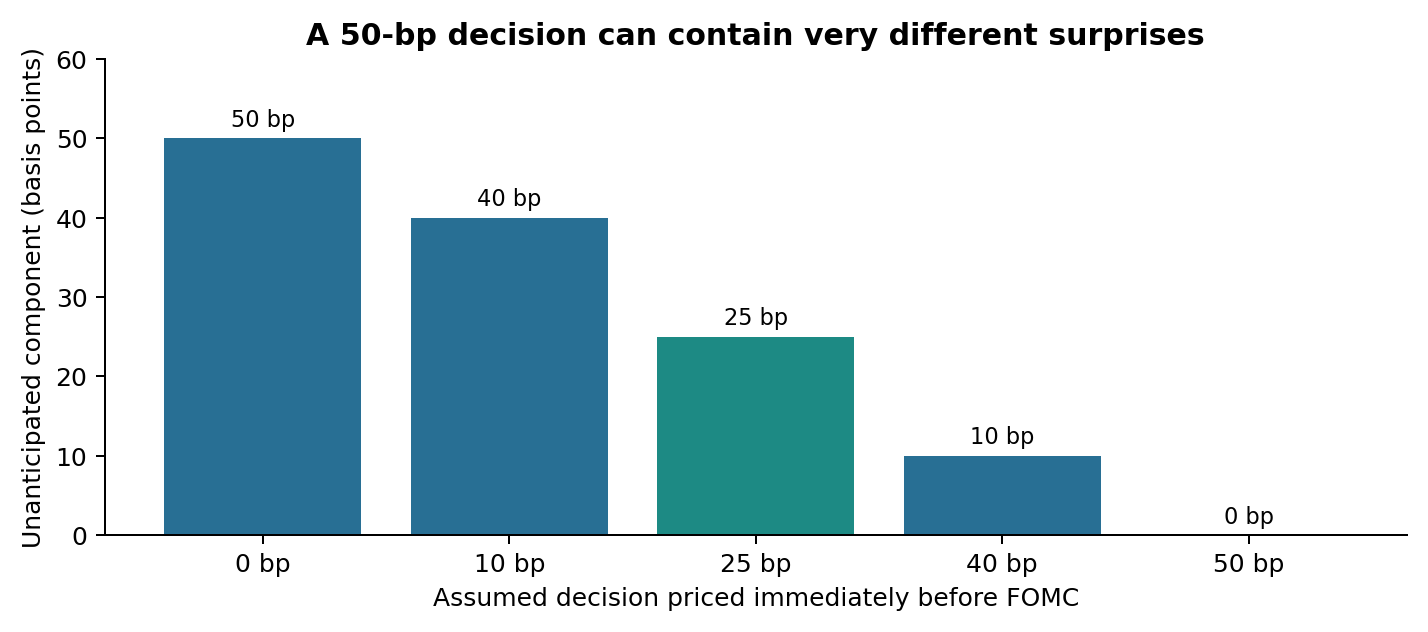
Figure 1. The change relative to expectations, not the size printed in a headline, drives the information surprise. Source: Hypothetical expectation scenarios; Dave Finances calculations.
Federal Reserve researchers measure policy surprises using changes in the pricing of Fed funds, SOFR futures, overnight-indexed swaps and Treasury yields immediately around the announcement. High-frequency windows reduce interference from unrelated news. That is more defensible than calculating ’50 minus last month’s rate’ and assuming the result is 50 basis points of surprise. A one-day EUR/USD move also contains other causes, so researchers must distinguish the rate-decision surprise from communication about the next several meetings, press-conference statements and new economic projections. One policy announcement contains multiple pieces of information.
Why the Expected Rate Path Matters More Than a Single Night
For EUR/USD, dollar strength typically appears as a lower numerical EUR/USD rate: one euro purchases fewer dollars. If the Fed unexpectedly tightens relative to the ECB, investors may revise upward the prospective return on dollar cash and bonds. That gives the dollar support through expected interest differentials and global portfolio shifts. But any effect depends on whether the ECB is also expected to tighten, on the inflation-adjusted return investors anticipate and on whether the Fed’s decision suggests a deterioration in US economic prospects. The ECB’s October 29 decision left its deposit facility rate at 2.50%, while the Fed’s October target midpoint was 3.875%. Those current settings are background; the shock is the change in future relative rates.
A useful price map begins with US two-year yields and SOFR/OIS repricing, then the equivalent euro or sterling market, and only then spot FX. If US two-year yields rise 20 basis points and German yields rise 18 basis points, the relative move is small; it is not the same setup as US yields rising 20 basis points against unchanged euro yields. Term premia, sovereign risk and liquidity can complicate that comparison. For investors already holding leveraged dollar-long positions, even a favorable rate shock can produce temporary profit-taking. The foreign-exchange effect depends on how much new information remains to be traded once the initial headlines are absorbed.
The Federal Reserve’s historical research finds sensitivity of the dollar to changes in expected policy, but the estimates vary across periods, currencies and identification methods. An older sample should not be turned into a mechanical ’25 basis points equals X pips’ rule for November 2026. A separate Federal Reserve retrospective on the 2021–23 global tightening found that aggregate observations did not imply a simple universal relationship between relative policy expectations and exchange-rate changes. These findings are compatible: a high-frequency surprise can move currencies while broader multi-year movements reflect many additional shocks. Our assessment of why inflation can strengthen the dollar examines one such complication.
A 50-Basis-Point Hike Has Two Distinct FX Effects
The first effect is a discretionary spot repricing: traders immediately buy or sell the currency based on the surprise, changing expected returns, risk appetite and portfolio demand. The second is mechanical carry. Holding the contemporaneous EUR/USD spot reference at 1.0975, assuming a 90-day horizon, and taking a flat 3.875% dollar interest rate versus 2.50% euro interest rate, the theoretical EUR/USD forward-equivalent quote is about 1.10125. Raise the assumed dollar rate by an additional 50 basis points for those same 90 days without moving spot or euro rates, and the forward premium increases by approximately 13.6 pips. The higher US yield creates a higher forward EUR/USD quote because the euro is the lower-interest-rate currency in this convention.
That often sounds backward. A hawkish Fed shock might cause EUR/USD spot to fall as the dollar strengthens, while the pure funding differential makes the futures–spot spread wider. The outright futures quote is the sum of the two effects. If spot drops 100 pips and additional carry adds roughly 14 pips, the futures quote could fall by around 86 pips on a stylized same-maturity basis before cross-currency-basis changes. These are separate channels and not a prediction that any future rate announcement will trigger a 100-pip spot decline. The result also depends on the persistence of the hike: a short-lived target-rate surprise may not increase the average funding rate for the entire 90 days by 50 basis points.
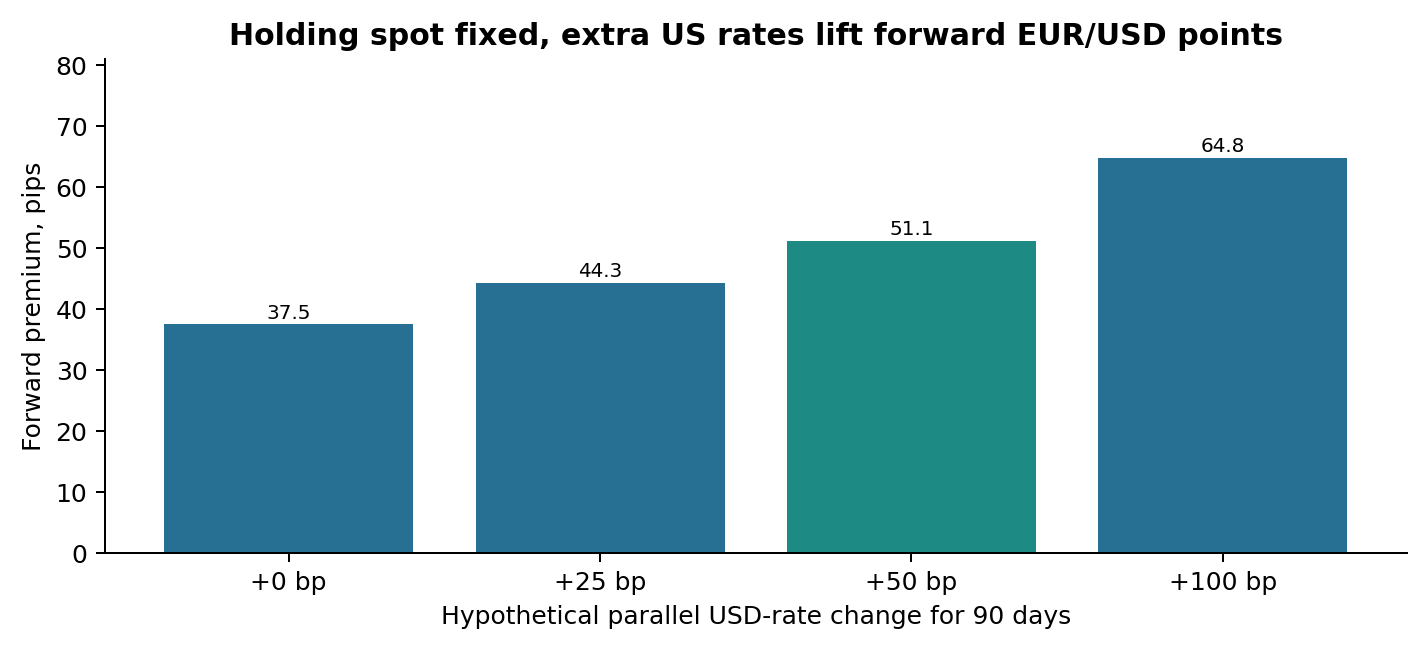
Figure 2. The forward-carry channel is mechanically positive for EUR/USD when USD rates rise, conditional on unchanged spot. Source: ECB reference rate and hypothetical rate assumptions; Dave Finances calculations.
Table 1. Two different transmissions from the same hypothetical 50-bp surprise.
| Layer | Initial direction if USD rates rise | Caveat |
|---|---|---|
| Spot EUR/USD | Often lower if relative USD yields improve | Risk sentiment and ECB repricing can reverse it |
| EUR/USD forward points | Usually higher under fixed spot and EUR rates | Only if the shock persists through the forward period |
| Outright Euro FX future | Net of spot and forward-points moves | No fixed pip response |
| Cross-currency basis | Can widen or narrow | Depends on funding stress and hedging flows |
This distinction is important for readers who see Euro FX futures rise by less than spot during an FOMC event. It may mean dollar carry moved against euro holders at the same time that the euro itself appreciated. The futures basis should be evaluated with aligned timestamps and actual secured rates, not with one quote from pre-release CME trading and another from a delayed retail broker feed. CME itself describes the spot-futures difference as financing carry plus basis. For all three cases—higher spot, lower spot or no net move—both the price level and the rate differential should be checked.
What Does a 0.3%, 0.7% or 1.2% Currency Move Cost?
Consider one standard CME Euro FX futures contract with €125,000 notional euro exposure. At an illustrative 1.1000 entry price, a 0.3% fall in EUR/USD corresponds to 33 pips and approximately $412.50 of gross mark-to-market loss for a long. A 0.7% decline corresponds to 77 pips and $962.50; a 1.2% decline corresponds to 132 pips and $1,650. These are sensitivity scenarios rather than observed reactions or probabilities. They strip out variation-margin timing, commissions, slippage and bid/ask widening, which can be material around a press conference.
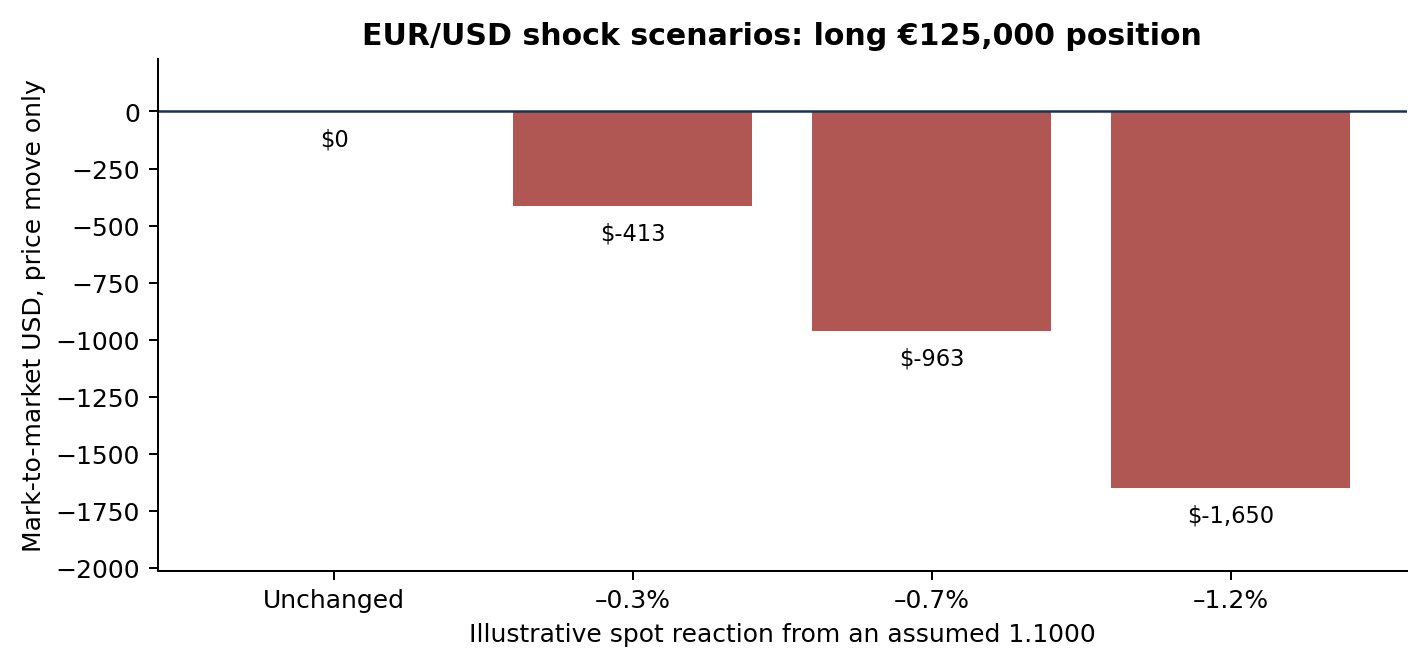
Figure 3. A sharp spot reaction can dwarf the small change in three-month forward points. Source: Illustrative EUR/USD anchor 1.1000 and CME contract size; Dave Finances calculations.
A retail OTC FX account holding €100,000 rather than €125,000 has a $10 per pip sensitivity, before fees, so a 77-pip move would be $770 instead of $962.50. Margin does not reduce the price exposure; it only changes how much account cash is initially required. A stop order can help control planned risk but cannot ensure execution at the indicated price through thin liquidity or a gap. The comparison to Forex lot sizes and pip values matter because the wrong contract multiplier is enough to distort a policy-event stress test by 25%.
In the cash FX market, the same currency move can have very different consequences depending on whether the user is an exporter, importer, international borrower or speculative trader. A European manufacturer invoicing $10 million in receivables is dollar-long before hedging and benefits from a stronger dollar in euro-reporting terms. A European importer owing dollars may lose. An asset manager that buys US Treasuries but hedges the dollars can see its local-currency yield benefit reduced by the higher cost of rolling the hedge. An unhedged US investor holding European assets sees the dollar value of those assets decline when the euro weakens, even if the local asset price does not change.
Why the Dollar Could Fall After a Hawkish Surprise
The announcement itself may carry unfavorable information. If a rapid half-point tightening convinces investors that inflation is not under control, longer-term US inflation compensation can rise faster than nominal yields. If the shock depresses growth expectations or damages financial stability, investors may demand a different risk premium for US assets. Conversely, severe global risk aversion could strengthen the dollar through safe-haven and funding demand even as US equities fall. Those channels can coexist, and the net response depends on their relative strength. Currencies have two sides; pressure on euro-area banks or imported energy costs can be as decisive as the Fed’s vote.
A fully priced hike can also be followed by guidance that disappoints dollar bulls. A 50-basis-point increase paired with a forecast for only one further move may lower the market’s previous expectation of a long cycle of tightening. If, by contrast, the Fed says that further hikes are likely and options markets had priced only a one-off step, the dollar could gain even after the initial rate surprise fades. The October 2026 minutes, covered in Dave Finances’ analysis of the Fed’s hawkish hold, help illustrate why a pause today and a higher policy path tomorrow are compatible.
Table 2. A practical identification checklist for an FOMC event.
| Observable | Supports dollar-positive interpretation | Challenges it |
|---|---|---|
| 2-year US vs German yields | Relative US yield rises | Foreign yields rise as much or more |
| US real yields | Increase after announcement | Inflation expectations offset nominal rise |
| EUR/USD and GBP/USD | Both weaken against USD | Only one idiosyncratic pair moves |
| Press conference | Longer restrictive path signaled | Market expects fewer future hikes |
Liquidity and positioning turn small surprises into large transactions. Ahead of a tightly watched Fed statement, dealers may quote smaller sizes or wider spreads; stop orders can cluster near recent highs and lows; options hedges may require buying dollars as the spot rate moves. Once some participants have traded, others may reduce risk mechanically. The result can overshoot the eventual macroeconomic implication. That is why a ’50-basis-point surprise’ scenario needs at least two market horizons: the first five to thirty minutes of repricing, and the weeks or months during which investors reassess relative real returns, growth and the Fed’s future decisions.
A Better Test of the Fed-Hike Thesis
The most useful falsification conditions are observable. The dollar-strength thesis looks weaker if US two-year yields do not rise relative to foreign yields; if nominal rates rise but inflation compensation accelerates more; if the currency pair reverses its move by the end of the session despite broad market liquidity; or if foreign central-bank forward curves shift more hawkishly than the US path. The thesis gains support if the relative real-rate spread widens, near-term dollar funding stays orderly and the move appears across multiple major pairs rather than only one idiosyncratic cross. The logic behind divergent Fed, ECB and BOJ policy is useful for constructing that comparison.
Retail traders should separate their directional forecast from their execution plan. The former may say that an unexpected half-point hike supports the dollar; the latter needs a defined exposure, a realistic gap and slippage allowance, a test of maximum tolerable loss and a decision whether to trade the announcement at all. The apparent precision of a rates-futures probability does not translate into an equally precise FX price target. A forecast that ignores spreads, broker liquidity and the likely distribution of price moves can be right on economics and wrong on the actual trade.
Three Ways the Same Headline Can Be Mispriced
The first error is to ignore the probability distribution immediately before the decision. If traders assigned a 70% probability to a quarter-point increase and 30% to a half-point increase, the simple expected policy change would be 32.5 basis points. A delivered 50-basis-point move is therefore 17.5 basis points above that expectation, not 50. That arithmetic is a deliberately simplified two-outcome model: real futures prices represent averages of effective overnight rates, can embed risk premia, and need adjustment for the number of days in the contract month after a decision. A common headline model that converts a contract-implied rate directly into an exact vote probability is unreliable without that calendar work.
The second error is to assume the announcement permanently raises the path by the delivered increment. A half-point decision accompanied by a clear signal that no more tightening is likely can leave the two-year market yield little changed or even lower if traders had expected several subsequent hikes. A smaller 25-basis-point decision accompanied by guidance of a higher terminal rate may lift two-year yields and the dollar more. The incremental price of dollar assets reflects the entire future short-rate path, not one overnight transaction. Rates futures for the decision month and those expiring six or twelve months later therefore need to be read together.
The third error is to infer a currency forecast from a historical average event reaction. Suppose a study finds a statistical association between a policy-path surprise and a dollar move. That relationship is conditional on the period, currency basket, data window and model controls. It does not disclose where the dollar will trade after a new shock involving unusually high energy prices, a banking stress event or simultaneous ECB tightening. Even a precisely measured 25-basis-point surprise does not determine the volatility, liquidity or positioning distribution traders face on that day. A sensitivity range should be a risk input, not a quoted guaranteed target.
For an investor, an especially revealing comparison is the dollar reaction against two currencies at once. If EUR/USD drops but GBP/USD stays flat following the same Fed shock, relative UK policy repricing may be offsetting the US move in sterling, or euro-specific news may be driving EUR/USD. Checking EUR/GBP provides a cross-rate consistency test. The next test is whether the dollar move persists when two-year rate spreads stop changing. Persistence suggests portfolio or risk-premium repricing beyond the initial rate arithmetic; quick reversal may reflect position liquidation or the market rejecting the guidance narrative. No single indicator settles causality, but triangulation makes an explanation testable.
Bottom Line
Forex markets do not attach a fixed EUR/USD or GBP/USD pip value to a 50-basis-point Fed hike. They price the component that differs from expectations, the communication about subsequent rates, the response from foreign interest curves, real returns and liquidity conditions. In a simple 90-day model, a persistent extra 50 basis points of US funding adds only about 14 positive EUR/USD forward pips if spot is held constant. Spot can move much more in either direction. The analytical mistake is to treat the half-point headline as both the surprise and the currency forecast. They are not the same variable.
Methodology and Limitations
All 50-basis-point decisions are hypothetical scenarios, not a reported November 2026 action. The 3.875% USD rate is the midpoint of the Fed October target range; the 2.50% EUR rate is the ECB October deposit facility. Forward points use the ECB November 26 EUR/USD reference 1.0975 and a simple 90-day matched-horizon approximation, holding spot constant. Price-move cases use a separate assumed 1.1000 EUR/USD entry; contract P&L = €125,000 × change in USD per EUR. No empirical reaction probability or 2026 exchange-rate forecast is claimed. Original figures: Dave Finances calculations.
Sources
01 Federal Reserve, October 28, 2026 FOMC Statement
02 Federal Reserve, Sensitivity of the Dollar to Monetary Policy Expectations
03 Federal Reserve, Constructing High-Frequency Monetary Policy Surprises from SOFR Futures
04 Federal Reserve, Monetary Policy and Exchange Rates During Global Tightening
05 Federal Reserve, International Spillovers of Tighter Monetary Policy
06 Federal Reserve, Exchange Rates and Monetary Policy Statements
07 ECB, October 29, 2026 Monetary Policy Decision
08 ECB, Euro Foreign Exchange Reference Rates, November 26, 2026
09 CME Group, Euro FX Futures Contract Specifications
10 CME Group, Covered Interest Parity and Cross-Currency Basis
11 CME Group, Reconciling FX Spot and Futures Prices
12 BIS, Global FX Markets When Hedging Takes Centre Stage

Johan Shamshad is Editor-in-Chief at Dave Finances, covering financial markets, digital assets, trading platforms, brokers, fintech, payments and regulation. Since 2023, he has also worked as an editor at Gulf News, the UAE English-language newspaper published by Al Nisr Publishing LLC. His work focuses on market-moving developments, company disclosures, regulatory changes and trading infrastructure, with an emphasis on primary-source verification and practical context for traders and investors.