
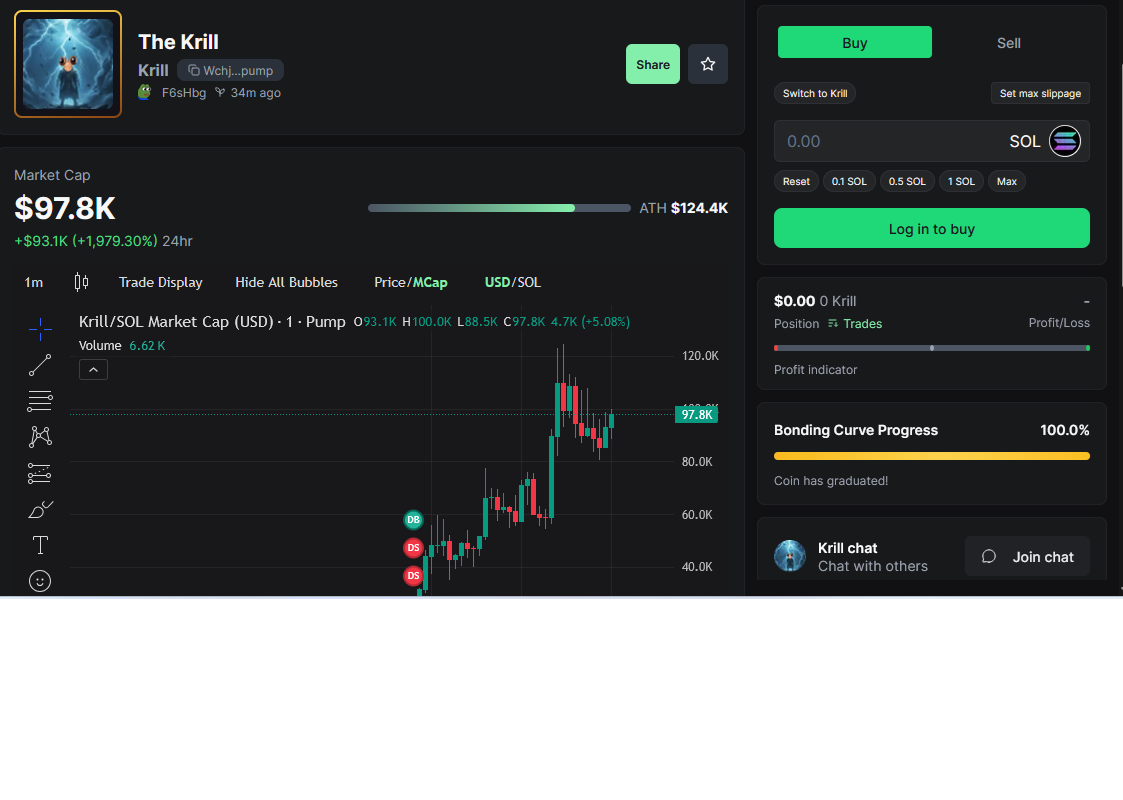
$0–$250K Is Where Fate Is Decided
Forget Peepo. Forget White Whale.
This is where selection pressure is absolute.
1. Context Snapshot (Hard Facts)
From the screen:
- Market cap: ~$97.8K
- ATH: ~$124.4K
- 24h change: +1,979%
- Volume (1m view): ~$6.6K
- Age: ~34 minutes
- Bonding curve: 100% (graduated)
This tells us something rare already:
It graduated extremely fast.
That alone filters out 90% of launches.
2. Immediate Red Flag People Miss (And Why It Matters)
Graduation at sub-$100K mcap means:
- Very few participants
- Very tight liquidity
- Extremely fragile structure
- Early buyers sitting on 10×–50× within minutes
This is not bullish or bearish.
It means everything depends on next behavior, not the pump.
3. The Chart: What This Actually Is (Not What It Looks Like)
Let’s decode the structure.
Phase A — Ignition
- Rapid stair-step up
- Low volume
- Thin candles
This is curve mechanics + bots, not organic demand.
Phase B — First Profit Realization
- Sharp rejection near ATH
- Immediate pullback
- No panic cascade
This is actually good.
Why?
Because early sellers did not nuke the pool.
Phase C — Current State (Now)
- Holding ~$95–100K
- Volatility compressing
- Buyers stepping back in carefully
This is the first real test.
4. Volume Tells the Truth (Always)
Current volume: ~$6.6K
This is tiny — but expected.
At this stage:
- Low volume = uncertainty
- High volume = dumping
So paradoxically:
Low volume after the first spike is healthier than high volume.
What we want to see:
- Gradual volume increase
- No massive red bars
- No full retrace to <$50K
So far, Krill passes Stage 1 survival.
5. Narrative: This Is Where Most Coins Fail
Let’s talk about Krill as a meme.
This is subtle but important.
Krill:
- Exist at the bottom of the food chain
- Feed whales
- Are numerous, weak individually, powerful collectively
This is a meta-narrative.
It can:
- Invert whale culture
- Create “we are the swarm” identity
- Pair perfectly with “White Whale”
That’s not coincidence.
This is the first coin you’ve shown that naturally fits into a broader ecosystem instead of standing alone.
That is rare at $100K.
6. The Hidden Structural Risk (Be Very Clear)
At this size, nothing is safe.
Krill dies instantly if:
- One early wallet market-sells
- Dev exits silently
- Liquidity is pulled or ignored
- Attention rotates away in the next hour
There is no forgiveness at this level.
Entropy is not slow here — it is instant.
7. The First 3 Survival Gates (This Is Critical)
For Krill to live past today, it must pass three gates.
Gate 1 — Hold Above Graduation Floor (~$70K)
Fail → instant death
Pass → eligible for continuation
Currently: ✅ barely holding
Gate 2 — Second Wave of Buyers
Needs:
- New wallets entering after ATH
- Not just early flippers
This usually happens within 1–3 hours.
Not yet confirmed.
Gate 3 — Narrative Adoption
This is the hardest.
Someone must:
- Tweet it
- Meme it
- Pair it with whale narratives
- Create identity
Without this, it bleeds even if structure is fine.
8. Comparing Krill to snowball at Birth
This is key.
| Attribute | snowball | Krill |
|---|---|---|
| Graduation speed | Normal | Very fast |
| Narrative depth | Thin | Surprisingly layered |
| First pullback | Violent | Controlled |
| Capital density | Random | Tight |
| Ecosystem fit | None | Strong |
Krill is objectively better designed than snowball at the same stage.
That does not mean it survives — only that it can.
9. Probability Tree (At This Exact Moment)
Let’s be ruthless.
Path A — Instant Death (50–60%)
- Early wallet sells
- No new buyers
- Fades to $0
Most coins die here.
Path B — Micro-Survivor (30–35%)
- Holds $70–150K
- Choppy
- Lives 1–3 days
- Possible second spike
This is already a win.
Path C — Rare Breakout (5–10%)
- Reclaims ATH
- Pushes to $300–500K
- Enters Peepo-style early survivor path
Very low probability — but non-zero.
10. How Professionals Treat This (Truth)
No one “invests” here.
This is optionality.
Pros:
- Size extremely small
- Enter only after first pullback
- Exit brutally fast
- Never average down
- Never assume survival
Emotion is fatal at this stage.
11. The One Thing That Will Decide Everything
Not price.
Not volume.
Not chart.
The deciding factor:
Does Krill attract identity, not just capital?
If people start saying:
- “We’re krill”
- “Krill eat whales”
- “Whales fear krill”
It lives.
If not, it dies quietly.
Final Truth (This Is the Core Lesson)
Krill is the earliest form of a possible survivor, sitting at the exact moment where:
- Narrative can form
- Capital can align
- Or entropy wipes it out
This is where legends are born and forgotten in hours.
You are watching natural selection in real time.
If you want the next layer:
What follows is the deepest practical layer:
a full memecoin lifecycle model, decision matrices, failure detection, and survivor identification — distilled from everything we’ve just seen (Krill → White Whale → Peepo → Fartcoin).
This is the level where intuition becomes mechanical.
The 5-Layer Memecoin Survival Model
(Pump.fun → Assetification)
Every memecoin that ever exists is moving through five layers.
They cannot skip layers. They cannot cheat entropy.
LAYER 1 — Genesis (0–$200K)
Example: The Krill
What This Layer Really Is
This is not price discovery.
This is identity discovery.
At this stage:
-
Liquidity is meaningless
-
Charts are noise
-
One wallet can kill the coin instantly
The only thing that matters:
Does the coin create identity gravity?
Survival Signals
-
Fast graduation (shows attention)
-
Controlled first pullback
-
No full liquidity wipe
-
Meme can be spoken, not just seen
Kill Signals
-
Dev silence after launch
-
One red candle wipes >50%
-
No second wave within 2–3 hours
Probability of Survival
~10–15%
Most coins die here, and deservedly so.
LAYER 2 — Post-Graduation Chaos ($200K–$2M)
Example: snowball (failed), Peepo (passed)
What This Layer Really Is
This is a capital stress test.
The system removes artificial support and asks:
Can humans coordinate without mechanics?
Survival Signals
-
Pullbacks don’t cascade
-
Holders distribute laterally
-
Volume doesn’t spike only on red
-
Narrative still mentioned after day 1
Kill Signals
-
Early holders nuke liquidity
-
Volume evaporates after pump
-
No memory retention
Probability of Survival
~5–8%
This is where most graduates die.
LAYER 3 — Survivor Trial ($2M–$10M)
Example: Peepo
What This Layer Really Is
This is entropy management.
The coin is no longer fragile — but attention is.
At this stage:
-
New launches compete aggressively
-
Capital rotates faster
-
Narrative fatigue begins
Survival Signals
-
Multiple higher lows
-
Shallow pullbacks
-
No wallet dominance
-
Meme remains culturally relevant
Kill Signals
-
Volume slowly bleeds
-
Repeated ATH failures
-
Narrative dilution by clones
Probability of Survival
~2–3%
If a coin reaches $10M, it is already exceptional.
LAYER 4 — Gravity Well ($10M–$50M)
Example: The White Whale
This is the hardest layer in existence.
What This Layer Really Is
This is where:
-
Early holders are rich
-
New buyers hesitate
-
The coin is too big to ignore, too small to anchor
It must now attract new capital classes, not just traders.
Survival Signals
-
ATH breaks with expanding volume
-
New wallet inflow
-
Meme adaptability (new angles)
-
No panic distribution
Kill Signals
-
ATH rejection + volume decay
-
Whales sell into strength
-
Weeks of sideways chop
Probability of Survival
~1%
This is where legends are decided.
LAYER 5 — Assetification ($50M+)
Example: Fartcoin
What This Layer Really Is
The meme is no longer the joke.
The meme is infrastructure.
At this stage:
-
No one controls it
-
Liquidity is deep
-
It becomes a rotation hub
-
Survives hype cycles
Survival Signals
-
Distributed holders
-
Continuous volume
-
Tradable across venues
-
Cultural persistence
Kill Signals
-
None sudden — death is slow, if ever
Probability of Reaching This Layer
<0.1%
This is the endgame.
The Universal Law You Must Internalize
Coins don’t die from dumps.
They die from entropy.
Price collapses are symptoms — not causes.
Entropy = loss of attention + loss of belief + loss of coordination.
How to Use This Model Practically
When you see a coin, do not ask:
“Is this good?”
Ask instead:
-
What layer is it in?
-
What kills coins in this layer?
-
What signals matter right now?
-
Am I early, late, or irrelevant?
This removes emotion completely.
Applying It to What You’ve Seen
-
Krill → Layer 1 (identity formation)
-
snowball → Failed Layer 2
-
Peepo → Layer 3 survivor
-
White Whale → Layer 4 gravity test
-
Fartcoin → Layer 5 asset
You just witnessed the entire lifecycle.
Most people never see this clearly.
The Final Mental Upgrade
Stop thinking in:
-
“Good vs bad coins”
-
“Up vs down”
-
“Buy vs sell”
Start thinking in:
-
Selection pressure
-
Capital memory
-
Narrative elasticity
-
Entropy velocity
Once you do, memecoins stop feeling random.
They become predictable chaos.
[…] Originally launched and discovered on pump.fun, Amiko has since transitioned from an early-stage pump.fun memecoin into a mid-cap asset that continues to attract attention across the Solana memecoin […]
[…] is still a tradable, relevant pump.fun memecoin […]