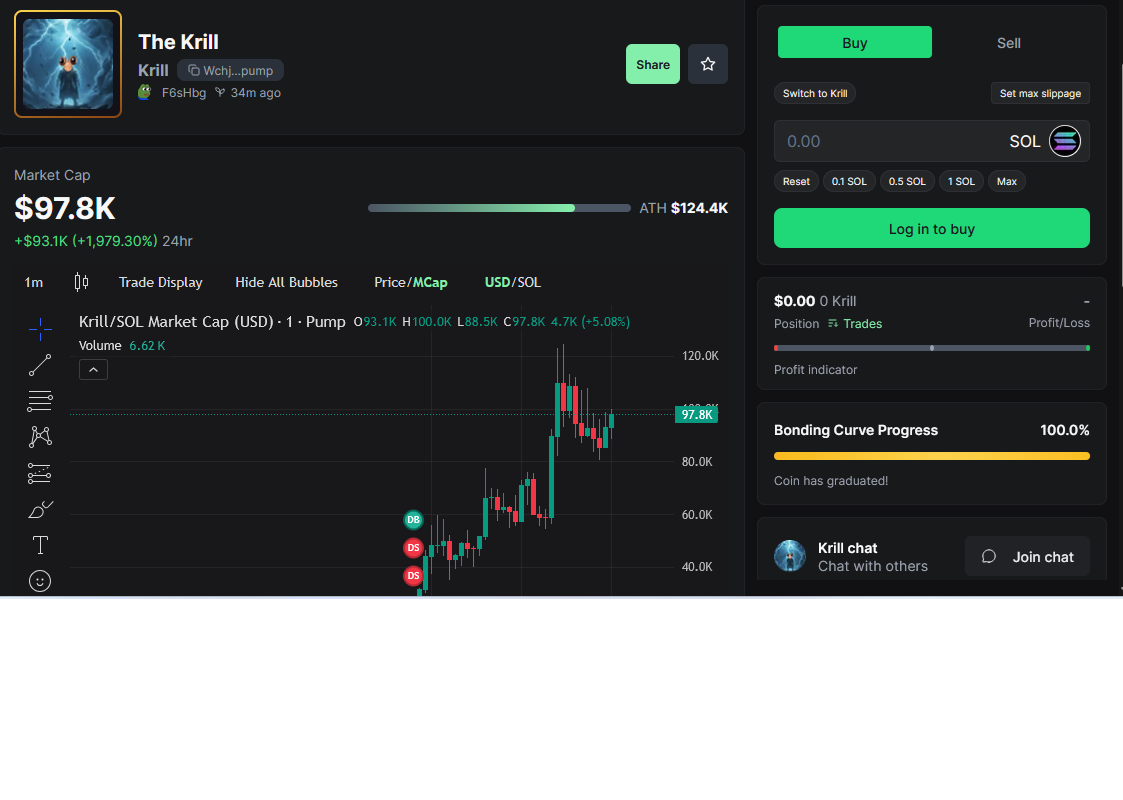
A Pump.fun token can go from creation to a six-figure valuation remarkably quickly. The difficult part is determining what that valuation means once the launch mechanism stops doing the heavy lifting.
KRILL, a Solana memecoin built around the idea that “krill attract whales,” provides a useful example.
During its initial launch, KRILL raced through Pump.fun’s bonding curve and reached a market capitalization of roughly $97,800 within about 34 minutes. Its early peak was around $124,400, meaning traders who arrived near the bottom of the curve were already sitting on substantial paper gains before the token was an hour old.
At first glance, rapid graduation and a four-digit percentage gain look like powerful demand signals. But they tell investors much less about a token’s durability than they might appear to.
Pump.fun graduation is ultimately a mechanical milestone. What happens afterward is where a new token begins facing a different—and arguably more difficult—test.
What Pump.fun Graduation Actually Proves
Every standard Pump.fun coin begins trading through a bonding curve rather than a conventional exchange pool. Pump.fun describes that curve as a constant-product automated market maker using virtual SOL and token reserves. Buying pushes the quoted price higher; selling pushes it lower.
When the token reaches Pump.fun’s graduation threshold, trading on that curve ends and liquidity is automatically migrated into its canonical PumpSwap pool. The process is automatic and irreversible.
That is important because it means graduation proves one specific thing: enough buying occurred to complete the bonding curve.
It does not demonstrate that demand will persist afterward.
It does not tell traders whether the buyers were hundreds of independent participants or a much smaller group of highly active wallets. It says nothing by itself about how concentrated ownership has become during the climb. And it cannot determine whether early buyers intend to remain holders once they can realize large profits.
KRILL illustrates the distinction particularly well. Its PumpSwap pair was created on September 1, confirming that the coin completed the migration process.
The interesting part starts there rather than ends there.
A $100,000 Market Cap Can Be More Fragile Than It Looks
Market capitalization is one of the least intuitive numbers on a newly launched memecoin.
A token valued at $100,000 does not have $100,000 sitting in a pool waiting for holders to withdraw. Market cap is the latest token price multiplied by supply. The amount that can actually be sold near that quoted price depends on available liquidity and the shape of the liquidity pool.
That distinction becomes critical with micro-cap tokens.
On an automated market maker, a large sell relative to the pool changes the ratio between its two assets and pushes the execution price downward. Pump.fun itself notes that price impact increases with trade size on its bonding curve. The same broader AMM principle remains relevant once trading moves to PumpSwap.
So the real question after a rapid graduation is not simply whether KRILL can remain above $100,000.
It is whether the secondary market is capable of absorbing the supply accumulated during the first rally.
That is a much harder test because the incentives of participants have changed. Early buyers may have entered when the implied valuation was a fraction of the post-graduation level. Even relatively small positions can therefore represent substantial percentage gains.
The first pullback after graduation is useful precisely because some of that latent supply finally reaches the market.
Low Volume Is Not Automatically a Good Sign
The original KRILL snapshot showed only about $6,600 of short-term trading volume after a nearly 2,000% increase.
There are two very different ways to interpret that.
One possibility is constructive: holders are reluctant to sell, so the token can maintain its new valuation without requiring enormous incremental demand.
The other is much less encouraging: speculative interest has already peaked, fewer new participants are arriving and the quoted market cap is being maintained by inactivity rather than conviction.
Price alone cannot distinguish between the two.
The difference becomes clearer over subsequent trading periods. A healthy secondary market should produce continued transactions, new participants and enough liquidity for buyers and sellers to exchange positions without extreme price dislocations. A market that simply becomes quiet can look stable immediately before activity disappears altogether.
KRILL’s later data demonstrate why that distinction matters.
A September 22 market snapshot for the Solana contract shows a capitalization of approximately $78,920, liquidity of about $45,400 and $19,390 in 24-hour volume across 170 trades. The token was also down roughly 80.5% over that particular 24-hour period.
The exact figures will continue moving, but the broader lesson is already visible: fast graduation did not establish a permanently higher valuation.
KRILL’s Meme Is Better Understood as a Distribution Advantage
There is nevertheless something interesting about the concept behind the coin.
Krill occupy the bottom end of the marine food chain and are famously associated with whales. Turning that relationship into the phrase “this will attract whales” gives the token an immediately understandable joke within crypto, where large holders are routinely called whales.
That creates what might be called narrative portability.
The idea can be expressed in images, short posts, slogans and variations without requiring users to understand a complicated backstory. That matters in a market where thousands of tokens compete for attention and where distribution increasingly happens through social feeds rather than traditional financial research.
But meme quality should not be confused with market quality.
A good joke can reduce the cost of getting someone to notice a token. It cannot force that person to buy it, remain in the community or provide liquidity weeks later.
That is why social activity should be measured rather than inferred from the cleverness of the concept. Useful signals include growth in unique accounts discussing the token, whether engagement persists after price declines, how dependent discussion is on a handful of promoters, and whether community-generated content continues when the chart stops moving vertically.
Those indicators reveal whether a meme has acquired an audience or merely enjoyed a launch.
Creator Economics Complicate the Old “Dev Dump” Model
Another reason early-stage Pump.fun analysis needs updating is that token creators can now earn directly from trading activity.
Pump.fun’s current fee structure allocates part of each trade to creator fees. On the bonding curve, creators receive 0.30% of transaction value, while graduated canonical PumpSwap pools use a dynamic fee schedule tied to market capitalization.
The platform’s terms also state that creator fees can be routed to one or multiple designated wallets.
That changes the economics of analyzing a creator wallet.
Historically, traders often looked primarily at how many tokens the deployer still held. A large balance created an obvious risk that the creator could sell into the market.
That check is still useful, but it is incomplete. A creator can now retain an economic interest in trading activity through fees even without maintaining a large visible token position.
More importantly, checking one wallet does not prove that the creator controls no others. On-chain ownership analysis therefore requires looking at funding relationships, early transfers, bundled purchases and clusters of wallets—not simply the address marked “creator” on a trading interface.
The First Hour Cannot Tell You Which Memecoin Will Survive
KRILL exposes the problem with trying to turn memecoin launches into a rigid five-stage lifecycle.
A $100,000 token is certainly different from a $100 million token. Liquidity, holder composition, exchange access and the amount of capital required to move the market all change dramatically with scale.
But there is no universal point at which a token automatically progresses from “genesis” to “survivor” to “assetification.”
Market capitalization is an outcome, not a developmental certificate.
For very young tokens, a more useful framework is to watch four variables: liquidity, ownership concentration, participation and attention.
Liquidity determines how much real buying and selling the market can absorb. Ownership shows how much supply can potentially reach the market from a small number of actors. Participation indicates whether activity is expanding beyond the original launch cohort. Attention helps explain whether there is a reason for the first three variables to keep growing.
KRILL passed one objective test extraordinarily quickly: it completed Pump.fun’s bonding curve and reached PumpSwap.
What happened afterward is more revealing. Its later market capitalization falling below the level observed during its first hour shows why graduation should be treated as the beginning of an experiment rather than proof that the experiment worked.
For micro-cap memecoins, the first pump establishes a price. The weeks after it establish whether there is actually a market.

Shane Neagle is a financial markets analyst and digital assets journalist specializing in cryptocurrencies, memecoins, prediction markets, and blockchain-based financial systems. His work focuses on market structure, incentive design, liquidity dynamics, and how speculative behavior emerges across decentralized platforms.
He closely covers emerging crypto narratives, including memecoin ecosystems, on-chain activity, and the role of prediction markets in pricing political, economic, and technological outcomes. His analysis examines how capital flows, trader psychology, and platform design interact to create rapid market cycles across Web3 environments.
Alongside digital assets, Shane follows broader fintech and online trading developments, particularly where traditional financial infrastructure intersects with blockchain technology. His research-driven approach emphasizes understanding why markets behave the way they do, rather than short-term price movements, helping readers navigate fast-evolving crypto and speculative markets with clearer context.