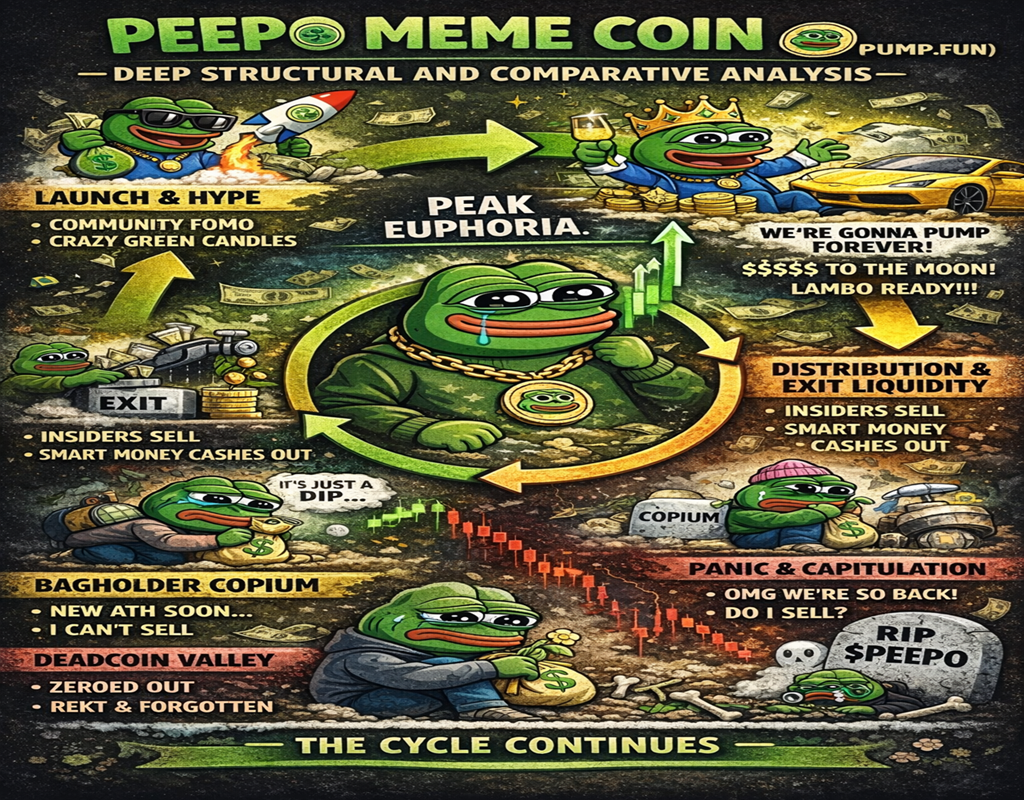
Peepo has already cleared one hurdle that defeats almost every token launched on Pump.fun: it made it through the bonding curve and continued attracting capital afterward.
Based on the latest market snapshot, the Pepe-derived Solana memecoin is roughly three days old, has traded as high as about $1.9 million in market capitalization and is holding near $1.5 million after gaining almost 39% over 24 hours. That is materially different from the familiar Pump.fun pattern in which a token graduates, gives early holders an exit window and rapidly unwinds toward its pre-graduation valuation.
But several conclusions commonly drawn from Peepo’s chart go too far. A stable price does not prove accumulation. A developer holding less than 3% of supply does not mean the developer cannot materially move the market. And graduation itself does not turn a speculative token into a durable asset.
Peepo is interesting precisely because it has made it far enough for those distinctions to matter.
Graduation Is Rare, but It Is the Beginning of the Test
Pump.fun’s current mechanics are slightly different from the way graduation is often described.
Tokens initially trade against a deterministic constant-product bonding curve. Once the graduation threshold is reached, the curve closes and liquidity is migrated automatically and irreversibly into the token’s canonical PumpSwap pool. Pump.fun says it does not subsequently seed or withdraw that migrated liquidity.
That means graduation is not simply the moment when “mechanical price support disappears.” Price discovery changes venues—from the original bonding curve to an AMM pool—but there was never a guaranteed floor beneath the token.
What graduation does prove is demand.
Available research illustrates how difficult even that step can be. A 2026 study covering more than 832,000 Pump.fun launches initially reported a 0.198% graduation rate. Its author subsequently disclosed that the dataset effectively captured only roughly the first six minutes after launch, meaning 0.198% should be treated as a lower bound rather than the true 24-hour graduation rate. The study cites separate 2025 research finding a roughly 0.63% graduation rate during that earlier period.
So describing Peepo as a rare survivor is reasonable. Claiming that its current valuation definitively places it in the “top 1–2%” of all launches is harder to substantiate without a complete distribution of post-graduation market caps.
The important point is simpler: most Pump.fun launches never reach the stage Peepo is in now.
Peepo Has Something More Valuable Than Pepe Branding: a Recognizable Deployer
One detail in the holder data changes the analysis considerably.
The address identified in the supplied market data as Peepo’s developer, BXAW…myGF, corresponds to the Pump.fun profile fibs. Pump.fun shows the account with roughly 25,000 followers. The same address is also listed by Pump.fun as the creator of UNC, another memecoin that previously reached multi-million-dollar valuations.
That gives Peepo a second source of narrative capital beyond its obvious Pepe ancestry.
Pump.fun is increasingly a creator economy as much as a token factory. Since May 2025, the platform has paid creator fees on eligible bonding-curve and canonical PumpSwap transactions, giving successful creators an economic reason to cultivate an audience capable of following subsequent launches.
For Peepo, that means some early buyers may not have been discovering an anonymous frog token from scratch. They may have been following a known Pump.fun account.
That distinction can shorten the time needed to bootstrap liquidity. It can also create what might be called creator portability: attention accumulated during one successful token cycle can migrate into the next launch.
There is a warning embedded in the same history, however. UNC demonstrates that a token can attract enormous attention and still experience severe valuation compression later. Creator recognition can accelerate discovery; it cannot manufacture permanent demand.
The Holder Distribution Looks Good—Until It Is Compared With Liquidity
Peepo’s visible holder distribution is initially encouraging.
According to the supplied holder snapshot, the largest non-pool addresses each control roughly 2.5% of supply, with the identified developer at approximately 2.46%. There is no obvious 15% or 20% developer allocation sitting at the top of the holder table.
But the conclusion that “no wallet controls the game” does not follow from those numbers.
First, wallets are not investors. One entity can control many addresses. Funding relationships, coordinated purchases and token transfers between wallets need to be examined before apparently separate 2% positions can be treated as independent holders.
Second, market impact depends on liquidity, not simply percentage ownership.
The liquidity pool in the supplied snapshot holds approximately 4.29% of Peepo’s token supply. A wallet containing 2.46% of total supply therefore holds tokens equivalent to roughly 57% of the amount of Peepo sitting on the token side of that pool.
That is a very different way to view the developer position.
In a simplified constant-product AMM with no other liquidity venues or arbitrage, dumping an amount equal to 57% of the pool’s existing token reserve would produce an enormous price displacement. The precise real-world effect would depend on routing, additional pools, fees, arbitrage and execution speed, but the exercise demonstrates why “only 2.46% of supply” can be misleading when liquidity is thin.
Three independent wallets holding roughly 2.5% each could collectively represent more token inventory than exists on the Peepo side of the main liquidity pool.
The good news is that canonical PumpSwap liquidity has protection against the classic liquidity-removal rug. Pump.fun says migrated pool tokens are locked and burned, meaning the developer cannot simply withdraw canonical liquidity to zero. The platform explicitly warns, however, that a developer holding a large token balance can still sell those tokens and cause a sharp decline.
That is the more accurate risk distinction for Peepo: LP-removal risk may be constrained, but inventory risk remains.
$46,000 of Volume Does Not Prove Accumulation
The original bullish interpretation of Peepo’s volume is also too confident.
At approximately $46,000 of daily volume against a $1.5 million market cap, turnover is only about 3%. Price holding up while volume falls can indeed mean holders are unwilling to sell.
It can also mean fewer buyers are arriving.
Those two conditions look almost identical on a simple price-and-volume chart.
Calling the pattern “accumulation” would require additional evidence: increasing holder count, new funded wallets entering, net positive flows from known traders, a healthy number of unique buyers, repeated absorption of meaningful sells, or wallets demonstrably increasing positions.
Without those signals, low volume is better described as low turnover.
That distinction matters especially on Pump.fun because Peepo competes in an extraordinarily active attention market. Pump.fun and PumpSwap have generated roughly $2.5 billion in DEX volume over the past 30 days, according to DeFiLlama. Capital is not absent from the ecosystem; it has thousands of alternative places to go.
For a three-day-old memecoin, the real enemy may therefore be substitution rather than selling.
Pepe Lineage Lowers the Cost of Attention but Increases Competition
Peepo has one obvious advantage over an entirely original meme: almost nobody familiar with crypto culture needs the frog explained.
Pepe derivatives inherit visual language, jokes, community associations and an enormous library of remixable content. That reduces what might be called the acquisition cost of attention. A new buyer can understand the meme before understanding the token.
But lineage cuts both ways.
Because Pepe is easy to reproduce, Peepo has little narrative exclusivity. Another frog token can be created within seconds. What matters is not simply whether traders recognize Peepo’s imagery, but whether this particular contract becomes the version around which liquidity and community coordinate.
That makes the next several stages more important than the first rally.
A genuinely strengthening Peepo market would show expanding unique ownership while the largest wallets’ share remains stable or declines, recurring trading activity after promotional bursts end, sufficient pool depth to absorb meaningful exits and social activity that remains attached to Peepo rather than rotating immediately into the next launch.
The opposite pattern is more subtle than an instant rug: market cap remains superficially stable while transaction counts fall, new-wallet growth stops and liquidity becomes increasingly dependent on a small group of existing holders. Eventually even a relatively modest sale becomes difficult for the pool to absorb.
Peepo Is a Better Experiment Than a Simple Bullish Chart
That is what makes Peepo more interesting than another Pump.fun coin that briefly crossed seven figures.
It has survived graduation. Its visible ownership is less concentrated than many micro-cap launches. It has recognizable meme ancestry. And the developer address appears connected to a Pump.fun creator with an existing audience and previous experience taking a token to substantially larger valuations.
Those are real advantages.
They are not proof that Peepo has escaped the economics of memecoins.
The most important question now is whether the token can replace departing capital with genuinely new capital. A $1.5 million market cap after three days demonstrates that Peepo won its first attention contest. It does not yet tell us whether the same holders are recycling positions, whether unrelated buyers are expanding the ownership base, or whether liquidity can survive a serious distribution event.
That is the line separating a successful launch from a persistent market.
For Peepo, the bonding curve is already history. The more revealing experiment has only just started.

Michael Lebowitz is a financial markets analyst and digital finance writer specializing in cryptocurrencies, blockchain ecosystems, prediction markets, and emerging fintech platforms. He began his career as a forex and equities trader, developing a deep understanding of market dynamics, risk cycles, and capital flows across traditional financial markets.
In 2013, Michael transitioned his focus to cryptocurrencies, recognizing early the structural similarities—and critical differences—between legacy markets and blockchain-based financial systems. Since then, his work has concentrated on crypto-native market behavior, including memecoin cycles, on-chain activity, liquidity mechanics, and the role of prediction markets in pricing political, economic, and technological outcomes.
Alongside digital assets, Michael continues to follow developments in online trading and financial technology, particularly where traditional market infrastructure intersects with decentralized systems. His analysis emphasizes incentive design, trader psychology, and market structure rather than short-term price action, helping readers better understand how speculative narratives form, evolve, and unwind in fast-moving crypto markets.