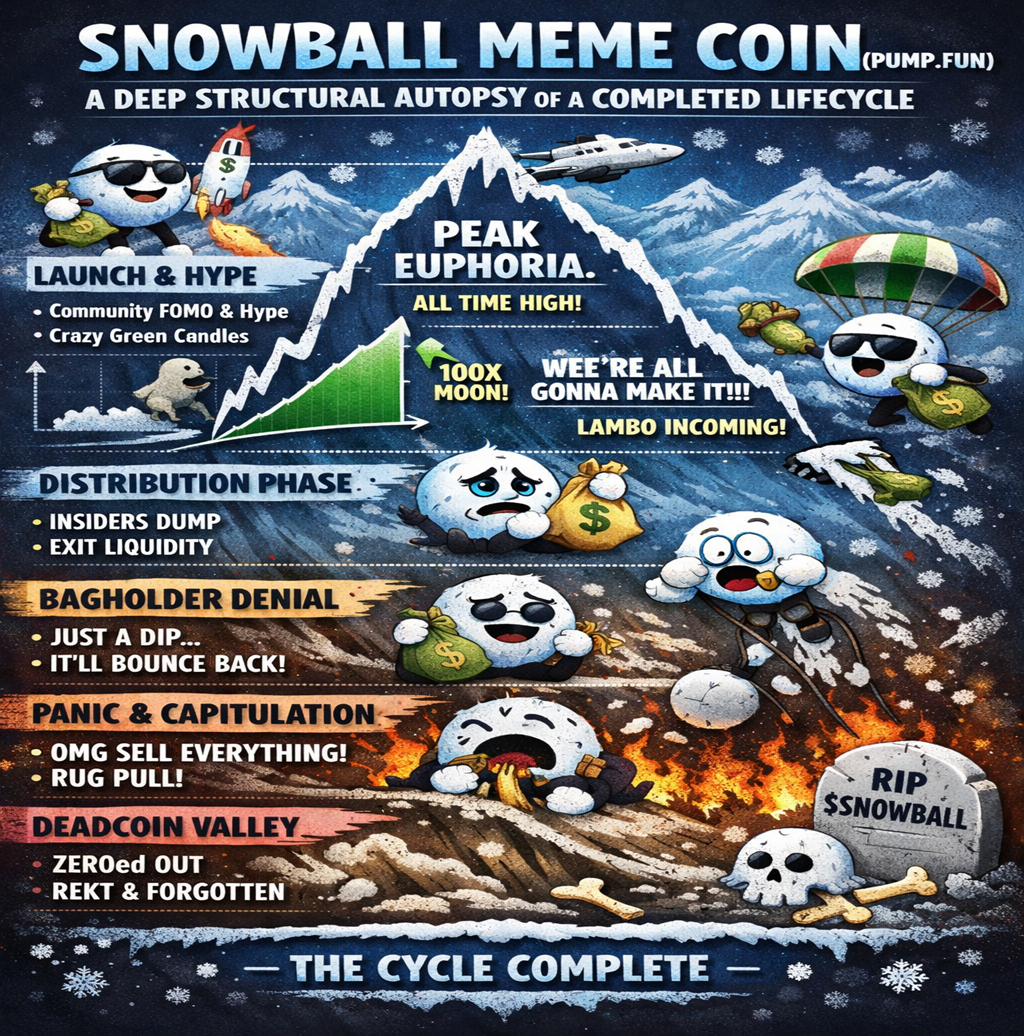
Snowball looked like a familiar Pump.fun story during its first day of trading.
The Solana token graduated from Pump.fun’s bonding curve, briefly reached a valuation around $1.3 million and then retreated toward roughly $310,000. At that point, the easy explanation was that early buyers had won, late buyers had become exit liquidity and the token was beginning the long decline that consumes most speculative launches.
Nearly nine months later, part of that thesis looks right—but not for the reasons originally suggested.
DEX Screener showed Snowball at approximately $141,000 in market capitalization on September 22, with around $86,000 of liquidity, $4,200 in 24-hour volume and 7,822 holders. An archived Snowball market previously showed a capitalization around $1.3 million. The token has therefore surrendered most of its peak valuation while remaining a functioning, liquid market months after its initial surge.
More interestingly, Snowball now promotes an economic mechanism designed specifically to change what happens after launch: creator fees generated by trading are used to buy Snowball from the market and burn the purchased tokens.
That makes Snowball a useful test of a much broader question. Can token mechanics create durable demand after Pump.fun’s launch machinery has done its job, or do they merely recycle activity that already exists?
Pump.fun Does Not Actually Guarantee Early Winners
Understanding that question requires correcting a common misconception about Pump.fun.
Every token launched through the standard system begins on a bonding curve. Pump.fun describes it as a constant-product automated market maker with virtual reserves. When somebody buys, the ratio of those reserves changes and the next quoted price rises. When somebody sells, the opposite happens. Larger orders create greater price impact.
So the bonding curve does not mechanically force a token upward regardless of demand.
Buying pushes it upward.
That distinction matters because it undermines the idea that Pump.fun somehow guarantees profits to early participants. An early buyer benefits only if sufficient later demand pushes the price higher and that buyer successfully sells before the market reverses.
Pump.fun does solve an important problem, however: the cold start.
A newly created token does not need its creator to find a market maker, build an order book or manually provide a conventional liquidity pool. The bonding curve makes it immediately tradable. Once the graduation requirement is reached, the curve closes and liquidity is migrated automatically into the token’s canonical PumpSwap pool.
That is where the character of the market changes.
Graduation Does Not Mean the “Mechanical Support” Disappears
The original Snowball analysis described graduation as the moment when all mechanical support disappears.
That is too strong.
After graduation, Pump.fun says the SOL and tokens transferred from the bonding curve become the canonical PumpSwap liquidity pool. Pump.fun does not subsequently seed or withdraw that liquidity, and the pool is owned by the protocol.
What disappears is the bonding-curve phase, not liquidity itself.
The more important change is economic. Before graduation, the token is completing a predefined launch process. Afterward, it must survive as an ordinary secondary market in which holders can continuously enter and leave.
That makes graduation less like finishing a race and more like removing the starting blocks.
The market now has to answer questions the bonding curve cannot: How many buyers remain? How much supply do profitable holders want to sell? Is there enough liquidity to absorb them? Will anybody still care about the token after the launch itself stops being news?
Snowball Did Face a Real Overhang—But the Chart Could Not Tell Us Who Owned It
The first-day decline from approximately $1.3 million toward $310,000 certainly indicated that supply had overwhelmed demand.
What it could not establish was exactly who was selling.
The original analysis assumed that early bonding-curve buyers remained 10x to 30x in profit and would therefore unload into every rebound. That is plausible, but a price chart cannot reconstruct wallet cost bases.
Early buyers may already have sold. Some wallets may have accumulated later. The same participant may control multiple addresses. Bots can enter and leave repeatedly. Supply can migrate among traders without the aggregate chart revealing those relationships.
That is why wallet-level analysis matters.
The distinction becomes especially clear today. DEX Screener counts more than 7,800 Snowball holders, yet its latest 24-hour activity involved only 61 traders and approximately $4,200 of volume.
A large nominal holder count therefore does not necessarily mean a large active market.
It may instead represent a long tail of dormant positions left behind by previous trading cycles.
Snowball Added Something More Interesting Than a Meme
The original analysis also dismissed Snowball’s narrative as generic.
The project’s current proposition is considerably more specific.
Snowball says creator fees produced by trading are claimed by an automated process. Once enough SOL accumulates, the system divides it into fixed 0.05 SOL lots, purchases Snowball and burns the acquired tokens in the same transaction. According to the project, the swap and burn are atomic: if the burn cannot execute, the purchase does not complete either.
This mechanism is possible because Pump.fun pays creators a portion of transaction fees. Its current bonding-curve schedule allocates 0.30% of each trade to the creator, while canonical PumpSwap pools use a variable creator-fee schedule based on market capitalization.
The Snowball model therefore creates a feedback loop:
trading generates fees → fees fund purchases → purchased tokens are burned → circulating supply declines.
At first glance, that appears to solve the post-graduation demand problem.
It does not quite do that.
A Buyback Funded by Trading Is Endogenous Demand
The crucial distinction is where the money originates.
Snowball’s buyback system does not generate revenue from an external business. There are no profits from software subscriptions, lending, advertising or another independent activity being used to purchase tokens.
The money originates from Snowball traders themselves.
That means the mechanism converts a portion of existing trading activity back into token demand.
This can still matter. Persistent buybacks remove tokens from circulation and create repeated market purchases that otherwise would not occur.
But it cannot independently solve the attention problem.
Snowball acknowledges this directly on its website: if volume disappears, fee generation disappears with it and the buyback process slows or stops.
That makes the mechanism reflexive.
Trading supports buybacks, but buybacks require trading.
A token experiencing rising activity can therefore receive more mechanical buying precisely when demand is already strong. A token losing attention receives less assistance precisely when additional demand would be most useful.
The Mechanism Has Another Counterintuitive Weakness
Snowball’s own documentation highlights an unusually candid limitation.
Because fee revenue increases when trading activity is high, the system may accumulate the most money to spend during periods when the token is already expensive. The project describes the mechanism as effectively a “buy-high machine by construction” rather than pretending it times purchases intelligently.
That matters.
A buyback program sounds automatically supportive when described only as reduced supply. But the economic result also depends on the prices at which tokens are removed.
Spending substantial fee revenue during speculative spikes can burn fewer tokens per SOL than spending the same amount after a major decline.
There is also an operational distinction. Snowball says the process is run by a keeper rather than being an immutable rule enforced entirely by the network. The individual burn transactions can be verified onchain, but users still depend on the process continuing to operate.
That is a much more meaningful risk to analyze than whether the word “snowball” is sufficiently memeable.
Volume-to-Market-Cap Ratios Are Not a Survival Formula
The original analysis also argued that sustainable second waves typically require daily volume equal to or greater than market capitalization.
There is no established market rule supporting that threshold.
Volume divided by market capitalization can be useful descriptively. It tells us how much reported turnover occurred relative to the token’s quoted value.
It cannot tell us why the turnover occurred.
High volume can represent fresh demand, panic selling, arbitrage, bots or rapid churn among the same traders. Low volume can indicate strong holders unwilling to sell—or simply a market nobody cares about anymore.
Snowball itself demonstrates the limitation.
At the original $310,000 snapshot, roughly $99,000 of volume looked substantial. Today the PumpSwap pool has roughly $86,000 of liquidity against a market capitalization around $141,000, yet daily turnover has fallen to only a few thousand dollars.
The token remains tradable, but activity has contracted dramatically.
That tells us more than assigning the old 0.32 volume-to-market-cap ratio a label such as “healthy” or “weak.”
Snowball’s Outcome Is More Nuanced Than “Pump or Die”
Snowball never returned permanently to its early $1.3 million valuation. In that sense, the initial warning about post-launch decay proved directionally useful.
But Snowball also did not simply disappear.
Nine months after launch, thousands of wallets still hold it, its main PumpSwap market retains tens of thousands of dollars in liquidity, and the project has developed a fee-funded buyback-and-burn model around its token.
That is more interesting than declaring it either a survivor or a failure.
Snowball shows that Pump.fun graduation does create a difficult transition, but not because the platform mechanically manufactures winners and losers. Graduation simply moves a token from a launch system capable of solving its initial liquidity problem into a secondary market that must continuously justify its existence.
Snowball has attempted to change that equation by recycling creator fees into purchases and burns.
The mechanism can reduce supply. It can create recurring buy orders. It can even make Snowball structurally different from thousands of otherwise interchangeable memecoins.
What it cannot manufacture is the input on which the entire machine depends.
Trading.
That is the deeper lesson from Snowball. After graduation, a Pump.fun token can redesign how existing attention is monetized and recycled. It still cannot escape the need to attract attention in the first place.

Michael Lebowitz is a financial markets analyst and digital finance writer specializing in cryptocurrencies, blockchain ecosystems, prediction markets, and emerging fintech platforms. He began his career as a forex and equities trader, developing a deep understanding of market dynamics, risk cycles, and capital flows across traditional financial markets.
In 2013, Michael transitioned his focus to cryptocurrencies, recognizing early the structural similarities—and critical differences—between legacy markets and blockchain-based financial systems. Since then, his work has concentrated on crypto-native market behavior, including memecoin cycles, on-chain activity, liquidity mechanics, and the role of prediction markets in pricing political, economic, and technological outcomes.
Alongside digital assets, Michael continues to follow developments in online trading and financial technology, particularly where traditional market infrastructure intersects with decentralized systems. His analysis emphasizes incentive design, trader psychology, and market structure rather than short-term price action, helping readers better understand how speculative narratives form, evolve, and unwind in fast-moving crypto markets.