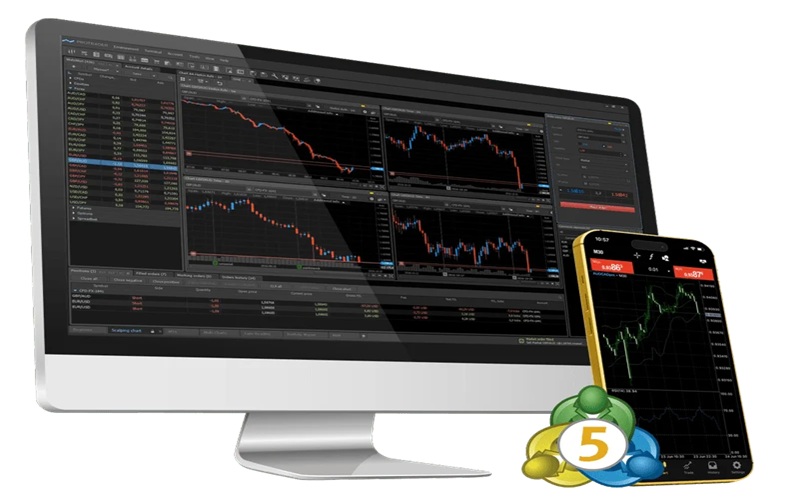
Build 6180 Pushes AI Deeper Into Strategy Testing
MetaQuotes has expanded the artificial intelligence capabilities inside MetaTrader 5, giving its AI Assistant new access to Strategy Tester reports, Expert Advisor logs and optimization functions as the trading-technology provider moves beyond conversational AI toward agents capable of interacting directly with trading tools.
MetaTrader 5 Build 6180, released on September 3, expands the set of actions available to the platform’s AI Assistant. MetaQuotes said the changes are intended to make it easier for traders and developers to analyze, test and optimize automated trading strategies.
One of the biggest additions is direct access to Strategy Tester reports. The AI Assistant can now retrieve results from tests and optimization runs and analyze them without the user manually exporting the data.
That means a trader can ask the assistant to assess an Expert Advisor’s performance, compare different optimization passes or look for weaknesses in a strategy based on the results produced by MT5’s testing environment.
The assistant can also initiate the optimization process. MetaQuotes said users can ask it to help configure optimization criteria for an Expert Advisor before running the process through the Strategy Tester.
Build 6180 additionally allows the AI system to inspect the current tester configuration, including the selected Expert Advisor, instrument, timeframe and other parameters. This gives the model more context before it performs an analysis or starts another action.
Troubleshooting has also been expanded.
The AI Assistant can retrieve Strategy Tester logs and analyze messages generated during testing or optimization to identify errors and possible causes. It can separately access terminal and Expert Advisor logs, giving users another way to diagnose problems with MQL5 applications without manually searching through potentially lengthy log files.
MetaQuotes has also added simpler chart-level actions. A trader can instruct the assistant to place technical indicators on a chart and configure their parameters. The company gives the example of asking AI to add 20-period and 50-period moving averages to the active chart.
The update represents the latest step in an AI rollout that accelerated during the summer.
MetaQuotes introduced native Model Context Protocol support and agentic AI to MetaTrader 5 in Build 6060 on July 23. That release allowed AI systems to access market information, analyze charts, work with trading accounts and interact with MetaTrader functionality through a standardized MCP interface.
It also transformed the AI Assistant inside MetaEditor into a development tool capable of generating MQL5 programs, reviewing existing code, finding errors, suggesting fixes and assisting with refactoring.
MetaQuotes designed the architecture so users are not tied exclusively to its own AI service. Build 6060 added support for external AI providers including OpenAI, Anthropic, Gemini, DeepSeek and Ollama, while MCP-compatible external systems such as Codex and Claude Code could also be connected to MetaTrader 5.
The following Build 6140 update on August 20 broadened the list of supported large-language-model providers further, adding services including Alibaba, Cerebras and z.ai. It also added an MCP command for stopping the Strategy Tester and made several other AI Assistant improvements.
Build 6180 therefore takes the integration a step further. Instead of AI being primarily a source of explanations, coding assistance or market analysis, the assistant is gaining access to more of the workflow normally performed manually when developing an automated trading system.
The change has relevance beyond MetaQuotes itself because MT5 remains a central platform across the retail FX and CFD industry.
Finance Magnates Intelligence reported that MT5 accounted for 62% of trading volume generated on MetaQuotes platforms in the third quarter of 2025, compared with 38% for the older MT4 platform. Its latest broker-data service tracks MT4 and MT5 exposure across a database of 265 FX and CFD brokers.
MetaQuotes has separately been expanding automation on the broker side of the platform. In August, Java Global Futures, Born2trade and Mercato Brokers disclosed implementations of MetaTrader 5 Automations for tasks ranging from dealing operations and server monitoring to client communications and risk alerts.
Build 6180 is different from that broker back-office automation product. Its new AI tools operate primarily in the trader and developer environment. But brokers distributing MT5 inherit a platform with an increasingly capable AI layer without having to develop those functions themselves.
AI Is Starting to Change What an MT5 Broker Actually Offers
The important change in Build 6180 is not that MetaTrader now has another chatbot.
It is that the chatbot is increasingly being allowed to do things.
There is a substantial difference between asking an AI model to explain why an Expert Advisor performed badly and allowing the same model to retrieve the testing report, inspect the configuration, read the error log, compare optimization passes and initiate another optimization.
The first is assistance. The second begins to resemble workflow automation.
For retail traders, that potentially lowers one of the largest barriers surrounding algorithmic trading: technical friction.
Building an Expert Advisor has traditionally required some combination of MQL5 programming knowledge, familiarity with the Strategy Tester, an understanding of optimization parameters and the ability to interpret a large amount of performance data.
Generative AI has already made writing code easier. Build 6180 starts addressing what happens after the code is written.
A trader could theoretically describe a strategy in natural language, use AI to generate much of the Expert Advisor, compile and troubleshoot it, run a backtest, examine the results and then optimize parameters while interacting with the same assistant.
That does not mean the resulting strategy will be profitable.
In fact, easier optimization creates its own risk. A trader who can rapidly test hundreds or thousands of parameter combinations can also overfit a strategy to historical data much faster. An AI assistant may find the combination that produced the most attractive historical result without that result having any predictive value for future trading.
The platform can automate experimentation. It cannot remove market uncertainty.
For brokers, however, the commercial attraction is obvious.
Most FX and CFD brokers have little reason to build a complete AI development and backtesting environment themselves if those capabilities are arriving natively inside MT5. A broker can instead market AI-assisted algorithmic trading as part of its platform offering while MetaQuotes handles much of the underlying technology.
This could gradually alter the competitive checklist for MT5 brokers.
Spreads, execution, leverage, instruments and copy trading have traditionally dominated platform marketing. AI-assisted coding, strategy testing and optimization can now become another differentiator — even if rival MT5 brokers ultimately have access to the same underlying functionality.
There is an important distinction here. Build 6180 does not suddenly give a broker’s dealing desk an AI agent that autonomously manages its business. MetaQuotes has a separate MetaTrader 5 Automations product for broker-side operational workflows.
What Build 6180 does is potentially make every broker’s MT5 terminal a more sophisticated automation environment for the broker’s customers.
And because MT5 already sits inside hundreds of brokers’ technology stacks, MetaQuotes does not need to persuade traders to move to an entirely new AI trading platform. It can put the AI layer inside software they already use.
That distribution advantage may prove more significant than any individual feature in Build 6180.
The September update is therefore less about one new Strategy Tester command and more about the direction MetaTrader is taking: from a platform on which traders manually operate automated systems toward a platform where AI increasingly helps build, test, diagnose and control those systems itself.

Shane Neagle is a financial markets analyst and digital assets journalist specializing in cryptocurrencies, memecoins, prediction markets, and blockchain-based financial systems. His work focuses on market structure, incentive design, liquidity dynamics, and how speculative behavior emerges across decentralized platforms.
He closely covers emerging crypto narratives, including memecoin ecosystems, on-chain activity, and the role of prediction markets in pricing political, economic, and technological outcomes. His analysis examines how capital flows, trader psychology, and platform design interact to create rapid market cycles across Web3 environments.
Alongside digital assets, Shane follows broader fintech and online trading developments, particularly where traditional financial infrastructure intersects with blockchain technology. His research-driven approach emphasizes understanding why markets behave the way they do, rather than short-term price movements, helping readers navigate fast-evolving crypto and speculative markets with clearer context.