
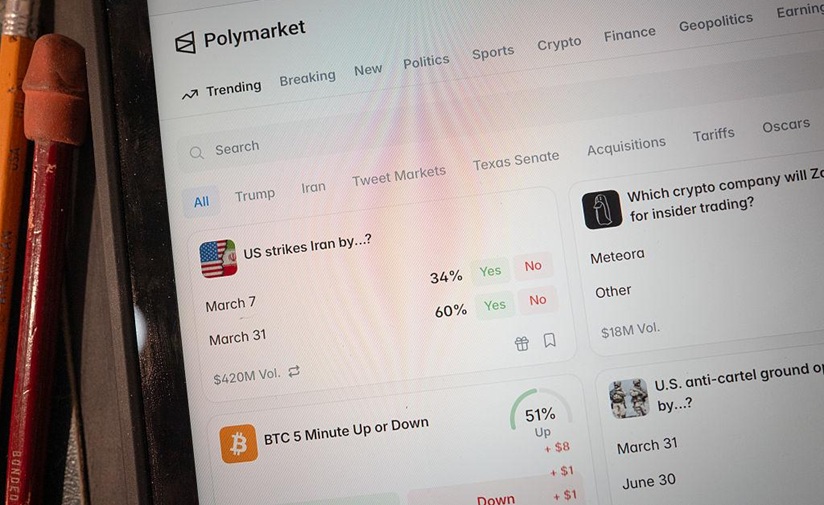
A network of 19 interconnected Polymarket accounts correctly predicted 41 of 42 earnings outcomes involving companies audited by KPMG, generating roughly $22,000 in profit and raising new questions about whether nonpublic corporate information may be finding its way into prediction markets.
Blockchain analytics firm Bubblemaps identified the cluster after examining accounts trading contracts tied to quarterly results from 18 KPMG-audited companies, including Wells Fargo, Home Depot and DoorDash.
The reported success rate was approximately 98%.
The dollar amount is relatively small, particularly compared with conventional insider-trading cases. The unusual part is the consistency of the results and the common link between the companies involved.
Bubblemaps found that the accounts were connected through on-chain fund flows and frequently traded overlapping earnings markets. The pattern led the analytics firm to conclude that the wallets may represent one trader or coordinated group rather than 19 unrelated users.
That conclusion does not establish insider trading.
There is currently no public evidence identifying the individual or individuals controlling the accounts, proving they possessed material nonpublic information, or connecting them to KPMG employees.
But the findings arrive at an especially sensitive moment for prediction markets.
Separate KPMG Employee Investigation Raises the Stakes
Federal authorities are separately investigating a KPMG employee over suspected prediction-market trading involving advance knowledge of a public company’s earnings, according to previous reporting by The Wall Street Journal.
Authorities were reportedly preparing charges, although no public criminal case against that employee has been announced.
There is also no confirmed connection between that investigation and the 19-account cluster.
That separation is important.
The known employee investigation reportedly concerns trading around one company’s earnings. The Bubblemaps pattern extends across numerous companies sharing KPMG as their auditor.
If the two eventually prove connected, the scope of the issue could become substantially more serious. For now, they remain two separate pieces of evidence that happen to point toward the same information channel.
KPMG has said it has zero tolerance for employees trading on confidential client information and has strengthened monitoring aimed at identifying potential misuse.
The firm audits a significant number of publicly listed companies, giving some employees legitimate access to commercially sensitive information before earnings reports become public.
Independent Analysis Also Found an Unusual Trading Record
A separate investigation by blockchain data firm Bitquery, published Sept. 13, reconstructed much of the same trading network using Polygon transaction data.
Its methodology produced slightly different totals from Bubblemaps, but the underlying pattern remained unusual.
Bitquery found the accounts had a 19-2 record across KPMG-client earnings markets under its market-level methodology and calculated approximately $21,519 in profit. It also found that 43 of 44 individual positions it analyzed had been opened before the companies publicly filed their results.
Bitquery was explicit about the limit of that evidence: blockchain data can show when wallets traded, how money moved between them and how accurately they predicted outcomes, but it cannot reveal who possessed the private keys or how those traders obtained their information.
That limitation is familiar in on-chain investigations, where transaction trails can establish relationships and timing without necessarily identifying the people behind the wallets.
Prediction-Market Insider Trading Is No Longer Theoretical
The KPMG-linked activity emerges after U.S. regulators began taking direct action against traders accused of using privileged information on event-contract platforms.
In May, federal prosecutors and the Commodity Futures Trading Commission charged Google software engineer Michele Spagnuolo with using confidential internal search data to trade Polymarket contracts.
Authorities allege that Spagnuolo, using the account AlphaRaccoon, risked approximately $2.75 million across Google-related markets and generated about $1.2 million in profits.
The CFTC has argued that its anti-fraud authority applies to event contracts and that trading based on misappropriated confidential information can violate the Commodity Exchange Act.
The agency followed with another enforcement action in August against a White House teleprompter operator who used advance access to presidential speeches to trade mention contracts, requiring him to disgorge more than $107,000 in profits and imposing a three-year trading ban.
Platforms themselves are responding as well. Kalshi has previously investigated hundreds of suspicious cases and imposed sanctions in a prediction-market insider-trading case involving a MrBeast editor.
Congress has also entered the debate. The House Oversight Committee opened an investigation in May into how Polymarket and Kalshi identify account holders, detect anomalous trading and prevent users from exploiting nonpublic information.
The $22,000 Profit May Be the Least Important Part
Twenty-two thousand dollars does not sound like a major financial scandal.
That is precisely why this pattern is interesting.
If someone genuinely possessed a repeatable information advantage across earnings reports, the obvious assumption would be that they would bet much more.
But there are several reasons they might not.
Large trades attract attention. They move prediction-market prices. They create obvious profit trails. And once somebody starts consistently risking six-figure amounts immediately before corporate announcements, surveillance becomes much easier.
Small positions spread between multiple wallets are less conspicuous.
That does not mean the accounts were deliberately attempting to hide insider trading. There could be innocent explanations for both the wallet structure and the unusually strong results.
But splitting activity across 19 connected accounts makes the relatively modest total profit less reassuring than it initially appears.
The Auditor Link Is What Makes the Pattern Hard to Ignore
The important variable is not simply that these traders were good at predicting earnings.
It is that their strongest results appear concentrated around companies sharing the same auditor.
That provides a potential information pathway.
An ordinary skilled trader might repeatedly outperform because they understand banking, retail or technology earnings better than the market.
That becomes harder to explain when the companies span different industries but share one professional-services firm with pre-release access to their financial statements.
This is similar to the way blockchain investigators look for common infrastructure when apparently unrelated transfers produce the same outcome. Recent cases involving changes in blockchain risk classifications show how much information can be inferred once seemingly isolated transactions are connected through a common counterparty.
The same logic applies here.
Home Depot and Wells Fargo have very different businesses.
KPMG is the common denominator.
Prediction Markets Create a New Outlet for Corporate MNPI
This may ultimately be the biggest issue for audit firms, corporations and regulators.
Traditional insider-trading surveillance is built largely around stocks, options and other securities accounts.
Prediction markets create another way to monetize exactly the same confidential information.
An employee does not necessarily need to buy shares before earnings anymore.
If they know whether revenue will beat expectations, whether an acquisition will be announced, whether a CEO will resign or whether a regulator will approve something, there may be a prediction contract directly tied to that outcome.
And blockchain-based markets add another wrinkle: traders can divide activity across multiple wallets.
Public blockchains make those transactions unusually transparent once investigators know what to look for, but wallet attribution remains difficult. The same tension has appeared in investigations into complex crypto transaction networks, where investigators can map flows long before they can confidently identify every participant.
The Transparency of Crypto Is Both the Weakness and the Defense
Ironically, Polymarket’s blockchain architecture may make suspicious activity easier to reconstruct than it would be at many traditional venues.
Wallet transfers remain visible.
Investigators can compare timestamps, funding sources, counterparties and repeated behavioral patterns long after markets settle.
That is how Bubblemaps was able to connect accounts that superficially appeared independent.
Similar techniques have become central to tracing crypto flows across interconnected platforms.
The weakness is that an on-chain address is not the same thing as a legal identity.
Investigators can see that wallets are connected without immediately knowing whether one employee, a group of employees, an outside trader or somebody entirely unrelated controls them.
That is where platform KYC records, exchange funding data and subpoenas become important.
This Could Become a Much Bigger Compliance Problem
The immediate temptation is to ask whether somebody at KPMG leaked earnings information.
That is still unproven.
The broader question is whether professional-services firms are prepared for prediction markets becoming a mainstream monetization channel for confidential information.
Auditors, lawyers, consultants, investment bankers and government employees routinely receive information that can determine the outcome of event contracts.
The classic insider-trading compliance program was designed around securities brokerage accounts.
That may no longer be enough.
Companies may increasingly need to monitor prediction-market activity, wallet relationships and crypto funding alongside traditional personal trading accounts.
Regulators face the same adaptation problem.
The CFTC has made clear that it believes insider-trading rules can reach event contracts, but the legal framework is still being tested in court. Defendants in some prediction-market cases are already challenging whether existing commodities-fraud statutes apply to the contracts they traded.
The Next Evidence Will Matter More Than the Win Rate
A 98% hit rate makes a good headline.
It does not prove a crime.
The next stage of this story depends on attribution.
Who controlled the 19 wallets?
Where did their initial funding come from?
Did any of those accounts interact with wallets linked to the KPMG employee reportedly under investigation?
Did bets cluster around companies or engagements accessible to a particular audit team?
And were account names rotated or funds deliberately moved between wallets to make common control harder to identify?
Those answers would move the story from statistical suspicion toward evidence of an information source.
Until then, the safest conclusion is narrower.
A connected network of Polymarket accounts repeatedly made unusually successful earnings bets on companies sharing the same auditor. The pattern is strong enough to warrant scrutiny, but neither Bubblemaps nor the available on-chain evidence proves the accounts traded on inside information.
The bigger warning for prediction markets is already clear, though.
If event contracts continue expanding into earnings, corporate announcements and government decisions, material nonpublic information is going to become one of the industry’s central market-integrity risks.
And unlike traditional insider trading, some of the evidence will be sitting publicly on-chain for anyone patient enough to connect it.

Shane Neagle is a financial markets analyst and digital assets journalist specializing in cryptocurrencies, memecoins, prediction markets, and blockchain-based financial systems. His work focuses on market structure, incentive design, liquidity dynamics, and how speculative behavior emerges across decentralized platforms.
He closely covers emerging crypto narratives, including memecoin ecosystems, on-chain activity, and the role of prediction markets in pricing political, economic, and technological outcomes. His analysis examines how capital flows, trader psychology, and platform design interact to create rapid market cycles across Web3 environments.
Alongside digital assets, Shane follows broader fintech and online trading developments, particularly where traditional financial infrastructure intersects with blockchain technology. His research-driven approach emphasizes understanding why markets behave the way they do, rather than short-term price movements, helping readers navigate fast-evolving crypto and speculative markets with clearer context.