
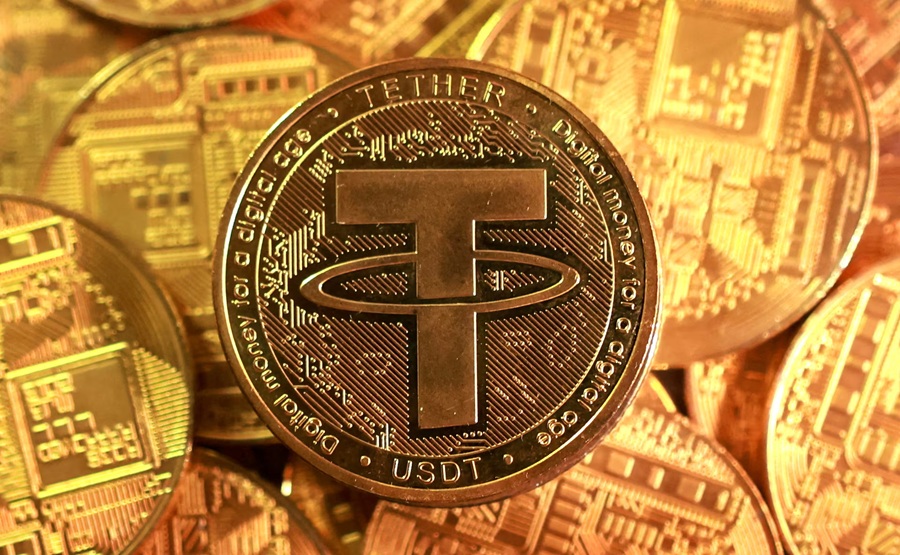
Largest Wallet Held More Than $1.1 Million When Freeze Executed
Tether’s USDT contract blacklisted 15 addresses on the Tron network holding a combined $3.31 million in a concentrated series of freezes, with one wallet containing more than $1.13 million when the restriction was executed.
On-chain monitoring data shows the 15 addresses held precisely 3,313,462.02 USDT at the time of the freeze events during the Sept. 14 UTC reporting window. A blacklist tracker published the batch in its Sept. 15 daily report.
No corresponding Ethereum USDT freezes were recorded in the same dataset.
The largest affected address, TLUQfWcfnUbZ1sY6TNoiZ6t9MioEPa7wwp, held 1,134,712.62 USDT. Other large balances included 391,155.75 USDT, 334,686.62 USDT, 257,638.34 USDT and 216,117.22 USDT.
The freezing was highly concentrated in time. Several of the largest addresses were blacklisted in the same Tron block at approximately 21:55 UTC on Sept. 14, indicating that the restrictions were executed as a batch rather than independently over several hours.
There is currently no public explanation from Tether identifying why those specific addresses were frozen.
The wallets therefore should not be described as belonging to hackers, sanctioned entities, scammers, money launderers or any other category without additional evidence.
That distinction is important because Tether can blacklist USDT addresses for several reasons, including cooperation with law enforcement, sanctions enforcement, fraud investigations and other risk or compliance processes.
Tether has increasingly formalized that capability through the T3 Financial Crime Unit, a partnership with Tron and blockchain intelligence company TRM Labs. The initiative has already frozen more than $450 million in crypto linked to illicit activity since launching in 2024.
TRM Labs says the system combines blockchain tracing, Tron network visibility and Tether’s issuer-level authority to prevent USDT from moving once an address has been identified. In some law-enforcement cases, the process can move from a request to an executed freeze within 24 hours.
There is no evidence that the latest $3.3 million batch originated from T3 or from any particular law-enforcement agency.
Initial tracing of the largest wallet has not produced a reliable public entity label.
Publicly indexed transaction records nevertheless show a noteworthy pattern. The $1.13 million address repeatedly received large transfers from the same upstream Tron wallet, TWjjm4u8rVrRa3J2YfRn7a3t8gp4TwDDDj, before it was blacklisted.
Recorded transfers include approximately 1.00 million USDT on Aug. 17, 503,000 USDT on Aug. 27, 545,000 USDT on Sept. 8 and another 1.02 million USDT on Sept. 9. Those four transactions alone amount to more than $3 million of incoming USDT.
The upstream wallet does not carry a sufficiently reliable public label to attribute it to an exchange, payment processor or other service.
The lack of attribution means the flow is useful as an investigative lead but not enough to establish why Tether acted.
The freeze activity also continued after the $3.31 million batch.
At 01:18 UTC on Sept. 15, another Tron address, TJdnP3HW6RBfmAgihBFdjXDJhvoCgNvNk9, was blacklisted while holding 310,449.66 USDT. That event falls outside the UTC window containing the original 15 addresses and may indicate that additional restrictions were still being executed after the larger batch.
Another address within the earlier group, TRpmus1xxg6EBvaafgmzBpDJxY1CN3paoi, held 151,570 USDT when it was blacklisted.
A separate metric from the blacklist tracker adds another angle. It reported 10 transfers worth approximately $775,900 into addresses that were already blacklisted during its daily reporting period.
Those transactions should not be assumed to involve the 15 newly frozen addresses. But they highlight a recurring operational problem around issuer-controlled stablecoins: blockchain addresses can remain technically capable of receiving tokens even after the issuer has prevented those tokens from being transferred onward.
That creates a screening challenge for exchanges, payment services and individual users sending USDT.
The episode comes as USDT increasingly operates as financial infrastructure rather than simply an exchange trading pair. Tether-linked liquidity is spreading across chains, including through cross-chain stablecoin infrastructure, while regulated firms are also building on-chain bank accounts around tokenized dollars.
The $775,900 Sent to Blacklisted Wallets May Be the More Important Signal
A $3.3 million freeze sounds dramatic, but the fact that Tether can immobilize USDT is already well established.
The more interesting operational question is what happens immediately after an address is blacklisted.
If the tracker is correct that 10 transfers worth roughly $775,900 were sent to addresses that were already banned, someone was still routing substantial amounts of USDT toward destinations whose tokens could no longer move normally.
There are several innocent explanations.
A user may have copied an old deposit address. An automated payment system may not have refreshed its screening data quickly enough. A service could have queued a withdrawal before the blacklist event but broadcast it afterward. The sender may simply have had no idea that the destination had been restricted.
That is why identifying the senders is potentially more revealing than identifying the frozen balances themselves.
If the transactions originated from a major centralized exchange or payment processor after the blacklist became visible on-chain, it would raise questions about how quickly that service updates its sanctions and wallet-risk screening.
Crypto companies already perform increasingly aggressive transaction monitoring, sometimes resulting in withdrawal restrictions after risk flags. The other side of that system is ensuring outbound transfers are not being sent into addresses that an issuer has already disabled.
There is also an important conceptual distinction between this event and the customer account freezes commonly reported at exchanges.
When an exchange makes customer funds inaccessible, the restriction generally exists inside the platform’s own custody and compliance system. Tether’s blacklist function operates at the token-contract level. Even a self-custody wallet cannot transfer its USDT once the issuer has blacklisted the address.
That is one reason stablecoin issuer power is becoming more significant as tokenized dollars move deeper into mainstream payments.
Companies such as Revolut are now developing their own stablecoin products, while banks and fintechs increasingly treat blockchain dollars as settlement infrastructure. The more stablecoins function like money, the more important issuer-level compliance controls become.
For law enforcement, that central control is a feature. A criminal organization can move Bitcoin to another wallet, but an issuer such as Tether can prevent USDT sitting at a known address from moving at all.
For users, the same capability introduces counterparty and censorship risk that does not exist in the same form with native decentralized assets.
The latest batch illustrates both sides of that trade-off.
Fifteen addresses containing more than $3.3 million were immobilized through an issuer action without requiring the underlying Tron blockchain to stop operating. At the same time, the public blockchain does not explain why those addresses were selected.
That leaves investigators with two jobs.
The first is to trace backward from the $1.13 million wallet and the other major addresses to determine whether they converge on common exchanges, OTC desks, payment processors, hacks or known criminal clusters.
The second is to trace the reported $775,900 of transfers into already blacklisted wallets and determine who continued sending funds after the restrictions were in place.
If those counterparties turn out to be large regulated services, the story shifts from a routine Tether blacklist event to a question about whether compliance infrastructure is keeping pace with issuer enforcement in real time.
Until those links are established, however, the safest conclusion remains narrow: Tether executed an unusually concentrated $3.3 million Tron blacklist batch, another $310,000 address was frozen shortly afterward, and the reason behind the wallets’ selection remains unconfirmed.

Shane Neagle is a financial markets analyst and digital assets journalist specializing in cryptocurrencies, memecoins, prediction markets, and blockchain-based financial systems. His work focuses on market structure, incentive design, liquidity dynamics, and how speculative behavior emerges across decentralized platforms.
He closely covers emerging crypto narratives, including memecoin ecosystems, on-chain activity, and the role of prediction markets in pricing political, economic, and technological outcomes. His analysis examines how capital flows, trader psychology, and platform design interact to create rapid market cycles across Web3 environments.
Alongside digital assets, Shane follows broader fintech and online trading developments, particularly where traditional financial infrastructure intersects with blockchain technology. His research-driven approach emphasizes understanding why markets behave the way they do, rather than short-term price movements, helping readers navigate fast-evolving crypto and speculative markets with clearer context.