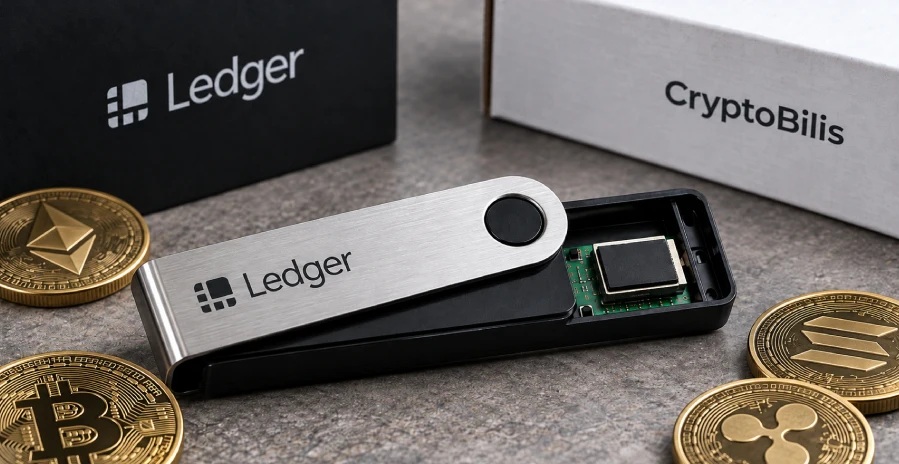
The mathematics of device attestation are sounder than the claim sometimes attached to them: authenticity is not comprehensive physical integrity.
Ledger’s Genuine Check is not a marketing sticker. It is a cryptographic attestation process designed to verify that a connected device includes an authentic Ledger Secure Element. This is valuable protection against substituted or counterfeit hardware. But the October 2026 hardware-wallet implant investigation exposed a sharp boundary: a product can contain a genuine authentication chip and still have an unauthorized component that copies recovery information. The investor must understand what the positive result proves, what it leaves untested, and which complementary checks are capable of reducing the remaining risk.
What the Genuine Check Actually Authenticates
Ledger describes a factory-provisioned secret key associated with the Secure Element. During setup, trusted Ledger software issues a challenge to the device and verifies a cryptographic response through Ledger’s authentication infrastructure. The signature is evidence that the answering component possesses the expected secret. This prevents a casual counterfeit without the genuine attestation key from simply printing the Ledger logo and claiming to be authentic.
The same trust system is involved in sensitive device-management operations such as app installations and firmware updates. Ledger’s Donjon threat-model documentation identifies device genuineness as a specific security objective alongside seed confidentiality, secure display and inputs, user consent and physical resistance. Those are complementary objectives. A successfully authenticated chip does not, by logic alone, prove that every component mounted beside it is authorized or that every human interaction surrounding it is safe.
There is another dependency: a user must run the check in authentic Ledger Wallet software. A counterfeit desktop application can show a bogus green tick without performing a meaningful challenge or accepting the result from a genuine verification service. Download provenance is therefore part of the attestation process. A seller’s screenshot of a successful check offers much less assurance than running the check yourself using software retrieved independently from Ledger.
The Crucial Distinction: Component Identity Versus System Integrity
Consider two devices. Wallet A is entirely counterfeit; its Secure Element cannot produce the valid Ledger attestation. Genuine Check should reject it. Wallet B is a legitimate Ledger with an additional spying circuit inserted in the display path. The Secure Element is untouched, so it can answer the authenticity challenge correctly. Genuine Check can pass even though the device is unsafe for a different reason.
This is not a hypothetical loophole invented by critics. The Ledger Donjon page explicitly notes that the check cannot detect unauthorized physical modifications, including spying implants, when the original Secure Element remains intact. Ledger’s consumer purchasing guidance repeats that qualification. The technical conclusion is narrower—and more useful—than either blanket reassurance or blanket dismissal: the check meaningfully addresses a counterfeit-chip threat, but it cannot serve as a full-board forensic inspection.

Figure 1. Security-claim coverage. A qualitative scope matrix, not a quantitative detection-rate score.
The October 2026 Stress Test
The CryptoBilis incident supplied a real-world test case. Ledger’s reported technical examination found an unauthorized implant capable of decoding the 24-word recovery phrase as it appeared during setup and transmitting that information over cellular service. The account did not require replacing the Ledger Secure Element, breaking its signing logic or changing transaction signatures. That makes the case directly relevant to the limitations of attestation.
The date and scope matter. The October 9 wallet-draining event was investigated through on-chain tracing, device analysis and reseller records. Independent researchers later advanced loss estimates above $100 million, but those estimates are not the same as a manufacturer-certified number of victims or definitive proof that every suspect transfer came from the same implant. Reports concerning European store purchases require separate corroboration. Dave Finances’ investigation into the CryptoBilis loss estimates and proposed European links keeps those evidentiary categories apart.
For Genuine Check, the decisive fact is architectural rather than the total stolen. A spying board can leave the cryptographic signing core alone and merely observe recovery material on a peripheral path. If authentication queries only the signing core, the unauthorized observer is outside the test’s field of view.
A Map of the Security Claims
| Question a buyer may ask | Can Genuine Check answer it? | Better evidence or additional control |
| Is the attesting Secure Element genuine? | Yes, with genuine verifying software | Perform check in independently obtained official app |
| Is the entire physical wallet unmodified? | No | Model-specific physical examination and custody records |
| Was the phrase secretly read off the display? | No | Forensic inspection; avoid suspect provenance |
| Was the seed supplied by a scammer on paper? | No | Reject any prefilled seed or PIN |
| Did the buyer install a malicious companion app? | Not reliably from a fake app | Independent software provenance verification |
| Are future DeFi approvals safe? | No | Review transaction permissions and destination on signer |
| Is the wallet’s recovery phrase private? | No, not as a full statement | New independently generated secret and secure handling |
The table shows why a universal “pass = safe” rule is invalid. Attestation certifies one property of a component. It does not retroactively verify the provenance of every recovery sheet or guarantee that the customer will refuse a malicious signing request. This distinction applies beyond Ledger: researchers have found vulnerabilities in genuine-check implementations of other hardware-wallet ecosystems, which reinforces the need to examine exactly what a given protocol authenticates.
Why the Device Screen Is Both a Defense and a Potential Exposure Path
One of the major advantages of dedicated signers is an independent display for reviewing recipient addresses and transaction details. Ledger’s Secure Element drives its secure screen under the documented design, reducing the trust placed in a potentially infected laptop display. But the 2026 implant case demonstrates an important distinction between integrity and confidentiality. A display can faithfully show the intended words or address to its owner while a hidden observer also receives a copy.
A user who reads the correct transaction address from the signer has evidence about what they are authorizing. They do not thereby prove that nobody else saw recovery words earlier. The two security goals—what the user sees and who else can see it—are related but different. The Dave Finances examination of maliciously modified Trezor wallets provides a further comparison: changing how secrets are generated and secretly observing legitimate secrets are distinct attack paths with similar consequences.
How to Interpret an Authenticity Result in Practice
A failed Genuine Check is high-priority evidence to stop using the device and seek help from Ledger. A pass should normally increase confidence relative to a counterfeit threat, provided the verifying application is authentic. But the pass should not override a conflict with other evidence, such as a suspicious reseller, altered package, unexpected PCB components, a preconfigured seed, or a known distribution incident. Security checks must be interpreted jointly rather than voted on as if each carries equal authority.
A reasonable decision framework has three layers. First, provenance asks who sold and handled the wallet. Second, attestation asks whether its core authentication hardware is legitimate. Third, confidentiality and setup asks whether a fresh seed was generated privately and whether the device was free of suspicious additions. Weakness in one layer cannot always be compensated by strength in another. For example, a plausible sales receipt cannot override a failed chip attestation; conversely, a passed chip attestation does not explain away a covert radio board.

Figure 2. Authentic chip attestation may pass even if an unauthorized observational component is present.
A Quantitative Example: How Much Is Left at Risk After a Pass?
The precise probability that a given Ledger is implanted is not public and cannot be inferred from isolated theft reports. It would be irresponsible to invent one. A more defensible exercise examines exposure conditional on a known attack type. Suppose a wallet passes Genuine Check but a malicious component has copied the seed. A user funds it with $5,000, then another $15,000, and finally $80,000. Assuming the attacker knows the full seed and has access to the relevant accounts, the maximum portfolio value potentially controlled through that secret rises from $5,000 to $20,000 to $100,000. Every successful check of the unchanged authentic chip leaves that exposure unchanged.
Now suppose $90,000 is transferred to addresses derived from a genuinely new seed on an independently trusted signer. Under the simplified assumption that the other $10,000 remains on the compromised seed and there are no shared spending rights, exposure through that seed falls to $10,000. Replacing the physical wallet while importing the same seed would instead leave exposure at $100,000. The numbers are a security-boundary calculation, not a prediction of theft or recovery.

Figure 3. Value potentially controlled through a leaked seed after different migration choices; conditional illustration.
The lesson also appears in the industry response. As covered in Dave Finances’ report on OneKey severing its CryptoBilis relationship, the manufacturer offered replacements but also advised users from the suspect channel to abandon affected recovery phrases. That recommendation acknowledges that hardware authenticity and credential secrecy are separate states.
Would an Internal Inspection Solve the Problem?
Ledger publishes physical reference information and PCB images for various models. Comparing the interior of a specific device against the correct revision might identify unauthorized electronics. But an ordinary retail buyer is not a hardware-forensics laboratory. Opening a Flex or another delicate unit can cause damage, destroy tamper evidence or introduce new faults. A visual comparison can also miss very small modifications and may be misleading if the viewer compares different board revisions.
Professional inspection is appropriate when an anomaly, suspicious custody chain or vendor warning justifies it. It should supplement—not replace—official software checks and cautious credential handling. Conversely, if a device is unused and clearly suspect, users may be better served by stopping and arranging return or examination than by repeatedly initializing it and creating new phrases.
Does the Check Guarantee Protection Against Transaction Scams?
No. A hardware wallet can be authentic and physically intact while its owner approves a malicious smart-contract allowance, fraudulent address or deceptive transaction. Genuine Check does not inspect economic intent or future counterparties. Transaction review and clear signing address a different security problem. In another scenario, a fake application tells the user to enter recovery words to “repair” a failed check; the device need not be hacked for the attacker to succeed.
There is also an important distinction between a missing credential and a stolen one. Losing the device may be recoverable with an uncompromised seed. Having the seed observed by a third party is not solved by acquiring new hardware. An imported old phrase recreates the same master-key relationship. This should guide both wallet users and incident-response teams when they design emergency recovery instructions.
What Evidence Would Improve Attestation?
For suppliers, stronger assurance might combine authentic-chip challenges with trusted-path tests, component bill-of-materials verification, monitored logistics, sealed inventory controls and auditable handling of returns. None is a silver bullet. A claim that a new method prevents every supply-chain attack would need independent, model-specific evaluation and a clearly defined adversary model. Customer-facing results should distinguish “chip authenticated,” “firmware verified,” “physical construction inspected,” and “custody route documented,” rather than compressing each into the same green check mark.
For investors, the useful outcome would be a better decision interface: a clear statement of which threats passed tests reduce and which remain. An honest, narrow security claim is more valuable than an expansive promise that cannot survive a real-world edge case.
The False Comfort of Treating All Green Checks as the Same
Security dashboards often communicate complex systems using a single color. That is useful for simplicity but hazardous when the underlying tests differ. A green indicator for chip genuineness might be misread as verification of firmware, board layout, supply-chain custody, private-seed confidentiality and transaction safety. In reality these are separate propositions. The analyst should always ask which proposition the verifier evaluates and whether the result is generated by software that can itself be trusted.
This is more than semantics. In a normal authenticator, the challenge is designed to be fresh so a counterfeit cannot simply replay an old response. The authentic Secure Element proves possession of its identity credential. It does not offer a signed inventory of every component wired to its display. To claim otherwise would require additional authenticated measurements, defined coverage of peripheral circuitry and a secure process for binding those measurements to the whole product. Ledger’s stated limitation is therefore consistent with ordinary principles of cryptographic attestation.
What a Stronger Product Assurance Label Could Say
A more informative consumer display could show four separately defined results: “Secure Element authentic,” “firmware accepted,” “physical construction not independently inspected,” and “distribution path based on seller records.” The first two may be strongly verified at a software and cryptographic level; the third remains unknown without examination; the fourth is documentary evidence and may be incomplete. None should be quietly promoted to the same certainty as the strongest test.
Such a label would also help separate a counterfeit wallet from an original wallet with a malicious add-on. A failed genuine-chip test is a reason to stop immediately. A successful genuine-chip test coupled with a credible implant report is also a reason to stop, but for a different cause. Consumer safety improves when the product explains what it knows and what it does not know, rather than asking buyers to resolve contradictory signals with intuition.
Bottom Line
Ledger’s Genuine Check is a necessary security layer when setting up a Ledger signer, and it can rule out many counterfeits by validating an authentic Secure Element. It is not sufficient to detect every compromised device. In particular, an additional hardware implant can leave the authentic chip untouched and still expose recovery words. Use the check, but combine it with seller verification, cautious physical inspection, independent software downloads and exclusive control of the seed. If that seed may already be known to someone else, moving assets to a new phrase matters far more than producing another green authentication result.
Methodology
This article uses Ledger’s purchasing guidance and Donjon genuineness documentation as the central technical evidence, supplemented by dated coverage of the October 2026 hardware-implant incident. Its assurance matrix is an editorial classification, not an externally validated lab detection score. The $100,000 exposure chart assumes complete compromise of the seed for the hypothetical wallet and varies only whether funds are moved to genuinely new keys; it does not assign breach probabilities. Research current to October 14, 2026.
Sources and further reading
Primary sources and dated investigative reporting are linked below. Source dates and scopes should be checked again before future publication updates.
01 Ledger: best practices for buying a signer (updated Sept. 2026)
02 Ledger Donjon: genuineness threat model
03 Ledger Donjon: secure display and inputs
04 Ledger Donjon: threat-model overview
05 Ledger: physical hardware inspection and component reference
06 Ledger: authorized reseller directory
07 Ledger: best practices for recovery-phrase security
08 Ledger: Secure Element architecture
09 Ledger: moving a wallet to new offline-generated keys
10 CoinDesk: Ledger CryptoBilis implant investigation, Oct. 13, 2026
11 The Block: Ledger Donjon findings and retail-channel updates, Oct. 13, 2026
12 Kim Zetter / ZERO DAY: Trezor tampering findings, Oct. 13, 2026
13 Ledger Donjon: physical resistance threat model
14 Ledger: Tangem Android authenticity-check bypass research
15 Ledger: RNG and entropy explained

Johan Shamshad is a financial markets writer at Dave Finances covering cryptocurrencies, trading platforms, brokers, fintech, financial regulation, and developments across global markets. He previously worked at Gulf News, adding newsroom experience to his coverage of fast-moving financial and digital-asset markets.
His work focuses on identifying market-moving events, company developments, regulatory changes, product launches, and shifts in trading and financial infrastructure.
Johan contributes news and analysis designed to help readers understand not only what happened, but why a development matters and how it may affect the wider financial landscape. You can reach out to him via his social media accounts:
Linkedin: https://www.linkedin.com/in/johan-shamshad-742851262/
X: https://x.com/Yasmine_FX
Investing: https://www.investing.com/members/contributors/279781574