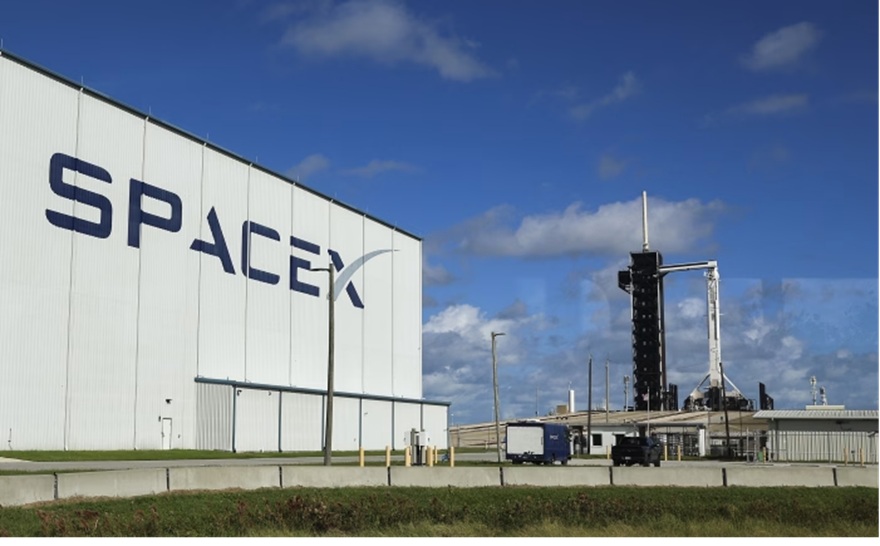
SpaceX is no longer positioning Starlink only as a satellite service that fills the gaps left by terrestrial carriers. Bloomberg reported that the company is seeking access to at least 80,000 cell sites across the United States, including discussions with Crown Castle, as it assembles the infrastructure required for a nationwide wireless network. The number is striking because 80,000 sites would be roughly half of the 158,500 purpose-built cell towers operating in the United States last year, according to figures cited by Reuters from the Wireless Infrastructure Association.
The market reaction was immediate: AT&T, Verizon and T-Mobile fell roughly 4% to 5% in premarket trading, while tower operators moved higher. That reaction is understandable, but the more important issue is strategic. SpaceX is combining satellite coverage, newly acquired low-band spectrum and a terrestrial layer that can be concentrated where capacity is needed. That is much closer to a fourth-carrier architecture than the earlier model of Starlink simply extending existing carriers’ coverage.
The 80,000-Site Number Changes the Nature of the Threat
SpaceX’s reported target is not a small infill network. It is national-scale infrastructure. Crown Castle operates approximately 40,000 U.S. cell towers, while American Tower has roughly 42,000 U.S. sites and Vertical Bridge about 18,000. The comparison is not a market-share calculation because portfolios and site definitions differ, but it gives the target useful scale: SpaceX is reportedly seeking an access footprint about twice the domestic tower count of either Crown Castle or American Tower.
That matters because satellite coverage and terrestrial capacity solve different problems. A satellite can cover a huge geographic area, but capacity is finite and varies with spectrum, satellite density and demand. A mass-market wireless service needs enough ground infrastructure in cities, along highways and in dense traffic corridors to deliver consistent capacity. The reported 80,000-site effort suggests SpaceX understands that distinction.
Spectrum Was the Missing Piece — and SpaceX Has Started Buying It
The tower negotiations follow SpaceX’s agreement to acquire a nationwide low-band spectrum portfolio from Grain Management. Reuters reported a transaction value of about $8 billion, although the terms were not officially disclosed and regulatory approval remains necessary. Low-band frequencies are valuable for broad mobile coverage because they travel farther and penetrate buildings and vegetation more effectively than higher-frequency spectrum.
That acquisition changes the Starlink proposition. SpaceX already operates a direct-to-cell system that connects ordinary phones through satellite infrastructure, largely in cooperation with mobile operators. The new strategy is more ambitious: control spectrum, deploy satellites optimized for mobile service and add enough terrestrial capacity to compete directly for subscribers. The FCC has explicitly said SpaceX’s D2D spectrum plans could increase competition in the U.S. mobile wireless market.
The Satellite Layer Is Already Much Further Along
SpaceX is not starting this mobile project from an empty infrastructure base. Its published materials say more than 650 Direct-to-Cell satellites were deployed by the middle of 2025, with commercial service already operating through mobile-network partners. Starlink’s current Mobile materials describe 650 launched satellite-to-mobile satellites and say the service supports data, voice, video and messaging across six continents, with access potentially reaching more than 1.7 billion people.
The architecture is important. SpaceX says Direct-to-Cell satellites carry an eNodeB modem that effectively functions as a cellphone tower in space and can connect to existing LTE devices. That makes the terrestrial network complementary rather than redundant: satellites provide coverage and resilience, while ground sites can supply additional capacity where subscriber density makes orbital capacity less efficient.
Why the Incumbent Carriers Sold the News
The immediate decline in AT&T, Verizon and T-Mobile shares reflects a threat to wireless economics rather than an expectation that SpaceX will suddenly take millions of customers. The incumbents have spent decades building nationwide networks and monetizing recurring wireless revenue. Their advantage is density: radios, backhaul, fiber, retail distribution and established customer relationships are already in place.
SpaceX attacks that structure differently. It can use satellites to cover areas that would not justify dense terrestrial infrastructure, then add ground capacity selectively. If that combination works, SpaceX may not need to reproduce every incumbent tower. It needs enough sites to make its spectrum useful in the places where satellite capacity becomes constrained. That could be a more efficient entry route than constructing a conventional fourth carrier entirely from scratch.
The Tower Companies Could Be the Quiet Winners
The irony is that the companies selling infrastructure to carriers may benefit from SpaceX becoming a competitor to those carriers. Crown Castle shares rose sharply after the report, while American Tower and other tower operators also gained. If SpaceX leases existing infrastructure instead of building tens of thousands of structures itself, the new entrant becomes another anchor tenant for an industry built around shared sites.
That could change the tenant mix of the tower business. AT&T, Verizon and T-Mobile have historically supplied much of the demand for U.S. tower infrastructure. A fourth national carrier would add another source of long-term lease revenue, particularly if SpaceX proceeds with anything close to the reported target.
The $80 Billion Question Is More Important Than the 80,000-Site Headline
TD Cowen has estimated that a nationwide terrestrial network could cost more than $80 billion and require years of investment. Leasing existing towers would be considerably less capital-intensive than constructing 80,000 new structures, but radios, antennas, spectrum integration, backhaul, power, software and maintenance still have to be financed. SpaceX therefore has to prove that its satellite economics can support a terrestrial network rather than simply using satellites to avoid one.
The company is simultaneously funding Starship, the next-generation Starlink constellation, AI infrastructure and other projects. The reported site target should therefore be read as evidence of strategic commitment, not as proof that $80 billion of network investment has already been approved. The commercial terms, number of leases actually signed and deployment schedule will tell investors far more.
What Could Stop SpaceX From Becoming a Fourth Carrier?
Capacity is the first constraint. Satellite coverage is powerful, but capacity per square kilometer in a dense urban environment is fundamentally different from broad rural coverage. SpaceX will need to identify where terrestrial sites provide the greatest incremental value and how much traffic can remain on the satellite layer without degrading the customer experience.
Regulation and deployment are another hurdle. Spectrum transactions require FCC approval, while terrestrial rollout brings zoning, permitting, interconnection and local infrastructure issues. SpaceX also needs a retail proposition that can compete with carrier bundles, device financing and established customer relationships. Technology can be impressive without automatically producing a profitable wireless business.
The Market Is Pricing an Option, Not a Finished Network
For AT&T, Verizon and T-Mobile shareholders, the rational interpretation is that the probability of a credible fourth national competitor has increased. SpaceX still has to secure sites, deploy equipment, integrate spectrum, finance the rollout and demonstrate that customers will pay for the service at attractive margins.
For SpaceX, however, the sequence is becoming unusually coherent. The company has a working satellite-to-phone system, regulatory authorization for a much larger constellation, additional spectrum in the pipeline and now reported plans for tens of thousands of terrestrial sites. If the 80,000-site target becomes signed leases and deployment schedules, Starlink Mobile will have to be treated as a genuine fourth-carrier threat rather than a satellite coverage product.

Chart 1. Reported SpaceX target compared with major U.S. tower portfolios. Original source: Crown Castle | Reuters

Chart 2. The reported 80,000-site target compared with the remaining U.S. purpose-built tower count cited by Reuters. Original source: Reuters

Chart 3. Direct-to-cell satellite milestones based on SpaceX’s published materials. Original source: SpaceX Direct to Cell | Starlink Mobile
Primary Sources And Original Visualization Links
• Reuters — SpaceX seeks access to 80,000 U.S. cell sites
• Reuters — SpaceX low-band spectrum acquisition
• FCC — SpaceX Gen2 Starlink authorization
• FCC — SpaceX D2D spectrum and competition
• Crown Castle — U.S. tower portfolio

Johan Shamshad is a financial markets writer at Dave Finances covering cryptocurrencies, trading platforms, brokers, fintech, financial regulation, and developments across global markets. He previously worked at Gulf News, adding newsroom experience to his coverage of fast-moving financial and digital-asset markets.
His work focuses on identifying market-moving events, company developments, regulatory changes, product launches, and shifts in trading and financial infrastructure.
Johan contributes news and analysis designed to help readers understand not only what happened, but why a development matters and how it may affect the wider financial landscape. You can reach out to him via his social media accounts:
Linkedin: https://www.linkedin.com/in/johan-shamshad-742851262/
X: https://x.com/Yasmine_FX
Investing: https://www.investing.com/members/contributors/279781574