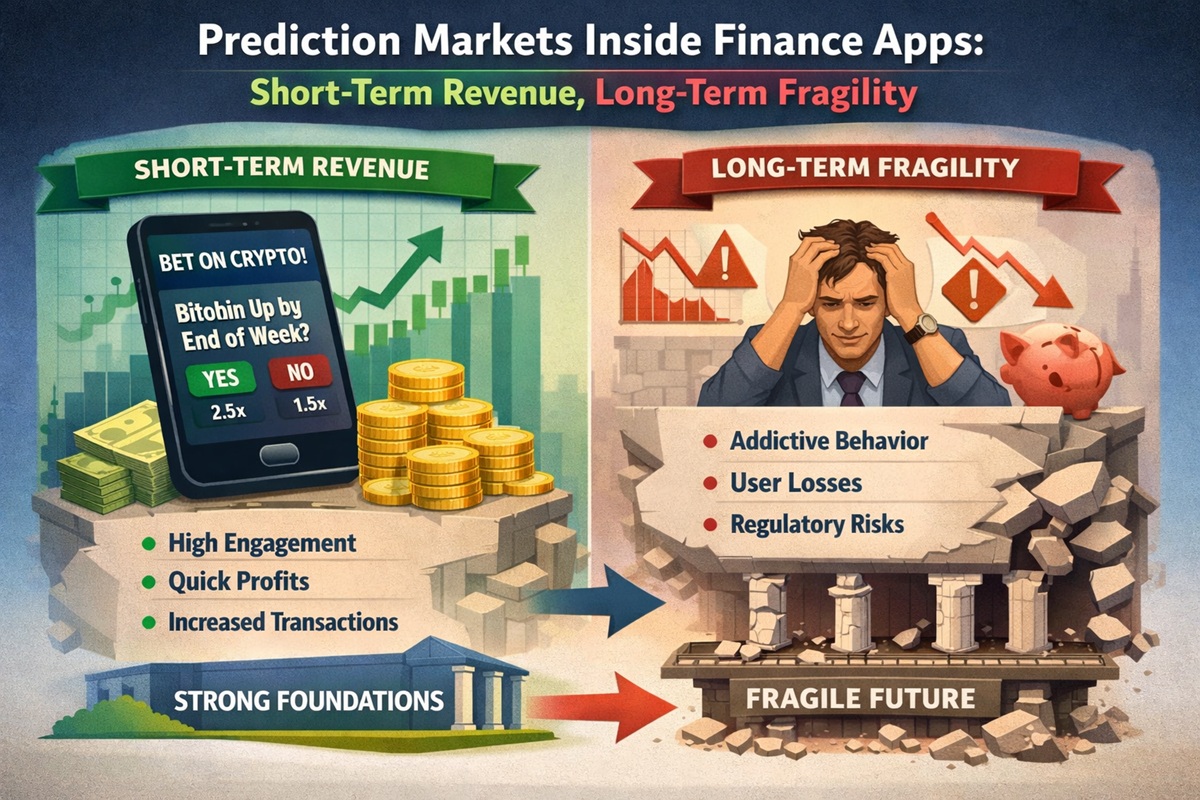
Prediction markets have crossed a threshold that few expected this quickly. In 2025, they stopped being experimental trading venues and became a mainstream financial product processing tens of billions of dollars in volume. What began as niche platforms pricing political outcomes has expanded into a multi-vertical market covering sports, monetary policy, macroeconomics, technology, climate, and popular culture.
At the center of this shift sit two dominant players — Kalshi and Polymarket — whose combined volumes now rival mid-sized derivatives exchanges. Yet just as prediction markets are consolidating their role in finance and media, competition is intensifying, regulatory scrutiny is sharpening, and the question of trust is emerging as the industry’s defining fault line.
The next phase of growth will not be decided by who launches the most markets or processes the most trades, but by which platforms can convince users, regulators, and institutions that outcomes are transparent, manipulation-resistant, and credibly settled.
From Election Curiosity to Financial Infrastructure
Prediction markets have existed for decades, but crypto provided the rails that allowed them to scale. Continuous trading, global access, and programmable settlement turned what were once academic experiments into live financial systems.
The 2024 US election was the inflection point. During that cycle, prediction markets consistently outperformed polls in forecasting outcomes, drawing attention from journalists, analysts, and institutional observers. That credibility carried over into 2025, when markets expanded aggressively beyond politics.
Sports contracts became the dominant growth driver. Betting on NFL games, championships, and player outcomes introduced a broader retail audience and dramatically increased transaction frequency. At the same time, contracts tied to Federal Reserve decisions, inflation prints, and economic indicators attracted macro-focused traders looking for more precise expressions of probability than traditional markets could offer.
By late 2025, prediction markets were no longer peripheral. They had become tools for price discovery, engines of engagement, and increasingly, inputs into real-world decision-making.
The Kalshi–Polymarket Duopoly
Despite the surge of interest, market power remains concentrated. Kalshi and Polymarket have formed a de facto duopoly that generated more than $44 billion in trading volume in 2025, with monthly volumes exceeding $10 billion in November alone.
According to data from The Block, the two platforms processed over $6 billion in December, pushing cumulative annual volume past $28 billion by Dec. 23.
Their dominance rests on different but complementary strengths.
Kalshi operates as a regulated US exchange, benefiting from formal approval by the Commodity Futures Trading Commission after a pivotal legal victory in May 2025. That ruling granted regulatory recognition to event contracts and provided a legal foundation for offering prediction markets to US retail participants through compliant channels.
Polymarket, by contrast, has thrived as a crypto-native platform, leveraging onchain settlement, global access, and deep liquidity to become the most visible prediction market brand worldwide. Its CEO, Shayne Coplan, has framed prediction markets as humanity’s most accurate forecasting tool — a claim that resonates in an era of declining trust in polls and punditry.
Together, the two platforms have embedded themselves into finance, media, and public discourse through partnerships with major broadcasters, data providers, and institutional backers.
Partnerships Change the Stakes
Prediction markets’ transformation from speculative novelty to infrastructure has been accelerated by strategic partnerships.
Kalshi’s exclusive data relationships with outlets like CNN and CNBC have pushed event probabilities into mainstream media workflows. Odds are no longer confined to trading dashboards; they now appear alongside traditional analysis, subtly reshaping how audiences interpret uncertainty.
Polymarket’s institutional backing, including reported investment from the Intercontinental Exchange, has further blurred the line between crypto-native experimentation and traditional market infrastructure. Capital from established exchange operators does more than fund growth; it signals confidence that prediction markets may become a durable component of the financial system.
As Axis co-founder Jimmy Xue argues, these developments have repositioned prediction markets as “dual pillars” of finance and media — simultaneously venues for trading and lenses through which reality is interpreted.
Why Volume Alone Is No Longer Enough
Rapid growth has attracted competitors, but it has also exposed a key vulnerability. As markets scale, credibility becomes more important than velocity.
In early-stage platforms, users tolerate ambiguity. At scale, ambiguity becomes unacceptable. Prediction markets are uniquely sensitive to trust because their value depends entirely on belief in the integrity of outcomes.
If users doubt that:
-
Outcomes are resolved objectively
-
Settlement rules are applied consistently
-
Manipulation is detected and punished
then probability prices lose meaning. Once credibility erodes, liquidity follows.
This is why criticism of opaque resolution processes — including past controversies around certain Polymarket contracts — carries disproportionate weight. In a probability market, even isolated doubts can contaminate the entire price signal.
As Nexus Labs CEO Daniel Marin notes, competition alone will not drive progress if new entrants merely replicate existing models with better interfaces. The differentiator will be whether platforms allow users to verify outcomes and settlements independently, rather than relying on opaque governance decisions.
Challengers Enter the Arena
While Kalshi and Polymarket were busy expanding partnerships, a wave of challengers moved to break the duopoly — not by copying it outright, but by embedding prediction markets into broader ecosystems.
Crypto.com launched a prediction market platform in partnership with Fanatics, initially focusing on sports, finance, and politics. Its roadmap extends far beyond those categories, with planned contracts tied to crypto, equities, climate, AI, and pop culture.
The strategy is clear: prediction markets are not the product, but a feature — one component inside a larger financial super-app.
Gemini followed a different route, securing CFTC approval to operate a Designated Contract Market. Its forthcoming platform, Gemini Titan, positions prediction markets squarely within a regulated US framework, targeting users who value compliance and traditional brokerage access.
Perhaps the most disruptive entrant is DraftKings. By launching a standalone prediction markets app available nationwide — including in states where sports betting is restricted — DraftKings has exploited regulatory distinctions between event contracts and gambling. CEO Jason Robins has framed prediction markets as an expansion of total addressable market rather than a replacement for sportsbooks.
Together, these moves signal that prediction markets are no longer a standalone category. They are becoming modular, bundled into platforms with existing distribution power.
Distribution vs. Regulation
This shift has profound implications for competition.
In the early phase, regulatory approval acted as a moat. Kalshi’s CFTC recognition and Polymarket’s crypto-native reach limited serious challengers. Today, distribution is emerging as the dominant factor.
As RedStone co-founder Marcin Kazmierczak notes, embedding prediction markets into exchanges, wallets, and consumer apps could siphon casual retail flow away from dedicated platforms. Users who encounter prediction contracts alongside trading, payments, or sports engagement may never seek out standalone venues.
Axis co-founder Xue argues this dynamic effectively ends the duopoly by shifting competition from regulatory capture to audience reach. In other words, being compliant is no longer enough; platforms must be present where users already spend time.
The Regulatory Shadow Still Looms
Despite momentum, regulatory risk remains unresolved.
While event contracts have received CFTC approval at the federal level, several US states have taken enforcement actions against platforms they view as facilitating illegal gambling, particularly in sports-related markets.
This tension reflects a broader uncertainty around classification. Are prediction markets financial instruments, information tools, or gambling products? The answer varies by jurisdiction — and often by political climate.
If the narrative shifts toward “hyper-gambling,” as Kazmierczak warns, platforms could face backlash aimed at consumer protection. Such scrutiny would not necessarily halt growth, but it could fragment the market along regulatory lines, favoring well-capitalized players with legal resources.
Why Trust Is the Real Moat
As prediction markets expand, their success increasingly depends on whether users believe prices reflect reality rather than platform incentives.
Trust is built through:
-
Transparent settlement methodologies
-
Clear governance structures
-
Independent data sources
-
Auditability of outcomes
Platforms that fail on these dimensions may still grow in volume during speculative booms, but they will struggle to become lasting infrastructure.
This is especially relevant as prediction markets aspire to replace traditional polling and forecasting. Economists, strategists, and institutional analysts will not rely on probability data unless they are confident in its integrity.
In that sense, credibility is not a branding exercise. It is the product.
Beyond Finance: The Attention Economy
Prediction markets are increasingly described not just as financial products, but as engines of the attention economy. They convert passive consumption into active participation by attaching financial stakes to beliefs.
Instead of reading news, users trade on it. Instead of reacting to narratives, they price them.
This transformation explains why media companies, data providers, and analysts are paying attention. Prediction markets offer real-time signals that update continuously, rather than static forecasts.
As Xue argues, they may fundamentally change how society processes information, turning truth-seeking into an incentivized activity. That promise, however, depends entirely on whether markets are trusted to reflect honest probabilities rather than distorted incentives.
The Road Ahead
Prediction markets are no longer proving they can scale. They already have. The challenge now is proving they can govern themselves at scale.
The next winners will not necessarily be the platforms with the highest volume or the flashiest interfaces. They will be the ones that:
-
Earn institutional trust
-
Survive regulatory scrutiny
-
Resolve outcomes transparently
-
Balance growth with credibility
Kalshi and Polymarket still hold powerful positions, but the ground beneath them is shifting. Challengers with superior distribution, clearer governance, or stronger compliance frameworks are closing in.
In 2026, the prediction market race will be less about who can attract traders — and more about who can convince the world that their probabilities deserve to be believed.

Michael Lebowitz is a financial markets analyst and digital finance writer specializing in cryptocurrencies, blockchain ecosystems, prediction markets, and emerging fintech platforms. He began his career as a forex and equities trader, developing a deep understanding of market dynamics, risk cycles, and capital flows across traditional financial markets.
In 2013, Michael transitioned his focus to cryptocurrencies, recognizing early the structural similarities—and critical differences—between legacy markets and blockchain-based financial systems. Since then, his work has concentrated on crypto-native market behavior, including memecoin cycles, on-chain activity, liquidity mechanics, and the role of prediction markets in pricing political, economic, and technological outcomes.
Alongside digital assets, Michael continues to follow developments in online trading and financial technology, particularly where traditional market infrastructure intersects with decentralized systems. His analysis emphasizes incentive design, trader psychology, and market structure rather than short-term price action, helping readers better understand how speculative narratives form, evolve, and unwind in fast-moving crypto markets.