
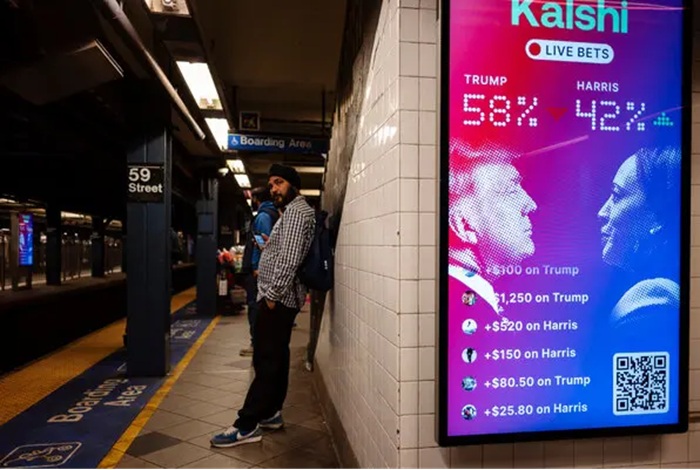
The Commodity Futures Trading Commission has ordered former White House teleprompter operator Gabriel Perez to surrender more than $107,000 in trading profits and pay a $65,000 penalty after finding that he used advance access to President Donald Trump’s speeches to trade prediction-market contracts on Kalshi.
The Aug. 28 settlement requires Perez to disgorge $107,539.02 and pay a $65,000 civil monetary penalty, bringing the total financial sanctions to $172,539.02. He is also barred for three years from trading on or subject to the rules of any CFTC-registered entity and must cease and desist from further violations. Perez consented to the order without admitting its findings or legal conclusions.
Perez worked as a technical adviser to Trump and operated the president’s teleprompter at public appearances. The CFTC said he routinely received prepared speeches before they were delivered and generally had access to the text about an hour before Trump spoke publicly.
That advantage became directly tradeable because Kalshi offered “mention markets” allowing customers to take Yes or No positions on whether Trump would use particular words or phrases during specified appearances.
Perez opened his Kalshi account on Dec. 8, 2025, and began trading Trump-related mention markets the following day. During the period covered by the CFTC order, which ran from December 2025 through March 2026, his activity was concentrated almost entirely in sports and Trump mention markets.
The regulator said Perez traded across 14 Trump mention markets and made profitable trades on 39 of the 43 contracts he bought.
His approach was unusually direct. According to the order, Perez would read Trump’s prepared speech and buy a Yes contract when the targeted word appeared in the text or take a No position when it did not. In one case, Perez changed his position after observing that Trump had deviated from or skipped the section of prepared remarks containing a word on which he had traded.
The markets covered speeches including Trump’s remarks in Pennsylvania and North Carolina, an address to the nation, appearances at the Detroit Economic Club and World Economic Forum, the National Prayer Breakfast and markets linked to the State of the Union.
The CFTC found that the prepared speeches constituted material nonpublic government information and that Perez breached duties of trust and confidentiality by using the information for his own financial benefit. Executive Branch ethics standards independently prohibit federal employees from using nonpublic government information in financial transactions or for private interests.
The case also provides one of the clearest examples yet of how the CFTC intends to apply conventional insider-trading principles to prediction markets.
The Commission classified the contracts Perez traded as swaps under the Commodity Exchange Act and applied the misappropriation theory of insider trading under Section 6(c)(1) and Regulation 180.1. It also charged violations of provisions that specifically restrict federal employees from using nonpublic information obtained through their positions to trade covered derivatives.
Kalshi Flagged the Trading
Kalshi played a central role in uncovering the activity.
The CFTC formally credited KalshiEX for assisting its investigation. Kalshi had previously said its surveillance systems detected trading that did not fit normal patterns, after which the exchange investigated, froze Perez’s account and referred the matter to the regulator. More than $90,000 in profits were frozen at the platform, according to Kalshi.
Perez subsequently cooperated extensively with investigators. The CFTC said he voluntarily sat for an interview almost immediately after being contacted, supplied documents, acknowledged that he reviewed speeches before trading and accepted responsibility for his conduct.
That cooperation materially reduced the penalty.
Under a CFTC cooperation policy adopted in May, Perez received an approximately 40% reduction in the civil monetary penalty, exceeding the policy’s normal 25% ceiling absent extraordinary circumstances. The regulator described his cooperation as extraordinary.
The $65,000 penalty itself will also be paid partly over time, although the $107,539.02 in disgorgement was ordered due within 10 days.
Second Prediction-Market Settlement in Four Weeks
The Perez settlement arrives only four weeks after the CFTC resolved another unusual Kalshi case involving former Rep. George Santos.
On July 31, Santos agreed to disgorge $17,569.98 and pay a $17,500 penalty after the regulator found that he traded a Kalshi contract on whether he would attend the 2026 State of the Union while making misleading social-media statements about his own attendance. He also received a three-year trading ban.
The theories were different. Santos was accused of manipulating a market whose outcome he could influence, while Perez was charged with trading using confidential information he received through government employment.
Perez is also the second major CFTC case this year involving a federal employee allegedly exploiting government information in prediction markets.
In April, the regulator sued active-duty U.S. Army service member Gannon Ken Van Dyke, alleging he used classified information connected to the operation to capture former Venezuelan President Nicolás Maduro to make more than $404,000 trading related Polymarket contracts. That case remains an allegation rather than a settled finding.
Corporate information has created similar problems. Federal prosecutors and the CFTC charged Google software engineer Michele Spagnuolo in May, alleging that he used confidential Google search data to earn approximately $1.2 million trading Year in Search contracts on Polymarket.
Congress has taken notice. House Oversight Committee Chairman James Comer opened an investigation in May into insider-trading controls at Kalshi and Polymarket, requesting information on identity verification, geographic restrictions and systems for identifying suspicious trading.
The CFTC itself is simultaneously rewriting the broader rules around prediction markets. Its March rulemaking request explicitly asked how markets should deal with nonpublic information held by federal employees, while a June proposal sought a clearer framework for evaluating event contracts involving areas such as gaming, war and other statutorily sensitive subjects.
Analysis: Prediction Markets Have Created a New Kind of Insider
The Perez case looks almost comically simple compared with conventional insider trading.
There were no leaked earnings forecasts, secret merger documents or complicated options trades. Perez allegedly knew what words were written on a piece of paper and found a market where knowing those words had an immediate dollar value.
That simplicity is exactly why the case matters.
Prediction markets can turn information that previously had little direct financial value into tradable information overnight. A speechwriter, sports employee, awards-show producer, technology worker or political operative may suddenly possess something equivalent to an earnings leak because somebody has created a contract whose payout depends on precisely what that person knows.
The CFTC’s response shows that regulators are not treating this as a legal vacuum.
The Perez order takes existing commodities law and applies a familiar misappropriation theory: a person has confidential information because of a relationship of trust, breaches that duty by using it for personal benefit and trades a regulated product connected to that information.
Importantly, this is a consent order, not a court decision establishing binding precedent. But it gives exchanges and traders a remarkably clear picture of the CFTC’s enforcement position.
That could matter more than the $65,000 fine.
Prediction markets sell themselves partly on their ability to aggregate dispersed knowledge. The difficult question is where superior research ends and unfair informational advantage begins.
Someone who studies hundreds of Trump speeches and predicts that he is likely to mention “tariffs” has done exactly what a functioning prediction market is supposed to reward. Someone who reads tomorrow’s speech inside the White House before buying the same contract is operating on a fundamentally different informational plane.
Markets need that distinction to remain credible.
There is another reason the Perez case is important for Kalshi. The exchange can point to the episode as evidence that its surveillance worked: abnormal activity was detected, the account was investigated, funds were frozen and the case was referred to regulators.
That matters as prediction-market operators argue that they should be treated as regulated financial exchanges rather than gambling companies.
But effective detection after profitable insider trading occurs is not the same as preventing it.
Mention markets are almost designed to attract information asymmetries. The relevant fact may be known with certainty to dozens of people — speechwriters, producers, executives or event organizers — while everyone else is estimating probabilities.
As market volume rises, the financial incentive to exploit that gap rises with it.
The CFTC anticipated this issue before settling Perez’s case. Its March prediction-market consultation specifically highlighted existing restrictions on federal employees using nonpublic government information and asked how those rules should shape prediction-market regulation.
Perez has now supplied a real-world answer.
The next stage is likely to involve more than prosecuting individual traders. Exchanges may face increasing pressure to identify employment relationships, restrict certain insiders from particular markets and combine identity information with behavioral surveillance before suspicious profits can leave the platform.
Prediction markets have become large enough to create an entirely new universe of financially valuable inside information. The Perez settlement shows that the enforcement framework is starting to catch up.