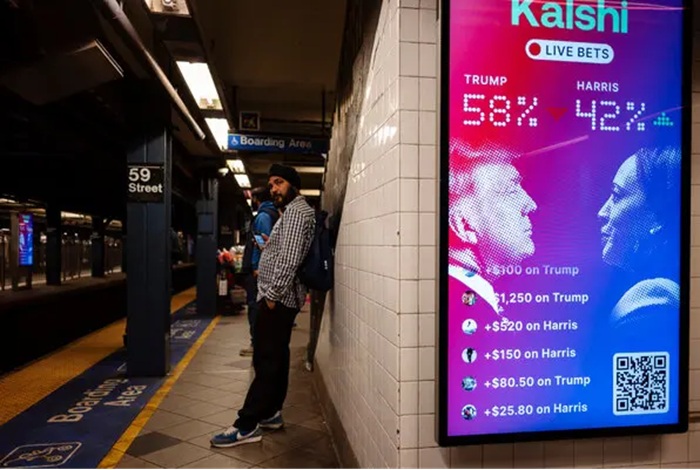
Federal-State Fight Over Prediction Markets Escalates as CFTC Orders Kalshi to Honor Michigan Trades
The legal battle over prediction markets in the United States entered a new phase after the Commodity Futures Trading Commission (CFTC) ordered Kalshi to honor trades involving Michigan residents, directly challenging a state court order that required the company to unwind those positions.
The move highlights the increasingly contentious jurisdictional dispute between federal regulators and state governments over whether prediction markets should be treated as federally regulated derivatives or as forms of online gambling subject to state law.
The CFTC exercised its emergency authority to block Kalshi from implementing an emergency rule change that would have canceled previously executed trades involving Michigan users. At the same time, the agency ordered the company to fulfill those trades under its normal operating procedures, arguing that federal law requires designated contract markets (DCMs) to provide nondiscriminatory access to participants nationwide.
“A state cannot force a DCM to violate its obligations, and federal law does not permit a DCM to discriminate against a state’s residents,” CFTC Chairman Michael Selig said in a statement.
The dispute stems from a Michigan court order issued roughly two weeks earlier that directed Kalshi to stop offering sports-related event contracts within the state and unwind certain existing positions. Michigan regulators have argued that Kalshi’s sports event contracts constitute unlicensed internet gambling under state law, rather than federally regulated derivatives.
Michigan Attorney General Dana Nessel previously defended the state’s enforcement action, saying gambling laws exist to protect residents from unlicensed and predatory operators and that violations carry significant legal consequences.
The CFTC sharply rejected that position.
“The Commission will not allow states or state courts to bully registered entities into violating the Commodity Exchange Act and CFTC regulations,” Selig said.
According to the regulator, Michigan is the first state to attempt to interfere directly with trades that have already been executed on a federally regulated designated contract market. The agency warned that forcing exchanges to reverse completed transactions could undermine confidence in derivatives markets by introducing uncertainty over whether legally executed contracts remain enforceable.
The Michigan dispute represents only one front in a rapidly expanding legal campaign.
The CFTC said it has already filed lawsuits against Arizona, Connecticut, Illinois, Kentucky, Minnesota, New Mexico, New York, Rhode Island and Wisconsin in an effort to defend what it argues is Congress’s grant of exclusive federal jurisdiction over event contracts traded on registered exchanges. The agency has also filed amicus briefs in multiple appellate courts to support the same legal position.
States have largely taken the opposite view.
Several attorneys general and gaming regulators argue that sports-event prediction contracts function as sports betting products regardless of how they are structured, allowing companies to bypass state licensing requirements, responsible gambling rules and tax regimes.
That disagreement has produced conflicting court rulings across the country.
Earlier this month, a federal judge in New York denied Kalshi’s request to block the state from enforcing its gambling laws, concluding that federal commodities law did not automatically preempt New York’s gaming regulations in that case. Kalshi has appealed the decision.
The CFTC nevertheless continues to argue that event contracts listed on federally regulated exchanges fall squarely within the Commodity Exchange Act and therefore cannot be subjected to a patchwork of state-level enforcement actions.
The dispute has become one of the defining regulatory battles surrounding prediction markets, an industry that has grown rapidly over the past two years by allowing users to trade contracts tied to elections, economic indicators, sporting events and other real-world outcomes.
Supporters argue these markets improve price discovery and aggregate information more efficiently than traditional polling or forecasting methods.
Critics contend that many sports-related contracts differ little from conventional sports betting and should therefore remain under state gambling oversight.
The outcome of the growing legal conflict could determine not only Kalshi’s future operations but also the regulatory framework governing prediction markets across the United States.
Prediction Markets Have Become a Federalism Battle—And Kalshi Is Just the First Casualty
Most people think this fight is about sports betting.
It isn’t.
Sports contracts are just the trigger. The real fight is about who gets to regulate an entirely new financial product.
That’s why the CFTC stepped in so aggressively.
When I read the agency’s statement, one sentence stood out immediately. It wasn’t the criticism of Michigan. It was the argument that canceling already executed trades threatens “certainty in contracting.”
That isn’t gambling language.
That’s derivatives language.
And that’s exactly how the CFTC wants this debate framed.
Forget Kalshi for a minute.
Imagine buying a Treasury futures contract, an oil future or an interest-rate swap, only to have one state decide two weeks later that every trade executed within its borders must be canceled.
Markets don’t work that way.
Settlement certainty is one of the foundations of every derivatives market on Earth.
Once you start questioning whether completed trades remain valid depending on where the customer lives, the market stops functioning as a national market.
That’s the principle the CFTC is trying to defend.
States see something completely different.
From their perspective, people aren’t hedging commodity risk.
They’re betting on baseball games.
That’s a difficult political argument to lose.
Walk into a state legislature and ask whether contracts tied to sports scores look more like CME futures or DraftKings wagers.
You already know the answer.
That’s why attorneys general keep describing these products as unauthorized gambling instead of innovative financial instruments.
Both sides are looking at exactly the same contracts.
They’re just wearing different regulatory glasses.
One sees derivatives.
The other sees sportsbooks without licenses.
Neither side is willing to blink.
What makes this case especially interesting is the CFTC’s strategy.
Normally, federal regulators defend their authority after enforcement actions arrive.
Here, the agency has gone on offense.
Arizona.
Illinois.
Connecticut.
New York.
Wisconsin.
New Mexico.
Kentucky.
Rhode Island.
Minnesota.
Now Michigan.
Instead of waiting for prediction markets to sue states individually, the federal regulator is suing states itself.
That’s unusual.
It tells me this isn’t simply about Kalshi surviving another cease-and-desist order.
The agency is trying to establish precedent before fifty different regulatory regimes emerge.
Because that’s the nightmare scenario.
Imagine prediction markets legal in 31 states.
Restricted in eight.
Partially available in six.
Election contracts allowed here.
Sports contracts banned there.
Weather contracts legal somewhere else.
Developers couldn’t build around that.
Liquidity would fragment overnight.
Prediction markets depend on national liquidity.
The more traders participate in one contract, the better the pricing becomes.
Split those traders across state-by-state markets and everyone loses efficiency.
That’s why the CFTC keeps emphasizing “uniform national markets.”
It’s protecting liquidity as much as jurisdiction.
There’s another layer that doesn’t get enough attention.
Tax revenue.
States have spent years building regulated sports betting ecosystems.
Licensing fees.
Operator taxes.
Responsible gambling programs.
Consumer protections.
Prediction markets threaten that model.
If someone can trade a federally regulated sports event contract instead of placing a sportsbook wager, states potentially lose both tax income and regulatory control.
That’s a powerful incentive to keep fighting.
I don’t think this battle stays confined to Kalshi.
Not even close.
Every company operating event contracts is watching these cases.
Robinhood’s prediction market initiatives.
Crypto-native platforms exploring regulated event trading.
Traditional exchanges considering similar products.
They’re all waiting for someone else to establish the legal boundaries.
And eventually somebody will.
Probably not next month.
Probably not this year.
But these lawsuits are stacking up too quickly to avoid appellate courts.
Honestly, I’d be surprised if the Supreme Court never sees some version of this dispute.
The legal question is too fundamental.
Can Congress give one federal agency exclusive authority over products that states believe are gambling?
That’s bigger than prediction markets.
That’s a federalism question.
The timing also matters.
Prediction markets aren’t niche anymore.
Election contracts attracted enormous attention.
Economic contracts are becoming more common.
Sports contracts have exploded in popularity.
Once meaningful money starts flowing through a new market, regulators stop treating it like an experiment.
They start drawing borders.
That’s exactly what’s happening now.
The irony is that both sides claim they’re protecting consumers.
Michigan says it’s protecting residents from unlicensed gambling.
The CFTC says it’s protecting market participants from fragmented regulation and canceled trades.
Neither argument is obviously wrong.
They’re simply incompatible.
If I had to guess where this ends, I don’t think either side gets everything it wants.
Sports contracts will probably face tighter scrutiny than macroeconomic or financial event contracts.
Congress could eventually be forced to clarify exactly where prediction markets stop being derivatives and start becoming gambling products.
Right now, that line barely exists.
And markets hate blurry lines.
For Kalshi, today’s order is a short-term win.
For the prediction market industry, it’s something much bigger.
It’s another reminder that the most important contracts being traded today aren’t on sports games or elections.
They’re the legal arguments that will determine whether this entire industry grows under one federal rulebook—or fifty different state ones.

Shane Neagle is a financial markets analyst and digital assets journalist specializing in cryptocurrencies, memecoins, prediction markets, and blockchain-based financial systems. His work focuses on market structure, incentive design, liquidity dynamics, and how speculative behavior emerges across decentralized platforms.
He closely covers emerging crypto narratives, including memecoin ecosystems, on-chain activity, and the role of prediction markets in pricing political, economic, and technological outcomes. His analysis examines how capital flows, trader psychology, and platform design interact to create rapid market cycles across Web3 environments.
Alongside digital assets, Shane follows broader fintech and online trading developments, particularly where traditional financial infrastructure intersects with blockchain technology. His research-driven approach emphasizes understanding why markets behave the way they do, rather than short-term price movements, helping readers navigate fast-evolving crypto and speculative markets with clearer context.