
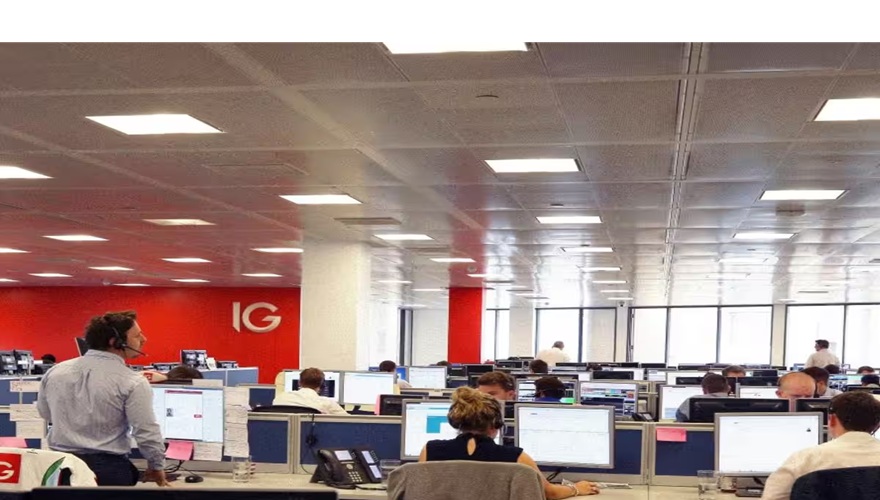
IG Group has cut its 2026 revenue-growth outlook after weaker-than-expected returns from its core over-the-counter derivatives business overshadowed continued double-digit customer growth, sending the trading company’s shares sharply lower in London.
IG expects total revenue of approximately £240 million for the three months ended September 30, down around 14% from £280.1 million a year earlier, according to the company’s October 2 trading update.
Net trading revenue is expected to decline to roughly £210 million from £249.5 million in the same quarter of 2025.
The problem was concentrated in IG’s OTC derivatives operation, where revenue retention fell to approximately 70%. That compares with an average of around 80% since IG introduced market-making optimisation measures during the second half of 2025.
The deterioration was significant enough for management to lower its full-year outlook. IG now expects 2026 Group total revenue to grow at a mid-single-digit percentage rate year over year.
IG had previously reiterated guidance in July for 10% to 15% organic total revenue growth from a 2025 base of roughly £1.1 billion, excluding Freetrade and Independent Reserve. The definitions are therefore not perfectly comparable, but the October update nevertheless represents a clear reduction in management’s revenue expectations.
IG Added Customers but Made Less From Their Trading Activity
The most interesting part of the update is that the weaker revenue was not caused by collapsing customer acquisition.
Organic first trades increased by more than 25% year over year during the third quarter, while organic active customers rose approximately 17%.
OTC customer income also increased by around 8%. Yet OTC net trading revenue fell approximately 18% to £155 million.
That gap points directly at revenue retention.
IG’s recent market-making changes were designed to allow the company to retain more customer income rather than hedge as much exposure externally. The strategy had helped lift retention to around 80% on average since the changes were introduced.
During the third quarter, however, only around 70% was retained as revenue.
IG said the quarter reflected “less supportive market conditions” and warned that the optimisation strategy can produce greater short-term variability even though the board continues to believe it should structurally improve retention over the medium to long term.
The result creates an unusual picture: more customers entered the platform, more customers were active and OTC customer income increased, but significantly less of that activity ultimately converted into reported trading revenue.
The Revenue Warning Comes After IG Spent Heavily on Acquisition
That distinction is particularly important because IG has been deliberately spending more to expand its customer base.
Advertising and marketing expenditure reached £75.4 million during the first half of 2026, up 51% from a year earlier. Dave Finances previously examined how IG increased marketing spending while taking a Premier League broadcast sponsorship as part of its attempt to bring a broader retail audience into the business.
The strategy has clearly produced accounts and activity.
In the first half, organic first trades rose 74%, while organic active customers increased 13%. The third-quarter figures show that acquisition momentum continued, even as revenue weakened.
That makes this update less about whether IG can find customers and more about how effectively it can monetize them.
Management has previously said customer-acquisition payback is around six months and that lifetime value is comfortably above acquisition cost. Those economics become more sensitive if revenue generated per active customer weakens for an extended period.
Underdog Grew Rapidly Ahead of Its Most Important Quarter
IG also highlighted strong trading at Underdog, the U.S. prediction-markets and fantasy-sports company it agreed to acquire in July.
Underdog generated approximately $105 million of net revenue in the third quarter, more than double the amount reported a year earlier.
The fourth quarter is particularly important for the business because it accounted for more than one-third of Underdog’s revenue in 2025.
IG agreed to acquire Underdog in a transaction worth up to approximately $1.3 billion, excluding a separate performance-linked management incentive arrangement. The deal remains subject to closing conditions.
The acquisition has already become one of the biggest strategic bets in IG’s history. Dave Finances previously examined the investor concerns surrounding IG’s $1.3 billion Underdog deal, including its financing, dilution and exposure to the still-evolving U.S. prediction-market regulatory environment.
IG will hold a dedicated Underdog investor seminar on October 8 before providing a broader strategy update on October 22.
Margins Are Also Moving Lower
The revenue downgrade is not IG’s only financial pressure.
The company expects approximately £30 million of non-recurring costs during 2026 relating to its proposed redomicile to Jersey and restructuring under the organisational changes announced in July. Of that amount, £16.4 million had already been reported during the first half.
Excluding those costs and Underdog acquisition expenses that depend on completion of the transaction, IG now expects a 2026 EBITDA margin in the low-40% range.
That is below the mid-40% margin level the company had previously targeted.
IG nevertheless maintained its medium-term confidence, pointing to continued customer growth, investment in its product and brand, and an expectation that OTC revenue retention will improve over time.
The Real Problem Is Monetization, Not Demand
For investors, the most revealing number in this update is probably not the 14% decline in quarterly revenue.
It is the combination of a 25%-plus increase in first trades and a 17% increase in active customers alongside an 18% decline in OTC net trading revenue.
That is a much more complicated signal than simply saying retail traders lost interest.
They did not.
IG is attracting more customers and getting more people onto the platform. What changed is the amount of revenue the company captured from the resulting OTC activity.
That distinction matters because customer acquisition is expensive. If a broker spends aggressively to acquire traders but monetization per customer fluctuates more than expected, revenue can become less predictable even while the headline user metrics look excellent.
This is one of the central questions facing the wider retail-broker industry. Dave Finances reached a similar conclusion when analyzing Robinhood’s expansion into 24/7 trading: additional activity matters financially only to the extent that a platform can turn that engagement into durable revenue at attractive margins.
IG’s Market-Making Changes Have Increased Both Opportunity and Variability
IG’s retention strategy adds another layer.
Hedging more customer exposure externally can reduce market risk, but it also costs money and gives up some potential revenue. Internalizing more of that flow can improve economics when outcomes are favorable, but it can also make quarterly retention less predictable.
The move from an approximately 80% recent average to 70% in Q3 shows what that variability can look like in practice.
Management still believes the optimisation measures will raise retention structurally over longer periods. If that proves correct, one weak quarter could eventually look like normal volatility inside a more profitable model.
If 70% retention persists, however, the economics change.
IG would then be spending more to acquire customers while converting a smaller proportion of their trading activity into revenue. That combination would put more pressure on marketing returns, margins and the investment case for continued aggressive acquisition.
Customer Growth Gives IG Something to Work With
There is an important positive side to the update.
Fixing monetization is easier when the customer base is still growing than when both revenue and users are declining.
IG has been broadening its business beyond traditional leveraged trading through Freetrade, spot cryptocurrency, investment products, a planned unified platform and the proposed Underdog acquisition. The wider brokerage sector is following a similar playbook, with competitors increasingly trying to deepen engagement through product breadth and technology. Dave Finances recently examined how eToro is rebuilding its trading app around engagement and cross-product usage.
That diversification can eventually reduce IG’s dependence on any single source of trading revenue.
But OTC derivatives remain economically important today, which is why a 10-percentage-point drop in retention was powerful enough to force a full-year guidance reset despite strong customer metrics elsewhere.
October 22 Now Becomes Much More Important
IG’s October 22 strategy update was already significant because management is reshaping the group through a new organisational structure, a proposed Jersey parent company, greater marketing investment and the Underdog transaction.
After this revenue warning, investors now need answers to a more immediate set of questions.
How volatile should OTC retention be under the new market-making strategy? Was 70% an unusually weak quarter or a realistic level that could recur regularly? How much revenue can IG generate from each new cohort of customers? And does management still expect increased marketing spending to produce the same lifetime-value economics when retention is lower?
The strong first-trade and active-customer numbers suggest IG’s growth engine is still bringing traders through the door.
The third quarter showed that getting them through the door is only half the equation.
For the next phase of IG’s strategy to work, the company has to prove that faster customer growth can reliably become faster revenue growth too.

Johan Shamshad is a financial markets writer at Dave Finances covering cryptocurrencies, trading platforms, brokers, fintech, financial regulation, and developments across global markets. He previously worked at Gulf News, adding newsroom experience to his coverage of fast-moving financial and digital-asset markets.
His work focuses on identifying market-moving events, company developments, regulatory changes, product launches, and shifts in trading and financial infrastructure.
Johan contributes news and analysis designed to help readers understand not only what happened, but why a development matters and how it may affect the wider financial landscape.