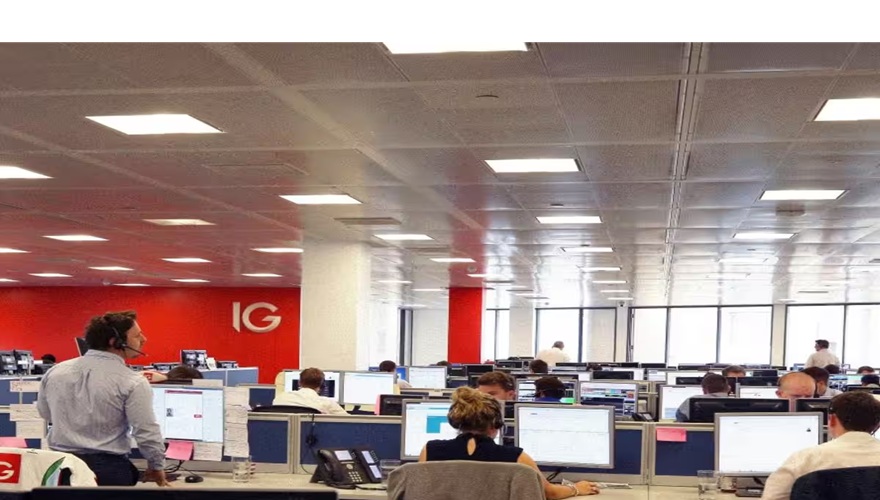
Shares Slide as Investors Question Deal Structure and Regulatory Risk
IG Group’s $1.3 billion push into U.S. prediction markets is drawing growing investor scrutiny, with the trading group’s shares falling sharply since it agreed to acquire Underdog Sports Holdings at the end of July.
Recent market analysis estimates that IG shares have dropped about 18% since the transaction was announced, suggesting investors remain unconvinced that the potential rewards from prediction markets justify the price, financing structure and regulatory risks attached to the deal.
IG agreed on July 30 to acquire Underdog, a U.S. daily fantasy sports and prediction-markets operator, in what Chief Executive Breon Corcoran described as a defining move into one of the fastest-growing areas of retail trading and entertainment.
The transaction values Underdog at an enterprise value of approximately $1.1 billion upfront, with shareholders eligible for an additional earnout of up to $200 million.
That headline figure does not include a separate management incentive plan for Underdog employees that could pay out as much as $850 million if the acquired business reaches exceptionally ambitious profitability targets.
The maximum payout would require Underdog to generate EBITDA of at least $400 million in 2028 and $700 million in 2029.
IG has argued that the structure aligns management rewards with significant value creation because the incentive payments would be funded by Underdog’s earnings and only become substantial if the business delivers strong growth.
For investors, however, the numbers underline how much IG is betting on prediction markets becoming a major U.S. financial and entertainment category.
Underdog generated approximately $466 million in net revenue during the 12 months through June, up 21% from a year earlier. It produced around $46 million in EBITDA on $122 million of revenue during the three months to June.
The company has built more than 11 million registered accounts and over five million depositing customers, initially through daily fantasy sports.
Prediction markets have become increasingly important to that customer base since Underdog entered the sector in September 2025.
IG believes the acquisition can turn Underdog into a much larger platform covering not only sports but also markets based on crypto, financial events, economic data, politics and culture.
The structure of the purchase is another point attracting attention.
IG expects the upfront equity value to be approximately $963 million. About 60% will be paid through approximately 24.1 million newly issued IG shares, representing around 6.8% of the enlarged company.
Another approximately $380 million is expected to be paid in cash, while IG will also refinance roughly $160 million of Underdog debt.
A $450 million bridge facility from Barclays and Goldman Sachs will help finance the cash requirements.
IG has also paused its share buyback program as it preserves capital for the transaction and expects gross leverage to remain below two times earnings at the end of 2026 before declining.
Management expects the acquisition to be broadly neutral to adjusted earnings per share during the first year and deliver double-digit percentage accretion by year three.
Those targets depend partly on prediction markets continuing their rapid expansion.
IG sees an opportunity to use Underdog’s sports audience as a funnel into a wider range of event contracts and eventually other trading products. The acquisition would also more than double IG’s U.S. revenue and increase its U.S. monthly active customer base by more than tenfold.
The strategic logic is strengthened by Underdog’s regulatory infrastructure.
The company has assembled a vertically integrated combination of futures commission merchant, designated contract market and derivatives clearing organization capabilities, giving it control across brokerage, exchange and clearing functions.
But that regulatory positioning sits at the center of the investor concern.
Prediction markets are regulated federally as derivatives by the Commodity Futures Trading Commission, yet several U.S. states continue to argue that sports event contracts are effectively gambling products and should be subject to state gaming laws.
Conflicting court decisions have intensified that uncertainty.
A federal appeals court has supported the argument that the CFTC has exclusive jurisdiction over some event contracts, while litigation involving Nevada has produced a competing interpretation favorable to state regulatory authority.
New Jersey has now asked the U.S. Supreme Court to consider the dispute, potentially putting the legal foundation of sports prediction markets before the country’s highest court.
For IG, that means the business it is spending heavily to enter could look substantially different depending on how those cases develop.
The Underdog transaction itself remains subject to U.S. regulatory approvals and antitrust clearance and is expected to close in late 2026 or early 2027.
IG shares ended Sept. 4 at around 1,335 pence, extending the pressure that followed the acquisition announcement.
The reaction creates a second major shareholder issue for IG as management reshapes the group. The company is separately proposing to establish a Jersey-incorporated parent company as part of a wider strategic reorganization, although its London listing, UK tax residency and UK operations are intended to remain unchanged.
The Underdog deal, however, represents the bigger financial gamble.
Investors are now being asked to accept dilution, additional leverage, suspended buybacks and exposure to an unsettled regulatory market in return for a potentially much larger U.S. growth opportunity.
IG Is Paying Today for a Market That Still Has to Prove Itself
The problem for IG is not that prediction markets lack potential.
They clearly have momentum.
What shareholders appear to be questioning is how much of that future value IG is paying for before the regulatory and economic model has fully settled.
That distinction matters.
Buying a rapidly growing company at a high price can work extremely well when the market develops as expected. It becomes much more painful if regulators change the rules, customer growth slows or competitors force margins lower before the buyer has earned back its investment.
IG is taking several of those risks simultaneously.
The $1.1 billion upfront valuation alone represents a significant commitment. Add the potential $200 million earnout and the theoretical $850 million employee incentive pool, and the economics become much more complicated than the headline acquisition price suggests.
The incentive plan does have an important defense: the largest payments only occur if Underdog generates extraordinary earnings.
If EBITDA reaches $700 million in 2029, IG shareholders are unlikely to complain that employees received large rewards for creating a business of that scale.
But investors still have to believe those targets are achievable.
That is where regulatory uncertainty becomes more than a legal footnote.
Underdog’s opportunity is partly based on prediction markets escaping the fragmented state-by-state structure that governs conventional sports betting. Federal CFTC regulation potentially gives operators access to a national market with a single infrastructure.
If states eventually win greater authority over sports event contracts, part of that advantage disappears.
IG could then find itself owning a business that looks more like another gaming operator navigating dozens of local regimes rather than the nationally scalable trading platform envisioned when the deal was signed.
There is also a strategic identity question.
IG has spent decades operating financial trading businesses built around CFDs, options and derivatives. Underdog brings millions of sports-focused customers whose behavior sits somewhere between trading, fantasy sports and betting.
Management believes those worlds are converging.
That may be correct, but buying Underdog means IG is paying heavily to prove the thesis rather than testing it gradually.
The paused share buyback makes the trade-off visible to existing shareholders.
Cash that could have been returned to investors is now being preserved for an acquisition whose strongest returns are expected several years in the future. Existing investors will also be diluted when the new shares are issued to Underdog shareholders.
The falling share price is therefore an important message.
It does not mean investors believe prediction markets will fail. It suggests they are applying a higher discount to IG while waiting for management to demonstrate that the growth opportunity can compensate for the extra risk.
Corcoran may ultimately be early rather than wrong.
Prediction markets are beginning to blur the boundaries between brokerage, sports betting, crypto and entertainment. If event contracts become a mainstream U.S. product, acquiring an established customer base and an integrated regulatory stack before the market matures could look unusually well timed.
But IG has made the stakes much higher by spending $1.3 billion to secure that position.
The company is no longer merely experimenting with prediction markets. It is making them a meaningful part of its future growth story.
That is why shareholders are paying closer attention.
The question is no longer whether prediction markets are an interesting opportunity for IG. It is whether management has taken on too much financial and regulatory risk to get there first.

Shane Neagle is a financial markets analyst and digital assets journalist specializing in cryptocurrencies, memecoins, prediction markets, and blockchain-based financial systems. His work focuses on market structure, incentive design, liquidity dynamics, and how speculative behavior emerges across decentralized platforms.
He closely covers emerging crypto narratives, including memecoin ecosystems, on-chain activity, and the role of prediction markets in pricing political, economic, and technological outcomes. His analysis examines how capital flows, trader psychology, and platform design interact to create rapid market cycles across Web3 environments.
Alongside digital assets, Shane follows broader fintech and online trading developments, particularly where traditional financial infrastructure intersects with blockchain technology. His research-driven approach emphasizes understanding why markets behave the way they do, rather than short-term price movements, helping readers navigate fast-evolving crypto and speculative markets with clearer context.