
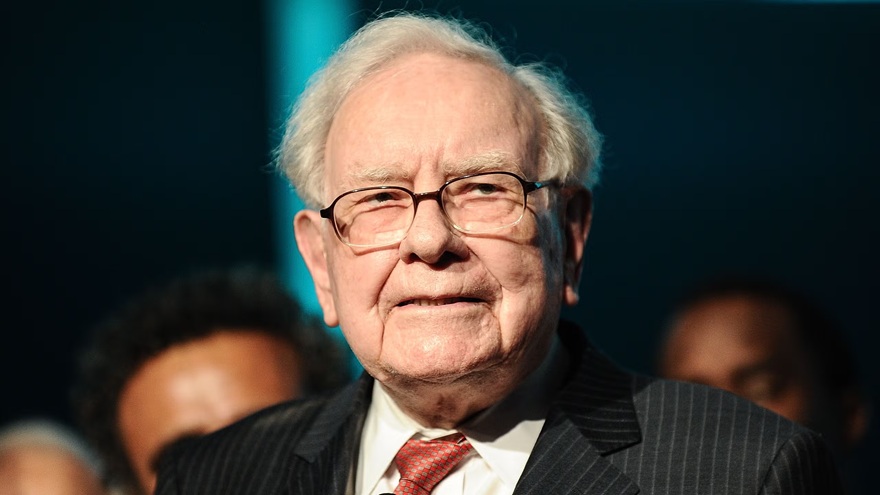
Buffett’s $370 Billion Cash Pile Raises Fresh Questions Over Record US Stock Valuations
Warren Buffett ended his final quarter as Berkshire Hathaway’s chief executive much as he had spent the preceding two years: selling more publicly traded stocks than the company bought and allowing cash to accumulate on its balance sheet.
By the time Buffett stepped down at the end of 2025, Berkshire held roughly $373 billion in cash, cash equivalents and short-term US Treasury bills. The conglomerate had continued reducing parts of its equity portfolio while generating cash from its operating businesses, leaving Buffett’s successor, Greg Abel, with the largest financial reserve in Berkshire’s history.
The position has taken on greater weight as US equity valuations push into territory previously associated with periods of extreme investor optimism. Buffett has not predicted an imminent market crash, and Berkshire’s cash balance should not be treated as a market-timing call. Still, the combination of continued net stock sales, limited large acquisitions and Buffett’s warnings about speculative behavior has strengthened the view that he saw few attractively priced opportunities during his final stretch as CEO.
“We’ve never had people in a more gambling mood than now,” Buffett said during remarks in May, criticizing the growing tendency to treat financial markets as a venue for short-term betting rather than long-term ownership.
That warning came as enthusiasm around artificial intelligence, options trading, prediction markets and newly listed technology companies pushed investor risk appetite higher.
It also came from an investor who had spent decades telling shareholders that holding cash was not inherently conservative. Buffett viewed cash as optionality: capital that could be deployed quickly when markets broke, credit disappeared or a strong business became available at a rational price.
The problem through much of 2024 and 2025 was not Berkshire’s ability to invest. It was price.
Berkshire Keeps Selling Into a Rising Market
Berkshire’s portfolio decisions have been closely watched since the company began sharply reducing its Apple position in 2024. Apple remained one of Berkshire’s largest holdings, but the scale of the sales showed that even a company Buffett admired could become too large a position or offer less attractive prospective returns at a higher valuation.
Berkshire also reduced other holdings while purchasing fewer stocks than it sold. At the same time, it found no acquisition large enough, attractive enough and understandable enough to absorb a meaningful share of its growing cash reserve.
That distinction matters.
Berkshire was not retreating from business ownership. Its operating subsidiaries continued spanning insurance, railroads, energy, manufacturing, retail and services. Nor did Buffett argue that investors should abandon equities altogether.
Instead, Berkshire appeared unwilling to chase assets simply because cash was piling up.
Buffett has repeatedly said he would rather tolerate the discomfort of holding a large amount of low-risk liquidity than permanently impair capital through an overpriced acquisition. With Berkshire’s size, even a successful investment of several billion dollars barely changes overall results. The company needs exceptionally large opportunities before a transaction can materially improve shareholder value.
Those opportunities become scarce when almost everything is expensive.
US Equities Enter Rare Valuation Territory
The S&P 500 produced a total return of roughly 314% over the 10 years through July 16, including reinvested dividends. That gain far exceeded the pace investors would normally expect from a mature equity market over a full cycle.
Large technology companies generated much of the advance. Cloud computing, digital advertising, semiconductors and, more recently, artificial intelligence allowed a small group of businesses to produce exceptional earnings growth while attracting increasingly large allocations from active and passive investors.
Nvidia became the clearest example.
Its shares rose more than 15,000% over the decade as graphics processors moved from a specialist computing product to the core hardware used to train and run artificial intelligence systems. By July 2026, Nvidia’s market value had reached around $5 trillion, making it the world’s most valuable listed company.
The business had grown at a pace that would have looked unrealistic only a few years earlier. Yet the size of the valuation also raised the bar for future performance. At $5 trillion, Nvidia was no longer merely priced to remain a successful semiconductor company. Investors were betting that AI spending would remain enormous, that Nvidia would defend its position and that earnings would eventually grow into one of the largest valuations ever assigned to a business.
SpaceX’s 2026 initial public offering offered another view of the same appetite.
The company entered public markets at a valuation of roughly $1.7 trillion, despite generating less than $20 billion in annual revenue and continuing to spend heavily on Starship, Starlink and other capital-intensive projects. The listing reflected genuine admiration for SpaceX’s technological achievements and its dominant position in commercial launches.
It also showed how far investors were willing to reach for a business tied to a powerful story.
At that valuation, investors were not paying only for current launch revenue or existing Starlink subscribers. They were paying in advance for a global communications network, future government contracts, satellite services, launch-market control and commercial opportunities that may take years to develop.
The shares initially surged before giving back much of the gain, briefly erasing hundreds of billions of dollars in market value. The volatility did not prove that SpaceX lacked long-term potential. It showed how unstable prices can become when expectations leave little room for ordinary execution problems.
Buffett Indicator Reaches a Record
One of the market measures most closely associated with Buffett compares the total value of US publicly traded stocks with the size of the US economy.
The ratio, commonly called the Buffett Indicator, reached roughly 237% in July 2026, its highest recorded level under widely followed versions of the calculation. That means the quoted value of the US stock market was more than 2.3 times annual gross domestic product.
Buffett once described the ratio as one of the best broad measures of where valuations stood at a given moment. Its logic is straightforward: corporate value cannot indefinitely grow far faster than the economy supporting corporate revenue and profit.
But the indicator is not a clean sell signal.
US companies now generate more revenue overseas than they did in earlier decades. Listed corporations represent a different share of economic activity. Interest rates, tax policy, profit margins and the composition of the stock market have also changed.
The indicator can therefore remain elevated for years without causing an immediate decline.
Its stronger message concerns prospective returns. When investors pay substantially more for each dollar of economic output, future gains become more dependent on unusually strong profit growth, persistently high margins or even richer valuations.
None is guaranteed.
Shiller CAPE Adds to the Warning
The cyclically adjusted price-to-earnings ratio points in the same direction.
The Shiller CAPE compares stock prices with average inflation-adjusted earnings over the previous 10 years. By smoothing a full decade of profits, it reduces the distortions caused by a temporary earnings boom or recession.
The ratio stood around 41 to 42 in July 2026. It had been higher only around the peak of the dot-com bubble, depending on the date and dataset used.
Again, that does not tell investors when stocks will decline.
A market can remain expensive, become more expensive and punish anyone who exits too early. Valuations were already considered elevated in parts of the 2010s, yet the S&P 500 continued compounding as technology profits rose, interest rates stayed low and US companies increased margins.
The CAPE ratio is more useful as a long-range temperature reading. Historically, unusually high starting valuations have tended to correspond with weaker subsequent returns, while depressed valuations have created better long-term entry points.
The present reading therefore suggests that investors may be pulling future gains into today’s prices.
Buffett’s Cash Is a Warning, Not a Forecast
There is a temptation to turn Berkshire’s cash balance into a dramatic message: Buffett expects a crash.
The evidence does not support that claim.
Berkshire needs more liquidity than an ordinary company because its insurance operations can face enormous claims. Its scale limits the number of investments that can matter. Treasury bills also offered meaningful yields during the period, reducing the cost of waiting.
Buffett’s selling may have reflected individual stock valuations, portfolio concentration, tax considerations or the lack of sufficiently large acquisitions rather than a single bearish view of the S&P 500.
Still, the direction is difficult to ignore.
Berkshire was a persistent net seller while investors pushed valuation measures toward historical extremes. Buffett warned that markets had become more gambling-oriented. The company finished his tenure with more than $370 billion ready to deploy.
That does not provide a date for the next downturn.
It does show where one of history’s most disciplined capital allocators found the better risk-reward trade: patience.
Buffett Is Not Calling the Top, but He Clearly Hates the Price
Let’s kill the easy headline first.
“Buffett has $370 billion in cash, so a crash is coming.”
Too neat.
Markets rarely give you that kind of clean tell. Buffett has held uncomfortable amounts of cash before. Stocks kept climbing. People mocked him. Then the cycle broke and Berkshire suddenly had options that everyone else desperately needed.
Cash did not predict the day.
It made Berkshire dangerous when the day arrived.
That is how I read this setup now.
Buffett was not hiding under his desk waiting for the S&P 500 to implode. He simply refused to pretend that a great company is automatically a great investment at any price.
Big difference.
The Numbers Are Screaming, Even If the Market Isn’t Listening
A Buffett Indicator near 237%.
A CAPE ratio above 41.
Nvidia around $5 trillion.
SpaceX entering the market near $1.7 trillion on less than $20 billion in annual revenue.
Pick whichever metric you like. They all land in roughly the same place: investors are paying today for a ridiculous amount of tomorrow.
Maybe tomorrow delivers.
AI could boost productivity across whole industries. Nvidia could keep printing cash at a rate that makes today’s valuation look sane. SpaceX could turn Starlink into essential global infrastructure and make its IPO price look cheap years from now.
Possible.
But the margin for error is glass-thin.
That is what bugs me.
A company does not need to fail for an expensive stock to wreck shareholders. Growth can remain strong and the share price can still get nuked because the original expectations were stronger.
That happened throughout the dot-com unwind. The internet was real. The adoption thesis was right. Plenty of stock prices were still fantasy.
People confuse those two questions all the time.
Is the technology transformative?
And is the stock attractive at this price?
Not the same trade.
Nvidia Is Amazing. That Does Not End the Valuation Debate
I would never dismiss Nvidia as hype.
The company built the hardware and software ecosystem that became the default stack for much of the AI boom. Demand exploded. Earnings followed. Competitors spent years trying to close the gap.
Real business. Real cash.
But at $5 trillion, “Nvidia is a great company” is useless analysis.
Of course it is.
The real question is how much growth is already baked into the stock. How long can hyperscalers keep throwing capital at AI infrastructure? How durable are today’s margins? What happens when customers optimize spending, use more custom chips or discover that some AI workloads do not produce an acceptable return?
At this size, a minor disappointment is not minor.
When I see investors treating any pullback in an AI leader as free money, I get nervous. That is not research. That is conditioning. The chart trained people to believe every dip gets bought.
Until one doesn’t.
The SpaceX IPO Has Peak-Narrative Energy
SpaceX might be the most impressive private company built in decades.
It lowered launch costs, reshaped the rocket business and created a satellite network at a scale competitors struggled to match. I am not arguing with any of that.
Then the market slapped a $1.7 trillion valuation on it.
That is where admiration turned into a financing event.
You were no longer buying rockets and Starlink subscriptions. You were buying orbital dominance, global connectivity, future government business, possible mobile services, Mars optionality and whatever else could be squeezed into the deck.
That is a heavy bag of assumptions.
When a valuation depends on five different futures going right, it is not cheap just because the company is exceptional.
The early share-price swing proved the point. Traders aped into the story, the valuation pushed higher, then hundreds of billions disappeared when the market cooled.
Nothing fundamental had to collapse.
The mood changed.
That is the problem with narrative-driven pricing. The floor is not always earnings. Sometimes the floor is whatever confidence remains after the tourists leave.
Buffett’s “Gambling Mood” Comment Hits the Real Weak Spot
Buffett’s comment about people being in a gambling mood is more important than the cash total.
Look around.
Zero-day options.
Prediction markets on everything.
Leveraged ETFs built around single stocks.
Retail traders chasing IPO candles.
Social feeds treating market-cap milestones like sports scores.
People are not merely investing in businesses. They are betting on the next person paying more before the clock runs out.
I’ve seen this setup before, and it usually feels brilliant right up to the point where liquidity vanishes.
The worst part is that rising markets validate bad behavior.
Someone buys a stock without understanding the business. It rises 40%. Now the person believes the process worked.
It didn’t.
The outcome worked.
That distinction disappears during a bull run because almost every sloppy trade looks smart. Buffett’s whole career was built on refusing to confuse price action with proof.
Right now, the market is doing exactly that.
Passive Investing Is Not the Villain, but It Changes the Plumbing
The rise of index investing gets blamed for every strange market move. Most of that criticism is lazy.
Passive funds are not sitting in a room deciding that Nvidia deserves another $200 billion in market value. They follow flows and index weights. Investors choose where to put the money.
Still, the plumbing matters.
When fresh retirement contributions and fund allocations pour into market-cap-weighted indexes, the largest companies receive the biggest dollar inflows. Rising prices increase their index weights, which directs more passive money toward them.
That loop does not create earnings.
It can amplify momentum.
And when a handful of giant technology companies account for an unusually large share of the index, “buying the market” quietly becomes a concentrated bet on the same AI and platform businesses everyone already owns.
Diversified by ticker count.
Less diversified by economic driver.
A High CAPE Does Not Mean Sell Everything
This is where doom-posting usually goes off the rails.
The CAPE ratio is not a countdown clock. Neither is the Buffett Indicator. Anyone who used valuation alone to exit US equities in 2013 missed years of gains.
That matters.
Expensive markets can stay expensive because earnings grow. They can also become more expensive because liquidity, excitement and fear of missing out keep dragging buyers in.
Calling the exact top is ego bait.
I’m not interested.
What high valuations change is the range of likely outcomes. Paying more today usually means accepting lower long-term returns, greater sensitivity to disappointment or both.
That does not require dumping every stock and living in Treasury bills.
It does require dropping the fantasy that buying at any price is harmless as long as you call yourself a long-term investor.
Time does not fix every valuation.
Ask anyone who bought the wrong company at the top of the dot-com bubble. Some waited 10 or 15 years to break even. Others never did.
What Buffett’s Cash Really Buys
Optionality.
That word gets thrown around, but here it is literal.
Berkshire can earn interest while waiting. It can fund insurance claims without selling assets into a panic. It can buy public shares when other investors are forced out. It can finance companies when credit markets freeze. It can negotiate terms unavailable to ordinary shareholders.
During calm markets, that cash looks lazy.
During a crisis, it becomes a weapon.
Buffett has always understood that the price of optionality is looking foolish before you need it.
That is why I do not see the cash pile as fear.
I see discipline.
He could have forced the money into fashionable AI names, paid up for a giant acquisition or launched buybacks at unattractive prices. Berkshire shareholders probably would have cheered for a quarter.
He waited instead.
Boring. Irritating. Correct.
I Would Not Copy Berkshire Trade for Trade
Berkshire’s situation is not yours.
It runs giant insurance operations. It needs liquidity. It has almost no small-cap opportunities because a $500 million win barely moves the needle. Buffett also had tax, concentration and succession issues that ordinary investors do not share.
So no, I would not sell every equity position because Berkshire sold stocks.
I also would not ignore the message.
At extreme valuations, I want less garbage in the portfolio. Less leverage. Less exposure to companies whose entire thesis depends on cheap capital and heroic growth. More room to buy when the market finally offers decent prices.
Dollar-cost averaging still makes sense for investors with long horizons and diversified portfolios.
Blind dollar-cost averaging into whatever happens to be hottest? Different game.
I would keep contributing. I would stay invested. But I would stop chasing.
No aping into trillion-dollar IPO stories because the first week went vertical. No pretending a 50-times-sales company is “cheap on 2032 numbers.” No buying a weak business just because it has AI in the presentation.
And I would hold enough liquidity that a market break feels useful rather than terrifying.
The Warning Is About Behavior, Not Tuesday’s Closing Price
Buffett may be wrong early.
He often is.
That is the deal when you refuse to chase crowds. You look outdated while the party gets louder.
But his final year as CEO leaves a fairly clear message.
Prices matter.
Liquidity matters.
Temperament matters most when everyone around you decides it no longer does.
The market could keep running. Nvidia could add another trillion. SpaceX could recover and rip past its IPO peak. The Buffett Indicator could reach 250% while bears get flattened again.
None of that would make today’s risk disappear.
It would just hide it under a higher price.
I’m not calling a crash.
I’m saying the easy-money part of this trade looks mature, expectations are doing too much work, and Buffett chose to leave Berkshire with $370 billion of dry powder rather than join the feeding frenzy.
That is not panic.
It is a man looking at the table, deciding the odds are lousy and keeping his chips.

Shane Neagle is a financial markets analyst and digital assets journalist specializing in cryptocurrencies, memecoins, prediction markets, and blockchain-based financial systems. His work focuses on market structure, incentive design, liquidity dynamics, and how speculative behavior emerges across decentralized platforms.
He closely covers emerging crypto narratives, including memecoin ecosystems, on-chain activity, and the role of prediction markets in pricing political, economic, and technological outcomes. His analysis examines how capital flows, trader psychology, and platform design interact to create rapid market cycles across Web3 environments.
Alongside digital assets, Shane follows broader fintech and online trading developments, particularly where traditional financial infrastructure intersects with blockchain technology. His research-driven approach emphasizes understanding why markets behave the way they do, rather than short-term price movements, helping readers navigate fast-evolving crypto and speculative markets with clearer context.