
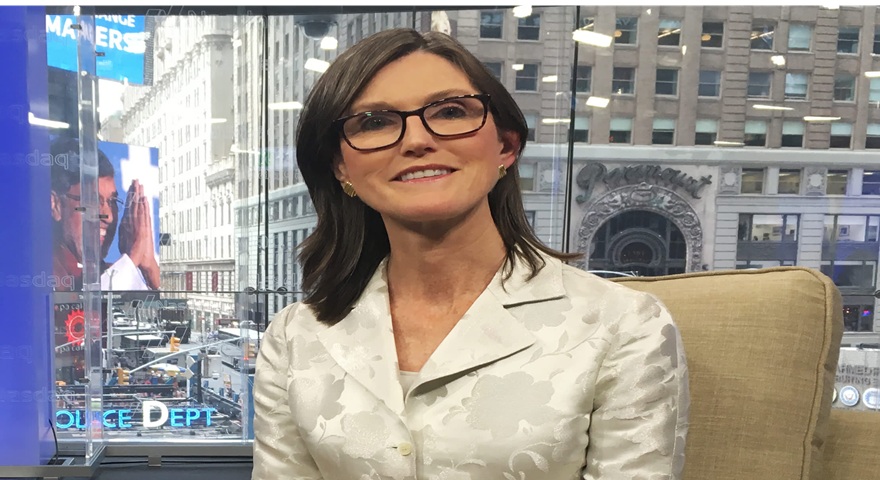
Cathie Wood Adds to Eli Lilly Despite Massive Rally
Ark Investment Management CEO Cathie Wood has increased her firm’s position in Eli Lilly, reinforcing her long-standing strategy of investing in companies developing breakthrough technologies across healthcare and other innovation-driven industries.
The move comes after an extraordinary run for Eli Lilly shares, which have gained more than 1,600% over the past decade, making the pharmaceutical giant one of the best-performing large-cap healthcare stocks during that period.
The investment reflects continued confidence that Eli Lilly’s growth story extends well beyond the blockbuster success of its GLP-1 franchise, with multiple late-stage pipeline assets and expanding therapeutic areas supporting future revenue growth.
Tirzepatide remains at the center of that thesis.
The drug, marketed for type 2 diabetes, obesity and obstructive sleep apnea, generated more than $30 billion in annual sales last year across its approved indications. Achieving that level of revenue only four years after its initial approval places tirzepatide among the fastest-growing medicines in pharmaceutical history.
The company believes demand for obesity treatments remains in its early stages, leaving substantial room for expansion as more patients gain access to therapy and new products reach the market.
Oral GLP-1 and Next-Generation Obesity Drugs Expand Opportunity
Eli Lilly has already begun broadening its obesity portfolio beyond injectable therapies.
Earlier this year, the company launched Foundayo, an oral GLP-1 treatment that has shown strong early adoption, particularly among patients who had not previously used GLP-1 medications. Oral therapies are widely viewed as an important next step for expanding the obesity market because they eliminate the need for injections, potentially improving patient acceptance and adherence.
The pipeline extends further.
Retatrutide, one of Eli Lilly’s most closely watched experimental drugs, is being developed as a next-generation obesity treatment targeting patients requiring greater levels of weight reduction. Industry analysts have identified the candidate as one of the most promising future entrants in the rapidly expanding weight-loss market.
Taken together, the company’s approved products and pipeline give Eli Lilly one of the broadest obesity portfolios among major pharmaceutical companies, positioning it to compete across multiple patient groups rather than relying on a single therapy.
Alzheimer’s Program Adds Another Growth Engine
Although investors often associate Eli Lilly primarily with GLP-1 medicines, the company has been expanding aggressively across other therapeutic areas.
One of the most significant opportunities lies in Alzheimer’s disease.
Kisunla, which recently entered the market, is expected by some analysts to eventually generate more than $1 billion in annual sales. The therapy is administered through intravenous infusions every four weeks.
Eli Lilly is also developing remternetug, another Alzheimer’s treatment currently in Phase 3 clinical trials.
Unlike Kisunla, remternetug is being evaluated in both intravenous and subcutaneous injection formats. A successful injectable version could offer greater convenience by reducing the need for hospital or infusion-center visits, potentially improving patient adoption if clinical outcomes prove competitive.
The Alzheimer’s franchise represents part of a broader diversification strategy as Eli Lilly continues expanding across immunology, oncology, neuroscience, pain management and rare diseases.
Artificial Intelligence and Drug Development
Beyond individual medicines, Eli Lilly has also been investing in artificial intelligence to improve various stages of drug discovery and development.
AI tools are increasingly being used across the pharmaceutical industry to identify drug candidates, optimize clinical trial design and shorten development timelines. While these initiatives remain difficult to quantify financially, successful implementation could improve research productivity over time.
The company also continues returning capital to shareholders through dividends while maintaining substantial investment in research and manufacturing capacity to support future product launches.
Valuation Remains the Key Debate
Despite the company’s strong operating momentum, Eli Lilly’s valuation has become one of the central questions for investors.
After years of exceptional stock performance, expectations are exceptionally high. Any slowdown in obesity drug demand, increased competition, manufacturing constraints or disappointing clinical trial results could weigh on future returns.
Competition is also intensifying.
Several pharmaceutical companies are developing next-generation obesity therapies, including oral GLP-1 drugs and combination treatments designed to improve weight-loss efficacy or reduce side effects. Maintaining technological leadership will require Eli Lilly to continue delivering successful clinical results across its pipeline.
Still, many investors view the company’s expanding product portfolio as providing multiple avenues for long-term growth beyond its current blockbuster medicines.
Why Cathie Wood Isn’t Buying Eli Lilly for Today’s GLP-1 Business
Most people think this is another GLP-1 bet.
I don’t.
If Cathie Wood simply wanted exposure to obesity drugs, there are easier ways to get it. Eli Lilly is already a trillion-dollar company. The easy money from discovering GLP-1 wasn’t made yesterday—it was made years ago.
So why buy more now?
Because I think this is becoming something different.
The Market Keeps Calling Eli Lilly a Weight-Loss Company
That’s understandable.
Tirzepatide is everywhere.
It generated more than $30 billion in annual sales last year. That’s a staggering number for a drug that only entered the market a few years ago.
But here’s what caught my attention.
Eli Lilly isn’t acting like a company trying to squeeze one blockbuster for as long as possible.
It’s acting like a company trying to build an entire metabolic platform.
Those aren’t the same thing.
Foundayo expands into oral treatments.
Retatrutide targets patients needing greater weight reduction.
Researchers continue exploring new indications for existing GLP-1 medicines.
Every successful expansion makes the addressable market larger than investors thought six months earlier.
That’s a different investment story.
Obesity Isn’t the Finish Line
The market still underestimates how many diseases obesity drugs could eventually touch.
We’re already talking about diabetes.
Sleep apnea.
Weight management.
But studies continue exploring cardiovascular disease, kidney disease, fatty liver disease and several other metabolic conditions.
If those opportunities materialize, investors won’t be valuing one blockbuster drug.
They’ll be valuing an entirely new treatment platform.
That’s why I think focusing only on current sales misses the bigger picture.
Diversification Matters More Than People Think
The other misconception?
That Eli Lilly lives or dies by GLP-1.
Look deeper.
Alzheimer’s.
Immunology.
Oncology.
Pain management.
Rare diseases.
Neuroscience.
Remternetug may never become another tirzepatide.
It doesn’t have to.
A handful of billion-dollar medicines spread across different therapeutic areas creates a much more resilient business than relying on one franchise forever.
That’s exactly what Lilly appears to be building.
The Oral GLP-1 Opportunity Might Be Bigger Than Investors Expect
This is the part I keep coming back to.
Injectable drugs changed the obesity market.
Oral drugs could expand it dramatically.
Not everyone wants weekly injections.
Some patients simply won’t start treatment because of the needle.
Others stop.
A pill lowers that psychological barrier.
If Foundayo succeeds with first-time users—as early demand suggests—it isn’t just taking market share.
It’s creating new demand.
That’s far more valuable.
AI May Be Quietly Becoming the Next Competitive Edge
Every pharmaceutical company now talks about artificial intelligence.
Most presentations sound interchangeable.
But here’s the difference.
Companies like Eli Lilly already generate enormous amounts of biological, clinical and manufacturing data.
If AI genuinely improves candidate selection, reduces failed trials or shortens development timelines by even a small margin, the financial impact compounds over decades.
Nobody can model that precisely today.
Which is exactly why the market may be underpricing it.
The Biggest Risk Isn’t Competition
Everyone immediately points to Novo Nordisk.
Fair enough.
Competition matters.
But I think expectations are the larger risk.
When a stock climbs more than 1,600% in ten years, investors stop asking whether the business is improving.
They start asking whether it’s improving fast enough.
That’s a dangerous shift.
Outstanding earnings can still disappoint if Wall Street expects miracles every quarter.
I’ve seen that happen repeatedly with market leaders.
Can Eli Lilly Stay a Trillion-Dollar Growth Story?
That’s the real question.
Not whether obesity drugs will sell.
They will.
Not whether Lilly has a strong pipeline.
It clearly does.
The question is whether management can keep finding entirely new growth engines before the current ones mature.
So far, the answer looks like yes.
Every time investors think they’ve identified Lilly’s biggest opportunity, another pipeline program starts attracting attention.
That’s difficult to replicate.
What I’d Watch Instead of Quarterly Sales
Everyone will focus on tirzepatide revenue.
I won’t.
I’ll watch clinical trial results.
Pipeline expansion.
New indications.
Manufacturing capacity.
Regulatory approvals.
Those determine what Eli Lilly looks like five years from now—not next quarter’s earnings report.
The stock won’t be cheap.
It probably won’t ever look cheap again if the current strategy keeps working.
That’s often the price investors pay for companies that consistently create entirely new markets rather than simply competing inside existing ones.
Cathie Wood appears to be betting that Eli Lilly still has several of those markets left to build.
That may prove to be the more important investment thesis than GLP-1 itself.

Shane Neagle is a financial markets analyst and digital assets journalist specializing in cryptocurrencies, memecoins, prediction markets, and blockchain-based financial systems. His work focuses on market structure, incentive design, liquidity dynamics, and how speculative behavior emerges across decentralized platforms.
He closely covers emerging crypto narratives, including memecoin ecosystems, on-chain activity, and the role of prediction markets in pricing political, economic, and technological outcomes. His analysis examines how capital flows, trader psychology, and platform design interact to create rapid market cycles across Web3 environments.
Alongside digital assets, Shane follows broader fintech and online trading developments, particularly where traditional financial infrastructure intersects with blockchain technology. His research-driven approach emphasizes understanding why markets behave the way they do, rather than short-term price movements, helping readers navigate fast-evolving crypto and speculative markets with clearer context.