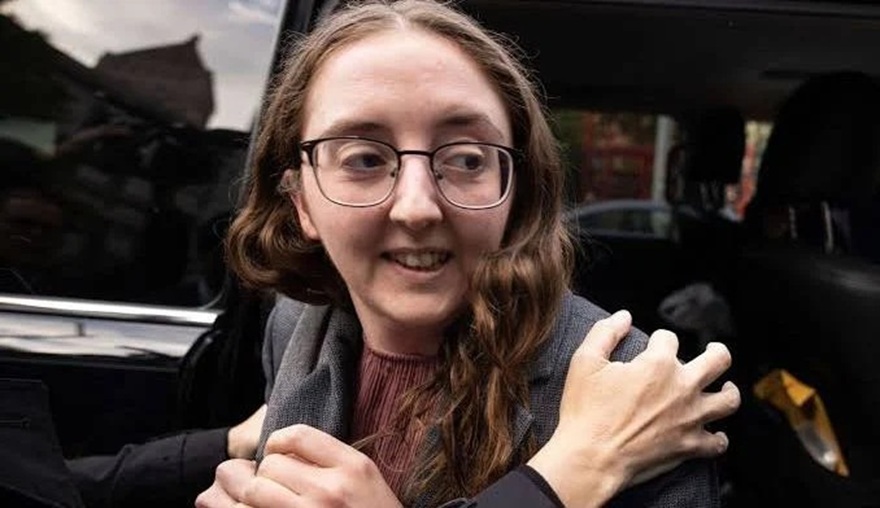
Ellison Worked Under the Name “Carol” Before Full-Time Hire
Former Alameda Research CEO Caroline Ellison has joined nonprofit funding platform Manifund, giving one of the most prominent figures in the FTX collapse her first publicly disclosed role since completing her prison term.
Manifund co-founder Austin Chen announced Friday that Ellison had accepted a full-time position focused on developing the organization’s funding platform and researching how philanthropic money can be allocated more effectively.
The appointment was not entirely new.
Ellison began a work trial with Manifund on July 13 and moved into a full-time role on Aug. 10. For nearly two months, she published research, contributed to the platform and communicated with users under the pseudonym “Carol.”
Manifund disclosed her identity on Sept. 11.
Ellison said she initially preferred not to make the trial public because she did not know whether it would result in a permanent job. With the full-time position now established, she said she wanted to be open about her involvement.
Her responsibilities include improving Manifund’s technical infrastructure, operations and customer support, alongside work on its funding and grantmaking systems.
Chen said Ellison had already built a reconciliation tool that identified incorrectly recorded transactions in Manifund’s database involving amounts in the five- to six-figure range.
The hire immediately attracted attention because of Ellison’s central role in the collapse of FTX and Alameda Research.
Ellison served as chief executive of Alameda, the crypto trading firm closely linked to FTX, before both businesses collapsed in November 2022.
She pleaded guilty in December 2022 to seven federal charges, including wire fraud, conspiracy to commit wire fraud, commodities fraud, securities fraud and money laundering conspiracy.
Ellison became one of the prosecution’s most important cooperating witnesses against FTX founder Sam Bankman-Fried.
During his 2023 trial, she testified extensively about the relationship between Alameda and FTX, including the use of billions of dollars in FTX customer funds by Alameda. Bankman-Fried was ultimately convicted and sentenced to 25 years in prison.
Ellison received a substantially lighter sentence because of her cooperation.
In September 2024, U.S. District Judge Lewis Kaplan sentenced her to two years in prison and three years of supervised release. She was also ordered to forfeit approximately $11 billion and continue cooperating with government agencies and the FTX bankruptcy estate when requested.
Ellison began serving her sentence in November 2024.
She was released from federal custody in January 2026 after serving roughly 14 months, including a period in community confinement.
Chen directly addressed the controversy surrounding the decision to hire her.
He said he believed in redemption, pointing to Ellison’s guilty plea, cooperation in the FTX investigation and time in prison as reasons she should have an opportunity to contribute again.
Ellison also addressed her past in the announcement, saying she remained deeply sorry for what she had done at Alameda and FTX and understood why some people may be unwilling to work with her.
She described herself as grateful for a second chance and said she believed in Manifund’s mission.
The organization operates a platform designed to connect donors with charitable projects and experiment with different ways of allocating philanthropic capital.
Its work has particularly focused on areas associated with the effective altruism community, including artificial intelligence safety, animal welfare, global health and projects aimed at reducing large-scale future risks.
That connection adds another layer to Ellison’s appointment.
FTX and Bankman-Fried were themselves deeply associated with effective altruism before the exchange collapsed. The FTX Future Fund distributed large amounts of money to projects connected to the movement, while Bankman-Fried publicly presented earning money for philanthropy as an important part of his worldview.
Chen said the Future Fund had also helped finance projects that influenced his own path into the effective altruism community.
He specifically noted that the fund provided seed funding to prediction-market platform Manifold and supported events that shaped his involvement in the movement. Manifund’s current grantmaking approach was also influenced by aspects of the Future Fund model.
Chen nevertheless acknowledged that FTX caused serious harm and said its collapse hurt both users and the effective altruism movement.
He also recognized that Ellison’s presence could make some donors and partners uncomfortable.
That tension is now likely to follow Manifund as Ellison moves from working anonymously behind the scenes to becoming one of its most recognizable employees.
The Hire Tests How Far Professional Redemption Should Go
Ellison’s new job raises a difficult question that extends well beyond crypto: what should happen professionally after someone has admitted participating in an enormous financial fraud, cooperated with prosecutors and served the sentence imposed by a court?
There are two easy answers, and neither is particularly satisfying.
One is that Ellison should permanently be defined by FTX and effectively excluded from positions involving money, systems or institutional trust.
The other is that she served her punishment, so her past should no longer matter.
Reality sits somewhere between those positions.
A prison sentence is supposed to end. Permanent unemployment is not part of the judgment Ellison received.
If rehabilitation means anything, people who complete criminal sentences need some path back into productive work.
But second chances do not erase context.
Manifund is not hiring Ellison to perform work completely unrelated to her previous career. It is giving her responsibilities involving financial systems, reconciliation, operations and the allocation of philanthropic capital.
Those are areas where trust is central.
That does not automatically make the decision wrong. In some respects, Ellison may now understand financial control failures better than many people who have never experienced one.
But it makes Manifund’s governance around her work important.
Independent review, clear authorization limits, separation of duties and transparent financial controls would do more to justify the appointment than arguments about whether she is personally remorseful.
There is also an unavoidable irony in the effective altruism connection.
FTX’s collapse damaged the movement precisely because so much philanthropic ambition became tied to money generated by a business whose internal controls were catastrophically weak.
Hiring one of the central participants back into an organization influenced by the FTX Future Fund therefore brings that history unusually close to the surface.
Chen appears willing to accept that reputational cost.
The use of the “Carol” pseudonym is more complicated. Testing an employee privately before a public announcement is understandable, particularly when that person is globally recognizable.
But Manifund presents transparency as one of its values, and users interacting with “Carol” were not told they were dealing with Caroline Ellison.
Chen has acknowledged that contradiction himself.
Ultimately, the strongest argument for the hire will not be philosophical.
It will be operational.
If Ellison performs useful work, Manifund maintains strong controls and its donors retain confidence in the organization, the appointment may eventually look like a genuine case of rehabilitation.
If governance problems emerge, every failure will inevitably be viewed through the lens of FTX.
That is the unusual burden Manifund has accepted.
It is giving Ellison a second chance, but unlike an ordinary new employee, she begins with almost no margin for another serious mistake.

Michael Lebowitz is a financial markets analyst and digital finance writer specializing in cryptocurrencies, blockchain ecosystems, prediction markets, and emerging fintech platforms. He began his career as a forex and equities trader, developing a deep understanding of market dynamics, risk cycles, and capital flows across traditional financial markets.
In 2013, Michael transitioned his focus to cryptocurrencies, recognizing early the structural similarities—and critical differences—between legacy markets and blockchain-based financial systems. Since then, his work has concentrated on crypto-native market behavior, including memecoin cycles, on-chain activity, liquidity mechanics, and the role of prediction markets in pricing political, economic, and technological outcomes.
Alongside digital assets, Michael continues to follow developments in online trading and financial technology, particularly where traditional market infrastructure intersects with decentralized systems. His analysis emphasizes incentive design, trader psychology, and market structure rather than short-term price action, helping readers better understand how speculative narratives form, evolve, and unwind in fast-moving crypto markets.