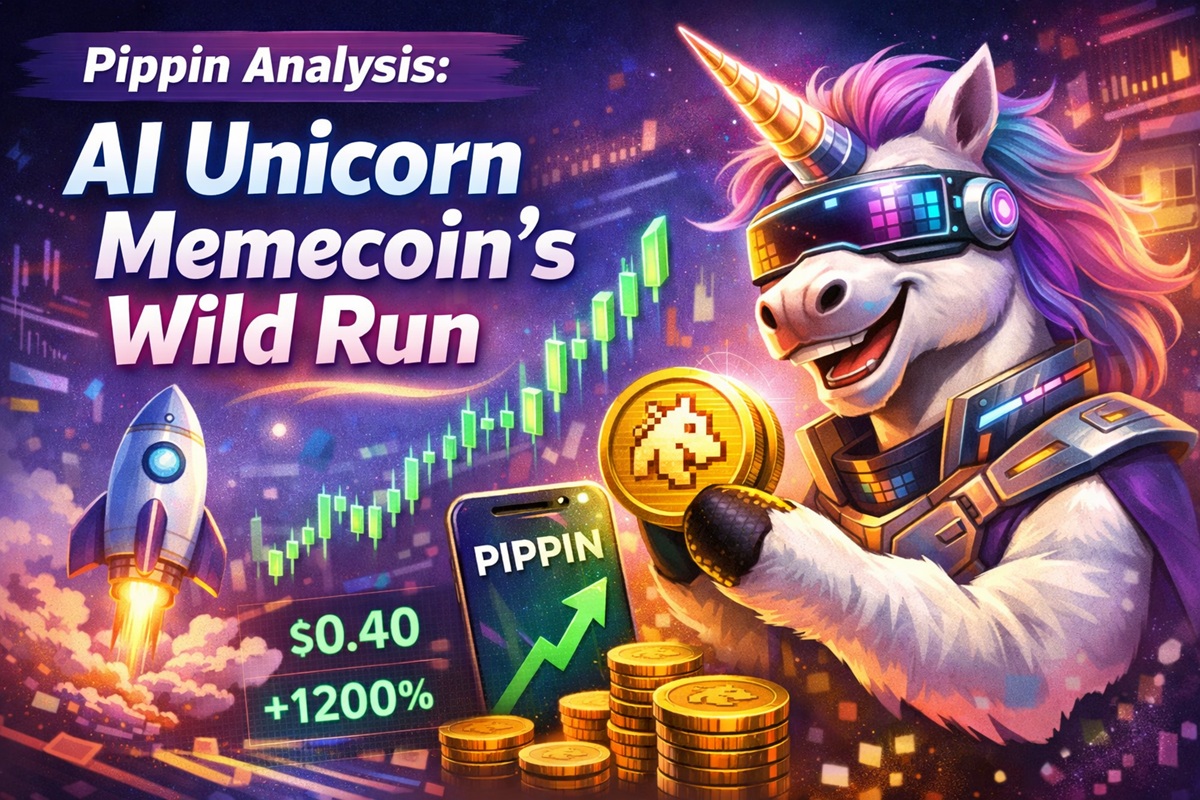
Pippin has one of the stranger origin stories in the Solana memecoin market. An AI generated a unicorn. Someone else turned it into a cryptocurrency without telling the person who created the character. That creator subsequently embraced the experiment, built actual autonomous-agent software around the unicorn, and watched the associated token eventually approach a $900 million valuation.
Then almost all of that valuation disappeared.
As of September 22, 2026, PIPPIN trades around $0.019, giving its roughly one billion circulating tokens a market capitalization of about $19 million. Daily volume is approximately $2.5 million. CoinMarketCap counts around 48,000 holder addresses. Most strikingly, PIPPIN is roughly 98% below its February 26, 2026 all-time high of $0.8964.
That history makes Pippin more useful as a case study than as another story about an “AI memecoin.” It shows how a legitimate AI experiment, a memecoin, centralized-exchange access, derivatives and concentrated speculative capital can become economically intertwined even when there is no obvious mechanism connecting the token’s valuation to the underlying technology.
Pippin Wasn’t Originally a Crypto Project
The first important correction is that Yohei Nakajima did not create PIPPIN as a token.
Nakajima, the venture investor and developer best known for creating BabyAGI, says Pippin began when he was experimenting with AI-generated SVG images in November 2024. ChatGPT o1-mini produced a simple unicorn illustration. When someone asked what the creature should be called, Nakajima asked ChatGPT again. The model chose “Pippin.”
Then something unexpected happened.
According to Nakajima’s own account, someone created a Pippin memecoin on Pump.fun without his knowledge. Rather than distancing himself from it, Nakajima subsequently opened a Solana wallet, purchased some of the tokens on the market and decided to turn the character into an AI influencer.
That reverses the conventional crypto development sequence.
Normally, a team builds a project and then creates a token around it. With Pippin, the meme appeared first, an unrelated participant tokenized it, and the technical project developed afterward.
The distinction matters because PIPPIN was never a conventional venture-backed AI token with a published allocation, fundraising round and roadmap. Its relationship with the AI project is cultural rather than contractual.
The AI Part of Pippin Was Real
Calling Pippin purely an AI-themed marketing exercise would also be inaccurate.
Nakajima published working open-source software for the character. Pippin’s architecture runs a continuous loop in which an LLM selects activities according to internal variables such as energy and happiness, executes those activities, records experiences into a SQLite-based memory system and uses previous memories to influence future behavior.
The software can generate posts, draw images, take simulated walks and perform other modular activities. Developers can add new behaviors, while OpenAI embeddings allow Pippin to retrieve semantically related memories. Nakajima released the project under an MIT license.
That gave PIPPIN something most AI memecoins lacked: an actual software artifact behind the narrative.
But there was another crucial limitation. Nothing in that architecture gives PIPPIN holders a claim on revenue, compute, ownership of the software or economic output generated by the agent. The token and the AI character became associated socially, but token ownership was not equivalent to ownership of an AI business.
That distinction became much more important later.
PIPPIN Eventually Rallied Without the AI Becoming More Active
PIPPIN’s price history does not look like one continuous viral event.
Bubblemaps reconstructed a much stranger sequence. According to the blockchain analytics company, PIPPIN initially reached roughly $330 million in fully diluted value before crashing about 90%. By late 2025, the token had largely faded from attention.
Then it suddenly returned.
Bubblemaps reported that PIPPIN rose roughly tenfold, from around $20 million to $220 million, over a two-week period despite no major project announcement and no posts from the Pippin X account for approximately six months.
Current activity data makes the divergence even more striking. Third-party tracking of @pippinlovesyou shows roughly 30,000 followers but no original post for around a year. The Pippin GitHub organization similarly shows its principal repositories last updated in early 2025.
Yet the token did not peak in 2024 or early 2025.
It reached its record price on February 26, 2026, when $0.8964 per token implied a valuation approaching $900 million.
That timing is difficult to reconcile with the simple argument that improving AI technology or growing use of the autonomous character drove the valuation.
The technology supplied the story. The market supplied something else.
The Wallet Evidence Complicates the Viral-Growth Narrative
Bubblemaps’ investigation provides one possible explanation for part of that disconnect, although its conclusions should be treated as on-chain attribution rather than established proof of common ownership.
During PIPPIN’s late-2025 revival, Bubblemaps said it identified 50 connected wallets that collectively purchased about $19 million of PIPPIN. The wallets had reportedly been funded from HTX during tight time windows, received similar quantities of SOL and had little or no previous blockchain activity.
Separately, Bubblemaps identified 26 addresses that withdrew approximately 44% of PIPPIN’s supply from Gate over two months, with many withdrawals concentrated around October 24 and November 23. The firm said those similarities suggested coordinated activity.
A later Bubblemaps update went further, alleging that connected clusters controlled as much as 80% of PIPPIN supply. That figure has been widely repeated, but it should not be presented as proof that one identifiable “insider” beneficially owns 80%. Wallet-link analysis can identify common funding patterns and synchronized behavior; it cannot automatically establish who ultimately controls every address.
The concern nevertheless became considerably harder to dismiss after PIPPIN’s subsequent price behavior.
On March 17, 2026, two wallets reportedly moved about $560,000 of PIPPIN through deposit addresses into Gate shortly before a violent selloff. PIPPIN subsequently lost roughly half its value during the session.
By September, it was around 98% below its February peak.
Full Circulation Does Not Mean Broad Distribution
PIPPIN has almost exactly one billion tokens outstanding, and essentially the entire supply is already circulating. Its market capitalization and fully diluted valuation are therefore nearly identical.
That removes one familiar altcoin problem: there is no enormous scheduled investor or team unlock waiting to dilute the public float.
But it replaces that problem with a different one.
Circulating supply measures whether tokens are unlocked. It does not measure whether ownership is dispersed.
A billion tokens can technically circulate while a large percentage remains under the economic control of a comparatively small group. For PIPPIN, the relevant supply question has therefore never been future dilution. It is whether apparently independent wallets represent genuinely independent capital.
That is a much harder question to answer from a token-supply dashboard.
Exchange Access Both Amplified and Retreated
The original PIPPIN story also overstates the permanence of exchange adoption.
Binance introduced a PIPPINUSDT perpetual contract in January 2025 with leverage of up to 25x and made PIPPIN accessible through Binance Alpha. Kraken currently supports PIPPIN purchases, while KuCoin added it to KuCoin Alpha in January 2026.
But the history also contains delistings.
OKX terminated its PIPPINUSDT perpetual contract in July 2025. Bitget, which had originally listed PIPPIN in its Meme and AI zone, removed the PIPPIN/USDT spot pair in November 2025 as part of a periodic asset review.
Exchange availability therefore expanded PIPPIN’s ability to attract capital and leverage, but it has not moved in only one direction.
Derivatives are particularly important. Once perpetual futures exist, a memecoin can experience price moves driven not merely by people buying the underlying token, but by leverage, liquidations, crowded shorts and reflexive momentum. At that point, trading infrastructure can become a larger short-term price catalyst than developments in the AI project itself.
Pippin Became an Experiment in Narrative Detachment
Pippin’s original idea remains unusually clever.
An AI generated a character. The internet tokenized it without permission. Its creator then adopted that spontaneous market event and turned the character into functioning open-source software.
Few memecoins can claim such an organic sequence.
But PIPPIN’s subsequent history demonstrates something more revealing about crypto markets. The token eventually became financially larger after the underlying AI experiment had become less visibly active. Its biggest valuation occurred amid concerns about concentrated wallets, derivatives-driven speculation and a revival that on-chain investigators said was accompanied by coordinated accumulation.
Today, the roughly $19 million market cap is still substantial compared with the thousands of Pump.fun launches that disappear entirely. PIPPIN retains tens of thousands of holder addresses, active trading and one of the most recognizable origin stories from the AI-agent memecoin cycle.
But describing it as a $170 million “meme blue chip” or a stable core holding no longer fits the evidence.
The more interesting description is this: PIPPIN became a natural experiment in how far a crypto asset can travel once a compelling technological story becomes detached from the activity that created that story.
The AI gave Pippin an identity.
Its journey from an accidental Pump.fun launch to nearly $900 million—and then back below $20 million—shows that identity alone was never what determined the price.

Michael Lebowitz is a financial markets analyst and digital finance writer specializing in cryptocurrencies, blockchain ecosystems, prediction markets, and emerging fintech platforms. He began his career as a forex and equities trader, developing a deep understanding of market dynamics, risk cycles, and capital flows across traditional financial markets.
In 2013, Michael transitioned his focus to cryptocurrencies, recognizing early the structural similarities—and critical differences—between legacy markets and blockchain-based financial systems. Since then, his work has concentrated on crypto-native market behavior, including memecoin cycles, on-chain activity, liquidity mechanics, and the role of prediction markets in pricing political, economic, and technological outcomes.
Alongside digital assets, Michael continues to follow developments in online trading and financial technology, particularly where traditional market infrastructure intersects with decentralized systems. His analysis emphasizes incentive design, trader psychology, and market structure rather than short-term price action, helping readers better understand how speculative narratives form, evolve, and unwind in fast-moving crypto markets.